
Get Professional Results with These Affordable Baking Thermometers

Welcome to BakeWithEase, your trusted guide to baking bliss! Ever wondered how professional bakers achieve perfect results every time? The secret often lies in precise temperature control. Dive into our latest guide and unlock the key to consistent, delicious outcomes with our affordable baking thermometer tips. Discover how a simple tool can elevate your baking game, ensuring perfectly baked cakes, breads, and pastries. Curious to know which thermometer is right for you and your budget? Let's get started!
- Achieving Baking Perfection on a Budget: Affordable Baking Thermometer Tips
-
Top Affordable Baking Thermometers for Precise Cooking: Our 2024 Picks
- 1. ThermoPro TP03 Digital Instant Read Thermometer: The Budget-Friendly All-Rounder
- 2. KT THERMO Professional Oven Thermometer: Reliable Oven Temperature Monitoring
- 3. Habor Digital Candy Thermometer: Achieving Sugar-Crafting Success Without Breaking the Bank
- 4. MEATER Plus Wireless Meat Thermometer: Hands-Free Temperature Monitoring for Larger Bakes
- Choosing the Right Affordable Thermometer: Key Considerations
- Affordable Baking Thermometer Tips for Accurate Readings and Extended Lifespan
- Elevate Your Baking with Precision: Affordable Baking Thermometers That Deliver
-
Frequently Asked Questions
- What is the most important factor to consider when choosing an affordable baking thermometer?
- Are digital or analog baking thermometers better for beginners?
- Can I use a meat thermometer for baking?
- How do I calibrate my baking thermometer to ensure accuracy?
- Where is the best place to insert a baking thermometer for the most accurate reading?
- Final Reflection: The Sweet Science of Affordable Precision
- Unlock Your Baking Potential: Take the Next Step!
Achieving Baking Perfection on a Budget: Affordable Baking Thermometer Tips
Precision is the secret ingredient that separates good baking from great baking. While recipes provide time estimates, the true indicator of doneness, especially for complex bakes like bread, cakes, or candies, is internal temperature. Relying solely on visual cues or baking time can lead to undercooked centers or overbaked crusts. This is where a reliable thermometer becomes indispensable in the kitchen.
Fortunately, achieving this level of precision doesn't require investing in expensive professional-grade equipment. There are many excellent, affordable baking thermometer options available that can significantly improve your results. By understanding how to choose and use these tools effectively, you can unlock consistent success in your baking endeavors, proving that professional results are well within reach, even on a modest budget. Applying smart affordable baking thermometer tips can truly transform your kitchen creations.
Top Affordable Baking Thermometers for Precise Cooking: Our 2024 Picks
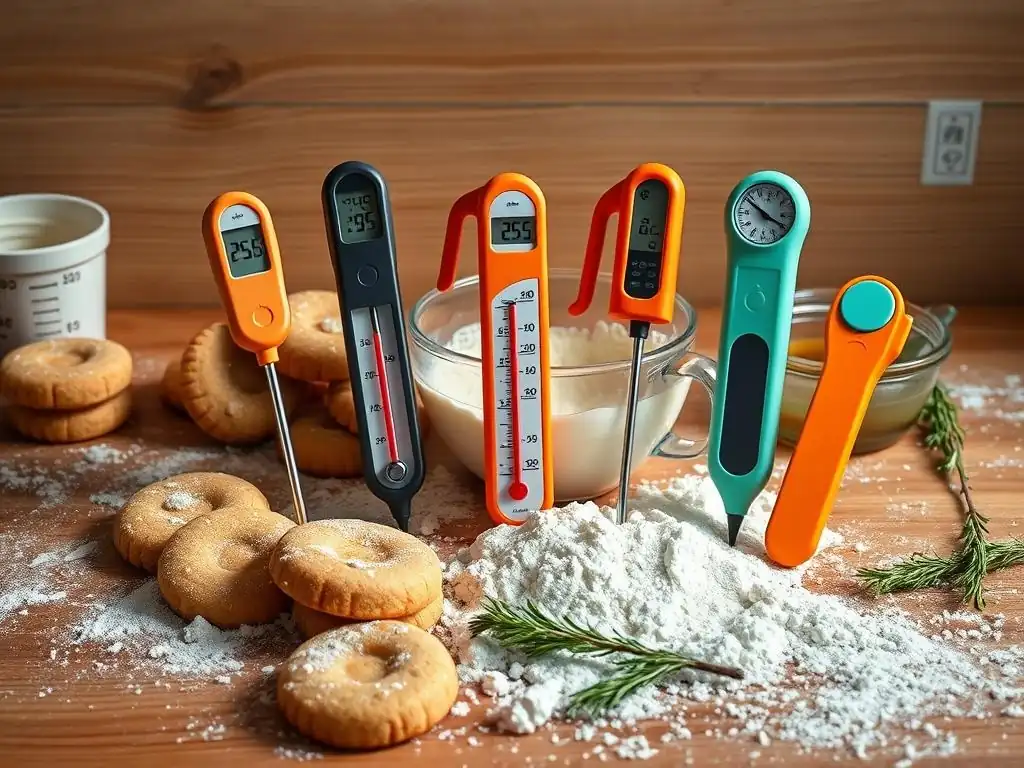
Equipping your kitchen with the right tools doesn't have to be a significant expense. We've looked at several popular and well-regarded thermometers that offer excellent value for their price, helping you achieve precise temperatures without overspending. These selections represent different types of thermometers, each suited for specific baking tasks, providing a range of affordable baking thermometer solutions.
1. ThermoPro TP03 Digital Instant Read Thermometer: The Budget-Friendly All-Rounder
The ThermoPro TP03 is a staple in many home kitchens due to its accessibility and performance. Typically priced around $10-15, it offers a fast reading within 3-5 seconds, which is crucial when you're trying to quickly check the internal temperature of bread or the doneness of a cake without leaving the oven door open too long. Its temperature range often spans from -58°F to 572°F (-50°C to 300°C), making it versatile enough for everything from chilling dough to checking boiling sugar.
This instant-read thermometer usually features a simple foldaway probe, auto-shutoff to save battery, and a clear digital display. While not designed for leaving in the oven during baking, its speed and wide range make it perfect for spot-checking temperatures. It's an excellent entry point for anyone seeking affordable baking thermometer precision for a variety of tasks.
2. KT THERMO Professional Oven Thermometer: Reliable Oven Temperature Monitoring
An often overlooked but critical tool is an oven thermometer. Many home ovens have thermostats that can be off by 25°F (around 14°C) or more, significantly impacting baking results. The KT THERMO oven thermometer, often found for under $10, is a simple, mechanical dial thermometer designed to hang or stand inside your oven, providing a constant, accurate reading of the actual air temperature.
This type of thermometer typically measures temperatures up to 500°F (about 260°C), covering the range needed for most baking, roasting, and broiling. By placing one of these inside your oven, you can verify if your oven is preheating correctly and maintaining the set temperature throughout the bake. Adjusting your oven's dial based on this accurate reading is one of the most effective yet affordable baking thermometer tips for improving consistency.
3. Habor Digital Candy Thermometer: Achieving Sugar-Crafting Success Without Breaking the Bank
Working with sugar requires hitting very specific temperatures to achieve different stages like thread, soft ball, firm ball, hard ball, soft crack, and hard crack. A standard instant-read thermometer might work, but a dedicated candy thermometer, like those from Habor (often priced around $15-20), comes with features tailored for this task. These usually have a long probe and a clip to secure it to the side of a pot, keeping the sensor immersed in the sugar syrup without you having to hold it constantly.
Habor digital candy thermometers typically offer a range suitable for high temperatures, often up to 450°F (around 232°C). They provide quick, stable readings vital for monitoring the rapidly changing temperature of boiling sugar. Their design minimizes the risk of burns and ensures the probe is at the correct depth in the liquid, making precise sugar work achievable and safer for the home baker looking for affordable baking thermometer options specifically for confectionery.
4. MEATER Plus Wireless Meat Thermometer: Hands-Free Temperature Monitoring for Larger Bakes
While primarily marketed for meat, the MEATER Plus (often costing $70+) offers a unique wireless capability that can be beneficial for specific baking tasks, particularly large items like significant loaves of bread or large format cakes where checking the internal temperature without opening the oven is ideal. It's a higher investment compared to the others listed, but offers a different level of convenience and monitoring capability.
The MEATER Plus uses a single probe inserted into the bake, communicating wirelessly via Bluetooth to a base that then connects via WiFi to your phone, offering a range of up to 165 feet (about 50 meters). You can monitor both the internal temperature of your bake and the ambient oven temperature from an app on your phone.
Its maximum internal temperature is typically around 212°F (100°C), sufficient for checking bread (done around 190-210°F / 88-99°C) or cakes (done around 200-210°F / 93-99°C). While not the cheapest, it represents a more advanced, hands-free approach within the spectrum of tools that can provide professional-level temperature control.
Choosing the Right Affordable Thermometer: Key Considerations
Selecting the best thermometer for your needs involves more than just looking at the price tag. Different baking tasks require different features, and understanding these can help you make the most informed decision. Considering these points ensures you get the maximum value from your investment in affordable baking thermometer tools.
Temperature Range: Matching Your Baking Needs
The required temperature range is perhaps the most critical factor. A thermometer suitable for checking the temperature of dough proving (often around 75-85°F or 24-29°C) is different from one needed for boiling sugar (which can exceed 300°F or 150°C). An instant-read thermometer with a wide range (-50°F to 572°F is common) offers versatility for many tasks, from chilling butter to checking baked goods.
However, if your primary focus is high-temperature work like candy making or deep frying for pastries, ensure the thermometer's upper limit safely exceeds the temperatures you'll be working with, typically needing something that goes well over 400°F (200°C). For oven calibration, a thermometer rated for at least 500°F (260°C) is necessary. Matching the tool's capabilities to your specific baking activities is a fundamental affordable baking thermometer tip.
Accuracy: Why Precision Matters in Baking
Even small temperature deviations can significantly impact baking outcomes. For instance, yeast activity is highly sensitive to temperature; dough that is too cold will rise slowly, while dough that is too hot can kill the yeast. Similarly, sugar stages are defined by narrow temperature windows, and being off by just a few degrees can mean the difference between soft caramel and brittle toffee.
Look for thermometers that specify a low margin of error, ideally within ±1-2°F (around ±0.5-1°C). While perfect accuracy might be elusive in budget models, reputable brands often provide specifications. Checking reviews for consistency in readings is also helpful. Prioritizing accuracy, even with an affordable baking thermometer, is key to repeatable, successful bakes.
Response Time: Fast Readings for Perfect Timing
In baking, timing is everything. When checking the internal temperature of a cake or loaf of bread, you want a reading quickly to avoid leaving the oven door open longer than necessary, which causes temperature fluctuations. An instant-read thermometer that provides a stable reading within 3-5 seconds is ideal for these quick checks.
For tasks like monitoring boiling sugar, a fast response time helps you react promptly as the temperature climbs rapidly through critical stages. While oven thermometers don't need to be instant (they provide a constant reading), for probe thermometers used in the bake, speed prevents heat loss and ensures you pull your creation at the peak of perfection. Fast response is a valuable feature when applying affordable baking thermometer tips.
Ease of Use and Cleaning: Making Baking Enjoyable
A thermometer should be a helpful tool, not a hassle. Look for features that simplify its use, such as a clear, easy-to-read display (especially useful in a steamy kitchen), simple controls, and a probe long enough to reach the center of your largest bakes. A magnetic back or a loop for hanging can make storage convenient.
Cleaning is also crucial for hygiene and maintaining the thermometer's lifespan. Probes should be easy to wipe down, and ideally, at least the probe tip should be waterproof or water-resistant. Avoid models with intricate crevices that are difficult to clean. Choosing a user-friendly and easy-to-clean affordable baking thermometer adds to the overall enjoyment of your baking process.
Affordable Baking Thermometer Tips for Accurate Readings and Extended Lifespan
Owning a thermometer is just the first step; knowing how to use and care for it properly ensures you get reliable readings every time and extends the life of your tool. Implementing these simple yet effective affordable baking thermometer tips will help you maximize the utility of your purchase.
Calibration: Ensuring Accuracy Over Time
Even affordable thermometers can lose accuracy over time due to drops or temperature extremes. Regularly checking your thermometer's calibration is vital. A common method is the ice bath test: fill a glass with crushed ice, add a little cold water (enough to fill gaps but leave ice floating), stir for a minute, then insert your thermometer probe, ensuring it doesn't touch the bottom or sides.
A properly calibrated thermometer should read 32°F (0°C) in an ice bath. If it reads differently, note the difference. Some digital thermometers allow recalibration; for others, you'll just need to add or subtract the difference from your readings. Performing this simple check periodically is one of the most important affordable baking thermometer tips for consistent results.
Proper Placement: Getting the Most Accurate Reading
Where you place the thermometer probe significantly impacts the reading. For checking the internal temperature of bread or cakes, insert the probe into the thickest part, avoiding any bones (if applicable, e.g., in meat included in a savory bake) or touching the bottom of the pan. Ensure the probe tip is in the center of the bake, as this is usually the last part to reach the target temperature.
When measuring the temperature of liquids like sugar syrup or oil, ensure the probe tip is fully submerged but not touching the bottom of the pot, as the bottom can be hotter than the liquid itself. For oven thermometers, place them near the center of the oven cavity, away from the walls or heating elements, to get a true reading of the ambient air temperature. Correct placement is a fundamental skill when applying affordable baking thermometer tips.
Cleaning and Storage: Protecting Your Investment
Proper cleaning after each use prevents the buildup of food residues, which can harbor bacteria and potentially affect future readings. For probes used in food, wipe them down immediately after use with a damp cloth and food-safe sanitizer or soapy water. Avoid immersing the main body of digital thermometers in water unless they are specifically rated as fully waterproof; often, only the probe is water-resistant.
Store your thermometer in a clean, dry place where it won't be easily dropped or exposed to extreme temperatures. Many come with protective sleeves or cases for the probe. Taking these simple steps for cleaning and storage is an essential part of maintaining the accuracy and longevity of your affordable baking thermometer.
Elevate Your Baking with Precision: Affordable Baking Thermometers That Deliver
Achieving bakery-quality results at home is more accessible than ever, and incorporating a reliable thermometer into your workflow is a significant step towards that goal. By understanding the importance of temperature control and utilizing the many excellent and affordable baking thermometer options available, you eliminate much of the guesswork.
From ensuring your yeast dough proofs at the ideal temperature to hitting the precise sugar stage for perfect caramel or verifying the internal doneness of your loaves and cakes, a thermometer provides the objective data needed for success. Applying these affordable baking thermometer tips empowers you to bake with confidence, consistency, and precision, proving that professional results are absolutely attainable without requiring a professional budget.
Frequently Asked Questions
What is the most important factor to consider when choosing an affordable baking thermometer?
The most important factor is accuracy and quick response time. You want a thermometer that gives you reliable readings quickly to avoid over or under-baking. Look for models with good reviews regarding accuracy.
Are digital or analog baking thermometers better for beginners?
Digital thermometers are generally considered better for beginners due to their ease of reading and precise temperature display. Analog thermometers can be harder to interpret accurately, especially for those new to baking.
Can I use a meat thermometer for baking?
While some meat thermometers can be used for baking, it's best to use one specifically designed for baking. Baking thermometers often have a wider temperature range and features suitable for baking needs.
How do I calibrate my baking thermometer to ensure accuracy?
Most baking thermometers can be calibrated using the ice water test. Place the thermometer in a glass of ice water and check if it reads 32°F (0°C). Adjust accordingly if it doesn't. Regular calibration is crucial.
Where is the best place to insert a baking thermometer for the most accurate reading?
Insert the thermometer into the thickest part of the baked good, avoiding contact with the pan. This ensures you're getting a reading of the internal temperature, which is critical for doneness.
Final Reflection: The Sweet Science of Affordable Precision
The pursuit of perfect baked goods doesn't require a hefty investment; mastering the art of baking hinges on precision, and that starts with a reliable, affordable baking thermometer. The right tool, even a budget-friendly one, can elevate your baking game from amateur attempts to consistently delicious results, transforming frustration into joy in the kitchen.
This exploration into the world of affordable baking thermometers has highlighted not just the practical benefits of accurate temperature control, but also the deeper connection between tool and craft. The simple act of checking the temperature transforms baking from a gamble into a science, allowing for greater control and understanding of the process. The difference between something good and something great is attention to detail.
This quote resonates deeply, as the seemingly small detail of temperature accuracy significantly impacts the final product. The impact extends beyond the individual baker, influencing the enjoyment of family and friends who benefit from perfectly baked treats.
Now, consider your own baking journey. What small investment could unlock a world of improvement in your kitchen? Don't let the fear of cost deter you from achieving baking excellence. Take the leap, invest in an affordable baking thermometer, and experience the transformative power of precision. The perfectly baked cake, cookie, or pie awaits – and it's closer than you think.
Unlock Your Baking Potential: Take the Next Step!
Thanks for taking the time to learn about choosing the right baking thermometer! We hope you now feel confident in creating perfectly baked goods every time. Ready to elevate your baking game?
- Invest in your dream thermometer today: Browse our curated selection of affordable, high-quality thermometers and find the perfect fit for your baking style. Don't wait—perfect pastries are just a click away!
- Share your baking triumphs: Show off your perfectly baked creations on social media using #BakeWithEase and tag us! We love seeing your results.
- Try a new recipe this week: Challenge yourself with a recipe you've always wanted to try, confident in your new thermometer skills.
What delicious creation will you bake first with your new, accurate thermometer? Let us know in the comments!