
Royal Icing Secrets: Books That Will Teach You Intricate Piping and Details

Welcome to BakeWithEase, your trusted guide to the delightful world of baking! Ever wondered how professional bakers achieve those breathtakingly intricate designs on cookies and cakes? Dive into our latest article and unlock the secrets to mastering royal icing piping techniques. Discover the best books that will transform you from a novice to a pro, allowing you to create stunning edible masterpieces. Ready to elevate your baking skills? Let's get started!
- Mastering Royal Icing Piping Techniques: A Baker's Guide
- Best Royal Icing Piping Techniques Tutorial Books for Beginners
- Advanced Royal Icing Piping Techniques: Books for Experienced Bakers
- Essential Royal Icing Piping Supplies Highlighted in These Books
- Troubleshooting Common Royal Icing Piping Problems (Based on Book Solutions)
- From Basic Borders to Intricate Designs: The Royal Icing Piping Journey
- Investing in Your Royal Icing Education: Courses vs. Books
- Conclusion: Elevate Your Baking with Royal Icing Piping Mastery
-
Frequently Asked Questions
- What is royal icing, and why is it important for intricate piping?
- What are some essential tools recommended in the "Royal Icing Secrets" article for royal icing piping?
- Are the books recommended suitable for beginners who are new to royal icing piping?
- What kind of designs can I learn from a royal icing piping techniques tutorial?
- Where can I find easy-to-find ingredients for making royal icing as mentioned in the article?
- Final Reflection: The Enduring Allure of Royal Icing
- Unleash Your Inner Royal Icing Artist!
Mastering Royal Icing Piping Techniques: A Baker's Guide
Why Royal Icing Mastery is Key for Cake Decorating
Royal icing is a classic medium in the world of cake decorating, renowned for its ability to dry hard and create incredibly fine, detailed work. Mastering royal icing piping techniques tutorial skills allows bakers to transform simple cakes and cookies into edible works of art. Unlike buttercream, which remains soft, royal icing sets firm, making it perfect for structural elements, delicate lacework, intricate lettering, and crisp borders that hold their shape beautifully. This durability also makes decorated items easier to transport and display.
Developing proficiency in handling royal icing opens up a vast array of decorative possibilities. From elegant wedding cakes adorned with fine filigree to cheerful cookies decorated with vibrant, detailed designs, the versatility of royal icing is unmatched for precision work. Learning to control consistency, pressure, and movement is fundamental, and dedicated practice through a structured royal icing piping techniques tutorial or guide is essential for achieving professional-looking results.
Choosing the Right Royal Icing Recipe for Piping Perfection
The success of your royal icing piping techniques tutorial journey heavily depends on starting with the correct icing consistency, which begins with a reliable recipe. Traditional recipes use fresh egg whites and powdered sugar, while many modern recipes utilize meringue powder for stability and safety. Both can yield excellent results, but the ratio of liquid (egg white or reconstituted meringue powder) to powdered sugar is critical for achieving the right stiffness for piping.
For intricate piping, like fine lines or lettering, you need a relatively stiff consistency that holds sharp peaks but can still flow smoothly through a small tip. A slightly thinner consistency, often called "outline" or "20-second" icing (referring to how quickly a dropped line merges back into the bowl), is ideal for outlining shapes before flooding. Flooding consistency, much thinner, is used to fill in areas smoothly. Understanding these different consistencies and how to adjust your base recipe is a core part of any good royal icing piping techniques tutorial.
Best Royal Icing Piping Techniques Tutorial Books for Beginners
"The Complete Photo Guide to Cake Decorating" by Autumn Carpenter: A Beginner's Foundation
Autumn Carpenter's guide is often recommended as a solid starting point for anyone new to cake decorating, including fundamental royal icing piping techniques tutorial basics. The book excels in its visual approach, providing clear, step-by-step photographs for nearly every technique. It demystifies the process of making and coloring royal icing and introduces essential piping skills like holding the bag, applying even pressure, and creating simple lines, dots, and basic borders.
This book typically covers foundational skills needed before tackling complex designs. It helps build confidence by breaking down techniques into manageable steps, often illustrating the results you can expect from various piping tips commonly used with royal icing. For a beginner eager to learn the mechanics of piping, Carpenter's book serves as an accessible and encouraging introduction to the craft.
Key Royal Icing Techniques Covered in Carpenter's Book
Carpenter's book usually covers essential beginner techniques using royal icing. This includes outlining shapes on cookies or cakes, creating simple bead or shell borders using tips like a medium round (#5) or closed star (#18), and practicing basic pressure control to make uniform dots or pull-out stars. It also often introduces the concept of flooding outlined areas for smooth surfaces, a key skill for cookie decorating.
Furthermore, the guide typically demonstrates how to use different tip shapes to create varied effects, such as leaves with a leaf tip or simple rosettes with a star tip. The focus remains on fundamental skills: achieving smooth, consistent lines, understanding how pressure affects the icing flow, and cleanly starting and stopping your piping. These basic royal icing piping techniques tutorial elements are crucial building blocks.
Where to Buy: Affiliate Link to [Amazon/BakeDeco]
Available from major online retailers and baking supply stores.
Marian Poirier's "Sweetopia's Cookie Decorating" shifts the focus to the popular realm of cookie decorating, where royal icing is the star medium. While not exclusively about piping techniques in the traditional sense of cake borders, it provides an excellent royal icing piping techniques tutorial specifically for creating intricate and beautiful designs on a smaller, flat surface. The book is known for its inspiring designs, vibrant colors, and clear instructions tailored for cookies.
This book is invaluable for beginners who want to specialize in cookie art. It covers making and coloring royal icing specifically for cookie decorating consistencies (outlining, flooding, detail), and dives into techniques like wet-on-wet designs, marbling, and piping fine details. The scale of cookies necessitates precision, making this book a great way to hone fine motor control with royal icing.
Learning Intricate Cookie Designs with Marian's Guidance
Marian's book guides readers through creating a wide range of cookie designs using royal icing. Techniques like piping intricate patterns directly onto dry flood coats, creating dimensional elements, and using very fine tips (such as a #1 or even #0) for tiny details like eyes or lettering are typically covered. She also often includes tips on achieving smooth, flawless flooded surfaces free of craters or bubbles.
The book serves as a detailed royal icing piping techniques tutorial specifically for the unique challenges and opportunities presented by cookies. It emphasizes techniques that make cookies visually striking, such as layering icing, creating subtle textures, and using various consistencies to achieve different effects within a single design.
Where to Buy: Affiliate Link to [Etsy/Local Bookstore]
Available from online retailers and specialty craft stores.
Advanced Royal Icing Piping Techniques: Books for Experienced Bakers
"Cake Decorating for Professionals" by Carol Deacon: Elevating Your Skills
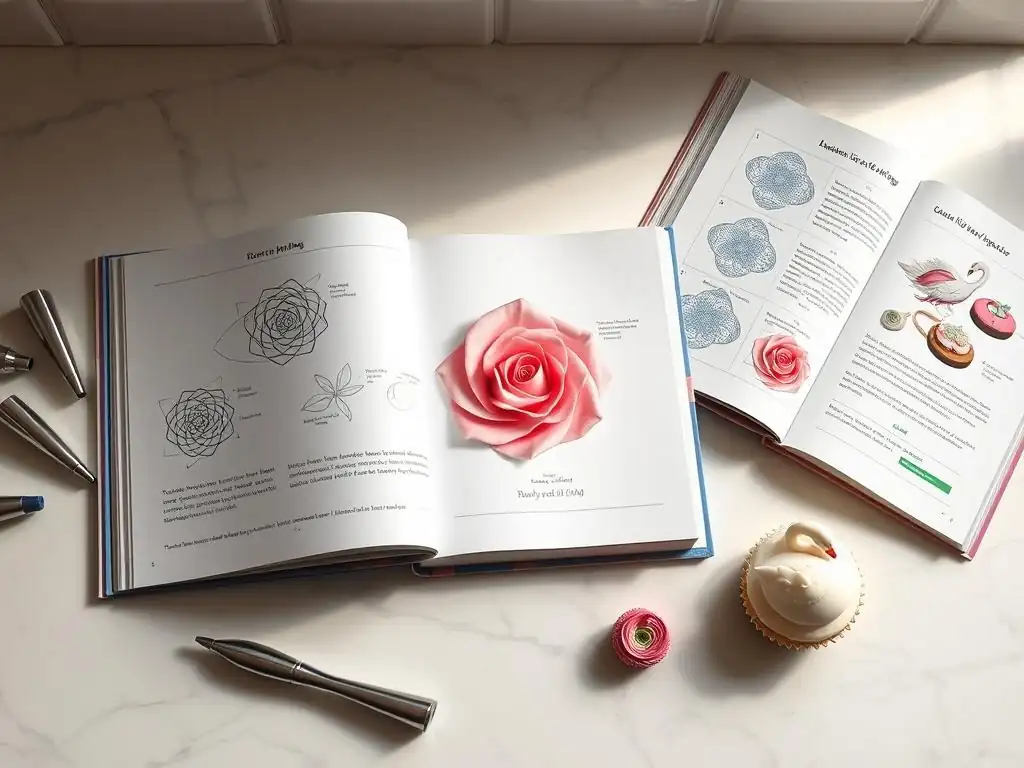
Carol Deacon's "Cake Decorating for Professionals" is geared towards those with some experience looking to refine their skills and tackle more complex projects. While covering various decorating mediums, it delves into advanced royal icing piping techniques tutorial lessons suitable for creating elaborate cake designs. This book often assumes a basic understanding of icing preparation and focuses on precision, control, and intricate pattern work.
The content typically includes techniques required for professional-level presentation, such as creating delicate lacework, intricate overlays, and structural royal icing pieces. It challenges bakers to move beyond simple borders and explore designs that require consistent pressure, steady hands, and a deep understanding of how royal icing behaves under different conditions and with various tip sizes, including very fine ones.
Mastering Complex Royal Icing Designs with Deacon's Expertise
Deacon's expertise shines in sections covering advanced techniques like brush embroidery, which uses a brush to soften piped lines for a fabric-like effect, and intricate pressure piping to create dimensional details. The book often demonstrates how to build up layers of piping to create complex patterns and textures, or how to execute fine filigree work that adds an element of delicate elegance to cakes.
Learning from a guide like this means focusing on consistency in execution, mastering pressure control for uniform lines and shapes, and understanding how humidity and drying time affect complex royal icing structures. It's a comprehensive royal icing piping techniques tutorial for those aiming for professional-quality results and challenging designs.
Where to Buy: Affiliate Link to [Publisher's Website]
Available directly from the publisher and professional baking suppliers.
"The Art of Royal Icing" by Eddie Spence MBE: Timeless Techniques from a Master
Eddie Spence MBE is a legendary figure in the world of royal icing, and his book, "The Art of Royal Icing," is considered a foundational text for serious students of the craft. This book focuses on traditional British royal icing techniques, including the intricate Lambeth method and English overpiping. It's a deep dive into classic methods that require immense patience, precision, and practice.
Learning from Eddie Spence is like studying with a master craftsman. His book details techniques that build dimension and texture through layering and precise pressure control, often using very fine tips. It's less about trendy designs and more about mastering the fundamental skills that have defined classic royal icing decoration for decades. For those wanting to truly master the art, this is an essential royal icing piping techniques tutorial.
Learning from a Royal Icing Legend: Eddie Spence's Legacy
Spence's book teaches techniques like creating intricate swags, delicate trellis patterns, and dimensional cornelli lace. A significant focus is often placed on overpiping, where layers of icing are built up to create raised, sculptural designs. This requires exceptional control and consistency. The book also typically covers essential skills like preparing boards for piping and handling the icing to achieve flawless results for complex structures.
Studying this book provides a historical context for many modern techniques and emphasizes the discipline required for achieving truly masterful results. It's a challenging yet rewarding royal icing piping techniques tutorial that honors the rich history and intricate beauty of traditional royal icing work.
Where to Buy: Affiliate Link to [Specialty Baking Supply Store]
Available from specialty baking suppliers and select art book sellers.
Essential Royal Icing Piping Supplies Highlighted in These Books
Piping Bags and Tips: Finding the Right Tools for Precision
Having the right tools is as crucial as having a good royal icing piping techniques tutorial. Piping bags come in various materials – disposable plastic, reusable plastic, and fabric. Disposable bags are convenient for quick color changes and easy cleanup, while reusable bags can be more economical over time. The choice often comes down to personal preference and the scale of your project.
Piping tips are the metal or plastic nozzles that shape the icing as it's squeezed from the bag. For royal icing, a range of round tips is essential, from very fine (#00, #0, #1, #2) for tiny details and outlines to medium (#3, #5) for outlining and flooding. Star tips (#16, #18, #21) are useful for creating borders, rosettes, or stars. Leaf tips and petal tips can also be used for specific designs. The specific tip used dramatically impacts the final appearance of the piped design.
Recommendations from [Book Author Names] on Their Favorite Piping Tips
Experts like Autumn Carpenter and Marian Poirier often emphasize the versatility of small round tips, particularly sizes #1, #2, and #3, for outlining and fine detail work on both cakes and cookies. For flooding larger areas, a medium round tip like #5 or #6 is frequently recommended to allow for quicker coverage.
Carol Deacon and Eddie Spence, when discussing advanced techniques, would likely highlight the importance of using incredibly fine tips, potentially down to #00 or #0, for achieving the delicate filigree and intricate overpiping characteristic of traditional methods. They might also favor specific types of metal tips known for their precision.
Generally, experts agree that investing in a quality set of seamless stainless steel tips is beneficial for achieving clean, crisp lines, which is paramount in mastering royal icing piping techniques tutorial lessons. Having a variety of sizes within the round tip family is often considered the most important starting point for any royal icing decorator.
Affiliate Links to Recommended Piping Tip Sets on [Amazon/BakeWithEase Store]
Available from major online retailers and baking supply stores.
Food Coloring: Achieving Vibrant and Consistent Royal Icing Colors
Achieving vibrant and consistent colors in your royal icing is key to creating visually appealing decorations. Unlike liquid food coloring, which can thin out the icing too much, gel or paste food colorings are highly concentrated and add minimal liquid. This is critical for maintaining the correct consistency needed for precise royal icing piping techniques tutorial applications.
High-quality gel colors offer intense pigments, allowing you to achieve deep, rich colors with just a small amount. This prevents oversaturating the icing with liquid, which can lead to issues like bleeding colors or a compromised texture. Choosing reputable brands known for their color intensity and stability is recommended for the best results.
Choosing the Best Gel Food Colors for Royal Icing (As Recommended by the Books)
While specific brand endorsements might vary, books on royal icing decorating frequently recommend using professional-grade gel or paste food colorings. Brands commonly cited or used by experts include Wilton, Americolor, and Chefmaster. These brands are favored for their wide range of colors, intensity, and the fact that they do not significantly alter the icing's consistency when used correctly.
Using a toothpick or clean scribe to add color gradually allows for precise color matching and prevents accidentally adding too much. Achieving consistent color across batches is also a skill developed with practice and by using reliable, concentrated colors. This attention to color is a vital part of presenting professional-looking royal icing work learned through a comprehensive royal icing piping techniques tutorial.
Affiliate Links to Quality Gel Food Coloring Brands on [BakeDeco/Specialty Food Store]
Available from baking supply stores and online retailers.
Practice Boards and Templates: Honing Your Royal Icing Skills
Practice is fundamental to mastering any skill, and royal icing piping techniques tutorial practice is no exception. Practice boards and templates are invaluable tools that allow you to hone your skills without wasting edible icing or baked goods. These reusable surfaces mimic the texture of a cake or cookie and often come with pre-printed patterns or lines to follow.
Using a practice board allows you to focus solely on your hand movement, pressure control, and consistency of your lines and shapes. You can scrape off the icing, re-mix it if needed, and practice the same technique repeatedly until you achieve the desired result. This repetitive practice is crucial for building the muscle memory needed for intricate designs.
Using Practice Boards for Consistent Royal Icing Lines and Shapes
Practice boards are typically covered with a smooth, non-porous material that allows royal icing to be easily applied and then scraped off. Many boards feature printed grids, straight lines, curves, circles, and common patterns like shells, swags, or leaves. Following these guides helps develop a steady hand and the ability to pipe uniform shapes and consistent line thickness.
Regular practice sessions on a board dedicated to royal icing piping techniques tutorial exercises can dramatically improve your control and confidence before you attempt to decorate a final product. It allows for experimentation with different tip sizes and icing consistencies without the pressure of perfection on an actual cake or cookie.
Affiliate Links to Practice Boards and Templates on [Etsy/Amazon]
Available from online marketplaces and craft supply stores.
Troubleshooting Common Royal Icing Piping Problems (Based on Book Solutions)

Royal Icing Too Thick or Too Thin: Solutions from the Experts
One of the most common challenges in royal icing piping techniques tutorial is achieving and maintaining the correct icing consistency. If your royal icing is too thick, it will be difficult to squeeze through the piping tip, resulting in jagged or broken lines and requiring excessive hand pressure.
Experts recommend adding liquid very gradually – a drop or two of water or lemon juice at a time – stirring thoroughly until the desired flow is achieved. For outline consistency, a common test is the "15-second" or "20-second" rule: a line dropped from a spoon into the bowl should disappear into the surface in that timeframe.
Conversely, if the royal icing is too thin, it will spread uncontrollably, losing its shape and definition. Fine details will blur, and borders won't hold their form. The solution here is to add more powdered sugar, again, adding a tablespoon at a time and mixing until the icing reaches the desired stiffness. It's always easier to thin icing than to thicken it, so start with a slightly thicker consistency than you think you need and thin it down cautiously.
Air Bubbles in Royal Icing: Prevention and Removal Techniques
Air bubbles are the nemesis of smooth, consistent royal icing lines. They can cause breaks in your piping, resulting in frustrating imperfections, especially in fine detail work. Air bubbles are often introduced during the mixing process or when the icing is transferred to the piping bag. Over-whipping the icing can incorporate too much air.
To prevent bubbles, experts suggest mixing royal icing on a lower speed once the ingredients are combined, avoiding excessive whipping. After mixing, cover the bowl with damp paper towel and plastic wrap pressed directly onto the surface and let the icing rest for 10-15 minutes; this allows trapped air to rise.
Before filling a piping bag, gently stir the icing by hand to release surface bubbles. Once the bag is filled, twist the top tightly and gently massage the bag or tap it against the counter to encourage any remaining bubbles to move towards the tip, where they can be squeezed out onto a practice surface before you begin piping on your project.
Bleeding Colors: Avoiding Color Migration in Royal Icing
Color bleeding, where colors seep into adjacent areas, can ruin intricate royal icing designs. This is often caused by humidity, using too much liquid coloring, or applying wet icing next to a different color that hasn't fully dried. Certain colors, particularly reds and blacks, are more prone to bleeding due to the concentration of pigment required.
To minimize bleeding, always use high-quality gel or paste food colors sparingly; a little goes a long way. Ensure each section of royal icing is completely dry before piping an adjacent color or adding details on top. This is especially critical for dark colors next to light ones.
Working in a low-humidity environment is also beneficial. Some advanced decorators even suggest adding a tiny amount of cornstarch to very dark colors or sealing large areas of dark color with a thin layer of clear piping gel once dry, although drying time remains the most crucial factor in preventing color bleed when executing royal icing piping techniques tutorial designs.
From Basic Borders to Intricate Designs: The Royal Icing Piping Journey
Starting with Simple Royal Icing Borders and Outlines
The journey to mastering royal icing piping techniques tutorial skills typically begins with foundational exercises. Learning to pipe simple borders like shells, beads, or ropes using medium-sized tips (#16, #18, #21 for shells/stars, #5, #6 for beads/ropes) helps develop consistent pressure and movement. Simultaneously, practicing piping straight lines, curves, and dots with small round tips (#2, #3) is essential for outlines and basic control.
These initial steps focus on the mechanics: holding the piping bag correctly, applying even pressure to ensure a steady flow of icing, and lifting the bag cleanly at the end of each stroke. Practicing these basic movements repeatedly on a practice board builds the muscle memory necessary for more complex work. Consistency in size, spacing, and shape is the primary goal at this stage.
Progressing to Complex Designs: Flowers, Lacework, and More
Once basic control is established, bakers can progress to more intricate royal icing piping techniques tutorial applications. This involves learning to create delicate drop flowers using a petal tip (#101, #104), piping roses layer by layer, or forming leaves with a leaf tip. Moving beyond individual elements, techniques like creating fine lacework patterns, delicate filigree, or brush embroidery come into play.
These advanced designs often require using very fine tips (#0, #1, #00), mastering pressure control to vary line thickness, and understanding how to build up layers of icing for dimensional effects, as seen in the Lambeth method. Patience, precision, and the ability to work with different icing consistencies simultaneously are key to successfully executing these complex patterns.
Applying your learned royal icing piping techniques tutorial skills to actual baked goods is the exciting culmination of your practice. Start with simple projects like decorating sugar cookies with outlines and flood fills, adding piped dots or simple patterns. Progress to decorating the sides of a small cake with basic borders or simple piped patterns.
As your skills grow, tackle more ambitious projects. Decorate a multi-tiered cake with elegant piped swags and delicate lacework. Create a themed set of cookies featuring intricate details and layered designs. Pipe intricate monograms or detailed scenes onto cake tops or cookie surfaces. The possibilities are vast, allowing you to showcase your mastery of royal icing piping techniques and create stunning edible art for any occasion.
Investing in Your Royal Icing Education: Courses vs. Books
The Benefits of Royal Icing Piping Techniques Online Courses
For some learners, an online course can be a highly effective way to learn royal icing piping techniques tutorial skills. The benefits often include live video demonstrations, allowing you to see the techniques being executed in real-time. Many courses offer structured lessons that build skills progressively, sometimes with opportunities for feedback from an instructor or community.
Online courses can provide motivation through scheduled lessons and interaction with other students. They often cover a specific set of techniques in depth and may offer troubleshooting support. For visual learners who benefit from watching techniques performed, an online royal icing piping techniques tutorial course can be an excellent investment.
[Example Online Royal Icing Course Name] - Affiliate Link
Look for comprehensive online courses covering foundational to advanced royal icing piping techniques.
When Books are the Better Choice for Learning Royal Icing Piping
While courses offer valuable interactive learning, books remain a cornerstone for mastering royal icing piping techniques tutorial skills for many reasons. Books offer the flexibility of self-paced learning; you can revisit complex sections as many times as needed without time constraints. They are portable, allowing you to learn and practice anywhere.
High-quality books, especially those with detailed photographs and clear instructions like the ones mentioned, serve as permanent reference guides that you can consult repeatedly over your decorating journey. They are generally more affordable than comprehensive courses and provide a broad overview of techniques and styles. For focused, detailed, and self-directed learning, books are an invaluable resource for any aspiring royal icing artist.
Conclusion: Elevate Your Baking with Royal Icing Piping Mastery
Mastering royal icing piping techniques tutorial skills is a rewarding pursuit that significantly elevates your baking and decorating capabilities. Whether you aspire to create elegantly adorned cakes or intricately decorated cookies, royal icing provides the perfect medium for precision and detail. By utilizing the knowledge found in comprehensive guides and dedicating time to practice, you can steadily improve your control, consistency, and artistic expression.
Investing in quality tools and learning from experienced authors provides a strong foundation for your journey. Embrace the process, practice diligently, and soon you'll be piping breathtaking designs with confidence, transforming your baked goods into stunning works of edible art.
Frequently Asked Questions
What is royal icing, and why is it important for intricate piping?
Royal icing is a hard, white icing made from powdered sugar and egg whites (or meringue powder). It's crucial for intricate piping because it dries hard and smooth, allowing for detailed decorations that hold their shape.
What are some essential tools recommended in the "Royal Icing Secrets" article for royal icing piping?
The article doesn't specify tools, but generally, piping bags, tips of varying sizes, and couplers are essential. Also, gel food coloring is preferred for vibrant colors without changing the icing consistency.
Are the books recommended suitable for beginners who are new to royal icing piping?
While the article doesn't directly say, royal icing can be challenging for beginners. Starting with books that cover basic techniques and simple designs is advisable before tackling intricate details.
What kind of designs can I learn from a royal icing piping techniques tutorial?
You can learn a wide range of designs, from basic borders and lettering to complex floral patterns and character designs. The possibilities are virtually limitless depending on your skill and the tutorial's focus.
Where can I find easy-to-find ingredients for making royal icing as mentioned in the article?
Royal icing ingredients are typically easy to find in most grocery stores. Look for powdered sugar, meringue powder (or egg whites), and food coloring in the baking aisle.
Final Reflection: The Enduring Allure of Royal Icing
The delicate art of royal icing piping, once a skill confined to professional bakers, is now blossoming into a widely accessible craft. This accessibility, fueled by the readily available resources highlighted in this article, signifies a powerful shift in how we engage with culinary artistry. No longer is intricate piping reserved for the elite; it's a skill waiting to be discovered and mastered by anyone with passion and patience.
The journey through the world of royal icing, as explored through these recommended books, reveals more than just piping techniques; it unveils a deeper connection to creativity and self-expression. The meticulous detail, the precision required, and the sheer beauty of the final product offer a unique form of meditative practice. As artist and author, Martha Stewart, once said, Baking is at once child's play and adult joy. And love is the best ingredient.
This sentiment perfectly encapsulates the rewarding experience of mastering royal icing, transforming simple ingredients into breathtaking works of art, infused with personal care and intention.
Now, it's your turn. Pick up a book, gather your supplies, and embark on your own royal icing adventure. Don't be afraid to experiment, to fail, and to learn from each attempt. The beauty of this craft lies not just in the perfect rose or intricate border, but in the journey of self-discovery and the joy of creating something beautiful with your own two hands. Let the delicate swirls of royal icing be a testament to your creativity and a sweet reward for your dedication.
Unleash Your Inner Royal Icing Artist!
Thanks for exploring the world of intricate royal icing with us! We hope you've discovered some new techniques and inspiration to elevate your baking. Ready to put your newfound knowledge into practice?
- Dive into a royal icing project today! Choose your favorite design, gather your supplies, and let your creativity flow. Even a small practice piece will build your confidence.
- Share your creations! Post your royal icing masterpieces on social media and tag us – we’d love to see what you make!
- Explore different piping techniques: Try experimenting with new nozzles and pressures to achieve unique textures and styles.
What stunning design will you create first?