
Your Beginner Baking Journey Starts Here: Essential Tools You Need

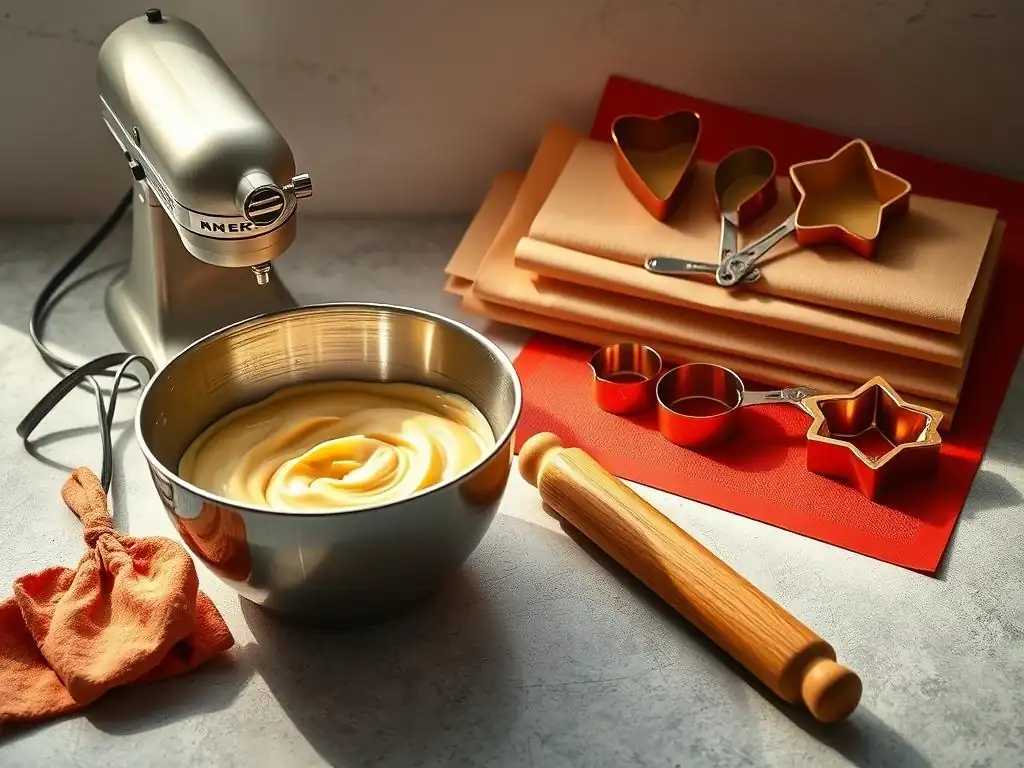
Welcome to BakeWithEase, your kitchen companion for all things baking!
Ready to transform your kitchen into a delightful bakery? Discover the secrets to effortless baking, no matter your skill level. This week, we're diving into the essential baking tools for beginners, unraveling the mystery of what you really need to get started. Are you ready to equip yourself for success and unlock a world of delicious possibilities? Read on to discover the must-have items that will make your baking journey a breeze!
- Getting Started with Baking: Essential Baking Tools for Beginners
- Must-Have Baking Tools for Aspiring Bakers
- Other Helpful Baking Tools for Beginners
- Building Your Beginner Baking Toolkit: Tips and Considerations
- Mastering Basic Baking Techniques with the Right Tools
- Level Up Your Baking: Beyond the Basics
-
Frequently Asked Questions
- What are the absolute must-have essential baking tools for beginners?
- How much should I expect to spend on essential baking tools when starting out?
- What's the difference between a rubber spatula and a silicone spatula, and which is better for a beginner baker?
- Do I really need a stand mixer, or can I get by with hand mixing when learning basic baking techniques?
- What are some tips for maintaining and cleaning my baking tools to ensure they last?
- Final Reflection: The Sweetness of Beginnings and the Joy of Baking
- Unleash Your Inner Baker: Get Baking Today!
Getting Started with Baking: Essential Baking Tools for Beginners
Baking can seem daunting at first, with visions of complicated techniques and precise measurements. But truly, it's a delightful journey that becomes incredibly rewarding with practice. Think of your kitchen as a laboratory where delicious magic happens, and like any good scientist or artist, you need the right equipment. Starting your beginner baking adventure with the correct essential baking tools for beginners sets you up for success, minimizing frustration and maximizing your chances of creating tasty treats right from the start.
Having a foundational set of essential baking tools for beginners isn't about buying the most expensive gadgets; it's about acquiring reliable items that perform specific tasks effectively. These tools help ensure consistency in your results, which is crucial when following a recipe. Imagine trying to measure flour accurately without proper cups or mix batter smoothly without a sturdy bowl – it would make the process much harder and the outcome less predictable. Building your collection of essential baking tools for beginners step-by-step is a smart way to begin, focusing on versatility and quality within your budget.
Why Having the Right Baking Tools Matters
Precision is paramount in baking. Unlike cooking, where you can often adjust ingredients as you go, baking relies on chemical reactions that require specific ratios of ingredients. Using accurate measuring tools, for instance, ensures that your leavening agents (like baking soda or powder) react correctly with wet or dry ingredients, leading to cakes that rise properly or cookies that spread just right.
Without the right tools, you might inadvertently add too much flour, resulting in a dense loaf, or not enough sugar, affecting moisture and texture. Studies have shown that even small variations in flour weight can significantly impact cookie spread and texture, highlighting the need for precise measurement tools.
Beyond measurement, the right tools impact technique and efficiency. A good quality whisk helps incorporate air into batters for a lighter texture, while a flexible spatula ensures you scrape down the sides of your bowl effectively, preventing unmixed pockets of ingredients. Using a proper baking pan ensures even heat distribution, preventing burnt edges or undercooked centers.
For example, a standard 9-inch round cake pan made of a light metal like aluminum conducts heat efficiently, promoting even browning compared to a dark, non-stick pan which might brown the edges too quickly. Investing in these essential baking tools for beginners simplifies steps and helps you execute techniques accurately, paving the way for consistent, delicious results.
Must-Have Baking Tools for Aspiring Bakers
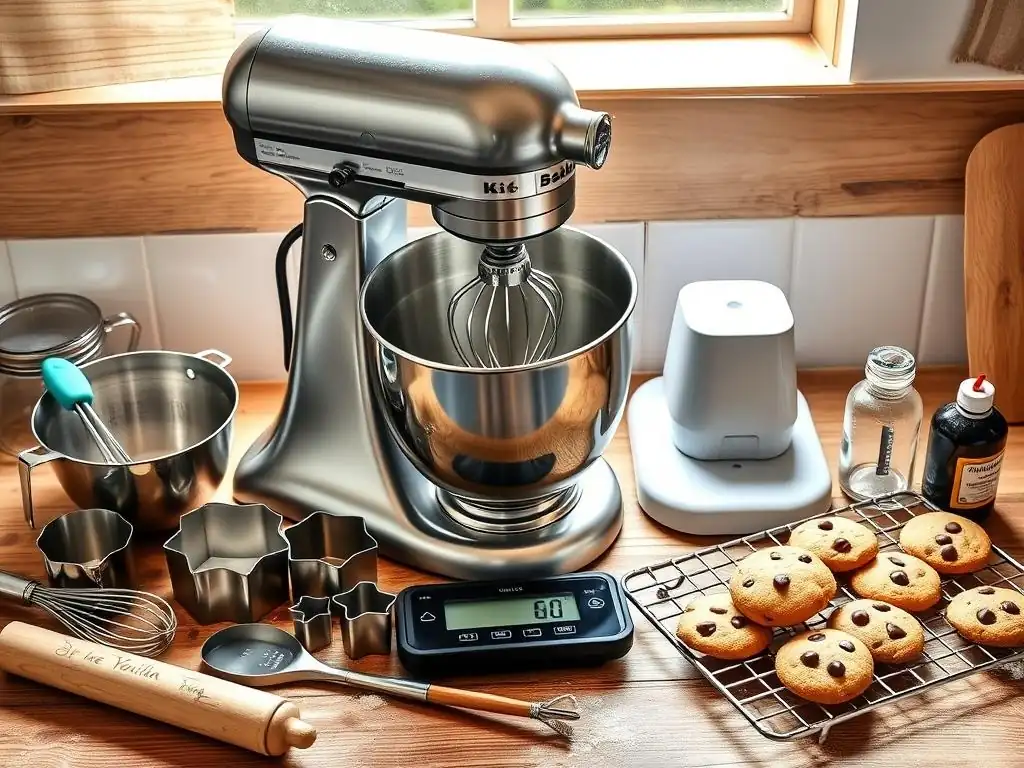
Essential Measuring Tools for Accurate Baking
Accuracy in measuring ingredients is arguably the most critical step in successful baking. Using the correct tools ensures your dry goods, liquids, and smaller additions like salt or spices are added in the exact quantities specified by the recipe. This precision is what allows chemical reactions to happen as intended, leading to reliable results every time you bake. Think of measuring tools as the foundation of your essential baking tools for beginners kit.
Having a set of reliable measuring tools reduces guesswork and minimizes common beginner mistakes like tough cookies or flat cakes. Different types of ingredients require different measuring techniques and tools. Understanding which tool to use for what ingredient makes a significant difference in your final product.
Measuring Cups: Dry vs. Liquid
Dry measuring cups are designed to be leveled off, ensuring you get an exact amount of ingredients like flour, sugar, or oats. They typically come in sets ranging from 1/4 cup to 1 cup. To use them correctly, spoon the dry ingredient into the cup without packing it down (unless specified), then level off the excess with a straight edge like a knife or the back of a spatula. Packing flour, for example, can add up to 25% more flour than intended, significantly altering the recipe outcome.
Liquid measuring cups, usually made of clear glass or plastic, have a spout for easy pouring and markings on the side. They are designed to be read at eye level on a flat surface. This allows you to accurately measure liquids like milk, water, or oil by observing the meniscus (the curve of the liquid surface) at the desired volume line. Trying to measure liquids in dry measuring cups often leads to spills and inaccurate volumes due to the lack of a spout and side markings. Standard liquid cup sets often include 1-cup, 2-cup, and 4-cup sizes.
Measuring Spoons: Precision is Key
Measuring spoons are essential for accurately portioning smaller amounts of ingredients like baking powder, baking soda, salt, spices, and extracts. These potent ingredients, even in small quantities, can significantly impact the flavor, texture, and rise of your baked goods. A slight mismeasurement of baking soda, for instance, can cause a cake to collapse or have a soapy taste.
Sets of measuring spoons typically include 1/4 teaspoon, 1/2 teaspoon, 1 teaspoon, and 1 tablespoon. Like dry measuring cups, dry ingredients measured in spoons should be leveled off. Liquid ingredients measured in spoons should fill the spoon exactly without overflowing. Their small size and precise volumes make them indispensable for ensuring the delicate balance of flavors and leavening in your recipes, making them a vital part of your essential baking tools for beginners.
Kitchen Scale: The Ultimate Accuracy Tool
For the highest level of accuracy in baking, especially when dealing with flour, sugar, and other dry ingredients, a digital kitchen scale is invaluable. Measuring by weight (grams or ounces) is far more consistent than measuring by volume (cups). A cup of flour can vary in weight by as much as 30-40 grams depending on how it's scooped and leveled, whereas 120 grams of flour is always 120 grams. Many professional bakers and advanced recipes rely solely on weight measurements for this reason.
Investing in a kitchen scale is a step that significantly improves the reliability of your baking results. It simplifies measuring sticky ingredients like honey or peanut butter (just place the container on the scale, tare it, and pour until the desired weight is reached) and reduces the number of dishes used. While not strictly necessary for every beginner recipe, a scale quickly becomes one of the most used and appreciated essential baking tools for beginners aiming for consistent success.
Mixing Bowls: Choosing the Right Material
You'll need sturdy bowls for combining your ingredients, from whisking eggs to mixing batter. Mixing bowls come in various materials, each with its own advantages. Having a few different sizes is helpful – perhaps a small one for whisking eggs, a medium one for dry ingredients, and a large one for mixing the main batter. A set of three nested bowls (e.g., 1.5-quart, 3-quart, and 5-quart) is a great starting point for your collection of essential baking tools for beginners.
The material of your mixing bowl can affect how easily ingredients combine and even how certain mixtures, like whipped cream or egg whites, behave. Consider how often you'll be using heat (like setting a bowl over a double boiler) or needing to see the mixing process.
Stainless Steel Mixing Bowls: Versatile and Durable
Stainless steel mixing bowls are lightweight, durable, and non-reactive, meaning they won't interact with acidic ingredients like lemon juice or vinegar. They are excellent conductors of temperature, making them ideal for tasks like setting a bowl over a pot of simmering water to melt chocolate or create a double boiler. They are also easy to clean and won't shatter if dropped, a definite plus in a busy kitchen.
Their smooth, non-porous surface makes them easy to scrape clean with a spatula, ensuring you get all that precious batter or dough out. A typical set might range from very small (0.75 quart) up to very large (8 quarts or more), but for most beginner baking, a few in the 2-quart to 5-quart range will cover your needs. Their versatility and resilience make them a staple among essential baking tools for beginners.
Glass Mixing Bowls: See-Through Convenience
Glass mixing bowls are heavier than stainless steel but offer the advantage of transparency. You can easily see how well your ingredients are mixing, whether you're creaming butter and sugar or folding in dry ingredients. Glass is also non-reactive and can often be used in the microwave (check for microwave-safe labeling).
While they can break, glass bowls are excellent for tasks where visual inspection is helpful, such as proofing yeast dough (you can see it rise) or melting butter. They also retain heat well, which can be useful in some applications. Standard sizes are similar to stainless steel, with sets commonly including 1-quart, 2.5-quart, and 4-quart bowls. Having one or two glass bowls alongside stainless steel ones provides flexibility in your essential baking tools for beginners.
Spatulas and Scrapers: Essential for Baking
Spatulas and scrapers are the workhorses of baking, used for everything from gently folding delicate mixtures to scraping every last bit of batter from a bowl. You'll likely need more than one type for different tasks. These tools are fundamental for ensuring ingredients are fully incorporated and minimizing waste.
Having a variety of spatulas and scrapers in your essential baking tools for beginners collection will make tasks like folding, mixing, and spreading much easier and more efficient. Their flexibility and shapes are designed for specific purposes in the baking process.
Rubber Spatulas: Flexible and Essential
Flexible rubber or silicone spatulas are indispensable. Their primary job is to scrape down the sides of mixing bowls, ensuring that all ingredients are fully incorporated into the batter or dough. They are also perfect for folding delicate ingredients like whipped egg whites or cream into a mixture without deflating them. Silicone spatulas are heat-resistant, making them suitable for stirring hot mixtures like custards or sauces.
Look for spatulas with sturdy handles and flexible heads. A good quality silicone spatula can withstand temperatures up to 400°F (200°C) or higher. Having a couple of different sizes – a smaller one for reaching into jars or small bowls and a larger one for mixing batters – is highly recommended as part of your essential baking tools for beginners.
Offset Spatulas: Icing Made Easy
An offset spatula has a thin, flexible metal blade that is "offset" or angled from the handle. This design keeps your knuckles clear of the surface you're working on, making it ideal for spreading frosting or glazes smoothly and evenly onto cakes, cupcakes, or cookies. They are also useful for lifting delicate cookies from a baking sheet.
Offset spatulas come in various sizes, from small ones with a 4-inch blade for intricate work on cupcakes to larger ones with a 8-inch or 10-inch blade for frosting large cakes. A medium-sized offset spatula (around 6-8 inches) is a versatile choice for beginners and a valuable addition to your essential baking tools for beginners.
Bench Scrapers: Dough Handling
While often associated with bread making, a bench scraper (also called a bench knife) is useful in many baking applications, especially when working with dough. It's a flat, rectangular metal blade with a handle along one edge. It's used for scraping sticky dough or flour from your work surface, dividing dough into portions, and even for lifting and transferring chopped ingredients.
A standard bench scraper is typically about 6 inches wide and 4 inches tall. Its straight edge allows you to cleanly cut through dough for portioning rolls or pastries. It's also excellent for gathering up scraps or transferring dough from a bowl to a floured surface. For anyone planning to bake bread or pastries, a bench scraper quickly proves its worth among essential baking tools for beginners.
Baking Pans: Selecting the Right Shape and Size
Baking pans provide the structure and shape for your baked goods and are crucial for even heat distribution. Using the size and type of pan specified in a recipe is important, as it affects baking time and how the heat penetrates the batter. Having a few standard pans is key to getting started with various recipes.
Selecting the right baking pans for your collection of essential baking tools for beginners will open up a world of possibilities, from classic layer cakes to muffins and sheet pan cookies. Pay attention to the material and finish, as they impact how quickly and evenly your baked goods brown.
Cake Pans: Round, Square, and Beyond
Most beginner cake recipes call for standard round or square pans. An 8-inch or 9-inch round cake pan is perfect for single-layer or double-layer cakes, while a 9x13-inch rectangular pan is versatile for sheet cakes, brownies, or bar cookies. Darker non-stick pans absorb more heat and can cause edges to brown faster than lighter metal pans, so adjust baking time or temperature if necessary.
Consider starting with one 9x13 inch pan and two 8-inch or 9-inch round pans. These sizes cover a vast array of cake and brownie recipes. Look for pans made from aluminum or aluminized steel for good heat conductivity. Having these basic cake pans is fundamental for your essential baking tools for beginners.
Muffin Tins: Perfect for Individual Treats
A standard 12-cup muffin tin is essential for baking muffins, cupcakes, and even mini quiches or savory egg cups. The individual cups ensure portion control and even baking for smaller items. Muffin tins are typically made of metal, often with a non-stick coating.
Non-stick surfaces are convenient but still benefit from greasing and flouring or using paper liners, especially for delicate recipes. A good quality 12-cup muffin tin will serve you well for countless batches of baked goods and is a non-negotiable item in your set of essential baking tools for beginners.
Baking Sheets: Versatile Baking Surface
Baking sheets (also called cookie sheets or sheet pans) are flat or have low sides and are incredibly versatile. They are used for baking cookies, scones, pastries, roasting vegetables, and even baking sheet pan dinners. Look for sturdy, heavy-gauge aluminum baking sheets for even heat distribution. Lighter gauge pans can warp at high temperatures.
A standard half-sheet pan size (approximately 13x18 inches) is the most common and useful size. Having two of these allows you to bake multiple batches of cookies efficiently. Lining baking sheets with parchment paper or silicone mats (like Silpat) prevents sticking and makes cleanup easier. Baking sheets are fundamental for any collection of essential baking tools for beginners.
Whisks: Achieving Light and Airy Mixtures
A whisk is used to incorporate air into ingredients, emulsify liquids, or combine dry ingredients. Different types of whisks serve different purposes, but even a basic whisk is a crucial part of your essential baking tools for beginners. It's far more effective than a fork for many tasks, especially when aiming for lightness.
Choosing the right whisk can make a difference in achieving smooth batters and light textures. The shape and number of wires affect how much air is incorporated and how efficiently ingredients are blended.
Balloon Whisks: For Maximum Volume
A balloon whisk is the most common type, characterized by its many thin wires forming a wide, rounded shape. Its design is optimized for incorporating air into mixtures like egg whites, cream, or light batters, helping them become frothy or reach stiff peaks. The numerous wires cover a large surface area, making whipping more efficient.
Use a balloon whisk in a large bowl with plenty of room for movement to maximize air incorporation. A standard 10-inch or 12-inch balloon whisk is a versatile size for most beginner baking tasks. Mastering the technique of using a balloon whisk is key to achieving light and airy results in recipes requiring whipped elements.
Flat Whisks: Great for Sauces
A flat whisk, or roux whisk, has wires that are arranged in a flatter, more elongated shape. While less effective for whipping air into large volumes, they are excellent for getting into the corners of pots or pans. They are ideal for stirring sauces, gravies, or custards directly on the stovetop, preventing lumps from forming on the bottom.
While not strictly necessary for every single beginner recipe, a flat whisk is very useful if you plan to make cooked components like pastry cream or lemon curd. It's a specialized tool that complements the more general-purpose balloon whisk, adding to the versatility of your essential baking tools for beginners.
Other Helpful Baking Tools for Beginners
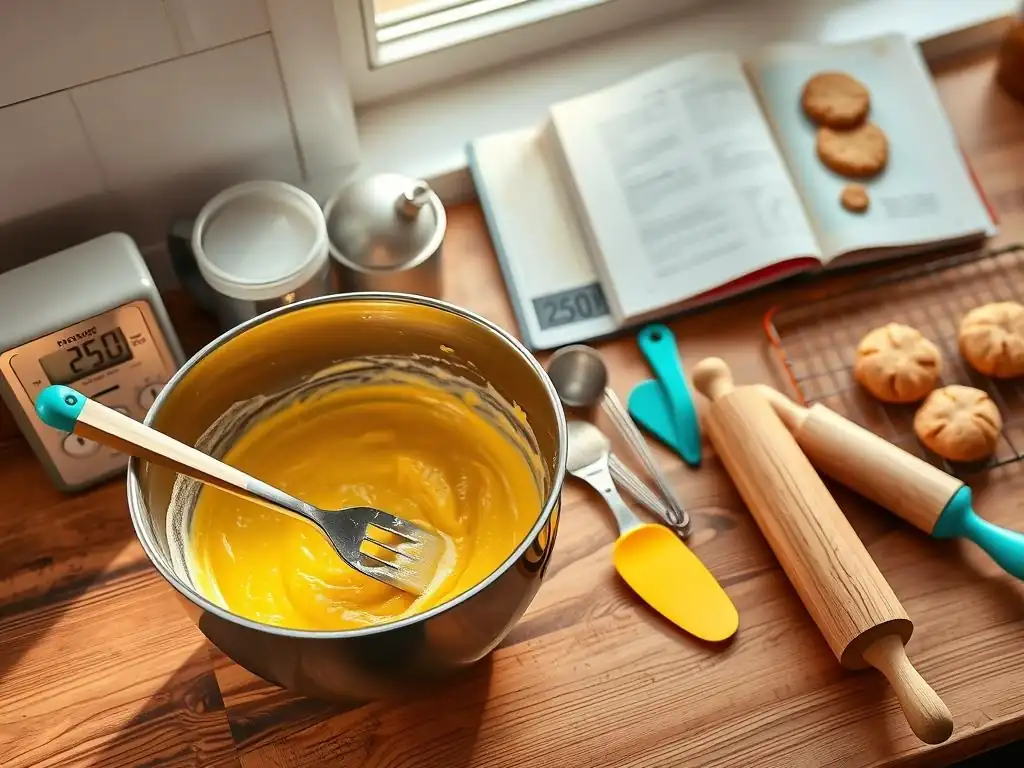
Beyond the absolute must-haves, there are several other tools that can significantly streamline your baking process and improve your results. While you don't need them all on day one, they are excellent additions to consider as you expand your skills and tackle more complex recipes.
Adding these tools gradually to your essential baking tools for beginners collection can make certain tasks much easier and more enjoyable. They often provide convenience or help achieve specific textures and finishes.
Rolling Pin: Flattening Dough with Ease
If you plan to bake cookies that require rolling, pie crusts, or pastries, a rolling pin is essential. Rolling pins come in various styles, including classic American-style pins with handles and French-style pins which are handle-less and tapered. The key is to evenly flatten dough to a consistent thickness, ensuring even baking.
A basic wooden rolling pin is a good starting point. Some rolling pins even have adjustable rings on the ends to help you roll dough to a precise thickness, such as 1/8 inch or 1/4 inch, which is very helpful for consistent cookies or pie crusts. This consistency is vital for even baking.
Sifter: Achieving Light and Fluffy Ingredients
A sifter (or fine-mesh sieve) is used to aerate dry ingredients like flour, powdered sugar, or cocoa powder, removing lumps and ensuring they are light and evenly distributed in the batter. Sifting also helps combine dry ingredients like flour, baking powder, and salt more thoroughly than simply stirring them together.
While you can technically whisk dry ingredients together as an alternative, sifting provides a finer, lump-free result, contributing to a lighter texture in cakes and pastries. A medium-sized fine-mesh sieve is versatile and can also be used for straining liquids or dusting surfaces with powdered sugar.
Pastry Brush: Adding the Finishing Touch
A pastry brush, typically with natural or silicone bristles, is used for applying liquids like melted butter, egg washes, glazes, or simple syrups to baked goods. It's essential for greasing intricate pans, brushing egg wash onto bread or pie crusts for a golden shine, or moistening cake layers with syrup.
Silicone brushes are easy to clean and heat-resistant, while natural bristle brushes hold liquids well. Having one small pastry brush is very handy for adding those final touches that enhance both the appearance and taste of your baked creations.
Cooling Rack: Preventing Soggy Bottoms
A cooling rack is a wire rack that allows air to circulate around baked goods as they cool. Placing cakes, cookies, or bread on a cooling rack after removing them from the oven and often from their pan prevents moisture from accumulating on the bottom, which can lead to a soggy texture.
Cooling is a crucial step in the baking process, as baked goods continue to cook slightly as they cool and their internal structure sets. A standard wire cooling rack with sturdy feet is inexpensive and makes a significant difference in the final texture of your baked goods. Aim for one that fits a standard half-sheet pan.
Building Your Beginner Baking Toolkit: Tips and Considerations
Putting together your set of essential baking tools for beginners doesn't have to happen all at once. You can gradually build your collection as you try new recipes and discover which tools you need most often. Starting with the absolute basics (measuring tools, bowls, spatulas, a few key pans) is a smart approach.
Consider the types of recipes you are most interested in baking. If you dream of making elaborate layer cakes, investing in good cake pans and an offset spatula early on makes sense. If cookies are your passion, prioritize good baking sheets and a reliable rolling pin.
Budget-Friendly Baking Tools: Where to Save and Where to Splurge
You don't need to break the bank to acquire quality essential baking tools for beginners. For items like mixing bowls or basic spatulas, you can often find affordable yet functional options at general stores or online retailers. Look for durable materials like stainless steel or heat-resistant silicone.
Consider splurging slightly on items where precision or performance is critical, such as a digital kitchen scale for accurate measurements, or sturdy, heavy-gauge baking sheets that won't warp in the oven. A reliable set of measuring cups and spoons is also worth investing in for accuracy. Reading reviews can help you find a balance between cost and quality.
Storing Your Baking Tools: Keeping Everything Organized
As your collection of essential baking tools for beginners grows, keeping them organized will make your baking experience much smoother. Dedicate a specific drawer or section of a cabinet for your baking tools. Measuring cups and spoons can often be kept together with a ring or clip.
Mixing bowls often nest neatly inside each other, saving space. Baking sheets and cooling racks can be stored vertically in a narrow cabinet or a dedicated rack. Keeping spatulas, whisks, and other utensils together in a crock on the counter or in a drawer divider makes them easy to find when you need them. An organized space reduces clutter and makes baking more enjoyable.
Cleaning and Maintaining Your Baking Tools: Ensuring Longevity
Proper cleaning and maintenance will extend the life of your essential baking tools for beginners. Wash measuring cups and spoons immediately after use to prevent sticky residue from hardening. Most metal, glass, and silicone tools are dishwasher safe, but check manufacturer instructions.
For non-stick pans, avoid using abrasive scrubbers or metal utensils that can scratch the surface. Hand washing with warm, soapy water and a soft sponge is often recommended. Dry tools thoroughly before storing them to prevent rust or mildew. Taking a few moments to clean up properly after baking saves time and effort in the long run and keeps your tools in good condition.
Mastering Basic Baking Techniques with the Right Tools
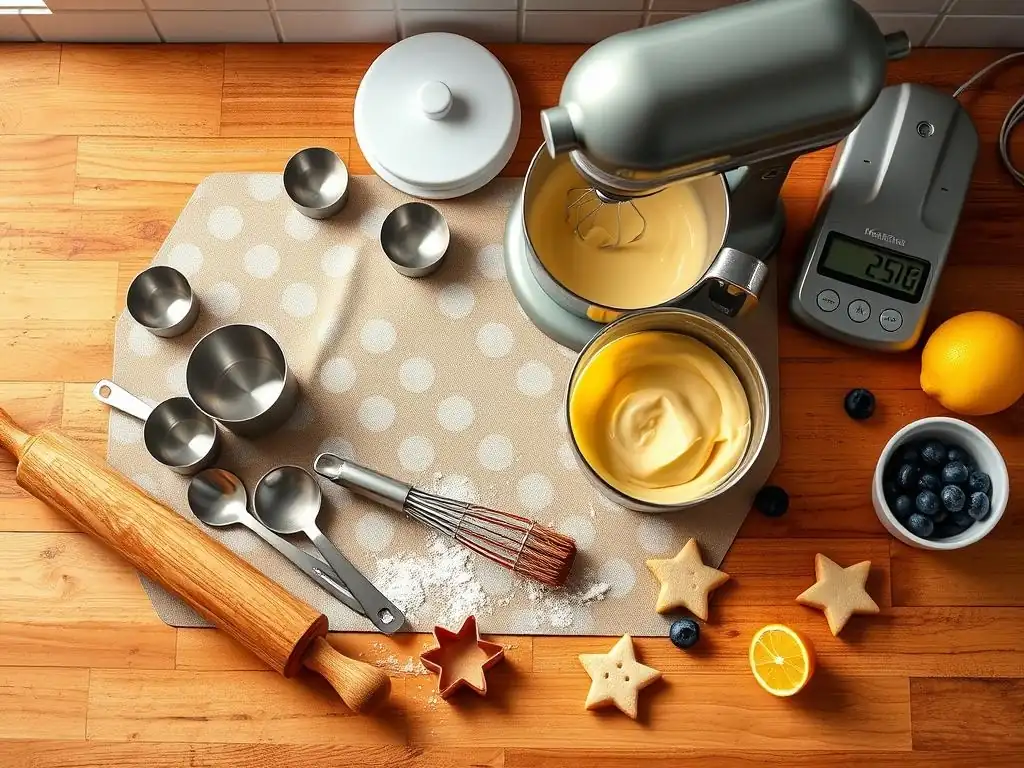
Having the right essential baking tools for beginners allows you to practice and master fundamental baking techniques. These techniques form the building blocks for countless recipes. Let's look at how the tools we discussed are used in a common beginner recipe.
By understanding how each tool contributes to a simple recipe, you'll gain confidence and be ready to tackle more complex bakes. The interplay between your skills and your tools is where baking success truly happens.
Making classic chocolate chip cookies is an excellent way to use many of your essential baking tools for beginners.
- Measuring: Use your kitchen scale to weigh flour and sugars for accuracy (e.g., 180g all-purpose flour, 100g granulated sugar, 150g brown sugar). Use liquid measuring cups for vanilla extract (e.g., 1 teaspoon) and eggs. Measuring spoons are essential for baking soda (e.g., 1/2 teaspoon) and salt (e.g., 1/4 teaspoon).
- Mixing: Use a medium mixing bowl for dry ingredients (flour, baking soda, salt), perhaps whisking them together with a flat whisk or sifting them through a sieve. Use a large mixing bowl to cream softened butter (e.g., 115g) and sugars using a sturdy rubber spatula or wooden spoon. Add eggs and vanilla, mixing until combined. Gradually add dry ingredients to the wet, mixing until just combined using your rubber spatula, scraping down the sides of the bowl thoroughly. Fold in chocolate chips (e.g., 200g).
- Portioning & Baking: Use a cookie scoop (optional but helpful for consistent size) or two spoons to drop portions of dough onto a baking sheet lined with parchment paper. Bake according to the recipe (e.g., at 375°F or 190°C for 9-11 minutes).
- Cooling: Use an offset spatula to carefully transfer warm cookies from the baking sheet to a wire cooling rack to cool completely.
Using the right tools at each step makes this classic process smoother and increases the likelihood of achieving that perfect balance of chewy and crispy.
Level Up Your Baking: Beyond the Basics
Once you've mastered the fundamentals using your essential baking tools for beginners, you might find yourself ready to explore new techniques and recipes. This is when you might consider adding more specialized tools to your collection.
Advanced Baking Tools: Expanding Your Arsenal
As you grow in your baking journey, tools like a stand mixer, pastry blender, tart pans, loaf pans, piping bags and tips, or even a kitchen torch might become useful additions. These tools facilitate more advanced techniques like kneading dough efficiently, making flaky pastry crusts, decorating cakes, or caramelizing sugar. Expanding your collection allows you to tackle a wider range of recipes and refine your skills further.
Frequently Asked Questions
What are the absolute must-have essential baking tools for beginners?
The most essential baking tools include a good mixing bowl, measuring cups and spoons, a spatula, and a baking sheet. A reliable oven thermometer is also crucial for consistent results.
How much should I expect to spend on essential baking tools when starting out?
You can build a basic beginner baking toolkit for around $50-$100, focusing on quality over quantity. Prioritize essential tools and add more as you progress.
What's the difference between a rubber spatula and a silicone spatula, and which is better for a beginner baker?
While both are useful, a silicone spatula is generally more heat-resistant and easier to clean, making it a great choice for a beginner baker. A rubber spatula is more flexible.
Do I really need a stand mixer, or can I get by with hand mixing when learning basic baking techniques?
For basic baking, a hand mixer is perfectly adequate and more budget-friendly. A stand mixer is a helpful upgrade for more complex recipes or frequent baking.
What are some tips for maintaining and cleaning my baking tools to ensure they last?
Always wash your baking tools promptly after use with warm, soapy water. Avoid abrasive cleaners, and store them properly to prevent damage and maximize their lifespan.
Final Reflection: The Sweetness of Beginnings and the Joy of Baking
The humble act of baking, once a daunting task for many, is becoming increasingly accessible, fueled by a global desire for homemade comfort and creativity. This journey into the essential tools for beginner bakers highlights not just the equipment itself, but the potential for self-discovery and joy that lies within the process. The right tools empower you, transforming potentially frustrating experiences into moments of satisfying creation.
The impact of baking extends far beyond the delicious results; it's a connection to tradition, a celebration of shared meals, and a powerful form of self-expression. Baking is at once child's play and adult joy. And love, of course.
This quote perfectly encapsulates the magic of baking, a sentiment I've personally experienced countless times. The simple act of measuring flour, cracking eggs, and kneading dough becomes a meditative practice, a welcome escape from the everyday hustle. The influence of home baking continues to grow, fostering community and a renewed appreciation for simple pleasures.
Now, it's your turn. Don't let the perceived complexity of baking hold you back. Take a deep breath, gather a few essential tools, and embrace the adventure. Let the aroma of freshly baked goods fill your kitchen, and allow yourself to savor not just the taste, but the satisfaction of creating something delicious with your own hands. Your beginner baking journey awaits – and the rewards are sweeter than you can imagine.
Unleash Your Inner Baker: Get Baking Today!
Thanks for taking the time to explore the essential tools for your baking journey! We hope you're feeling inspired and ready to create delicious treats. Now it's time to put that knowledge into action.
- Begin with your first recipe: Choose a simple recipe from our website (think muffins or cookies!) and gather the tools you've learned about. This is your first step to baking success!
- Share your baking adventures: Post a picture of your creation on social media and tag us – we'd love to see what you bake! Use #BakeWithEase to connect with our community.
- Explore our Recipe Library: Dive deeper into our collection of beginner-friendly recipes and discover new flavor combinations.
Ready to transform your kitchen into a baking haven? What delicious recipe will you tackle first?