
Simple Substitutions: Replacing Wheat with LowCarb Flours


Welcome to BakeWithEase, your haven for simplifying the joy of baking! Ever wondered if you could indulge in your favorite treats without the guilt? This week, we're diving deep into the world of low carb flour substitutions, revealing how easy it is to adapt your recipes for a healthier twist. Curious about which flours work best and how to use them? Let's unlock the secrets together and discover delicious, guilt-free baking!
- Low-Carb Baking: Mastering Wheat Flour Substitutions
- Introduction to Keto Baking and Flour Alternatives
- Exploring Popular Low-Carb Flour Options
- Step-by-Step Guide to Low-Carb Flour Substitutions
- Low-Carb Flour Substitution Chart: Quick Reference
- Keto Baking Recipes Using Flour Substitutions
- Common Pitfalls to Avoid in Low-Carb Baking
- Conclusion: Expanding Your Low-Carb Baking Repertoire
-
Frequently Asked Questions
- What are the most common low-carb flour substitutions for wheat flour?
- How does almond flour affect the texture of baked goods?
- What is the best ratio for substituting coconut flour for wheat flour?
- Can I use a blend of low-carb flours for better results?
- What other ingredients might I need to adjust when using low-carb flours?
- Final Reflection: The Flour Power of Choice
- Unleash Your Inner Baker: Flour Power Awaits!
Low-Carb Baking: Mastering Wheat Flour Substitutions
Introduction to Keto Baking and Flour Alternatives
Benefits of Low-Carb Flours for Baking
Transitioning to low-carb baking opens up a world of delicious possibilities for individuals managing blood sugar, following a ketogenic diet, or simply seeking healthier alternatives. One of the primary benefits is the significant reduction in net carbohydrates compared to traditional wheat flour, which can contain around 20-25 grams of net carbs per quarter cup.
Low-carb flours, like almond or coconut flour, drastically lower this number, often ranging from 3 to 6 net carbs per serving, making it easier to enjoy baked goods while staying within dietary limits. This isn't just about carb count; many low-carb flours also bring additional nutritional value, such as higher fiber content, healthy fats, and protein.
Beyond the nutritional profile, exploring low carb flour substitutions encourages creativity in the kitchen. Bakers discover new textures, flavors, and techniques unique to these alternative flours. For instance, the subtle sweetness of coconut flour or the rich, nutty flavor of almond flour can enhance recipes in ways wheat flour cannot. Learning how to effectively use these alternatives empowers bakers to recreate favorite treats, from fluffy pancakes to dense brownies, making a low-carb lifestyle more sustainable and enjoyable. It's about adapting familiar recipes and building a new repertoire of keto-friendly baked goods.
Understanding the Differences Between Wheat and Low-Carb Flours
The fundamental difference between wheat flour and low-carb flours lies in their composition, particularly their carbohydrate structure and protein content. Wheat flour contains gluten, a protein network that provides structure and elasticity to baked goods, allowing them to rise and hold their shape. This gluten is largely absent in most low-carb flours. Additionally, wheat flour is high in starches (complex carbohydrates), which are broken down into glucose in the body.
Low-carb flours, on the other hand, are typically made from nuts, seeds, or dried fruits/vegetables that have a much lower starch content. They contain different types of carbohydrates, often higher in fiber, and lack the gluten structure. This absence of gluten means that low-carb flours behave very differently in recipes; they don't develop elasticity, and baked goods can be denser, crumblier, or require additional binding agents like eggs, psyllium husk, or xanthan gum to achieve a desirable texture. Understanding these inherent differences is the first critical step in successful low carb flour substitutions.
Achieving the Ideal Low-Carb Flour Blend
Successfully replacing wheat flour often involves creating a blend of low-carb flours rather than using a single substitute. Different low-carb flours bring unique properties to the table: almond flour provides structure and richness, coconut flour offers high absorbency and fiber, and psyllium husk acts as a binder. Combining these flours can mimic some of the characteristics of wheat flour, balancing texture, moisture, and structure in the final product. For example, a mix of almond flour and coconut flour is common, with the almond flour providing bulk and the coconut flour helping absorb excess moisture and add tenderness.
Developing an ideal low-carb flour blend depends heavily on the specific recipe you are adapting. A recipe for delicate muffins might benefit from a lighter blend, while a hearty bread might require stronger binders.
Experimentation is key; starting with established low-carb flour substitution ratios and then making small adjustments based on dough consistency and baking results is the best approach. Often, a blend will include a primary low-carb flour (like almond or coconut), a binder (like psyllium husk or xanthan gum), and sometimes other flours or starches in minimal amounts (like a tiny bit of tapioca starch, although this adds carbs, it can improve texture in very small quantities for some).
Exploring Popular Low-Carb Flour Options
Almond Flour: Versatility and Flavor
Almond Flour Characteristics and Applications
Almond flour, made from ground blanched almonds, is perhaps the most popular and versatile low-carb flour substitute. It is relatively high in fat and protein compared to wheat flour, contributing to a moist, tender crumb in baked goods. A typical quarter cup of almond flour contains around 6 grams of carbs, with about 3 grams of fiber, resulting in roughly 3 net carbs. Its fine texture makes it suitable for a wide range of applications, including cakes, cookies, muffins, pancakes, and even breading for savory dishes. It imparts a pleasant, slightly sweet, nutty flavor that complements many recipes.
Due to its lack of gluten, almond flour doesn't provide the same structural support as wheat flour. Baked goods made solely with almond flour can sometimes be dense or crumbly. It often requires more eggs or other binding agents to hold together effectively. While it can often be substituted for wheat flour in a 1:1 ratio by volume in many recipes, adjustments to liquids and binders are almost always necessary to achieve the desired consistency and texture. Its higher fat content also means it can brown faster than wheat flour, requiring adjustments to baking time or temperature.
Tips for Successful Almond Flour Baking
Achieving great results with almond flour involves understanding its unique properties. First, always use blanched almond flour for baking, as it has a finer texture and removes the bitterness of the skin. Meal (ground almonds with skins) is coarser and better suited for coatings or crumbles. Second, measure almond flour by weight (grams) rather than volume (cups) for more consistent results, as it can pack down easily. A standard conversion is roughly 1 cup = 96 grams.
Third, be prepared to adjust liquids and binders. You may need an extra egg or a teaspoon of xanthan gum per cup of almond flour to improve structure. Fourth, almond flour recipes often bake faster or brown more quickly due to their fat content; check for doneness earlier than you would with a wheat flour recipe and consider lowering the oven temperature slightly (perhaps by 25°F or 15°C). Finally, allow almond flour baked goods to cool completely before handling, as they are often fragile when hot and firm up as they cool.
Coconut Flour: Fiber and Absorbency
Coconut Flour's High Absorbency Explained
Coconut flour is made from dried, defatted coconut meat ground into a fine powder. It is remarkably high in dietary fiber, often containing 10-12 grams per quarter cup, which significantly contributes to its very low net carb count (typically 4-6 grams total carbs, with 1-2 net carbs per 1/4 cup).
This high fiber content is directly responsible for its exceptional absorbency – it acts like a sponge, soaking up liquids far more effectively than wheat or almond flour. A small amount of coconut flour can absorb a large volume of liquid, which is why you typically use much less coconut flour than you would other flours in a recipe.
Understanding this high absorbency is crucial for successful low carb flour substitutions using coconut flour. If you substitute coconut flour cup-for-cup with wheat or almond flour, your batter will be incredibly dry and dense, and the resulting baked good will be heavy and crumbly. Recipes specifically developed for coconut flour often call for significantly more liquid (like milk, water, or coconut milk) and more eggs than comparable recipes using other flours. The ratio of liquid to flour is critical, and even small errors in measurement can drastically affect the outcome.
Baking with Coconut Flour: Techniques and Considerations
Baking with coconut flour requires a different approach than baking with wheat or even almond flour. Because of its high absorbency, you use a much smaller quantity. A general rule of thumb (though it varies by recipe) is to use about 1/4 to 1/3 cup of coconut flour for every cup of wheat flour called for in a traditional recipe, while also drastically increasing the liquid and egg content. For example, a recipe calling for 2 cups of wheat flour might use only 1/2 to 3/4 cup of coconut flour, but potentially 4-6 eggs instead of 2.
Coconut flour also lacks gluten, so baked goods can be fragile. Eggs are essential in coconut flour baking not just for moisture but also for binding and structure. Psyllium husk powder can also be a helpful addition to improve texture and prevent crumbling. When mixing a coconut flour batter, it will often seem too wet at first, but the flour needs a few minutes to absorb the liquid; letting the batter sit for 5-10 minutes before baking is often recommended. Coconut flour baked goods also benefit from cooling completely to firm up.
Flaxseed Meal: Nutrition and Binding Properties
Flaxseed Meal as an Egg Replacement
Flaxseed meal, made from ground flaxseeds, is a nutritional powerhouse, rich in omega-3 fatty acids and fiber. It contains approximately 8 grams of total carbs per 1/4 cup, with about 7 grams being fiber, resulting in only about 1 net carb. While not typically used as the primary flour in a recipe due to its strong flavor and density, it is an excellent addition to low-carb baking, particularly for its binding properties. When mixed with liquid, ground flaxseeds form a gel-like consistency, making them a popular vegan egg substitute.
To create a "flax egg," you combine 1 tablespoon of flaxseed meal with 3 tablespoons of water and let it sit for 5-10 minutes until it thickens into a gel. This mixture can often replace one egg in a recipe, providing binding without adding significant carbs. Using flaxseed meal as a binder is especially useful in keto and low-carb recipes that tend to be crumbly due to the lack of gluten. It helps hold ingredients together, adds moisture, and contributes beneficial nutrients to your baked goods.
Incorporating Flaxseed Meal in Keto Baking
Beyond acting as an egg replacement, flaxseed meal can be incorporated directly into low-carb flour blends in smaller quantities to enhance nutrition and improve texture. Adding a few tablespoons to a recipe using almond or coconut flour can boost fiber content and aid in binding. For instance, in a keto bread recipe, flaxseed meal is often included alongside almond flour or coconut flour to provide structure and a slightly nutty flavor. It can also be used as a base for quick microwave muffins or as an ingredient in low-carb crackers.
When incorporating flaxseed meal, be mindful of its strong, distinct flavor, which can be noticeable if used in large amounts. It's best used in recipes where its earthy, slightly nutty taste is welcome, such as in bread, muffins with spices, or savory baked goods. Always use ground flaxseeds (meal), as whole seeds will not provide the same binding properties or nutritional benefits as they pass through the digestive system largely intact. Store flaxseed meal in the refrigerator or freezer to prevent the healthy fats from oxidizing and becoming rancid.
Other Low-Carb Flour Choices
Sunflower Seed Flour: A Nut-Free Option
Sunflower seed flour, made from ground sunflower seeds, is an excellent nut-free alternative for those with nut allergies looking for low carb flour substitutions. Its texture and behavior in baking are somewhat similar to almond flour, making it a viable substitute in many recipes. A quarter cup typically contains around 6-7 grams of total carbs and 2-3 grams of fiber, resulting in approximately 3-4 net carbs. It provides a good source of healthy fats and vitamin E.
However, there's a unique consideration when baking with sunflower seed flour: it can sometimes turn baked goods green, especially when exposed to baking soda or powder. This is due to a reaction between the chlorophyll in the seeds and the leavening agent. While harmless, it can be visually unexpected. To minimize this, some bakers add a bit of acid (like lemon juice or vinegar) to the batter or use cream of tartar. Despite this potential color change, it functions well in cookies, muffins, and quick breads, offering a nutty flavor profile.
Psyllium Husk Powder: Enhancing Texture and Structure
Psyllium husk powder, derived from the seeds of the Plantago ovata plant, is almost pure soluble fiber. It is not a flour to be used on its own but is an invaluable ingredient in low-carb and gluten-free baking due to its incredible ability to absorb liquid and create a gel-like consistency. This property helps bind ingredients together, provides structure, and gives baked goods a more bread-like texture, preventing the crumbliness often associated with low-carb flours. It contains virtually no net carbs, with about 7 grams of fiber per 2 tablespoons.
Adding psyllium husk powder (or whole psyllium husks) to low-carb bread or roll recipes is particularly effective. It helps create a dough that can be kneaded and shaped, mimicking the properties of gluten. A common ratio is about 1-2 tablespoons of psyllium husk powder per cup of low-carb flour blend in bread recipes. It significantly increases the need for liquid in a recipe, so be prepared to add more water or other liquids until the desired dough consistency is reached. Using too much psyllium can result in a gummy or dense texture, so precise measurement is important.
Lupin Flour: High Protein and Low Carb
Lupin flour is made from the seeds of the lupin bean, a legume. It stands out for its exceptionally high protein content (around 12 grams per 1/4 cup) and very low net carb count (often just 1-2 net carbs per 1/4 cup, with about 5-6 grams of fiber). This makes it one of the most carb-efficient low-carb flour substitutions available. It has a slightly bitter or beany flavor that some people are sensitive to, and it can be quite absorbent, though less so than coconut flour.
Due to its strong flavor and density, lupin flour is usually used in combination with other low-carb flours rather than as the sole flour. Adding a few tablespoons to a blend can boost the protein and fiber content and lower the overall net carbs of a baked good.
It works well in savory applications like crackers, bread, or pizza crusts, where its flavor is less prominent or can be masked by other ingredients. Start by substituting a small portion of your main low-carb flour (e.g., replace 1/4 cup of almond flour with lupin flour) to see how it affects the taste and texture of your recipe.
Step-by-Step Guide to Low-Carb Flour Substitutions

Step 1: Analyzing the Original Recipe's Composition
Before attempting any low carb flour substitutions, take a moment to understand the role wheat flour plays in the original recipe. Is it a delicate cake where structure is paramount? A chewy cookie where gluten provides that signature bite? A bread where rising and elasticity are key? Wheat flour provides bulk, absorbs liquid, and, thanks to gluten, creates structure. Different types of wheat flour (all-purpose, cake flour, bread flour) also have varying protein/gluten levels, affecting the final texture.
Consider the other ingredients too. How much liquid is there? Are there eggs, which provide binding? Is it a recipe that relies on significant leavening (like yeast in bread) or minimal leavening (like some cookies)? Recipes with higher fat and egg content are often easier to adapt with low-carb flours than lean, yeast-leavened breads. Understanding these elements helps you anticipate the challenges and select the most appropriate low-carb flour or blend and the necessary adjustments.
Step 2: Selecting the Appropriate Low-Carb Flour Blend
Based on your analysis of the original recipe and your understanding of different low-carb flours, choose the best substitute or blend. For recipes aiming for a tender crumb, like muffins or cakes, almond flour is often a good base. For recipes requiring high fiber and less bulk, or for nut-free options, coconut flour or a blend featuring it might work. Bread-like textures usually require a blend that includes psyllium husk for structure.
Consider the flavor profile you want. Almond flour is mild and slightly sweet, coconut flour is distinctly coconutty, and flaxseed meal has an earthy taste. For a neutral base, a blend of almond flour and a small amount of psyllium husk is common. Don't be afraid to combine flours; a mix of almond and coconut flour can balance texture and moisture. For example, a keto biscuit recipe might use a 2:1 ratio of almond flour to coconut flour, plus eggs and a little psyllium.
Step 3: Determining Accurate Flour Ratios and Conversions
This is often the trickiest part of low carb flour substitutions. There is no universal cup-for-cup conversion for wheat flour to low-carb flours because they absorb liquids so differently and lack gluten. As a very rough starting point:
- 1 cup Wheat Flour ≈ 1 cup Almond Flour (but needs more binder/less liquid)
- 1 cup Wheat Flour ≈ 1/4 to 1/3 cup Coconut Flour (and needs significantly more liquid/eggs)
- 1 cup Wheat Flour ≈ Blend (e.g., 3/4 cup Almond Flour + 1/4 cup Coconut Flour + 1 tsp Psyllium Husk)
Always measure low-carb flours by weight (grams) when possible for accuracy. Research specific conversions for the type of baked good you are making (e.g., conversions for keto cookies are different from keto bread). Many reliable low-carb recipe blogs provide substitution guides or recipes developed specifically for these flours, which are excellent resources. Expect to experiment; your first attempt might not be perfect, but it provides valuable feedback.
Step 4: Balancing Liquid and Binding Ingredients
Low-carb flours, especially coconut flour and psyllium husk, require significantly more liquid than wheat flour. Almond flour also tends to absorb less liquid than wheat flour, so you might need slightly less liquid than the original recipe calls for, unless you are adding highly absorbent binders like psyllium. Eggs are crucial binders in low-carb baking; many recipes use 2-3 times the number of eggs found in a similar wheat recipe.
When adapting a recipe, start by adding about half the liquid you think you'll need based on the flour substitution, then add more gradually until the batter reaches a consistency similar to what the original recipe described (though note that low-carb batters can sometimes seem thicker or slacker than wheat batters). If using psyllium husk, remember it will continue to absorb liquid as it sits. Xanthan gum (often 1/4 to 1/2 teaspoon per cup of low-carb flour) is also a powerful binder that mimics gluten's elasticity and can improve texture, especially in bread-like recipes.
Step 5: Optimizing Baking Time and Temperature
Low-carb baked goods often behave differently in the oven than their wheat-based counterparts. They can brown faster (especially almond flour due to its fat content) and may take longer to cook through because they are denser or have higher moisture content from extra eggs. Start checking for doneness earlier than the original recipe suggests. Look for signs like edges pulling away from the pan, a toothpick inserted into the center coming out clean, and the top appearing set and slightly golden.
Consider reducing the oven temperature by 25°F (15°C) to prevent the outside from browning too quickly before the inside is cooked. Tent with foil if the top is browning too much. Baking times are highly variable depending on the recipe, the type of oven, and even the pan used. It's essential to rely on visual cues and the toothpick test rather than strictly following the original recipe's timing. Allowing baked goods to cool completely on a wire rack is also vital for them to set and firm up properly before slicing or serving.
Low-Carb Flour Substitution Chart: Quick Reference
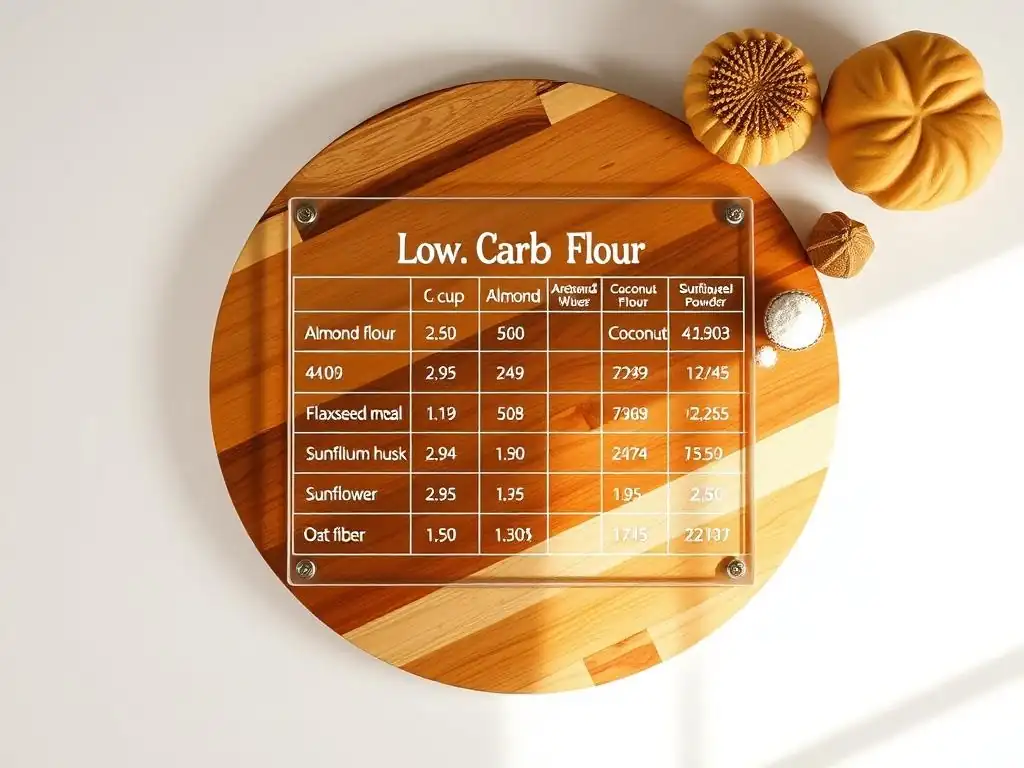
Low-Carb Flour Comparison: Ratios, Adjustments, and Uses
Understanding the general properties and typical adjustments for common low-carb flours is key to successful low carb flour substitutions. While precise conversions vary, this quick reference provides a starting point for comparison.
- Almond Flour:
- Approximate Ratio to Wheat (by volume): 1:1 (but needs adjustments)
- Key Adjustments: Often needs more binder (egg, xanthan gum). May need slightly less liquid. Browns faster.
- Best Uses: Cookies, muffins, cakes, quick breads, pancakes, coatings.
- Net Carbs (approx. per 1/4 cup): 3-4g
- Coconut Flour:
- Approximate Ratio to Wheat (by volume): 1:4 (use 1/4 cup coconut flour for 1 cup wheat)
- Key Adjustments: Needs significantly more liquid and more eggs (often 2-3x eggs). Absorbs a lot; let batter rest.
- Best Uses: Muffins, quick breads, dense cakes, mug cakes, recipes specifically designed for coconut flour.
- Net Carbs (approx. per 1/4 cup): 1-2g
- Flaxseed Meal:
- Approximate Ratio to Wheat: Used as a binder or additive, not primary flour.
- Key Adjustments: Mix 1 tbsp meal + 3 tbsp water for 1 "flax egg". Add liquid/binder when adding directly to blend.
- Best Uses: As an egg substitute, added to bread/muffin blends for fiber/binding, crackers.
- Net Carbs (approx. per 1/4 cup): 1g
- Psyllium Husk Powder:
- Approximate Ratio to Wheat: Used as a binder, not primary flour.
- Key Adjustments: Typically 1-2 tbsp per cup of low-carb flour blend (especially for bread). Needs significant extra liquid.
- Best Uses: Keto breads, rolls, pizza crusts for structure and chewiness.
- Net Carbs (approx. per 2 tbsp): 0g
- Sunflower Seed Flour:
- Approximate Ratio to Wheat (by volume): Similar to Almond Flour (approx. 1:1, needs adjustments)
- Key Adjustments: Similar to almond flour; may need extra binder. Can turn green with baking soda/powder.
- Best Uses: Nut-free alternative for cookies, muffins, quick breads.
- Net Carbs (approx. per 1/4 cup): 3-4g
- Lupin Flour:
- Approximate Ratio to Wheat: Use as a partial substitute in blends (e.g., replace 1/4 of another low-carb flour).
- Key Adjustments: Highly absorbent, strong flavor. Best used in small amounts in blends.
- Best Uses: Added to bread, cracker, or savory blends for protein/low net carbs.
- Net Carbs (approx. per 1/4 cup): 1-2g
Keto Baking Recipes Using Flour Substitutions
Keto Almond Flour Pancakes with Berries
These light and fluffy pancakes demonstrate the versatility of almond flour. A typical recipe uses almond flour as the base, combined with eggs (often more than a traditional recipe), a liquid like almond milk or heavy cream, a touch of sweetener, and baking powder for lift. The almond flour provides a tender crumb, while the eggs and a small amount of binding agent (sometimes xanthan gum) help hold them together during cooking. Served with fresh berries (low in carbs compared to other fruits) and sugar-free syrup, they make a perfect keto breakfast.
Ingredients often include:
- Almond flour
- Eggs
- Almond milk or heavy cream
- Sweetener (erythritol, stevia)
- Baking powder
- Pinch of salt
- Vanilla extract
Coconut Flour Bread with Seeds and Nuts
Coconut flour's high fiber content makes it excellent for creating denser, satisfying baked goods like bread. A keto bread recipe using coconut flour will feature a significant amount of coconut flour (though much less by volume than a wheat recipe), many eggs for structure and moisture, and often psyllium husk powder to provide that essential bread-like texture and prevent crumbling. Seeds and nuts like flaxseeds, chia seeds, sunflower seeds, or walnuts are frequently added for flavor, texture, and nutrition, complementing the slight sweetness of the coconut flour and creating a hearty loaf perfect for sandwiches or toasting.
Common ingredients:
- Coconut flour
- Psyllium husk powder
- Eggs
- Water or other liquid
- Oil or melted butter
- Baking powder or yeast (sometimes)
- Salt
- Seeds and nuts (optional)
Combining almond and coconut flour is a popular strategy for keto cookies. Almond flour provides the bulk and a tender texture, while a smaller amount of coconut flour helps absorb moisture and adds structure, preventing the cookies from spreading too much. A typical recipe might use a ratio like 3 parts almond flour to 1 part coconut flour. Eggs, butter, sweetener, vanilla, and sugar-free chocolate chips complete the mix. The resulting cookies have a delightful texture that is less crumbly than pure almond flour cookies and less dry than pure coconut flour cookies, showcasing effective low carb flour substitutions.
Recipe elements often include:
- Almond flour
- Coconut flour
- Butter
- Sweetener (erythritol blend)
- Egg
- Vanilla extract
- Baking powder or soda
- Salt
- Sugar-free chocolate chips
Common Pitfalls to Avoid in Low-Carb Baking
Excessive Use of Coconut Flour
One of the most common mistakes when starting with low carb flour substitutions is using too much coconut flour. Because it's often listed as a low-carb option, beginners might try to substitute it cup-for-cup with wheat flour or even almond flour. As discussed, coconut flour is incredibly absorbent due to its high fiber content. Using too much will result in a batter that is thick, dry, and impossible to mix properly, leading to baked goods that are dense, heavy, and crumbly with an unpleasant texture.
Remember that you need only a fraction of the amount of coconut flour compared to other flours. Always follow recipes specifically developed for coconut flour or use established, reliable substitution ratios (like 1/4 to 1/3 cup coconut flour per cup of wheat flour, while also increasing liquids and eggs significantly). Don't eyeball measurements; use measuring cups accurately, and ideally, weigh your ingredients for consistency, especially with coconut flour.
Insufficient Liquid Adjustments
Another frequent pitfall in low carb flour substitutions is failing to adjust the liquid content when switching from wheat flour. Since low-carb flours absorb liquids differently – some less (almond flour compared to wheat), some dramatically more (coconut flour, psyllium husk) – simply using the amount of liquid from the original wheat recipe will lead to problems. Too little liquid with highly absorbent flours results in dry, crumbly baked goods. Too much liquid with less absorbent flours can result in a wet, heavy, or gummy texture that won't cook through properly.
Always anticipate the need to adjust liquids. If using coconut flour or psyllium husk, expect to add significantly more liquid (water, milk, cream, etc.). If using primarily almond flour without highly absorbent binders, you might need slightly less liquid than a wheat recipe. It's often best to add liquids gradually until the batter reaches the desired consistency, keeping in mind that some low-carb batters (especially with psyllium or coconut flour) will thicken as they sit.
Neglecting Binding Agents
Gluten in wheat flour provides structure and binding. When you remove gluten by using low-carb flour substitutions, you must replace that binding function. Forgetting or using insufficient binding agents is a common cause of baked goods that fall apart, crumble excessively, or lack the desired structure. Eggs are the most fundamental binder in low-carb baking, providing structure, moisture, and richness. Many keto recipes use multiple eggs.
Beyond eggs, ingredients like psyllium husk powder, xanthan gum, chia seeds (ground or whole, soaked), or even a small amount of gelatin can act as binders. Psyllium husk is particularly effective for creating bread-like textures. Xanthan gum, used in tiny amounts (often 1/4 to 1/2 teaspoon per cup of flour), helps mimic gluten's elasticity and structure. Choosing the right binder and using enough of it is critical for preventing crumbly disasters and achieving a pleasant texture in your low-carb baked goods.
Inaccurate Baking Times
Low-carb baked goods often require different baking times and temperatures than traditional recipes. Because they might be denser, have different moisture levels, or brown faster due to higher fat content (like almond flour), relying solely on the timing from the original wheat recipe can lead to undercooked interiors or burnt exteriors. For example, a keto muffin made with almond flour might brown beautifully on the outside but still be raw in the center if not given enough time at the right temperature.
It's essential to treat the baking time in an adapted recipe as a guideline rather than a strict rule. Start checking for doneness several minutes before the recipe suggests. Look for visual cues: is the top set? Are the edges pulling away from the pan? Does a toothpick inserted into the center come out clean? Using a lower oven temperature (e.g., 325-350°F or 160-175°C) can help ensure the interior cooks through before the exterior burns. Always allow low-carb baked goods to cool completely on a wire rack, as they often finish setting and firming up as they cool.
Conclusion: Expanding Your Low-Carb Baking Repertoire
The Advantages of Experimenting with Keto-Friendly Flours
Embracing low carb flour substitutions is more than just a dietary necessity for many; it's an opportunity to expand your baking skills and discover exciting new ingredients and techniques. Successfully adapting recipes allows you to continue enjoying your favorite baked treats while adhering to a low-carb or ketogenic lifestyle, which can be crucial for long-term adherence and satisfaction. Beyond simple substitutions, learning how different low-carb flours interact opens the door to creating entirely new recipes tailored to these ingredients, leading to innovative and delicious results.
Experimenting helps you understand the nuances of each flour – how almond flour provides tenderness, how coconut flour manages moisture, how psyllium adds structure. This knowledge builds confidence and allows you to troubleshoot issues when a recipe doesn't turn out as expected. It transforms baking from following instructions into a creative process of balancing ingredients to achieve the desired texture, flavor, and nutritional profile. The journey of mastering low carb flour substitutions is rewarding, leading to a greater appreciation for the science and art of baking.
Resources for Advanced Low-Carb Baking
For those looking to deepen their understanding of low carb flour substitutions and refine their keto baking skills, numerous resources are available. Start by exploring reputable low-carb and keto baking blogs and websites; many offer detailed guides on working with specific flours, substitution charts, and tested recipes. Look for sites that explain the why behind the techniques, not just the how.
Consider investing in a well-regarded keto baking cookbook that provides foundational recipes and explanations of ingredient functions. Online communities and forums dedicated to keto or low-carb baking can also be invaluable resources for asking questions, sharing experiences, and finding solutions to common problems. As you gain experience, you might even start adapting your own traditional recipes, applying your knowledge of low-carb flour substitutions to create keto-friendly versions of family favorites. The key is continuous learning and practice.
Frequently Asked Questions
What are the most common low-carb flour substitutions for wheat flour?
The most common substitutions include almond flour, coconut flour, and flaxseed meal. These are all lower in carbohydrates than traditional wheat flour.
How does almond flour affect the texture of baked goods?
Almond flour adds a slightly nutty flavor and can create a moist and tender crumb. However, it doesn't bind as well as wheat flour, so you might need to add more eggs.
What is the best ratio for substituting coconut flour for wheat flour?
Coconut flour is very absorbent, so you generally need much less coconut flour than wheat flour. A good starting point is to use 1/4 to 1/3 cup of coconut flour for every 1 cup of wheat flour.
Can I use a blend of low-carb flours for better results?
Yes, using a blend of flours can often yield superior texture and flavor. Combining almond flour with coconut flour, for example, can help balance moisture and binding properties.
What other ingredients might I need to adjust when using low-carb flours?
Because low-carb flours often lack gluten, you might need to add binding agents like xanthan gum or psyllium husk powder. You may also need to adjust liquid levels to achieve the desired consistency.
Final Reflection: The Flour Power of Choice
The rising tide of health consciousness is pushing us to reconsider even the most fundamental ingredients in our diets, and nowhere is this more apparent than in the ongoing quest for low-carb alternatives. The simple act of swapping out wheat flour, a staple for centuries, represents a powerful shift in how we approach food and its impact on our well-being. This shift is not just a fleeting trend; it's a reflection of a growing understanding of the complex relationship between diet and health.
The exploration of low-carb flour substitutions has profoundly impacted my own culinary journey, forcing me to experiment, adapt, and ultimately appreciate the diversity of flavors and textures available beyond traditional wheat. The greatest discovery of all time is that a person can change his future by merely changing his attitude.
– Oprah Winfrey. This quote resonates deeply because embracing low-carb flours requires a change in attitude – a willingness to explore new possibilities and challenge ingrained culinary habits. This journey has not only improved my own health but has also opened up a world of creative culinary possibilities.
Now, it's your turn. Consider the ingredients you use daily and ask yourself: Are there healthier, more sustainable alternatives? Don't be afraid to experiment, to embrace the unknown, and to discover the unique benefits that low-carb flour substitutions can offer. The power to shape your health and your culinary experience lies in your hands. Start small, try a new recipe, and taste the difference. Your body and your palate will thank you.
Unleash Your Inner Baker: Flour Power Awaits!
Thanks for joining us on this delicious journey into the world of low-carb baking! We hope you've discovered some exciting new possibilities for your favorite recipes. Now it's time to put your newfound knowledge into practice.
- Bake your first low-carb masterpiece: Choose one recipe from the article and give it a try! Let us know how it turns out.
- Share your baking success (or even your struggles!) on social media using #BakeWithEaseLowCarb. We love seeing your creations!
- Explore our other resources on low-carb baking – we have tons of amazing recipes waiting for you!
Ready to transform your baking experience? What exciting low-carb creation will you bake first?