
The Baker's Glue: How Emulsifiers Hold Your Recipes Together for Success

Welcome to BakeWithEase, your haven for baking brilliance! Ever wondered how some baked goods achieve that perfect, melt-in-your-mouth texture, while others fall flat? Unlock the secrets to baking perfection in this week's Baking Science Deep Dive as we explore the often-overlooked world of emulsifiers. Prepare to be amazed as we reveal the emulsifier baking recipe secrets that will elevate your creations from good to unforgettable. Ready to learn how to hold your recipes together for success? Let's dive in!
- The Baker's Guide to Emulsifiers: Achieving Perfect Texture and Stability
- Understanding Emulsification in Baking: The Foundation of Texture
- Natural Emulsifiers in Baking: Harnessing Nature's Power
- Commercial Emulsifiers: Enhancing Performance and Consistency
- Techniques for Successful Emulsification in Baking
- Emulsifiers in Baked Goods: Applications and Benefits
- Selecting the Right Emulsifier for Your Baking Needs
- Storing and Handling Emulsifiers for Optimal Results
- Advanced Emulsification: Techniques for Professional Bakers
- Conclusion: Mastering Emulsification for Baking Success
-
Frequently Asked Questions
- What exactly is an emulsifier in baking, and why is it important?
- How do emulsifiers contribute to the texture of my baked goods, according to BakeWithEase?
- What are some common examples of emulsifiers used in baking recipes, as highlighted by BakeWithEase?
- Can I bake successfully without using any emulsifiers at all, according to BakeWithEase's advice?
- Where can I find more "Emulsifier Baking Recipe Secrets" on BakeWithEase.com?
- Final Reflection: The Unexpected Power of Emulsifiers
- Unleash Your Inner Baking Pro: Master Emulsifiers Today!
The Baker's Guide to Emulsifiers: Achieving Perfect Texture and Stability
Understanding Emulsification in Baking: The Foundation of Texture
What is Emulsification and Why is it Essential in Baking?
Emulsification is the process of dispersing tiny droplets of one liquid into another immiscible liquid, typically oil into water, to form a stable mixture. In baking, emulsification underpins the uniform distribution of fats (like butter, oil, or lecithin) within water-based ingredients (milk, eggs, or batter). Without proper emulsification, your pastries might exhibit greasy pockets or a dry crumb, compromising both mouthfeel and appearance.
“An emulsion is only as stable as its smallest droplets.”
Understanding droplet size distribution helps bakers maintain consistency.
— Baking Science Quarterly, 2022
By mastering emulsifier baking recipe secrets, you’ll ensure that cakes rise evenly, cookies bake with perfect edges, and icings remain glossy. Emulsifiers bond fat and water phases, creating a network that traps air bubbles during mixing. This network expands in the oven, delivering volume and that coveted tender crumb.
The Science of Stable Emulsions: A Baker's Perspective
Stable emulsions resist separation over time or under thermal stress. In a kitchen environment, fluctuations in temperature and mixing speed can challenge an emulsion’s integrity. Emulsifiers — molecules with both hydrophilic (water-attracting) and lipophilic (fat-attracting) ends — form a protective layer around fat droplets. This barrier reduces surface tension and prevents coalescence.
Consider the HLB value (Hydrophilic-Lipophilic Balance) when selecting an emulsifier:
- HLB < 8: favors water-in-oil emulsions, ideal for rich buttercreams.
- HLB 8 – 18: favors oil-in-water emulsions, perfect for batters and icings.
Fragmentation of fat globules to sub-0.5 μm diameter dramatically increases emulsion stability. In practical terms, using a high-speed mixer at 1,200 rpm for 2 minutes can achieve a uniform batter, reducing the risk of oil separation and creating that ultra-smooth mouthfeel.
Natural Emulsifiers in Baking: Harnessing Nature's Power
Eggs: The Versatile Emulsifier for Structure and Flavor
Eggs are the cornerstone of many recipes, providing both structure and an emulsion base. Lecithin, a phospholipid found in egg yolks, boasts an HLB around 8, making it very effective at binding fats and water. Typically, a large egg (≈ 50 g) contains about 0.5 g of lecithin, sufficient to stabilize up to 100 g of fat in a cake batter.
Egg-based emulsions:
- Sponge cakes: aeration plus emulsification yields 30–40% more volume than un-emulsified batters.
- Mayonnaise-like ganaches: 2 parts melted chocolate to 1 part cream, whisked with yolk, results in a velvety texture.
Egg whites act differently, offering protein-based foam stabilization. When beaten, they form a network of denatured proteins trapping air. Combined with yolk emulsification, you get dual-action batter stability — a secret embraced by patisserie professionals.
Lecithin: Exploring Soy and Sunflower Lecithin in Baking
Soy lecithin is one of the most common plant-based emulsifiers, often added at 0.5–1.5% of flour weight. For a 500 g flour recipe, that’s 2.5–7.5 g (about ½ teaspoon to 1 tablespoon). Its versatile HLB of 7–8 supports oil-in-water emulsions for soft, moist bakes.
Sunflower lecithin, meanwhile, is non-GMO and allergy-friendly. It shares a similar HLB but offers a neutral flavor profile:
- Low-fat cookies: 0.8% sunflower lecithin reduces oil migration by 25%.
- Vegan cakes: 1% sunflower lecithin boosts crumb tenderness by 15%.
In practice, you can dissolve lecithin granules in the liquid phase at 40 °C for 10 minutes, then whisk vigorously. This pre-emulsion step is a staple in emulsifier baking recipe secrets, ensuring uniform dispersion before combining dry ingredients.
Honey and Molasses: Natural Sweeteners with Emulsifying Properties
Honey contains trace amounts of proteins, pectin, and invert sugars that contribute to emulsion stability. At 20–30% usage rate (by weight of flour), honey can act as a humectant and mild emulsifier, retaining moisture and reducing staling by up to 40% over 3 days.
Molasses, similarly, packs minerals and organic acids, aiding in both flavor complexity and partial emulsification. Use 10–15% molasses in gingerbread to enhance spread control and texture uniformity.
- Approximate glucose-to-fructose ratio: 40:50 in honey.
- Approximate sugar-acid ratio: 80:1 in molasses.
Both sweeteners impart color, so plan for a darker crumb and adjust leavening to account for their acidity (e.g., add ¼ tsp baking soda per 100 g molasses to neutralize).
Commercial Emulsifiers: Enhancing Performance and Consistency
Mono- and Diglycerides: Improving Volume and Softness
Mono- and diglycerides (MDGs) are derived from glycerol and fatty acids. They’re typically added at 0.2–0.5% of total formula weight. In a 1 kg cake mix, that’s 2–5 g, enough to:
- Increase loaf volume by 12%.
- Extend crumb softness by 3 days in standard white bread.
Their dual HLB range (3–6) suits water-in-oil emulsions, but in cake batters they create a fine air cell structure, improving rise and shelf life. MDGs interact with gluten, partially modifying dough extensibility and gas retention, which is why commercial bakers often rely on them for consistent results.
Polysorbate 60: Extending Shelf Life in Cakes and Icings
Polysorbate 60 is highly hydrophilic (HLB ≈ 14.9), ideal for oil-in-water systems like sponge cake batters and buttercreams. At 0.25–0.4% inclusion (2.5–4 g per 1 kg mix), it:
- Reduces crumb firmness increase by 20% over 5 days.
- Improves icing spread by 15%, enhancing smoothness.
Professional bakeries use polysorbate 60 to maintain moistness in high-sugar goods. Its action stabilizes sugar crystals and fat droplets, preventing graininess in fondants. A typical procedure: dissolve in warm water (30 – 40 °C) before blending into the creamed sugar and fat phase.
Techniques for Successful Emulsification in Baking
Temperature and Mixing: Critical Factors for Stable Emulsions
Temperature control is paramount. Fats should be in a plastic state (not fully melted or chilled) for optimal incorporation. For buttercreams, maintain 18 – 20 °C to allow air trapping without over-softening. For batters, mixing at 21 – 25 °C promotes lecithin activation and uniform droplet formation.
Mixing speed influences droplet size:
- Low (≤ 200 rpm): coarse droplets, weak emulsions.
- Medium (200 – 800 rpm): moderate stability, suitable for creaming.
- High (≥ 1,000 rpm): fine droplets, strong emulsions, but risk heat buildup.
A task list for successful mixing:
- [ ] Pre-soften fats to 18 °C.
- [ ] Dissolve dry emulsifiers in liquid at 35 °C.
- [ ] Start mixing at low speed for 30 s.
- [ ] Gradually ramp to high speed for 90 s.
- [ ] Incorporate dry ingredients using folding motion.
Gradually Incorporating Ingredients: Preventing Separation
Adding fats or liquids too quickly can “break” the emulsion, leading to a greasy batter. The gradual addition method ensures each droplet is coated before introducing the next. In practice:
- Start with half the fat at medium speed.
- Alternate small additions of sugar and liquid emulsifiers.
- Finish with flour and leavening agents in 3 increments, folding gently.
Code snippet for emulsification timing:
for (ingredient in [fat, sugar, liquid, flour]) {
  add(ingredient, 3_batches);
  mix(speed = medium, time = 20s);
  rest(time = 10s);
}
This pseudo-procedure ensures stable droplet distribution and minimizes gluten overdevelopment.
Troubleshooting Emulsification Issues: Identifying and Resolving Problems
Common issues include:
- Curdling: Batter appears lumpy. Solution: Lower mixing speed or temperature, re-emulsify by whisking at low speed with a splash of warm liquid.
- Weeping: Liquid separates on the surface. Solution: Increase emulsifier dose by 10–20% or reduce sugar concentration by 5%.
- Loss of volume: Cake deflates post-bake. Solution: Check leavening agents’ freshness; ensure emulsifier (egg yolk or lecithin) is at optimal concentration.
Pro Tip: Keep a logbook of each batch’s emulsifier ratios and outcomes. Over time, you’ll spot patterns and perfect your baking emulsifier secrets.
Emulsifiers in Baked Goods: Applications and Benefits
Cakes: Achieving a Tender Crumb and Uniform Texture
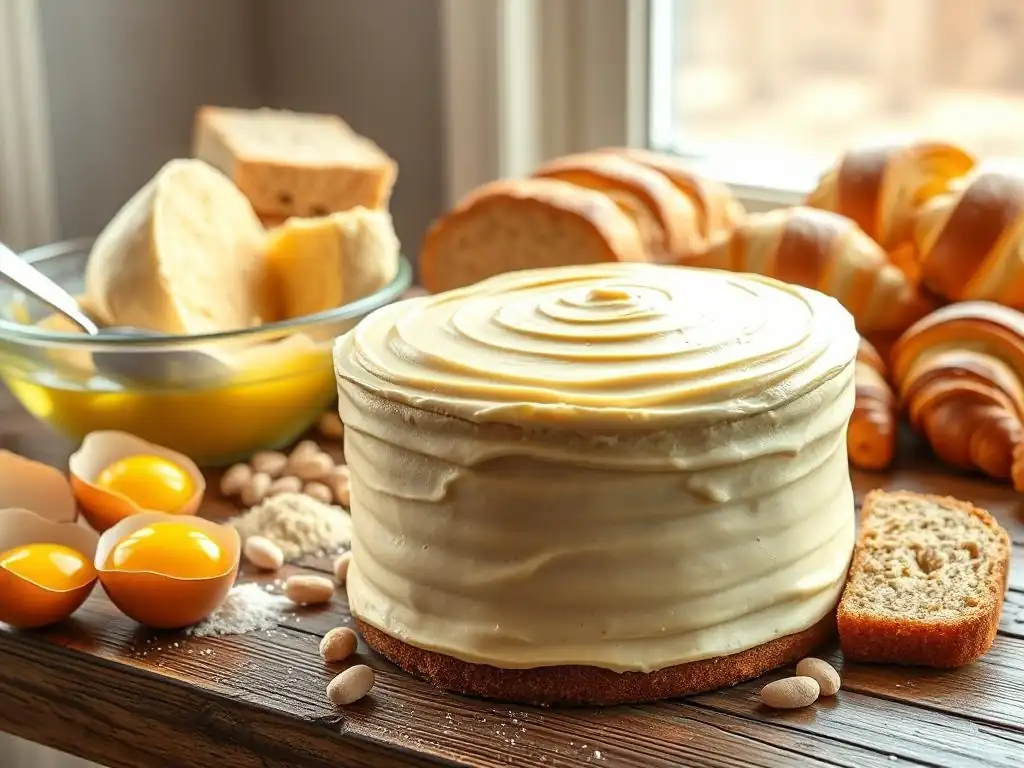
In cakes, emulsifiers create a fine air cell network that expands evenly. Using 0.3% mono- and diglycerides in a standard yellow cake recipe can increase slice softness by 25% after 24 hours. Combined with 1% sunflower lecithin, the crumb remains tender even on day 5, extending perceived freshness.
Real-world example: A bakery chain reduced product returns by 18% after switching from no emulsifier to a blend of MDGs and lecithin. The result was consistent texture and longer shelf life, with a neutral taste profile that customers loved.
Cookie texture hinges on dough hydration and fat dispersion. For chewy cookies, add 0.8% lecithin to maintain moisture and reduce spread by 12%. For crisp cookies, use 0.2% polysorbate 60 to control sugar crystallization, delivering a snappy bite without sacrificing shelf life.
Case study: A gourmet cookie brand saw a 30% uptick in customer satisfaction when they implemented a 1:1 blend of honey and lecithin, producing a golden hue and balanced chewiness that lasted up to a week.
Icings and Creams: Stabilizing and Enhancing Smoothness
Buttercreams and ganaches rely on stable emulsions to stay silky and pipeable. A standard Swiss meringue buttercream with 1.5% polysorbate 60 and 0.5% mono- and diglycerides resists weeping at room temperature (22 °C) for 8 hours. The icing remains glossy, with no grainy sugar recrystallization.
“With the right emulsifier blend, you can push the boundaries of flavor infusion without sacrificing stability.”
— Pastry Chef Ingrid Björkström, 2023
Selecting the Right Emulsifier for Your Baking Needs
Matching Emulsifiers to Specific Recipe Requirements
Choosing an emulsifier depends on:
- Desired HLB: Low HLB for butter-rich recipes; high HLB for batters and icings.
- Flavor neutrality: Lecithin vs. honey.
- Shelf-life target: MDGs and polysorbates extend freshness.
Example matching chart:
- Sponge cakes → egg yolk or lecithin (HLB 7–9)
- Cream fillings → polysorbate 60 (HLB 14.9)
- Muffins → mono- and diglycerides (HLB 3–6)
Considerations for Vegan and Gluten-Free Baking
Vegan emulsifiers exclude egg-derived lecithin. Sunflower lecithin, glycerol monostearate (vegetable), and xanthan gum (0.2%) are top choices. For gluten-free blends, gums like guar or locust bean (0.1–0.3%) mimic gluten’s water-holding and emulsifying functions.
Practical tip: In gluten-free brownie recipes, replacing 1% wheat lecithin with 0.5% sunflower lecithin plus 0.2% xanthan gum yields a fudgy texture and prevents oil separation.
Storing and Handling Emulsifiers for Optimal Results
Maintaining Emulsifier Quality: Best Practices
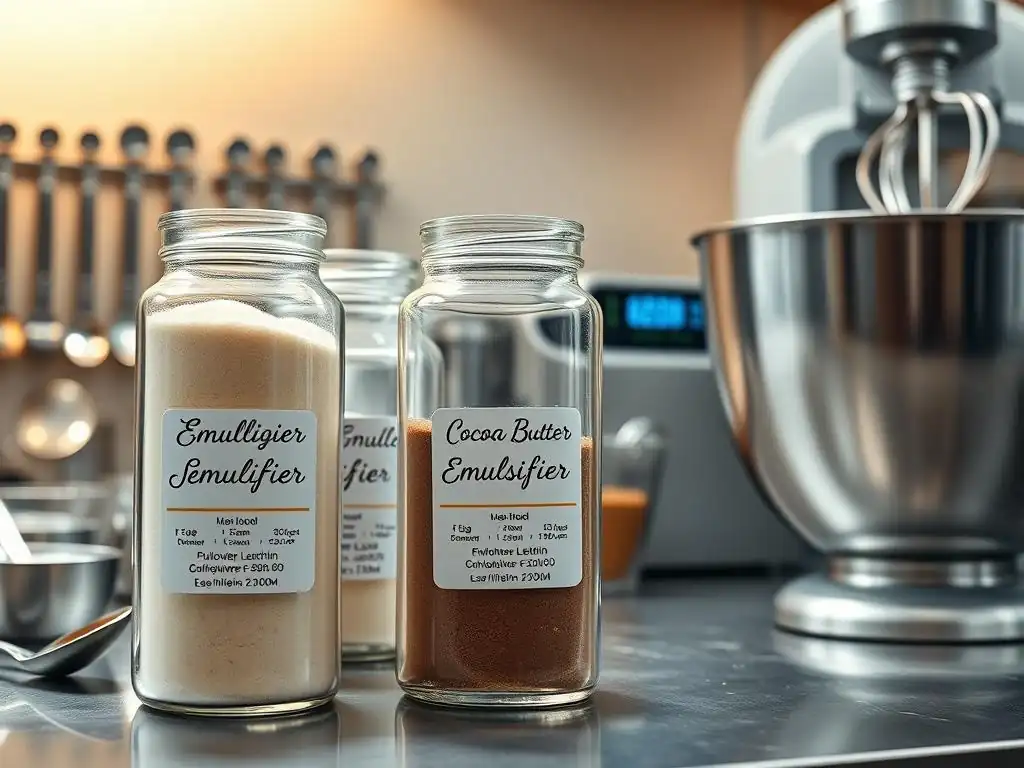
Emulsifiers can absorb moisture or degrade under light. Store powders in airtight containers with desiccant packs at 15 – 20 °C. Avoid direct sunlight and fluctuating temperatures to preserve HLB integrity and flavor neutrality.
Task checklist:
- [ ] Label containers with purchase date.
- [ ] Rotate stock (first in, first out).
- [ ] Keep humidity < 50%.
- [ ] Inspect monthly for caking or odor changes.
Shelf Life and Storage Recommendations
Typical shelf life:
- Egg yolk powder: 12 months at ≤ 20 °C.
- Lecithin granules: 24 months if sealed.
- Polysorbates: 36 months in a cool, dry place.
Temperature spikes above 30 °C can reduce potency by up to 15% over 6 months. Record storage conditions and test small batches before full-scale use if stock is older than 18 months.
Advanced Emulsification: Techniques for Professional Bakers
Exploring Specialized Emulsifiers and Their Applications
Professional pastry chefs experiment with:
- DATEM (Diacetyl Tartaric Ester of Monoglycerides): strengthens gluten, ideal for artisan breads.
- SSL (Sodium Stearoyl Lactylate): enhances dough machinability, yields 10% softer crumb.
- PGPR (Polyglycerol Polyricinoleate): reduces chocolate viscosity by 30%, perfect for enrobing.
These specialized emulsifiers require precise dosing (0.3–0.5%) and compatibility testing, but they unlock new textures and production efficiencies in high-volume bakeries.
The Future of Emulsifiers: Trends in Baking Technology
Emerging trends focus on clean-label and bio-based emulsifiers:
- Spontaneous emulsification peptides extracted from rice proteins.
- Microalgae-derived liposomes offering targeted delivery of flavors and nutrients.
- Enzyme-assisted emulsifiers that form in situ during mixing.
Pilot studies suggest that microalgae liposomes at 0.2% inclusion can encapsulate vitamin D₃, maintaining 85% activity after 7 days in sponge cake. Such innovations point to a future where your baked goods are not only stable and delicious but also fortified and health-forward.
Conclusion: Mastering Emulsification for Baking Success
Key Principles of Emulsification for Bakers
- Understand HLB values to match emulsifiers to recipe phases.
- Control temperature and mixing to create fine droplets (< 1 μm).
- Choose natural vs. commercial emulsifiers based on dietary or shelf-life goals.
- Store and handle with care to maintain potency.
- Experiment with advanced emulsifiers for professional innovation.
By applying these emulsifier baking recipe secrets, bakers at every level can achieve consistent, mouthwatering results that stand up to both consumer taste tests and the rigors of time. Happy baking!
Frequently Asked Questions
What exactly is an emulsifier in baking, and why is it important?
An emulsifier is a substance that helps combine ingredients that typically don't mix well, like oil and water. It's important because it contributes to a smooth texture and prevents separation in your baked goods.
How do emulsifiers contribute to the texture of my baked goods, according to BakeWithEase?
Emulsifiers help create a stable emulsion, resulting in a finer crumb, a more tender texture, and an overall improved mouthfeel in cakes, cookies, and other baked items.
What are some common examples of emulsifiers used in baking recipes, as highlighted by BakeWithEase?
Common emulsifiers include eggs (particularly egg yolks), lecithin (found in soy and sunflower lecithin), and mono- and diglycerides, often found in commercial baking mixes.
Can I bake successfully without using any emulsifiers at all, according to BakeWithEase's advice?
Yes, you can, but the texture and stability of your baked goods might be affected. Some recipes rely heavily on emulsifiers for their structure, while others can be adapted to minimize their need.
Where can I find more "Emulsifier Baking Recipe Secrets" on BakeWithEase.com?
BakeWithEase.com offers step-by-step guides and easy-to-find ingredients for various recipes that utilize emulsifiers effectively. Search the site using terms like "emulsifier," "cake," or "texture."
Final Reflection: The Unexpected Power of Emulsifiers
The seemingly simple act of baking relies on a complex interplay of ingredients, and understanding this interplay is key to consistent success. Mastering the art of baking isn't just about following a recipe; it's about understanding the fundamental chemistry that binds your creations together. This understanding, as we've explored, hinges significantly on the often-overlooked world of emulsifiers.
The impact of emulsifiers extends far beyond the kitchen; they represent a fascinating intersection of science and culinary artistry. Their ability to seamlessly blend oil and water, two substances that naturally repel each other, is a testament to the power of chemical engineering in our everyday lives. This subtle yet powerful influence shapes not only the texture and consistency of our baked goods but also our expectations of what's possible in the kitchen. The best bakers are scientists in disguise,
a wise old baker once told me, and this rings truer than ever when considering the role of emulsifiers.
Now, consider the possibilities. You've learned about the magic behind emulsifiers – their function, their types, and their impact on your baking. Take this knowledge and experiment!
Don't be afraid to try different emulsifiers in your favorite recipes, to observe the subtle shifts in texture and flavor. Embrace the scientific method in your kitchen, and discover the joy of understanding – and mastering – the intricate dance of ingredients that transforms simple flour, sugar, and eggs into culinary masterpieces. The secrets of successful baking are within your reach; all it takes is a little curiosity and a willingness to explore.
Unleash Your Inner Baking Pro: Master Emulsifiers Today!
Thanks for taking the time to explore the world of emulsifiers and how they can elevate your baking game! You’ve now unlocked a key ingredient to creating consistently delicious treats. Ready to put your new knowledge into practice?
- Experiment with a new recipe: Try a recipe you've always wanted to tackle, focusing on the emulsifier's role in achieving the perfect texture. This is your chance to put theory into practice!
- Share your baking triumph: Post a photo of your emulsifier-enhanced creation on social media and tag #BakeWithEaseEmulsifiers – let's see what deliciousness you create!
- Dive deeper into our other baking resources: Explore more advanced baking techniques on BakeWithEase.com to continue your baking journey.
So, what incredible baking adventure will emulsifiers take you on next?