
Small Kitchen, Big Baking Dreams: Best Compact Ovens


Welcome to BakeWithEase!
Ready to unleash your inner baker, even in a small kitchen? You've come to the right place. We understand the challenges of limited space, which is why we're diving deep into the world of compact ovens. Curious about how to achieve delicious, professional-quality results without sacrificing valuable counter space? Let's explore our compact oven baking tips and discover the perfect oven to bring your baking dreams to life!
- Baking in a Small Space: Unlocking Your Culinary Potential with Compact Ovens
- Top Compact Ovens for Baking Enthusiasts: A BakeWithEase.com Review
- Mastering Compact Oven Baking Techniques
- Compact Oven Baking: Common Mistakes and How to Avoid Them
- Conclusion: Embrace Baking Freedom with the Perfect Compact Oven
-
Frequently Asked Questions
- What are the key considerations when choosing a compact oven for baking?
- Are there specific baking techniques that are better suited for compact ovens?
- How do I adjust baking times and temperatures when using a compact oven?
- What types of recipes work best in a compact oven, and which should I avoid?
- How can I ensure even baking in a compact oven?
- Final Reflection: From Tiny Spaces, Giant Flavors Emerge
- Unleash Your Inner Baker: Small Space, Big Results!
Baking in a Small Space: Unlocking Your Culinary Potential with Compact Ovens
Living in a cozy apartment or a home with a modest kitchen shouldn't limit your baking ambitions. While a full-sized oven might be out of the question due to space constraints, the world of baking remains wide open thanks to the innovation of compact ovens.
These countertop powerhouses offer a fantastic alternative, providing the heat and functionality needed to bake everything from delicate cookies and moist cakes to crusty loaves of bread and flaky pastries, all within a smaller footprint. They are specifically designed to fit neatly on your counter, freeing up valuable kitchen space while still delivering impressive baking results.
Embracing a compact oven means you don't have to sacrifice your passion for baking or miss out on the joy of creating homemade treats. Whether you're a beginner taking your first steps into baking or an experienced home baker looking for a secondary oven or a solution for a smaller kitchen, a compact oven can be a game-changer.
They heat up quickly, often consume less energy than their full-sized counterparts, and offer surprising versatility. With the right compact oven baking tips and techniques, you can achieve results comparable to those from a conventional oven, proving that big baking dreams are absolutely possible in a small kitchen.
The Rise of Compact Ovens: Why They're Perfect for Small Spaces
Compact ovens, often referred to as toaster ovens or countertop ovens, have seen a significant surge in popularity, particularly in urban areas and among individuals living in smaller homes. Their primary appeal lies in their ability to provide essential baking functions without requiring the dedicated space or electrical hookups of a traditional built-in oven. For many, they represent the only viable option for baking at home.
According to recent market analyses, the global market for countertop ovens is projected to continue growing, highlighting their increasing adoption as practical and efficient kitchen appliances. This growth is a testament to their effectiveness in meeting the needs of modern, space-conscious households.
Beyond just saving space, compact ovens offer numerous advantages. They preheat much faster than standard ovens, often reaching baking temperature in just 5-10 minutes compared to the 15-20 minutes or more required by a full-sized oven. This speed is not only convenient but also contributes to energy savings. Furthermore, many compact ovens come equipped with multiple cooking functions, including toasting, broiling, air frying, and convection baking, making them incredibly versatile. This multi-functionality means one appliance can replace several others, further optimizing limited counter space. Understanding these benefits is the first step towards mastering compact oven baking tips.
Compact Oven Baking Tips: Maximizing Flavor and Efficiency in Limited Kitchens
Maximizing the potential of a compact oven requires understanding its nuances compared to a full-sized model. One crucial aspect is managing the smaller internal volume, which means the heating elements are closer to the food. This proximity can lead to faster browning or even burning if not carefully monitored.
Effective compact oven baking tips often involve reducing baking temperatures slightly (perhaps by 25°F or 15°C) and checking for doneness earlier than a standard recipe might suggest. Using oven-safe dishes and pans that fit well within the oven's dimensions without touching the walls or heating elements is also vital for even heat distribution. For instance, a quarter sheet pan is often the perfect size for many compact ovens.
Another key tip for successful baking in a compact oven is to minimize opening the oven door. Because of their smaller size, compact ovens lose heat very quickly when the door is opened, causing significant temperature fluctuations that can negatively impact delicate baked goods like cakes and soufflés. Relying on the oven light and window (if available) to check on progress is preferable.
If you must open the door, do so quickly. Furthermore, rotating your baking pan halfway through the baking time can help compensate for any hot spots within the oven, ensuring more uniform results, whether you're baking a batch of cookies or a small loaf of bread. Implementing these compact oven baking tips will significantly improve your baking outcomes.
Top Compact Ovens for Baking Enthusiasts: A BakeWithEase.com Review
Choosing the right compact oven is a critical step for any baking enthusiast navigating a small kitchen. The market offers a variety of models, each with different features, sizes, and capabilities. Our BakeWithEase.com review focuses on some top-rated contenders that stand out for their baking performance and versatility in a compact form factor. We've evaluated these ovens based on key criteria important to bakers, including temperature accuracy, even heating, capacity, and useful features like convection and multiple cooking modes. Finding a model that aligns with your specific baking needs and available space is essential for a successful baking journey.
This section delves into the specifics of a few popular and highly-regarded compact ovens. We'll look at what makes each model unique, its strengths and weaknesses from a baking perspective, and how it performs in real-world baking scenarios. Our aim is to provide you with detailed insights to help you make an informed decision.
Whether you prioritize precise temperature control for delicate pastries, ample capacity for small batch baking, or multi-functionality to save counter space, there's likely a compact oven that fits your requirements. Understanding the capabilities of these specific models will further enhance your understanding of compact oven baking tips.
Choosing the Right Compact Oven: Key Features to Consider
Selecting the ideal compact oven for your baking needs involves evaluating several key features that directly impact performance and usability. The first consideration is the oven's capacity and external dimensions. While you need an oven that fits on your counter, it also needs to be large enough to accommodate the types of baked goods you plan to make. Look at the interior dimensions and consider what size baking pan fits comfortably.
Some compact ovens can fit a quarter sheet pan or even a standard 9x13 inch baking dish, while others are smaller. It's crucial to balance the external size with the internal usable space. Don't forget to check the clearance needed around the oven for ventilation, typically a few inches on all sides and above.
Beyond size, temperature control and accuracy are paramount for baking success. A good compact oven should maintain a consistent temperature throughout the baking cycle. Look for models that offer precise temperature settings, ideally in 5 or 10-degree increments. Convection technology is another highly valuable feature for bakers.
A convection fan circulates hot air, promoting more even baking and faster cooking times, which is particularly beneficial in the smaller cavity of a compact oven. This can help achieve a crispy exterior on bread or perfectly uniform cookies. Additional features like multiple rack positions, an internal light, and a non-stick interior for easy cleaning also contribute to a better baking experience.
Size and Capacity: Finding the Perfect Fit for Your Countertop and Baking Needs
The physical size of a compact oven is perhaps the most immediate constraint for small kitchens. You need to measure your available counter space carefully, considering not just the width and depth of the appliance but also the height and the required clearance around it for safe operation and ventilation (usually 4-6 inches on the sides and top). While external dimensions dictate where it fits, the internal capacity determines what you can bake. Interior volume is often measured in liters or cubic feet, but it's more practical to think about the maximum size of baking pan or dish it can accommodate.
Can it fit a standard 12-cup muffin tin? A small loaf pan? A few cookies on a quarter sheet?
Consider what you typically bake or plan to bake. If you only need to bake a few cookies at a time or reheat small portions, a smaller capacity oven might suffice. However, if you plan on baking small cakes, loaves of bread, or larger batches of cookies, you'll need a model with a more generous internal cavity.
For instance, some compact ovens boast enough space to fit a 12-inch pizza or a whole roasted chicken, indicating a good usable baking area. Always check the manufacturer specifications for internal dimensions and recommended pan sizes. Don't just look at the total cubic feet; visualize how your favorite baking pans will fit inside.
Temperature Control: Ensuring Even Baking for Cakes, Cookies, and Breads
Accurate and stable temperature control is the backbone of successful baking, regardless of oven size. In a compact oven, where the heating elements are closer to your food, precise temperature management becomes even more critical to prevent burning or uneven cooking. Look for ovens that offer digital temperature settings, as these are generally more accurate than mechanical dials. The ability to set temperatures in small increments (e.g., 5°F or 10°C) allows for fine-tuning recipes. However, even with digital controls, compact ovens can sometimes have hot spots or temperature fluctuations.
To combat potential unevenness and ensure consistent results, especially when baking delicate items like cakes or multiple cookies, it's highly recommended to use an independent oven thermometer. Place it inside the oven to verify that the internal temperature matches the setting. If there's a significant discrepancy (more than 20-30°F or 10-15°C), you'll need to adjust your baking temperature accordingly.
For example, if your oven reads 350°F but the thermometer shows 325°F, you might need to set the oven to 375°F to achieve a true 350°F. Regularly checking your oven's actual temperature is one of the most valuable compact oven baking tips you can employ.
Convection Technology: The Secret to Crispy Crusts and Perfectly Cooked Interiors
Convection technology, which uses a fan to circulate hot air within the oven cavity, is a game-changer for baking in compact ovens. In a standard oven, heat radiates from the elements, creating static pockets of hot and cooler air. A convection fan eliminates these inconsistencies by distributing heat evenly around the food.
This results in faster cooking times (often requiring a 25°F or 15°C temperature reduction or a 10-15% reduction in baking time compared to conventional baking) and more uniform browning and crisping. For instance, cookies baked with convection tend to have more consistent color and texture across the entire batch, while bread loaves develop a beautiful, even crust.
While not strictly necessary for all baking, convection is particularly beneficial for roasting, baking multiple items at once, and achieving crispy textures like those on pastry or certain types of bread. Many modern compact ovens come with a convection setting, which can often be turned on or off depending on the recipe and desired outcome. For delicate items like custards or cheesecakes, conventional baking (without the fan) might be preferred to avoid surface cracking. However, for most everyday baking tasks, leveraging the convection feature is a powerful compact oven baking tip that enhances efficiency and quality.
Ninja Foodi Digital Air Fry Oven: A Powerful Performer in a Small Package
The Ninja Foodi Digital Air Fry Oven is a popular compact oven known for its unique design and multi-functionality, packing a lot of power into a relatively small footprint. Unlike traditional boxy toaster ovens, it has a flat, rectangular design that flips up against the wall when not in use, saving significant counter space – a major advantage for small kitchens.
Despite its slim profile (often around 7.5 inches tall when flipped up), it offers a generous 13-liter capacity when in use, large enough to fit a 13x13 inch sheet pan, 9 slices of toast, or even a 13-inch pizza. This capacity is impressive for a countertop appliance designed for space-saving.
This oven is marketed as an 8-in-1 appliance, offering functions like air frying, air roasting, baking, broiling, toasting, dehydrating, and keeping warm. Its digital controls are intuitive, and the bright, clear display makes selecting functions and setting time/temperature straightforward. The included accessories, such as a non-stick sheet pan, air fry basket, and wire rack, add to its versatility right out of the box. The ability to flip it up and store it vertically is a standout feature that directly addresses the core challenge of small kitchen space.
Key Features of the Ninja Foodi Digital Air Fry Oven
One of the most distinctive features of the Ninja Foodi Digital Air Fry Oven is its "Flip-Away" design, allowing it to be stored vertically to reclaim up to 50% of counter space when not in use. This innovative design doesn't compromise on internal capacity, as it can accommodate a 13"x13" sheet pan, which is larger than many comparable compact ovens.
It utilizes Digital Crisp Control Technology, which promises precise temperature control and powerful airflow for even cooking and crisping. The oven heats up remarkably fast, often reaching 400°F in under 60 seconds, significantly reducing preheating time compared to conventional ovens.
The 8-in-1 functionality means it's not just a baking oven; it's also a high-performance air fryer, toaster, and more. The included accessories are designed to fit perfectly within the oven's unique dimensions. The digital display provides clear information on cooking mode, temperature, and time, and includes a progress bar. The crumb tray is easily accessible for cleaning, though the interior can be a bit challenging to wipe down due to the heating elements. Its power output is typically around 1800 watts, allowing it to reach high temperatures quickly for various cooking tasks.
Baking Performance: Ninja Foodi Digital Air Fry Oven in Action
When it comes to baking, the Ninja Foodi Digital Air Fry Oven performs admirably, especially considering its multi-functionality. Its rapid preheating is a significant advantage for busy bakers. The baking function, often enhanced by the convection fan (which is part of the Digital Crisp Control Technology), provides relatively even heat distribution.
Users report success baking cookies, muffins, small cakes, and even bread in this oven. For instance, a batch of chocolate chip cookies baked at 325°F (adjusting from a standard recipe's 350°F due to convection and proximity of elements) might take just 8-10 minutes to achieve golden edges and soft centers. Baking a small loaf of quick bread might take 40-50 minutes at a slightly reduced temperature.
However, due to the powerful fan used for air frying and convection, delicate baked goods like soufflés might be challenging. Some users also report hot spots, particularly near the back heating element, necessitating turning pans halfway through baking – a valuable compact oven baking tip for this model. The included non-stick sheet pan is excellent for baking cookies or roasting vegetables. While it can fit a large sheet pan, stacking multiple racks isn't usually possible, limiting batch size compared to larger ovens. Overall, it's a strong performer for everyday baking tasks in a small kitchen.
Price and Value: Is the Ninja Foodi Digital Air Fry Oven Worth the Investment?
The Ninja Foodi Digital Air Fry Oven typically falls in the mid to high price range for compact ovens, often retailing between $180 and $250, depending on sales and specific model variations. This price point is higher than basic toaster ovens but competitive with other multi-functional countertop ovens that include air frying. Its unique space-saving design is a major value proposition for those with severely limited counter space. The 8-in-1 functionality also adds significant value, potentially replacing a dedicated toaster, air fryer, and small oven, thus saving both space and money on multiple appliances.
Considering its performance in baking, air frying, and other modes, coupled with the innovative space-saving feature, the Ninja Foodi Digital Air Fry Oven offers good value, particularly for individuals who want a versatile appliance in a small kitchen. The convenience of quick preheating and the ability to fit a decent-sized pan are definite positives for bakers. While it might not offer the ultra-precise temperature control of higher-end dedicated baking ovens, it excels as a multi-purpose tool. For small kitchen residents prioritizing versatility and space efficiency alongside solid baking capabilities, it's often a worthwhile investment.
Breville Smart Oven Pro: The Versatile Choice for Serious Bakers
The Breville Smart Oven Pro (often model BOV845BSS) is widely regarded as one of the top-tier compact ovens available, particularly favored by serious home bakers who demand precision and performance. It boasts a larger capacity than many competitors, typically around 21-25 liters, large enough to fit a 13x9 inch baking pan, a 12-cup muffin tin, or even a small roast chicken. Its design is robust and sleek, featuring a stainless steel exterior and a bright LCD display. This oven is built with quality materials and attention to detail, appealing to users who value durability and aesthetics.
What sets the Breville Smart Oven Pro apart is its "Element IQ" technology. This system uses intelligent sensors and algorithms to direct power to specific heating elements (there are five quartz elements) based on the cooking function and temperature selected. This precise power distribution aims to ensure even heating and consistent results, reducing the likelihood of hot spots. It offers 10 preset cooking functions, including Toast, Bagel, Bake, Roast, Broil, Pizza, Cookies, Reheat, Warm, and Slow Cook, providing exceptional versatility.
Breville Smart Oven Pro: Advanced Features for Precision Baking
The Element IQ technology is the cornerstone of the Breville Smart Oven Pro's baking prowess. Instead of simply turning all heating elements on and off, it intelligently adjusts the power and distribution among the five elements. For example, during baking, it might emphasize heat from the bottom elements initially for even rising, then balance top and bottom heat for uniform browning. This dynamic control contributes significantly to baking accuracy. The oven also features a convection fan, which can be used with various functions, further enhancing heat distribution and speeding up cooking times.
Other advanced features include a slow cook function (up to 10 hours), an interior oven light (essential for monitoring baking progress without opening the door), and a magnetic auto-eject rack that slides out automatically when the door is opened, making it easier and safer to remove hot items. The clear LCD display shows the chosen function, temperature, time, and includes a preheat indicator. The controls are intuitive, allowing for easy adjustment of time and temperature. It also comes with a 12"x12" enamel baking pan, a 12"x12" enamel broiling rack, and a 13" non-stick pizza pan.
Baking Performance: Mastering Every Recipe with the Breville Smart Oven Pro
The baking performance of the Breville Smart Oven Pro is consistently praised for its evenness and accuracy, often rivaling that of full-sized ovens. The Element IQ system, combined with the convection fan, minimizes hot spots and ensures baked goods brown uniformly. Users report excellent results with a wide range of items, from delicate French macarons and perfectly risen cakes to evenly browned cookies and loaves of artisan bread with satisfying crusts.
For example, baking a batch of sugar cookies might take 10-12 minutes at 350°F with convection, resulting in cookies with consistent color and texture. A 9x13 inch cake bakes evenly without excessive doming or burning edges.
While it is a compact oven, it handles baking tasks with precision. The accurate temperature control means you can often follow standard recipes with minimal adjustments, though monitoring is always advised, especially when first using the oven. The multiple rack positions allow for flexibility depending on what you're baking. The magnetic rack is particularly helpful for checking on items or carefully removing finished goods. Its ability to maintain stable temperatures over longer periods also makes the slow cook function viable for things like baked custards or cheesecakes.
Pros and Cons: Is the Breville Smart Oven Pro Right for You?
The Breville Smart Oven Pro offers significant advantages, making it a strong contender for serious bakers in small spaces. Pros include its excellent baking performance and temperature accuracy thanks to Element IQ, generous capacity for a compact oven (fitting 9x13 inch pans), versatile cooking functions (including slow cook), convection option, interior light, and durable build quality. It consistently delivers reliable and even results, which is crucial for successful baking. The intuitive controls and included accessories are also positives.
However, there are some potential drawbacks. The Breville Smart Oven Pro is one of the larger compact ovens, so while its internal capacity is good, its external footprint is substantial and requires significant counter space (typically around 18.5"W x 15.7"D x 11"H, plus clearance). It's also one of the most expensive compact ovens on the market, often priced between $270 and $350 or more. While the investment is justified by its performance and features for many, it may be outside the budget for others.
The interior cleaning can also be challenging around the heating elements. For bakers who prioritize precision, capacity, and versatility and have the budget and counter space, the Breville Smart Oven Pro is an excellent choice. For those needing maximum space-saving or on a tighter budget, other options might be more suitable.
Cuisinart TOA-60 Convection Toaster Oven Airfryer: A Multi-Functional Baking Solution
The Cuisinart TOA-60 Convection Toaster Oven Airfryer is another popular compact oven that excels in offering a wide range of cooking functions within a single appliance, making it a highly practical choice for small kitchens. While it prominently features air frying, it is also a capable convection toaster oven with dedicated baking settings. Its capacity is decent for a multi-function unit, typically fitting a 12-inch pizza, 6 slices of toast, or a 4-pound chicken. The design is classic toaster oven style, often in stainless steel, with clear dial controls for function, temperature, and timer.
This appliance positions itself as a do-it-all countertop cooker, aiming to replace several other kitchen gadgets. It offers multiple functions including AirFry, Convection Bake, Convection Broil, Bake, Broil, Warm, and Toast. The use of mechanical dials keeps the operation simple and straightforward, though potentially less precise than digital controls. It comes with an oven rack, baking pan, and an air fryer basket. Its popularity stems from its combination of versatile features, solid performance, and a generally accessible price point.
Cuisinart TOA-60: More Than Just a Compact Oven
The Cuisinart TOA-60's main draw is its integrated air fryer function, which utilizes a powerful fan and heating element to rapidly circulate hot air, producing crispy results similar to deep frying with little to no oil. This makes it ideal for not just air frying but also enhances its convection baking capabilities. The "Convection Bake" setting uses the fan to distribute heat more evenly than the standard "Bake" setting. This multi-functionality means you can use the same appliance to bake a batch of muffins, air fry some chicken wings, toast your morning bagel, and broil a piece of fish.
The appliance typically features a 60-minute timer with an automatic shutoff and a toast shade selector. The interior is non-stick for easier cleaning, though the air fry basket and baking pan will require cleaning after use. The heating elements are typically quartz, providing fast and efficient heating. Its wattage is usually around 1800 watts, providing ample power for its various functions. The inclusion of both standard bake and convection bake options gives users flexibility depending on the recipe requirements.
Baking Performance: Achieving Delicious Results with the Cuisinart TOA-60
As a compact oven, the Cuisinart TOA-60 performs well for standard baking tasks. The "Bake" function works like a traditional oven, while the "Convection Bake" function leverages the fan for faster, more even results, particularly good for cookies, cakes, and muffins. Users generally find that it bakes evenly, though like most compact ovens, monitoring and potentially rotating pans is still a good practice to ensure uniform browning, especially when using the full capacity.
A batch of chocolate chip cookies might bake in 10-12 minutes at 350°F using the convection bake setting. Baking a small cake in an 8-inch pan might take around 25-30 minutes.
While the dial controls are less precise than digital, users generally adapt quickly. Using an external oven thermometer is a helpful compact oven baking tip for this model to verify the actual temperature. The oven heats up relatively quickly, though not as rapidly as some higher-end models. The included baking pan is a good size for smaller batches. Overall, it provides reliable baking performance for most common recipes, making it a solid choice for everyday baking needs in a small kitchen.
Value Proposition: Compact Oven, Toaster Oven and Air Fryer in One
The Cuisinart TOA-60 typically falls into the mid-price range for compact ovens, often available between $150 and $200. Its primary value proposition is its versatility, combining the functions of a toaster oven, convection oven, and air fryer into a single appliance. This saves significant counter space compared to having separate units. For individuals looking for a multi-functional kitchen tool that can handle baking alongside other cooking methods like air frying and toasting, the TOA-60 offers excellent value.
While it might not have the hyper-precision of the most expensive models or the innovative space-saving design of the Ninja, it provides a robust set of features at a competitive price. It's a practical choice for small kitchen dwellers who want to explore air frying while also needing reliable baking and toasting capabilities. The ease of use with dial controls and the included accessories add to its appeal. For many, the convenience of having these three core functions in one countertop appliance makes the Cuisinart TOA-60 a worthwhile investment for a small kitchen.
Mastering Compact Oven Baking Techniques
Baking in a compact oven presents unique challenges and opportunities compared to using a full-sized range oven. The smaller cavity means heat behaves differently, and the proximity of heating elements requires careful attention. However, with the right techniques and adjustments, you can achieve excellent results. Mastering compact oven baking tips involves understanding how heat distributes in a smaller space, adjusting standard recipes, and utilizing tools that are appropriate for the oven's size. It's all about adapting your approach to leverage the strengths of a compact oven while mitigating its limitations.
This section will guide you through essential techniques for baking various items in a compact oven, from adjusting recipes to suit the smaller environment to specific tips for different types of baked goods like cakes, cookies, and bread. We'll also cover useful tools that can make baking in a compact space easier and more efficient. By applying these techniques, you can confidently bake almost anything you would in a large oven, proving that small size doesn't mean small baking possibilities.
Adjusting Recipes for Compact Ovens: Converting Times and Temperatures
One of the most common questions when starting with a compact oven is how to translate standard recipes designed for larger ovens. The primary adjustments needed are typically to baking temperature and time. Because compact ovens are smaller and often have more powerful heating elements relative to their size, they tend to heat up faster and can cook food more quickly.
The general rule of thumb for compact oven baking tips regarding temperature is to reduce the temperature by 25°F (about 15°C) compared to what a standard recipe calls for, especially if using the convection function. For example, if a recipe says bake at 350°F, try 325°F in your compact oven.
Baking time also needs careful monitoring. While the total time might be shorter due to the reduced temperature and convection, the heat is more intense. Always start checking for doneness 5-10 minutes before the recipe's minimum suggested time. Use visual cues like browning, bubbling, or the toothpick test for cakes.
Keep a close eye on your baked goods, especially the first time you make a recipe in your compact oven. It's much easier to add a few more minutes of baking time than to rescue burnt edges. Note down the adjusted temperature and time for future reference with that specific recipe and oven.
Baking Cakes in a Compact Oven: Tips for Even Rising and Moist Crumb
Baking cakes in a compact oven requires careful technique to ensure even rising and prevent dry edges or a burnt top. The closer proximity of the top heating element can lead to the top of the cake browning too quickly before the center is cooked. Using a slightly lower temperature (25°F/15°C less than the recipe) is crucial. For instance, a cake recipe calling for 350°F might bake better at 325°F in a compact oven. Placing the cake pan on the lower rack position can also help shield the top from direct heat.
To encourage even rising, ensure your batter is evenly distributed in the pan. If you notice the top browning too fast, you can loosely tent the cake with aluminum foil for the remainder of the baking time. Avoid opening the oven door frequently, as temperature fluctuations can cause cakes to sink. Use the oven light to check visually. For best results, use cake pans that fit comfortably within the oven without touching the sides or back, allowing for proper air circulation. Small loaf pans or 6-inch round pans are often ideal sizes for compact oven baking.
Baking Cookies in a Compact Oven: Preventing Burning and Achieving Perfect Texture
Baking cookies in a compact oven is quick and efficient, but the intense heat requires vigilance to prevent burning, especially on the bottoms and edges. Again, reducing the baking temperature by 25°F (15°C) is a key compact oven baking tip for cookies. For example, if your cookie recipe bakes at 375°F, try 350°F in your compact oven. Using the convection setting can help achieve more even browning across the entire cookie sheet, but it might also further reduce baking time.
Using a quality baking pan and parchment paper or a silicone baking mat (like a Silpat) is essential. These help prevent sticking and insulate the bottoms of the cookies from the direct heat of the lower element. Rotating the baking sheet halfway through the baking time is highly recommended to ensure all cookies on the sheet bake evenly. Since compact ovens heat up quickly, your second batch of cookies might bake even faster than the first. Always watch the cookies closely and remove them as soon as the edges are golden brown and the centers look set.
Baking Bread in a Compact Oven: Achieving a Crusty Exterior and Soft Interior
Baking bread in a compact oven, especially artisan loaves that require high heat and steam, can be slightly more challenging but certainly achievable. For standard quick breads like banana bread or muffins, follow the cake baking tips: reduce temperature by 25°F/15°C and monitor closely. For yeast breads, especially those aiming for a crispy crust, the challenge is replicating the humid environment of a larger oven with steam injection or Dutch oven methods.
While a full-sized Dutch oven might not fit, some smaller cast iron pots or Dutch ovens designed for compact ovens do exist. Alternatively, you can try placing a small heatproof dish with water on the oven floor or lower rack during the initial baking phase to create steam. Preheat the oven fully to the required temperature (often higher initially, then reduced).
Placing the bread on a preheated baking stone or steel designed for compact ovens can also help achieve a good crust. Monitor closely for browning and internal temperature (around 200-210°F for most loaf breads) to ensure it's fully cooked without burning the crust.
Essential Baking Tools for Compact Ovens: Maximizing Space and Efficiency
Having the right tools is crucial for efficient and successful baking in any kitchen, but especially when working with the limited space and specific dimensions of a compact oven. Using bakeware that is specifically sized for your compact oven ensures proper fit and allows for optimal heat circulation around the pan, which is vital for even baking. Overcrowding the oven or using pans that touch the walls or heating elements will lead to uneven results and potential burning.
Investing in a few key pieces of bakeware designed for smaller ovens can make a significant difference in your baking outcomes and overall experience. These tools are readily available and are often scaled-down versions of standard bakeware, perfectly suited for the interior dimensions of most popular compact oven models. Utilizing these tools is a practical application of compact oven baking tips aimed at maximizing the capabilities of your appliance.
USA Pan Bakeware Half Sheet Pan: Designed for Compact Oven Dimensions
While many compact ovens come with a baking pan, its quality and size might not be optimal for all baking tasks. The USA Pan Bakeware Half Sheet Pan, specifically the "Half Sheet Pan" size, is often recommended, but it's crucial to clarify that a standard half sheet pan (approx. 18x13 inches) is too large for most compact ovens. What you need is a quarter sheet pan (approx.
13x9 inches) or a two-thirds sheet pan (approx. 15x21 inches) or a pan specifically marketed for 13x18 inch oven size, which is typically around 12x17 inches usable space. Correction: The standard US pan sizes are full (18x26), half (18x13), and quarter (13x9). Many compact ovens fit a quarter sheet pan (13x9 inches) comfortably, and some larger ones can fit a 13x13 inch pan or even a slightly smaller than standard half sheet pan (often called an "oven pan" or "jelly roll pan").
USA Pan is known for its high-quality, heavy-gauge aluminized steel bakeware with a fluted surface that promotes air circulation and adds strength. Look for their quarter sheet pan (approx. 13x9 inches) or a specific size they offer that fits your oven's internal dimensions. Using a sturdy, well-made pan like a USA Pan quarter sheet ensures even heat distribution and prevents warping at high temperatures. This is a fundamental piece of bakeware for baking cookies, roasting small batches of vegetables, or catching drips when baking items in other dishes.
Silpat Premium Non-Stick Silicone Baking Mat: Ensuring Easy Release and Even Baking
A silicone baking mat, such as the original Silpat brand or a high-quality alternative, is an invaluable tool for baking in a compact oven. These mats are placed directly on your baking pan and provide a non-stick surface that is far superior to parchment paper for many applications. Cookies slide off effortlessly, delicate pastries don't stick, and sticky candies or brittle release cleanly. This non-stick property is particularly helpful in compact ovens where items might be closer to the heat source.
Beyond non-stick properties, silicone mats also provide a layer of insulation between the hot pan and the bottom of your baked goods. This helps prevent the bottoms of cookies or pastries from burning before the tops are done, contributing to more even baking. Silpat mats are durable, reusable, and easy to clean. They are available in various sizes, including quarter sheet size (approx. 8.5x11.5 inches), which fits perfectly inside a quarter sheet pan suitable for many compact ovens. Using a silicone mat is a simple yet effective compact oven baking tip for improving results and simplifying cleanup.
Taylor Precision Products Classic Oven Thermometer: Monitoring Temperature for Perfect Results
As mentioned earlier, compact ovens can sometimes have temperature variations or inaccuracies compared to their set temperature. An independent oven thermometer, like a simple and reliable Taylor Precision Products Classic Oven Thermometer, is a crucial tool for verifying the actual temperature inside your oven. This small, inexpensive gauge hangs or stands on an oven rack and provides a real-time reading of the internal temperature.
Regularly checking the temperature with a thermometer allows you to understand how accurately your specific compact oven heats and whether it maintains a consistent temperature throughout the baking cycle. If you find your oven runs hot or cold, you can adjust the oven's setting accordingly to achieve the desired baking temperature.
For example, if you need 350°F but the thermometer reads 325°F when the oven is set to 350°F, you'll know to set your oven to 375°F in the future. This simple tool removes guesswork and is perhaps one of the most important compact oven baking tips for achieving consistently good results.
Compact Oven Baking: Common Mistakes and How to Avoid Them
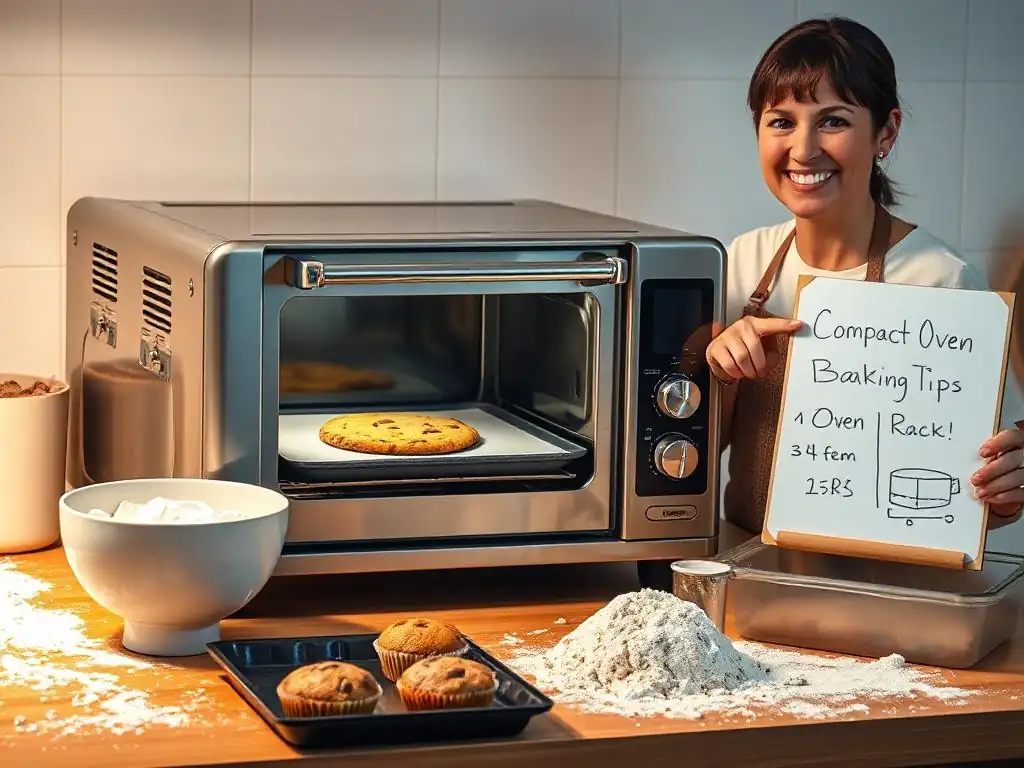
Baking in a compact oven can be incredibly rewarding, but like any new skill, there's a learning curve. Understanding the common pitfalls and how to avoid them will save you frustration and wasted ingredients. Many issues arise from the unique characteristics of compact ovens – their smaller size, faster heating, and proximity of heating elements. Recognizing these potential problems is the first step towards preventing them and mastering your compact oven.
This section addresses some of the most frequent issues encountered when baking in a compact oven, such as uneven baking and burning. We'll discuss the likely causes and provide actionable solutions based on the compact oven baking tips we've covered. By being aware of these common mistakes and knowing how to troubleshoot them, you can build confidence and achieve consistently delicious results from your small but mighty oven.
Uneven Baking: Troubleshooting Temperature Issues in Compact Ovens
Uneven baking is a common complaint with compact ovens, resulting in cookies that are darker on one side, cakes that rise unevenly, or bread with an inconsistent crust. This is often caused by hot spots within the oven cavity or inaccurate temperature control. While some high-end models minimize this with advanced heating technology, most compact ovens benefit from user intervention.
- Verify Temperature: Use an independent oven thermometer to check the actual temperature in different areas of your oven. If there are significant discrepancies, you may need to adjust your oven's set temperature.
- Rotate Pans: A simple yet highly effective solution is to rotate your baking pan 180 degrees halfway through the baking time. This exposes all sides of the baked good to potentially different temperature zones, promoting more even cooking and browning.
- Avoid Overcrowding: Do not try to fit too many items or too large a pan into the oven. Overcrowding restricts airflow, leading to uneven heat distribution. Ensure there is space around your pan for heat to circulate.
- Use the Right Rack Position: Experiment with different rack positions. Baking on a lower rack can help prevent the top from browning too quickly, while a middle rack is often ideal for overall evenness.
Burning Issues: Finding the Sweet Spot for Baking Time and Temperature
Burning is another frequent problem, particularly the bottoms or edges of baked goods. This is usually a result of the intense direct heat from the heating elements, which are much closer to the food in a compact oven than in a full-sized one.
- Lower the Temperature: As a primary compact oven baking tip, reduce the baking temperature by 25°F (15°C) from what the recipe calls for, especially if using convection.
- Shorten Baking Time: Start checking for doneness 5-10 minutes earlier than the recipe suggests. Compact ovens often cook faster.
- Use Proper Bakeware: Use good quality, lighter colored metal pans (dark pans absorb more heat and can cause bottoms to burn). Using parchment paper or a silicone baking mat on the baking sheet provides insulation for cookie bottoms.
- Shield if Necessary: If the top or edges are browning too quickly, loosely tent the item with aluminum foil.
- Monitor Closely: Stay near the oven and watch your baked goods, particularly during the last few minutes of baking. Visual cues are often more reliable than relying solely on a timer.
Small Oven, Big Flavor: Resources for Compact Oven Recipes and Inspiration
Finding recipes specifically developed or adapted for compact ovens can make your baking journey much smoother. While you can adapt standard recipes using the compact oven baking tips mentioned above, starting with recipes already tailored for smaller ovens removes some of the guesswork. The good news is that as compact ovens have become more popular, so too have resources for baking with them. You don't need a huge kitchen or a professional oven to create incredibly flavorful and satisfying baked goods.
Exploring dedicated collections of compact oven recipes allows you to see how others have successfully adapted techniques and ingredients. Online communities offer a wealth of shared knowledge, tips, and troubleshooting advice from fellow compact oven users. These resources provide inspiration and practical guidance, helping you unlock the full potential of your small oven and achieve big flavors.
BakeWithEase.com's Compact Oven Recipe Collection
At BakeWithEase.com, we understand the unique needs of bakers working with limited space. That's why we are building a dedicated collection of recipes specifically tested and optimized for compact ovens. This collection includes a variety of recipes, from scaled-down versions of classic cakes and cookies to quick breads and pastries designed to fit perfectly and bake beautifully in typical compact oven sizes.
Our recipes provide specific instructions tailored to the characteristics of compact ovens, including recommended temperatures and baking times based on our testing. We also include specific compact oven baking tips relevant to each recipe, such as suggested pan sizes, rack positions, and visual cues for doneness. Whether you're craving a small batch of brownies, a few perfect muffins, or a mini loaf of crusty bread, our collection aims to provide reliable recipes that take the guesswork out of compact oven baking. Check back often as we continue to expand this valuable resource for our community.
Online Baking Communities: Sharing Tips and Tricks for Compact Oven Baking
Joining online baking communities and forums can be an excellent way to gain practical compact oven baking tips and inspiration. Platforms like Reddit, Facebook groups dedicated to specific oven brands (like Ninja Foodi or Breville), or general baking forums often have threads or sections where users discuss baking with compact ovens.
These communities are invaluable for troubleshooting specific issues, finding user-tested adaptations of popular recipes, and discovering creative ways to use your compact oven. You can ask questions, share your successes (and failures! ), and learn from the collective experience of other home bakers facing similar space constraints. For example, you might find specific advice on baking sourdough in a particular compact oven model or discover a clever trick for creating steam for crusty bread. Engaging with these communities provides support and a constant stream of new ideas for maximizing your compact oven's potential.
Conclusion: Embrace Baking Freedom with the Perfect Compact Oven
Having a small kitchen no longer means saying goodbye to your baking aspirations. Compact ovens have revolutionized home baking for those with limited space, offering powerful performance and surprising versatility in a countertop footprint. By understanding the capabilities of these appliances and applying essential compact oven baking tips – like adjusting temperatures, monitoring closely, using convection, and employing the right tools – you can successfully bake a wide array of delicious treats.
Whether you choose a multi-functional powerhouse like the Ninja Foodi, a precision-focused model like the Breville Smart Oven Pro, or a versatile option like the Cuisinart TOA-60, the key is to select an oven that fits your needs and space, and then take the time to learn its nuances. With the right compact oven and a little practice, you can enjoy the simple pleasure of homemade cakes, the comforting aroma of freshly baked cookies, and the satisfaction of a perfectly baked loaf of bread, proving that big baking dreams truly can flourish in a small kitchen.
Embrace your baking freedom and start creating today!
Frequently Asked Questions
What are the key considerations when choosing a compact oven for baking?
When selecting a compact oven, consider its temperature accuracy, even heat distribution, and size relative to your baking needs. Features like convection settings are also beneficial.
Are there specific baking techniques that are better suited for compact ovens?
Yes, techniques that benefit from consistent temperature and controlled environments, such as baking smaller batches of cookies or cakes, often excel in compact ovens. Avoid overcrowding the oven to maintain even cooking.
How do I adjust baking times and temperatures when using a compact oven?
Due to their smaller size, compact ovens may heat up faster. It's recommended to monitor your baked goods closely and potentially reduce baking times by a few minutes. Use an oven thermometer to verify the internal temperature.
What types of recipes work best in a compact oven, and which should I avoid?
Recipes like cookies, muffins, and smaller cakes are ideal. Avoid recipes requiring very large pans or multiple racks, as space is limited.
How can I ensure even baking in a compact oven?
Rotating your baked goods halfway through the baking process can help promote even browning. Also, consider using baking stones or mats to distribute heat more evenly.
Final Reflection: From Tiny Spaces, Giant Flavors Emerge
The quest for delicious baked goods doesn't require a sprawling kitchen; it demands ingenuity and the right tools. The compact oven, once a compromise, is now a symbol of resourceful baking, proving that size isn't everything when it comes to culinary creativity. This shift reflects a broader societal trend towards mindful living and efficient space utilization, making the compact oven a surprisingly relevant appliance for today's home baker.
The journey through the world of compact ovens has been a revelation, highlighting not only the impressive capabilities of these smaller appliances but also the enduring power of baking itself. Baking, for many, is more than just a hobby; it's a form of self-expression, a connection to tradition, and a way to share joy with loved ones. Baking is at once child's play and adult joy. And love, of course.
– This sentiment perfectly encapsulates the heart of what we've explored in this article, demonstrating that even within constraints, the magic of baking can flourish.
Now, it's your turn. Consider your own kitchen space, your baking aspirations, and the possibilities that a compact oven might unlock. Don't let limited square footage limit your culinary dreams. Embrace the challenge, experiment with new recipes, and discover the joy of creating delicious treats, no matter the size of your oven. Let your baking journey begin!
Unleash Your Inner Baker: Small Space, Big Results!
Thanks for joining us on this baking adventure! We hope you’ve discovered the perfect compact oven to transform your kitchen dreams into delicious reality. Ready to get baking?
- Take the plunge and order your dream oven today! Imagine all the incredible treats you'll create.
- Share your favorite compact oven recipe with our community on social media using #BakeWithEaseSmallOven. Let's inspire each other!
- Explore more of our small-kitchen baking guides on BakeWithEase.com – we've got tons of tips and tricks to help you master your mini oven.
What delicious creation will you bake first in your new compact oven?