
The Science Made Simple: Supersaturation and Nucleation in Sugar

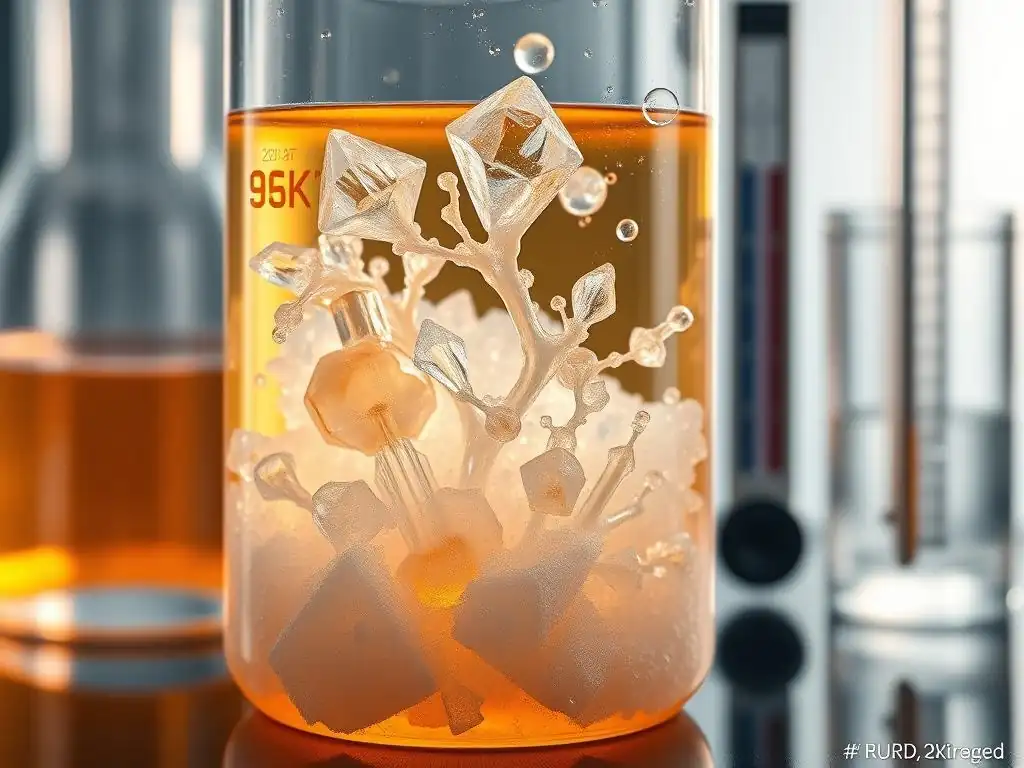
Welcome to BakeWithEase, where the magic of baking meets the precision of science! Ever wondered why your caramel sometimes turns grainy? We're diving deep into sugar crystallization science baking to unravel the secrets behind perfect textures and flawless finishes. Prepare to explore the fascinating world of supersaturation and nucleation, and discover how understanding these principles can elevate your baking from good to extraordinary. Intrigued? Let's get started!
- The Science of Sugar: Crystallization in Baking
- Introduction to Sugar Crystallization
- Supersaturation: A Detailed Explanation
- Nucleation: The Formation of Sugar Crystals
- Supersaturation and Nucleation: A Combined Process
- Practical Applications of Sugar Crystallization
- Troubleshooting Sugar Crystallization Problems
- Advanced Techniques in Sugar Crystallization
- Conclusion: Mastering Sugar Crystallization
-
Frequently Asked Questions
- What is sugar crystallization, and why is it important in baking?
- What is supersaturation, and how does it relate to sugar crystallization?
- What is nucleation, and what role does it play in sugar crystallization?
- How can I prevent unwanted sugar crystallization in my baked goods?
- How does understanding sugar crystallization help me become a better baker?
- Final Reflection: The Sweet Science of Control
- Unlock Your Baking Potential: Master Sugar Crystallization!
The Science of Sugar: Crystallization in Baking
Introduction to Sugar Crystallization
Understanding Crystallization: A Baker's Perspective
At its heart, baking is a blend of art and science, and nowhere is this more evident than in working with sugar. Sugar crystallization science baking is the process where dissolved sugar molecules in a liquid solution begin to arrange themselves into a highly ordered, solid structure – the sugar crystal. For bakers, understanding this transformation is fundamental to achieving the desired textures in everything from creamy fudge to brittle toffee and smooth glazes. It's not just about sweetness; it's about managing these tiny structures.
When we dissolve sugar, typically sucrose, in water or another liquid, the sugar molecules disperse evenly. However, as the liquid evaporates during cooking or as the solution cools, the concentration of sugar increases. At a certain point, the solution can no longer hold all the sugar in a dissolved state, and the sugar molecules start seeking each other out to form crystals. Controlling when and how this happens is the key to successful sugar work in baking and confectionery.
Why Sugar Crystallization Matters in Baking
The texture of many baked goods and confections is directly influenced by the size and number of sugar crystals present. Think about the difference between a smooth, melt-in-your-mouth caramel and a grainy fudge, or a clear, glossy glaze versus one that has turned cloudy and sugary. This difference often boils down to how effectively sugar crystallization science baking principles were applied during preparation.
Uncontrolled crystallization can lead to undesirable textures. For instance, if large crystals form in fudge, it becomes gritty. In hard candy, premature crystallization can turn a clear, glassy product opaque and crumbly. Conversely, intentionally controlling crystallization allows us to create textures like the fine grain of fondant or the structured chewiness of taffy. Mastering the science behind sugar crystallization is therefore essential for consistency and quality in a wide range of sweet treats.
Supersaturation: A Detailed Explanation
Defining Supersaturation in Sugar Solutions
Supersaturation is a state where a solution contains more dissolved solute (in this case, sugar) than it normally could hold at a given temperature under stable conditions. When you heat water and dissolve sugar into it, you can dissolve significantly more sugar than you could in cold water. As this hot, concentrated solution cools, the amount of sugar theoretically able to remain dissolved decreases.
However, if the cooling process is managed carefully, the sugar can remain dissolved in the solution even though it's now below the temperature at which it would normally saturate. This unstable state, holding excess dissolved sugar, is supersaturation.
Imagine water at room temperature (around 20°C). It can dissolve approximately 204 grams of sucrose per 100 grams of water. Now, heat that water to boiling (100°C). It can dissolve roughly 476 grams of sucrose per 100 grams of water – more than double! If you then cool this very concentrated hot solution down to 20°C without any sugar crystallizing out, it now holds far more than the normal 204 grams per 100g limit for 20°C. This excess sugar is what puts the solution into a supersaturated state, making it highly unstable and prone to crystallization if disturbed.
How Temperature Affects Sugar Solubility
Temperature has a profound impact on sugar solubility, which is the maximum amount of sugar that can dissolve in a given amount of solvent (like water) at a specific temperature. Generally, as temperature increases, the solubility of sugar also increases significantly. This is a critical concept in sugar crystallization science baking, as bakers often heat sugar solutions to high temperatures to dissolve large quantities of sugar needed for candies, syrups, and glazes.
Consider the solubility curve for sucrose: at 0°C, about 179g dissolves in 100g water; at 50°C, it's about 260g; and as mentioned, at 100°C, it's around 476g. This dramatic increase in solubility with temperature allows bakers to create highly concentrated solutions. When these solutions cool, they enter the supersaturated state, where the excess sugar is ready to crystallize. The rate and extent of cooling directly influence the degree of supersaturation achieved, which in turn dictates how readily crystallization will occur.
Creating a Supersaturated Sugar Solution
Creating a supersaturated sugar solution is a fundamental step in many sugar-based confections. It involves dissolving sugar in a liquid, usually water, at a high temperature to achieve a high concentration, and then allowing this solution to cool undisturbed. The key is to dissolve more sugar than the solvent could normally hold at a lower temperature. This is typically done by heating the mixture, as sugar's solubility increases with heat.
For example, when making hard candy, you might boil a sugar-water mixture to temperatures exceeding 150°C (300°F). At these high temperatures, the water content is significantly reduced through evaporation, and the remaining liquid holds a very high concentration of dissolved sugar. As this syrup cools, it becomes increasingly supersaturated. The goal is often to cool it significantly before crystallization starts, allowing the high concentration of sugar molecules to remain in a chaotic, dissolved state, which is essential for forming a glassy, amorphous candy structure rather than a crystalline one.
Nucleation: The Formation of Sugar Crystals
Defining Nucleation in Sugar Solutions
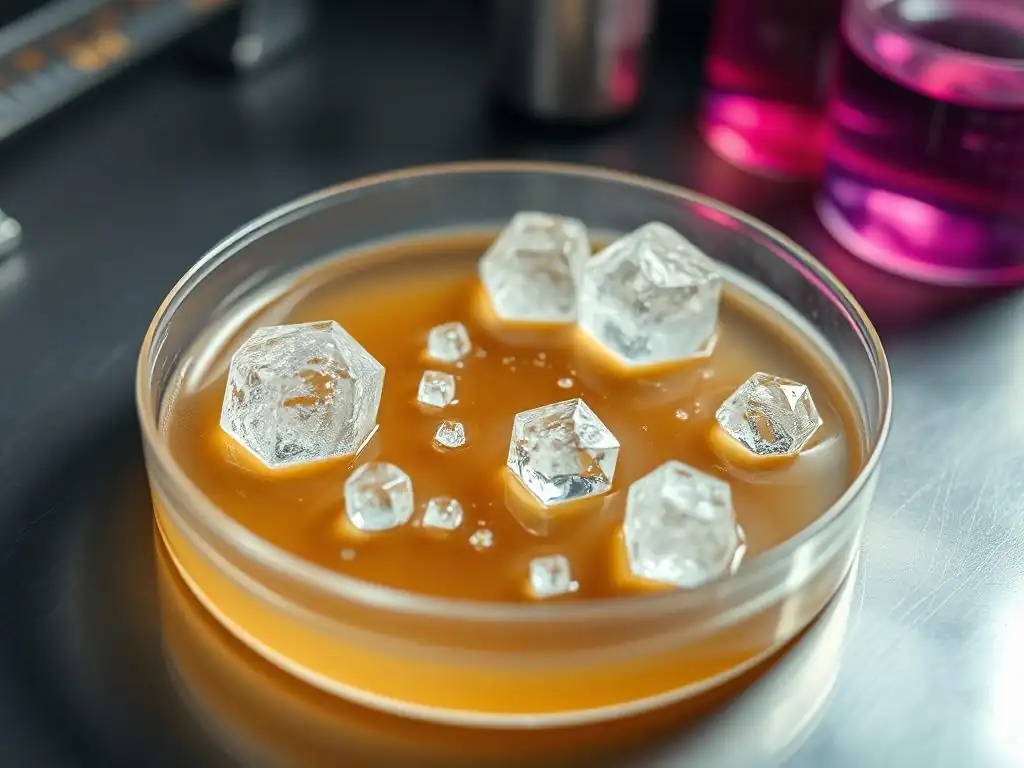
Nucleation is the crucial first step in the process of crystallization – it's the moment when the very first stable crystal forms within a supersaturated solution. Until nucleation occurs, the sugar molecules are just floating around in the liquid. Once a nucleus forms, it acts as a template or seed around which other sugar molecules from the supersaturated solution can attach and arrange themselves in an orderly fashion, causing the crystal to grow. Without nucleation, there can be no crystallization.
Think of it like building with LEGOs. The supersaturated solution is a bin full of loose LEGO bricks (sugar molecules). Nucleation is like two or three bricks clicking together to form a stable base structure. Once that base exists, it's much easier for other bricks to attach themselves neatly to it, building up a larger structure (the crystal). In a sugar solution, this initial nucleus might be incredibly tiny, perhaps just a few hundred sugar molecules arranged correctly, but it's enough to trigger further growth.
Homogeneous vs. Heterogeneous Nucleation
Nucleation can occur in two primary ways: homogeneous and heterogeneous. Homogeneous nucleation happens spontaneously within the bulk of the supersaturated solution itself, without any external help. It requires a very high degree of supersaturation because sugar molecules must collide and align perfectly by chance to form that initial stable nucleus. This is less common in practical baking scenarios because it requires near-perfect conditions and extreme supersaturation levels.
Heterogeneous nucleation, on the other hand, is far more common in sugar crystallization science baking. It occurs when the first crystals form on a surface or impurity within the solution. This could be a tiny dust particle, a scratch on the side of the pan, a sugar crystal that wasn't fully dissolved, or even tiny air bubbles.
These surfaces provide a physical site that lowers the energy barrier required for sugar molecules to come together and form a stable nucleus. This is why merely stirring a supersaturated solution or introducing a speck of sugar can instantly trigger widespread crystallization – you're providing sites for heterogeneous nucleation.
Factors Influencing Nucleation Rate
Several factors influence how quickly and easily nucleation occurs in a supersaturated sugar solution. The most significant is the degree of supersaturation. The more supersaturated the solution, the higher the concentration of excess sugar molecules, and the more likely they are to collide and orient correctly to form a nucleus. A highly supersaturated solution is very unstable and nucleation can happen almost instantly, even homogeneously if the supersaturation is extreme.
Other crucial factors include temperature and impurities/surfaces. Cooling a supersaturated solution increases its degree of supersaturation and thus increases the nucleation rate. Introducing impurities, dust, undissolved sugar crystals (seeding), or even simply agitating the solution provides heterogeneous nucleation sites, dramatically increasing the rate of nucleation compared to letting it sit undisturbed. Controlling these factors – supersaturation level, temperature, and the presence of nucleation sites – is key to managing sugar crystallization in baking.
Supersaturation and Nucleation: A Combined Process
The Interplay Between Supersaturation and Nucleation
Supersaturation and nucleation are intrinsically linked in the sugar crystallization process. Supersaturation is the necessary condition for crystallization to occur, while nucleation is the trigger that initiates it. A solution must be supersaturated for sugar molecules to have a thermodynamic drive to leave the dissolved state and join a crystal lattice. However, without nucleation, this process often cannot start, even if the solution is supersaturated. The supersaturation provides the potential energy for crystallization, and nucleation provides the initial structure (the nucleus) for that energy to be released as molecules join the growing crystal.
Think of a ball perched on a hilltop (the supersaturated state). It has potential energy (the drive to crystallize), but it won't roll down until it's given a nudge (nucleation). A higher hill (greater supersaturation) means the ball is more unstable and requires only a smaller nudge to start rolling. Similarly, a higher degree of supersaturation makes nucleation more likely, as the molecules are under greater "pressure" to crystallize.
How Supersaturation Drives Nucleation
The level of supersaturation directly impacts the likelihood and rate of nucleation. As a sugar solution cools and water evaporates, the concentration of dissolved sugar increases. When the concentration exceeds the saturation limit for that temperature, the solution becomes supersaturated. The further the concentration is pushed beyond this limit, the higher the degree of supersaturation.
A low level of supersaturation might require heterogeneous nucleation sites (like stirring or impurities) to trigger crystallization. However, as the degree of supersaturation increases, the solution becomes increasingly unstable. At very high levels of supersaturation, the probability of sugar molecules randomly colliding and aligning just right to form a stable nucleus (homogeneous nucleation) increases significantly. This is why rapidly cooled, highly concentrated sugar syrups tend to crystallize very easily if disturbed – they are extremely supersaturated, and even minor agitation provides enough energy or heterogeneous sites to kickstart nucleation.
Controlling Crystal Size Through Supersaturation and Nucleation
One of the most important aspects of sugar crystallization science baking is understanding how to control the size of the resulting sugar crystals, as this dictates texture. The degree of supersaturation and the rate of nucleation are the primary levers for this control. If nucleation happens very rapidly and simultaneously at many sites (high nucleation rate), many small crystals will start growing at once. Since there's a limited amount of sugar available to crystallize, these many crystals will remain small. This is desirable for smooth textures like fudge or fondant.
Conversely, if nucleation is delayed or occurs at only a few sites (low nucleation rate), the limited number of initial crystals will have access to a larger pool of supersaturated sugar to grow from. These few crystals will continue to grow larger over time. This results in a coarse, grainy texture, which is usually undesirable.
Therefore, to achieve small crystals, you want to encourage rapid, widespread nucleation from a highly supersaturated solution, often by cooling quickly and agitating. To avoid large crystals (or avoid crystallization altogether), you want to prevent or delay nucleation, often by cooling slowly and avoiding disturbance.
Practical Applications of Sugar Crystallization
Fudge Making: Achieving a Smooth Texture
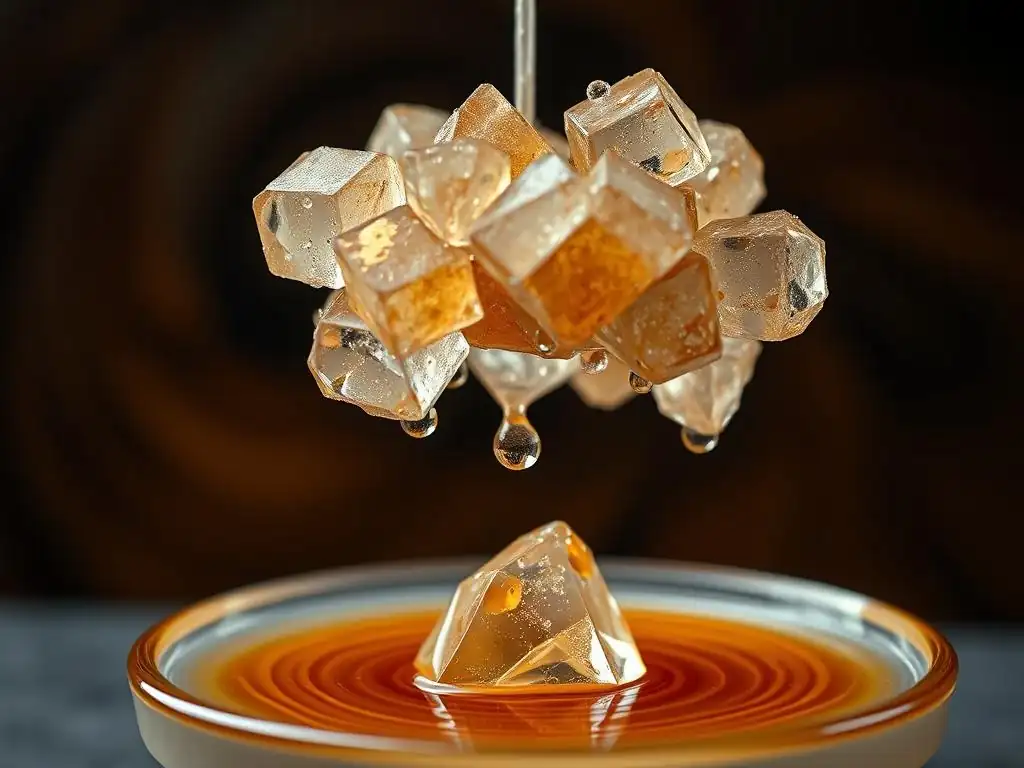
Fudge is a classic example of sugar crystallization science baking where controlling crystal size is paramount. The goal in traditional fudge is to create a confection with a smooth, creamy texture, which is achieved by having a very large number of very small sugar crystals. The process involves cooking a sugar, milk, and butter mixture to a specific temperature (typically the soft-ball stage, around 112-115°C or 234-239°F), which creates a supersaturated sugar solution as water evaporates.
After reaching the target temperature, the mixture is cooled significantly (often to around 43-50°C or 110-122°F) before being vigorously beaten or stirred. Cooling allows the solution to become highly supersaturated. Beating the cooled, supersaturated mixture introduces air bubbles and creates friction, providing numerous heterogeneous nucleation sites. This rapid, widespread nucleation from the highly supersaturated state encourages the formation of countless tiny crystals simultaneously. These crystals are so small they don't feel grainy on the tongue, resulting in the characteristic smooth texture of good fudge.
Candy Making: Controlling Crystal Formation for Desired Texture
From hard candies to caramels and brittles, different types of candy rely on distinct outcomes of sugar crystallization science baking. Hard candies, like lollipops or glass-like brittles, aim to prevent crystallization entirely. They are cooked to very high temperatures (hard crack stage, 149-154°C or 300-310°F), resulting in an extremely concentrated, supersaturated solution. These are then cooled rapidly without stirring or adding impurities. The rapid cooling increases the viscosity so dramatically that sugar molecules cannot move freely enough to find nucleation sites or attach to growing crystals, effectively freezing the sugar in an amorphous, non-crystalline (glassy) state.
Caramels, cooked to lower temperatures (soft ball to firm ball stage, 112-121°C or 234-250°F), typically have some degree of controlled crystallization. Chewy caramels often have very fine, almost imperceptible crystals, while others might have none.
To avoid graininess in caramels, similar principles to fudge apply: cook to the correct temperature for the desired chewiness (which relates to final sugar concentration), cool somewhat, and then handle carefully or stir strategically to manage crystal size. The presence of fats (butter, cream) and other sugars (lactose from milk, or added corn syrup) also interferes with sucrose crystallization, helping to keep the texture smooth.
Sugar Glazes: Preventing Undesirable Crystallization
Many simple sugar glazes, often made from powdered sugar and liquid (like milk or lemon juice), rely on sugar crystallization science baking principles to set into a smooth, opaque coating. Powdered sugar already consists of very fine sugar crystals, often mixed with a small amount of cornstarch to prevent clumping. When liquid is added, some sugar dissolves, creating a concentrated, potentially supersaturated solution around the undissolved particles.
As the liquid evaporates from the glaze on a cake or pastry, the solution becomes increasingly supersaturated. The undissolved powdered sugar particles act as abundant heterogeneous nucleation sites. Crystallization occurs rapidly around these existing particles, binding them together into a solid, opaque structure.
To prevent a glaze from becoming gritty or separating, ensure the powdered sugar is very fine and the liquid is incorporated smoothly. Adding a small amount of fat (like butter) or an interfering agent like corn syrup or lemon juice can also help manage crystallization, keeping the texture smooth and preventing the formation of large, noticeable crystals that would ruin the glossy finish.
Troubleshooting Sugar Crystallization Problems
Identifying Common Sugar Crystallization Issues
The most common problem related to sugar crystallization science baking is the undesirable formation of large, gritty crystals in confections that are meant to be smooth. This can turn fudge into a sandy mess or a clear glaze into a cloudy, sugary coating. Another issue is premature crystallization in high-temperature candies like hard candy or brittle, causing the syrup to seize up and become grainy or opaque before it reaches the target temperature or can be poured.
Understanding the signs is key. Graininess in fudge or fondant indicates that nucleation occurred too early or too slowly, allowing crystals to grow large. Cloudiness or rapid solidification in a syrup cooked for hard candy suggests premature heterogeneous nucleation, often triggered by stirring, impurities, or sugar adhering to the side of the pan falling back in. These issues are almost always related to the mishandling of the supersaturated state or the introduction of unwanted nucleation sites.
Preventing Grainy Textures in Confections
Preventing graininess, especially in fudge and similar confections, requires careful control of the cooling and crystallization process. The primary strategy is to delay nucleation until the solution has cooled sufficiently to be highly supersaturated, and then trigger rapid, widespread nucleation to get small crystals. This involves cooking the sugar mixture to the correct temperature (e.g., soft ball for fudge) to achieve the right concentration, which is crucial for the final texture.
After cooking, cool the syrup undisturbed to the appropriate lower temperature (e.g., 43-50°C for fudge). Avoid scraping the sides of the pan where sugar crystals might have formed, and don't stir while it's cooling. Once cooled, beat or stir the mixture vigorously. This agitation provides numerous nucleation sites, causing many small crystals to form simultaneously from the highly supersaturated solution. The limited amount of available sugar is then distributed among these many nuclei, resulting in tiny crystals and a smooth texture.
Solutions for Controlling Crystal Growth
Controlling crystal growth involves managing both supersaturation and nucleation throughout the process. For candies aiming for a non-crystalline structure (like hard candy), the goal is to prevent nucleation entirely. This is achieved by cooking to very high temperatures (high supersaturation), cooling rapidly to increase viscosity, and meticulously avoiding the introduction of any impurities or disturbances (heterogeneous nucleation sites). Wiping down the sides of the pan with a wet pastry brush during boiling can prevent seed crystals from forming there.
For confections requiring small crystals (like fudge or fondant), the strategy is different: encourage rapid nucleation from a controlled supersaturated state. Cook to specific temperatures, cool undisturbed, and then initiate vigorous stirring. Using interfering agents like corn syrup (glucose and fructose) or acids (like cream of tartar or lemon juice, which can hydrolyze sucrose into glucose and fructose) can also help. These different sugar molecules disrupt the orderly arrangement of sucrose molecules, making it harder for sucrose crystals to form and grow large, thus promoting a smoother texture in sugar crystallization science baking.
Advanced Techniques in Sugar Crystallization

Seeding: Controlling Crystal Formation
Seeding is a direct application of heterogeneous nucleation used to control sugar crystallization, particularly in fondant or certain types of candy. It involves intentionally adding a small amount of pre-formed sugar crystals to a supersaturated sugar solution to initiate crystallization. These added crystals act as nucleation sites, providing templates for the dissolved sugar molecules to attach to and grow.
By introducing seeds, you can control when nucleation begins and, to some extent, the number of initial nucleation sites. If you add a small amount of very fine powdered sugar or a tiny piece of fondant to a cooling supersaturated syrup at a specific temperature, it can trigger crystallization to begin. This method can be used to ensure crystallization starts uniformly and to encourage the formation of many small crystals if combined with agitation, helping to achieve a smooth texture in sugar crystallization science baking applications like fondant.
Using Invert Sugar to Manage Crystallization
Invert sugar, which is a mixture of glucose and fructose (the components of sucrose), is a powerful tool for controlling sugar crystallization in baking and confectionery. It is often added in the form of corn syrup, glucose syrup, or by adding an acid (like lemon juice or cream of tartar) during cooking, which hydrolyzes some of the sucrose into glucose and fructose. These monosaccharides are less prone to crystallization than sucrose and, more importantly, they interfere with sucrose crystallization.
When glucose and fructose molecules are present in a sucrose solution, they disrupt the ability of sucrose molecules to align and form their regular crystal lattice. This makes it much harder for sucrose crystals to nucleate and grow. By adding invert sugar, bakers can effectively reduce the rate and extent of sucrose crystallization, helping to keep syrups smooth, glazes glossy, and candies from turning grainy. For example, adding corn syrup to hard candy syrup helps prevent premature crystallization, ensuring a clear, glass-like product.
Controlling Cooling Rate for Crystal Size
The rate at which a supersaturated sugar solution cools significantly impacts the final crystal size and texture. Rapid cooling leads to a higher degree of supersaturation being reached quickly. This makes the solution very unstable and prone to rapid, widespread nucleation if disturbed, which favors the formation of many small crystals. This is the principle behind cooling fudge before beating it; the faster it cools to the target temperature, the more supersaturated it becomes, setting the stage for fine crystal formation upon agitation.
Conversely, slow cooling allows some crystallization to occur gradually, potentially at fewer sites, leading to the formation of larger crystals over time if the solution is not agitated correctly. For hard candies where crystallization is undesirable, rapid cooling is also beneficial because it quickly increases the viscosity of the syrup, physically inhibiting the movement of sugar molecules and preventing them from finding nucleation sites or joining growing crystals. Therefore, manipulating the cooling rate is a critical technique in sugar crystallization science baking to achieve desired textures, whether smooth and fine-grained or completely non-crystalline.
Conclusion: Mastering Sugar Crystallization
Key Takeaways on Supersaturation and Nucleation
Mastering sugar crystallization science baking is about understanding and controlling two fundamental processes: supersaturation and nucleation. Supersaturation is the state where a solution holds more dissolved sugar than it normally should, a state achieved by dissolving sugar at high temperatures and then cooling. It provides the driving force for crystallization, as the sugar molecules are in an unstable, high-energy state.
Nucleation is the critical first step where a stable crystal seed forms. This can happen spontaneously (homogeneous nucleation, rare) or, more commonly in baking, on existing surfaces or impurities (heterogeneous nucleation, common). The degree of supersaturation influences how easily nucleation occurs, and the rate of nucleation dictates the number of initial crystals.
A high nucleation rate (many starting points) generally leads to many small crystals and a smooth texture, while a low nucleation rate (few starting points) can lead to large crystals and a grainy texture. Controlling these two factors, often through temperature management, agitation, and the use of interfering agents, is key to achieving desired textures in sugar-based confections.
Further Exploration of Sugar Science
The science of sugar crystallization extends beyond basic supersaturation and nucleation to include complex interactions with other ingredients like fats, proteins, and different types of sugars. Exploring how fats inhibit crystal growth in caramels, how proteins in milk affect fudge texture, or the specific roles of glucose and fructose (as in corn syrup) in preventing crystallization can deepen your understanding.
Delving into topics like polymorphism (where sugar can crystallize in different forms), the glass transition temperature of sugar syrups, and the impact of humidity on sugar stability offers even more insight into the fascinating world of sugar crystallization science baking. The more you understand these principles, the better equipped you'll be to troubleshoot issues, adapt recipes, and create a wider range of perfect confections, transforming potentially frustrating experiences into consistent baking success.
Frequently Asked Questions
What is sugar crystallization, and why is it important in baking?
Sugar crystallization is the process where sugar molecules in a solution arrange themselves into an ordered, solid structure. It's important in baking because it affects the texture and appearance of many products, like candies, frostings, and certain cookies.
What is supersaturation, and how does it relate to sugar crystallization?
Supersaturation occurs when a solution contains more dissolved sugar than it normally can at a given temperature. This unstable state is crucial for crystal formation, as the excess sugar is driven to precipitate out and form crystals.
What is nucleation, and what role does it play in sugar crystallization?
Nucleation is the initial step in crystallization where a small cluster of sugar molecules (a nucleus) forms. This nucleus acts as a seed, allowing more sugar molecules to attach and grow into a larger crystal. It's essential for controlling crystal size and texture.
How can I prevent unwanted sugar crystallization in my baked goods?
Preventing unwanted crystallization involves controlling factors like temperature, sugar concentration, and agitation. Adding ingredients like corn syrup or cream of tartar can interfere with crystal formation, resulting in a smoother texture.
How does understanding sugar crystallization help me become a better baker?
Understanding sugar crystallization enables you to predict and control the texture of your baked goods. By manipulating factors like temperature and ingredients, you can achieve the desired consistency and appearance in everything from smooth fudge to crunchy candies.
Final Reflection: The Sweet Science of Control
Understanding supersaturation and nucleation in sugar isn't just a scientific curiosity; it's the key to unlocking consistent, predictable results in baking. Mastering these principles transforms the seemingly unpredictable art of sugar crystallization into a precise and repeatable science, allowing bakers of all levels to achieve stunning results.
The impact of understanding sugar crystallization extends far beyond the kitchen. It highlights the power of scientific principles in everyday life, demonstrating how seemingly simple processes are governed by complex interactions at a molecular level. The art of baking is really the science of baking, and the more you understand the science, the better your baking will be.
This quote encapsulates the core message of this article – that a deeper understanding empowers us to create with intention and precision. The ongoing exploration of these principles continues to refine baking techniques and inspire innovation in food science, pushing the boundaries of what's possible in the culinary world.
Now, consider your own baking experiences. Have you ever been frustrated by unpredictable sugar crystallization? This article provides you with the tools to move beyond frustration and into confident control. Take the knowledge you've gained here, experiment with different sugar concentrations and cooling methods, and observe the results. By actively engaging with the science, you'll not only improve your baking but also deepen your appreciation for the intricate processes that shape the textures and flavors we enjoy. The journey of mastering sugar crystallization is a rewarding one – embrace the science, and let your baking flourish.
Unlock Your Baking Potential: Master Sugar Crystallization!
Thanks for diving into the fascinating world of sugar crystallization! You've now got the science behind perfect candy and stunning frostings under your belt. Ready to put your newfound knowledge into practice?
- Try a new recipe: Challenge yourself with a recipe you've always avoided, like fondant or rock candy, and see how your understanding of supersaturation changes the results! This is your chance to experiment and refine your technique.
- Share your baking triumphs (or even your stumbles!): Let's build a community of bakers! Post your creations and share your experiences in the comments below. We love to see what you've made!
- Explore the BakeWithEase archives: Dive deeper into our collection of articles on confectionery science—we’ve got even more tips and tricks waiting for you.
What unexpected baking challenge are you ready to tackle now that you understand the science behind it?