
NoFail Simple Cake Tips Every Beginner Needs

Welcome to BakeWithEase, your shortcut to baking brilliance! Ever dreamt of creating the perfect cake but felt intimidated? You're not alone. Dive into our guide on nofail beginner cake tips and discover the secrets to flawless baking, even if you're just starting out. Unlock the confidence to bake delicious treats and watch your skills soar! What simple technique will make all the difference? Let's find out...
- Simple Cake Baking Tips for Beginners
- Your Guide to Successful Beginner Cake Baking
- Understanding Cake Baking Basics
- Avoiding Common Beginner Mistakes
- Simple Cake Recipes
- Troubleshooting Common Problems
- Elevating Your Baking Skills
- Conclusion: Your Cake Baking Journey
- Frequently Asked Questions
- Final Reflection: Baking Confidence: It's Easier Than You Think
- Unlock Your Inner Baker: Simple Steps to Cake Success!
Simple Cake Baking Tips for Beginners
Your Guide to Successful Beginner Cake Baking
Embarking on your cake baking journey should be exciting, not intimidating! Many beginners worry about common pitfalls like flat cakes, dry crumbs, or sticking disasters. But with the right approach and a few nofail beginner cake tips, you can achieve delicious, moist, and perfectly baked simple cakes right from your first attempt. This guide is designed to walk you through the essential steps, demystify the process, and help you avoid those common frustrations, ensuring a successful bake every time.
Mastering simple cakes is the perfect foundation for any aspiring baker. These foundational skills are transferable to more complex recipes later on, building confidence and competence in the kitchen. We'll cover everything from selecting the right ingredients and using essential tools to understanding oven dynamics and troubleshooting common issues, providing you with practical, nofail beginner cake tips that really work. Get ready to bake with ease and enjoy the sweet rewards!
Understanding Cake Baking Basics
Before you even preheat your oven, understanding the fundamental principles behind cake baking is crucial. Baking is often described as a science, and while it can be fun and creative, following basic guidelines ensures predictable and successful results. These principles form the bedrock of nofail beginner cake tips, guiding you toward consistent quality in your simple cakes.
Knowing the role of each ingredient, the function of your tools, and how your oven truly operates will empower you to bake with greater confidence. It takes the guesswork out of the process, allowing you to focus on the joy of creating something delicious. Let's dive into these core basics that will set you up for success.
Choosing the Right Ingredients
The quality and type of your ingredients significantly impact the final texture, flavor, and rise of your cake. Using the right kind of flour, fat, and leavening agents is one of the most critical nofail beginner cake tips. For most simple cakes, all-purpose flour works well, providing a balanced structure. However, for a finer, more tender crumb, some recipes might call for cake flour, which has a lower protein content. Using unsalted butter is often preferred as it allows you to control the saltiness of the cake, and ensures consistent results across different brands.
Ensuring your ingredients are fresh is also key. Leavening agents like baking powder and baking soda lose their potency over time. Baking powder, for instance, typically has a shelf life of 6-12 months once opened. Using expired leavener can result in a cake that doesn't rise properly, leading to a dense or flat outcome. Similarly, using fresh eggs, good quality vanilla extract, and dairy products within their expiration dates contributes to both the flavor and structure of your simple cake.
Essential Baking Tools
Having the correct tools on hand makes the baking process smoother and more accurate, which is vital for nofail beginner cake tips. A kitchen scale is incredibly useful for precise measurement, especially for flour, as volumetric measurements (cups) can vary. However, if using cups, having a set of dry measuring cups and liquid measuring cups is essential – they are designed differently for accuracy. A good set of measuring spoons is also non-negotiable for leaveners, salt, and extracts.
Other essential tools include mixing bowls of various sizes, a whisk for dry ingredients or whipping eggs, a rubber spatula for folding and scraping down bowls, and cake pans of the size specified in your recipe. Using the wrong size pan can affect baking time and cake thickness. An oven thermometer is also highly recommended; many home ovens can be off by 20-50°F (approx. 10-30°C), and knowing the true temperature ensures you bake at the correct heat for the specified time.
Mastering Oven Temperatures
Understanding and controlling oven temperature is fundamental to achieving a nofail simple cake. Most cakes are baked between 325°F and 375°F (approx. 160°C and 190°C), with 350°F (175°C) being a very common temperature. Baking at too low a temperature can cause the cake to sink or bake unevenly, while too high a temperature can result in a cake that is burnt on the outside but underbaked in the middle.
Always preheat your oven fully before placing the cake inside. This usually takes 15-20 minutes after the oven indicates it has reached the set temperature, as the internal components and walls need time to heat up. An oven thermometer helps confirm the actual temperature inside. Placing the cake pan in the center of the oven rack allows for even heat circulation. Opening the oven door frequently, especially in the first two-thirds of the baking time, can cause temperature fluctuations that may lead to the cake sinking, so try to resist peeking too often!
Avoiding Common Beginner Mistakes
Even with a great recipe, small errors in technique can derail your baking efforts. Learning to identify and avoid common pitfalls is a key part of mastering nofail beginner cake tips. These mistakes are easily preventable once you know what to look for and why certain steps are important.
Focusing on precision and patience will go a long way in ensuring your simple cakes turn out perfectly every time. Let's look at some of the most frequent errors made by novice bakers and how you can steer clear of them.
Tip #1: Accurately Measuring Ingredients
Accurate measurement is perhaps the most crucial nofail beginner cake tip. Baking relies on specific ratios, and even slight variations can alter the outcome. For dry ingredients like flour, the "spoon and level" method is widely recommended for cup measurements: gently spoon the flour into the measuring cup until it overflows, then level off the excess with a straight edge (like a knife or spatula) without packing it down. Scooping directly from the flour bag can pack the flour tightly, adding up to 25% more flour than intended, leading to a dry, dense cake.
Liquid ingredients, such as milk, oil, or water, should be measured in liquid measuring cups (those with a spout) placed on a flat surface. Bend down to eye level to ensure the liquid meets the correct measurement line. Using a kitchen scale to measure ingredients by weight (grams or ounces) is the most accurate method and highly recommended for consistent results, especially for flour, sugar, and fats.
Tip #2: Using Room Temperature Ingredients
Using room temperature ingredients, particularly butter and eggs, is a critical nofail beginner cake tip for achieving the correct cake texture. Butter should be soft enough to indent easily with your finger but not melted or greasy, typically around 65-68°F (18-20°C). When creamed with sugar, room temperature butter creates tiny air pockets that expand in the oven, contributing to the cake's rise and tender crumb. Cold butter will not cream properly, resulting in a dense cake.
Cold eggs do not emulsify as well into the batter, which can lead to a curdled mixture where the fat and liquid separate. Room temperature eggs (around 70°F or 21°C) integrate smoothly, creating a stable batter that bakes up evenly. To quickly bring eggs to room temperature, place them in a bowl of warm water for 5-10 minutes. For butter, cut it into smaller pieces and let it sit out for about 30-60 minutes.
Tip #3: Greasing and Flouring Cake Pans
A simple but essential nofail beginner cake tip is properly preparing your cake pan to prevent the cake from sticking. This is especially important for simple cakes baked in standard round or square pans. The most common method is to thoroughly grease the inside surfaces of the pan with butter or shortening, getting into all the corners and up the sides. Make sure to cover every bit of surface area the batter will touch.
After greasing, add a tablespoon or two of flour (or cocoa powder for chocolate cakes) to the pan. Tilt and tap the pan, rotating it to coat the greased surfaces evenly with a thin layer of flour. Discard any excess flour. For extra insurance, or for delicate cakes, lining the bottom of the pan with parchment paper cut to size after greasing is an excellent practice that virtually guarantees the cake won't stick to the base.
Tip #4: Avoiding Overmixing Cake Batter
Overmixing cake batter is a common mistake that can lead to a tough, dry cake. Flour contains gluten, a protein that develops structure when mixed with liquid. While some gluten development is necessary for the cake's structure, excessive mixing activates too much gluten, resulting in a chewy, bread-like texture instead of a tender crumb. This is a crucial nofail beginner cake tip often overlooked.
Once you add the dry ingredients to the wet ingredients, mix just until they are combined and no streaks of dry flour remain. This usually takes only 30-60 seconds on low speed or gentle folding by hand. A few small lumps are acceptable and will often disappear during baking. Stop mixing as soon as the batter looks relatively smooth. Overmixing is particularly detrimental when using the creaming method (beating butter and sugar), as it can deflate the air incorporated earlier.
Tip #5: Checking for Cake Doneness
Knowing when your simple cake is perfectly baked is key to avoiding both dry, overcooked cakes and gooey, underbaked ones. The baking time given in a recipe is always an estimate, as oven temperatures and pan types vary. A reliable nofail beginner cake tip is to use visual cues and the toothpick test. Cakes are typically done when the edges pull slightly away from the sides of the pan and the top springs back gently when lightly pressed.
The most common test is inserting a toothpick or a thin skewer into the center of the cake. If it comes out clean or with just a few moist crumbs attached, the cake is done. If it comes out with wet batter, it needs more time. Start checking a few minutes before the minimum baking time specified in the recipe. For instance, if a recipe says 30-35 minutes, start checking at 28 minutes.
Simple Cake Recipes
Exploring simple cake recipes is the perfect way to practice your newfound nofail beginner cake tips. These recipes are designed with straightforward steps and minimal ingredients, making them accessible and forgiving for those just starting out. They provide a canvas to build your skills and confidence.
While we won't provide full step-by-step instructions here, understanding the characteristics of simple cake types helps you choose your next baking project. These recipes are staples for a reason – they are delicious and relatively easy to master.
Vanilla Cake Recipe
A simple vanilla cake is often the first project for many bakers. It typically uses the creaming method, combining butter and sugar until light and fluffy, then adding eggs, followed by alternating dry and wet ingredients (like flour and milk). This method builds structure and incorporates air for a tender crumb. A basic recipe might call for ingredients like 1.5 cups (approx. 190g) of all-purpose flour, 1 cup (approx. 200g) of sugar, 1/2 cup (approx. 113g) of butter, 2 large eggs, 1/2 cup (approx. 120ml) of milk, 1.5 teaspoons of baking powder, and 1 teaspoon of vanilla extract.
This type of simple cake is incredibly versatile. You can bake it as cupcakes, a single layer 8 or 9-inch round cake, or even a simple loaf cake. Its classic flavor pairs well with almost any frosting or can be enjoyed plain, making it a perfect foundation for practicing your nofail beginner cake tips.
Chocolate Cake Recipe
Simple chocolate cakes are often celebrated for their moistness and deep flavor. Many beginner-friendly chocolate cake recipes use the "one-bowl" method, which is incredibly easy. This often involves whisking together dry ingredients like flour, sugar, cocoa powder (typically 1/4 to 1/2 cup, approx. 20-40g), baking soda, and salt, then adding wet ingredients like eggs, milk, oil (often 1/2 cup, approx. 120ml), vanilla, and sometimes hot water or coffee, mixing until just combined.
The use of oil instead of butter in some simple chocolate cakes contributes to their moist texture, as oil remains liquid at room temperature while butter solidifies. Hot liquid helps bloom the cocoa powder, intensifying the chocolate flavor. These cakes are often baked as a single layer or a loaf cake and are wonderfully forgiving, making them ideal for applying your nofail beginner cake tips.
Lemon Cake Recipe
Simple lemon cakes often fall into the quick bread category, meaning they use baking powder and/or baking soda for leavening and are mixed similarly to muffins or loaves. Ingredients typically include flour, sugar, eggs, a liquid fat like oil or melted butter, milk or buttermilk, lemon juice (often 1/4 cup, approx. 60ml), and significant lemon zest (from 1-2 lemons) for bright flavor. The wet ingredients are mixed separately from the dry, then combined until just blended.
These cakes are frequently baked in loaf pans, yielding an easy-to-slice cake perfect for snacking or serving with tea. The acidity from the lemon juice interacts with the leavening agents to help create a tender crumb. A simple lemon glaze (powdered sugar mixed with lemon juice) is a classic topping that adds extra citrus punch. Practicing with a simple lemon loaf is a great way to build confidence using your nofail beginner cake tips.
Troubleshooting Common Problems
Even with the best nofail beginner cake tips, sometimes things don't go exactly as planned. Knowing how to identify the potential causes of common problems can help you troubleshoot and adjust your technique for future bakes. Don't be discouraged if your first few cakes aren't perfect – each bake is a learning opportunity.
Here are some of the issues beginners face and the likely reasons behind them. Understanding the 'why' helps you prevent them next time and reinforces your understanding of cake baking basics.
Cake Sticking to the Pan
A cake sticking to the pan is incredibly frustrating after all your hard work. The primary cause is inadequate pan preparation. If the pan wasn't thoroughly greased and floured (or lined with parchment paper), the batter adheres directly to the metal as it bakes and cools. Using cooking spray alone might not provide sufficient non-stick coverage compared to butter/shortening and flour.
To prevent this, ensure you grease every internal surface of the pan the batter will touch, including the sides and corners. Follow with a generous amount of flour, tilting and tapping to coat, then discard excess. After baking, allow the cake to cool in the pan on a wire rack for the amount of time specified in the recipe (usually 10-15 minutes).
This allows the cake structure to set slightly and pull away from the sides naturally before you attempt to invert it. Trying to remove it too soon or letting it cool completely in the pan can both cause sticking.
Cake Sinking in the Middle
A cake sinking in the middle is often a sign that it wasn't fully baked. If the center isn't set, the structure collapses as it cools. This can happen if the oven temperature was too low, if the cake was removed from the oven too soon (check for doneness with a toothpick! ), or if the oven door was opened too frequently during baking, causing a sudden drop in temperature.
Other causes can include using too much leavening agent (baking powder/soda), which causes the cake to rise too quickly before the structure is stable, or having ingredients that were too cold, leading to uneven baking. Ensure your oven thermometer is accurate, use the toothpick test before removing the cake, avoid opening the oven door until at least two-thirds of the baking time has passed, and double-check your leavener measurements and freshness.
Dry Cake
A dry cake is often the result of one or a combination of factors related to moisture loss or incorrect ratios. The most common cause is overbaking – leaving the cake in the oven for too long or baking at too high a temperature evaporates too much moisture. Using too much flour (often due to inaccurate measuring, see Tip #1!) or not enough liquid or fat in the recipe can also lead to a dry crumb.
Ensuring accurate measurements, using the correct oven temperature (verified with a thermometer), and checking for doneness at the earliest recommended time with the toothpick test are your best defenses against a dry cake. If you know your oven runs hot, consider lowering the temperature slightly (e.g., from 350°F to 325°F, approx. 175°C to 160°C) and extending the baking time slightly for a more gentle bake.
Elevating Your Baking Skills
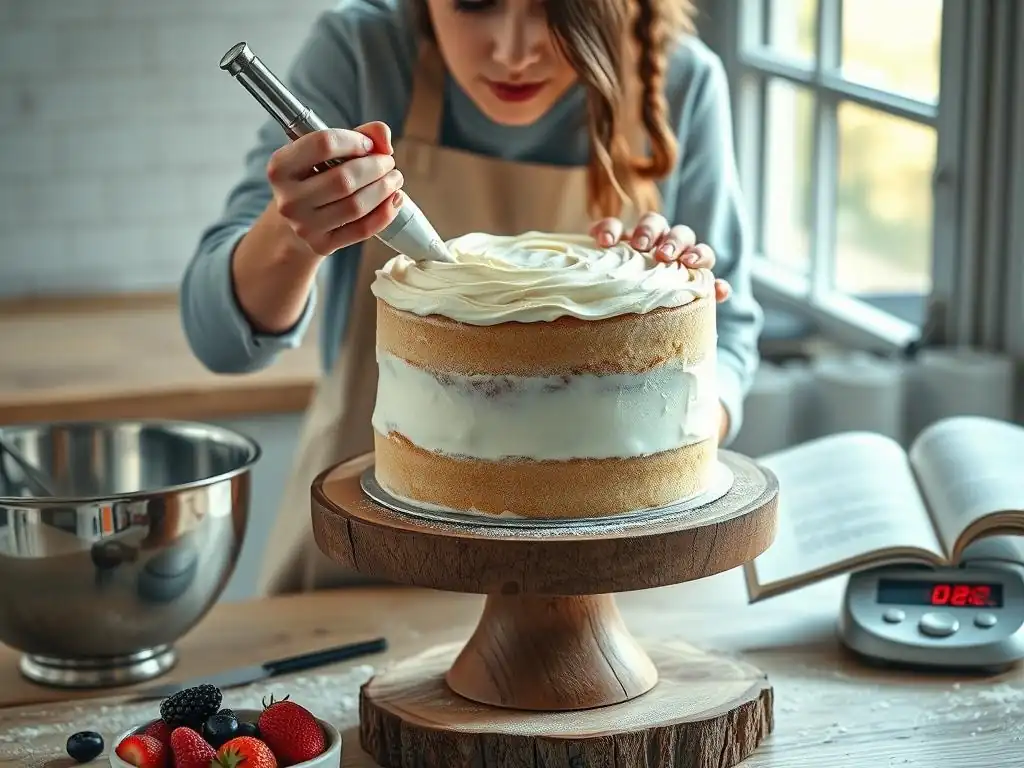
Once you've mastered simple cakes using your nofail beginner cake tips, you might want to add a little extra flair. Elevating your basic cake involves simple techniques like adding a frosting or incorporating different flavors. These steps are easy to learn and make your simple cakes even more impressive.
You don't need complex decorations or fancy ingredients to make your cakes special. Focusing on enhancing the flavor and adding a simple finish is a great next step in your baking journey.
Simple Frosting Techniques
A simple frosting can transform a plain cake into a treat. A basic American buttercream is easy to make: cream together 1/2 cup (approx. 113g) of softened butter with 2-3 cups (approx. 240-360g) of powdered sugar, adding 2-3 tablespoons of milk or cream and 1 teaspoon of vanilla extract until smooth and spreadable. This is a great frosting for simple cakes.
Applying frosting doesn't need to be complicated. Simply use an offset spatula or a knife to spread the frosting evenly over the cooled cake. For a rustic look, swirl the frosting. For a smoother finish, dip your spatula in hot water and dry it before smoothing the surface. A simple glaze, made by whisking powdered sugar with a liquid like milk, lemon juice, or water until pourable, is even easier and provides a light sweetness.
Adding Flavor Variations
Once comfortable with a basic cake recipe, you can easily introduce new flavors. This is a fun way to experiment with your nofail beginner cake tips. For example, you can add spices like cinnamon, nutmeg, or cardamom to a vanilla cake batter. For a chocolate cake, try adding a pinch of cayenne pepper for a subtle heat or instant coffee granules to enhance the chocolate flavor.
Folding in mix-ins is another simple way to add flavor and texture. Think about adding 1/2 cup (approx. 85g) of chocolate chips, chopped nuts, dried fruit, or fresh berries (tossed lightly in flour first to prevent sinking) to your batter just before baking. These additions turn a simple cake into something more exciting without changing the core baking process significantly.
Using Extracts and Zests
Extracts and zests are powerful tools for adding concentrated flavor to your simple cakes. Vanilla extract is a staple, but don't hesitate to explore others like almond extract (use sparingly, it's potent! ), lemon extract, or even peppermint extract for seasonal variations. Typically, a teaspoon or two is enough for a standard cake recipe.
Citrus zest – the colored outer layer of the peel – contains fragrant oils that add a bright, fresh flavor without the acidity of the juice. Adding the zest of one lemon or orange (about 1-2 tablespoons) to your batter, especially when creaming the butter and sugar, infuses the whole cake with citrus aroma. Always zest the fruit before juicing it, avoiding the bitter white pith underneath. Combining extracts and zests (like vanilla extract and lemon zest) can create wonderfully complex flavors in your simple cakes.
Conclusion: Your Cake Baking Journey
Armed with these nofail beginner cake tips, you're well on your way to baking delicious simple cakes consistently. Remember that baking is a skill that improves with practice. Don't be afraid to try new recipes, troubleshoot issues as they arise, and learn from each experience.
From understanding the basics of ingredients and tools to mastering oven temperatures and avoiding common mistakes like overmixing or improper pan preparation, you now have the knowledge to tackle simple cakes with confidence. Enjoy the process of creating something sweet and sharing it with others. Happy baking!
Frequently Asked Questions
What is the most important tip for baking a cake as a beginner?
The most important tip is to precisely measure all your ingredients. Accurate measurements are crucial for cake structure and texture.
What if I don't have all the fancy baking equipment?
You don't need fancy equipment! Start with the basics: mixing bowls, measuring cups/spoons, a whisk, a spatula, and a cake pan. Many recipes can be adapted for minimal equipment.
How can I prevent my cake from sticking to the pan?
Grease and flour your cake pan thoroughly. Using parchment paper at the bottom of the pan is also a foolproof method to prevent sticking.
My cake is always dry. What am I doing wrong?
Overbaking is a common cause of dry cakes. Use a toothpick test and remove the cake when it comes out mostly clean. Also, ensure you are using the correct amount of liquid ingredients.
What are some easy ingredients substitutions I can use?
You can often substitute applesauce for oil to reduce fat, or use buttermilk if a recipe calls for sour cream. However, be mindful that substitutions can affect the final texture and taste of the cake.
Final Reflection: Baking Confidence: It's Easier Than You Think
The seemingly daunting world of cake baking is actually surprisingly accessible, and mastering a few simple techniques can unlock a world of delicious possibilities. This article has highlighted that even beginners can achieve consistently perfect cakes with the right knowledge and a little practice. Forget the fear of failure; success is within reach.
The joy of baking, and specifically the satisfaction of creating a beautiful and delicious cake, transcends mere culinary skill. It's about the process of creation, the sharing of something homemade with loved ones, and the quiet confidence that blossoms with each successful bake. The best things in life are homemade.
This sentiment rings especially true when it comes to the simple pleasure of a perfectly baked cake, a testament to patience and a touch of culinary magic. The impact of this simple act extends beyond the individual, fostering connection and creating lasting memories.
Now, it's your turn. Don't let the perceived complexity of baking hold you back. Take the tips outlined in this article, experiment in your kitchen, and embrace the journey of learning. The next time you're tempted to buy a store-bought cake, remember the empowerment that comes from creating something delicious with your own hands. You might surprise yourself with what you can achieve. So, dust off your mixing bowls, preheat your oven, and embark on your baking adventure – your first perfect cake awaits!
Unlock Your Inner Baker: Simple Steps to Cake Success!
Thanks for taking the time to explore these simple cake tips! We hope you gained the confidence to bake amazing cakes, regardless of your skill level. Now it’s time to put your newfound knowledge into action.
- Bake your dream cake today! Grab your ingredients and try one of the recipes mentioned – you might be surprised at how easy it is!
- Share your baking journey! Post a picture of your creation on social media and tag us – we'd love to see your baking triumph!
- Challenge yourself to try a new flavor combination or decorating technique you learned about.
Ready to create something delicious? What's the first cake you're going to bake?