
Is Your Home Bakery Actually Making Money? Calculate Your Profit Margins


Welcome to BakeWithEase, your guide to transforming your passion for baking into a profitable venture! Are you dreaming of turning your kitchen into a thriving home bakery? But is that dream actually making you money? This article dives deep into the crucial topic of home bakery profit margin, revealing the secrets to accurately calculating your earnings and ensuring your delicious creations translate into a successful business. Intrigued? Let's unravel the numbers and discover if your home bakery is truly a sweet success.
- Understanding Home Bakery Profitability: More Than Just Revenue
- Step-by-Step Guide to Calculating Your Home Bakery Profit Margin
- Analyzing Your Home Bakery Profit Margin Percentage
- Tools and Resources for Tracking Home Bakery Finances
- Increasing Your Home Bakery's Profitability: Practical Tips
- Avoiding Common Pitfalls That Impact Home Bakery Profit Margins
- Case Study: Improving Profit Margins in a Home Bakery
- Key Takeaways: Ensuring Long-Term Financial Success for Your Home Bakery
- Frequently Asked Questions
- Final Reflection: Baking Dreams into Reality: Profit and Passion
- Unlock Your Bakery's True Potential: Profitable Baking Starts Now!
Understanding Home Bakery Profitability: More Than Just Revenue
Why Calculating Profit Margins is Crucial for Home Bakers
Understanding your home bakery profit margin is absolutely fundamental to turning your passion into a sustainable business. It's not enough to simply sell goods and cover costs; knowing your profit margin tells you how much money you're actually keeping after all expenses are paid.
This crucial metric provides clarity on your business's financial health, helping you identify which products are your most profitable, where you might be spending too much, and whether your pricing strategy is effective. Without this insight, you're essentially flying blind, unable to make informed decisions about growth, investment, or even whether your business is truly viable in the long run.
Calculating your home bakery profit margin empowers you to set realistic goals and make strategic adjustments. If your margins are low on a popular item, you might look into bulk ingredient purchasing or slightly adjusting your price. If a niche product has surprisingly high margins, it might be worth focusing more marketing effort there. This financial clarity allows you to move beyond guesswork and build a solid foundation for your home baking venture, ensuring that your hard work is translating into tangible financial success and not just busywork.
Common Misconceptions About Home Bakery Income
Many home bakers start with a passion for baking but may lack formal business training, leading to several common misconceptions about their income. The most prevalent is confusing revenue with profit. Selling a cake for $50 doesn't mean you've made $50 profit; you first have to subtract the cost of ingredients, packaging, and a portion of your operational expenses. Focusing solely on the total amount of money coming in (revenue) without accounting for the money going out (expenses) gives a misleading picture of financial success and can lead to unexpected cash flow problems down the line.
Another frequent oversight is failing to account for all expenses, especially indirect ones. While most bakers remember to factor in flour and sugar, they often forget the cost of utilities used for baking, wear and tear on equipment, the cost of marketing materials, or even a portion of their home's rent or mortgage if a dedicated space is used.
Furthermore, many home bakers undervalue their own time, failing to factor in labor costs when setting prices or calculating profitability. These omissions significantly inflate the perceived profit margin, masking the true cost of doing business and making it difficult to achieve sustainable growth.
Step-by-Step Guide to Calculating Your Home Bakery Profit Margin
Step 1: Identifying All Costs Associated with Your Baked Goods
Before you can calculate your home bakery profit margin, you must meticulously track every single cost involved in producing your baked goods. Think of this as building the foundation for your financial understanding. Costs can be broadly categorized into direct and indirect expenses, and accurately capturing both is essential for a true picture of profitability. This step requires diligent record-keeping, whether through spreadsheets, notebooks, or accounting software.
Getting this step right is crucial. It means looking beyond the obvious ingredient costs and digging into everything else that contributes to getting that finished product into your customer's hands. Missing costs will artificially inflate your profit margin, giving you a false sense of security about your business's performance. A detailed list of expenses, broken down per batch or per product, is the cornerstone of accurate financial calculation.
Direct Costs: Ingredients, Packaging, and Labels
Direct costs are expenses directly tied to the production of a specific item or batch. The most obvious are ingredients like flour, sugar, eggs, butter, leavening agents, and any specific flavorings or decorations. You need to determine the cost of the exact amount of each ingredient used in a recipe. For example, if a recipe calls for 1 cup of flour and a 5lb bag costs $5, you need to figure out the cost per cup (approximately $0.20, depending on weight per cup).
Beyond ingredients, packaging is a significant direct cost. This includes boxes, bags, wrappers, parchment paper, cupcake liners, and any ribbons or decorative elements used on the final product. Labels, including nutritional information, branding stickers, or ingredient lists, also fall under direct costs. It's important to track these per item or per batch to get an accurate cost of goods sold for each product you offer.
Indirect Costs: Utilities, Rent (or Mortgage Allocation), and Equipment Depreciation
Indirect costs, often called overhead, are expenses necessary to run your home bakery business but aren't directly tied to producing a single item. These include utilities like electricity (for ovens, mixers, lights), gas (for ovens), and water. While it can be tricky to separate personal from business use, estimate a reasonable percentage based on the time spent baking or the energy consumed by your equipment.
Other indirect costs include a portion of your home's rent or mortgage if you use a dedicated space for your business (e.g., a separate baking room or a significant portion of your kitchen). Equipment depreciation accounts for the wear and tear on your mixers, ovens, baking pans, and other tools over time; these items have a lifespan and their cost should be spread out over that time. Insurance, business licenses, and fees also contribute to your indirect costs. Accurately estimating and allocating these costs is vital for calculating your net profit margin.
Step 2: Determining Your Total Revenue from Baked Goods Sales
Once you've meticulously tracked your costs, the next step in calculating your home bakery profit margin is to figure out exactly how much money your baked goods have brought in. This is your total revenue. It might seem straightforward – just add up all your sales – but there are nuances, especially when dealing with discounts or promotions.
Accurate revenue tracking is the other half of the equation for understanding profitability. Without a clear picture of your income, comparing it against your expenses is impossible. This step sets the stage for calculating both your gross and net profits.
Tracking Sales: Methods for Accurate Revenue Calculation
To accurately determine your total revenue, you need a reliable system for tracking every sale. This could involve using a simple spreadsheet where you log each order, the items sold, the price, and the date. More advanced methods include using a point-of-sale (POS) app on your phone or tablet, which can automatically total sales and often integrate with inventory tracking.
Regardless of the method, consistency is key. Record every transaction as it happens. This includes cash sales, online payments, and any payments received through apps. Make sure your system captures the full selling price of the items before any deductions. Regularly reviewing your sales records is essential for understanding your income stream.
Accounting for Discounts and Promotions
When calculating total revenue, you must account for any discounts or promotions you offered. For instance, if you sold a dozen cookies for $20 but offered a 10% discount, the actual revenue from that sale is $18, not $20. Promotions like "buy one, get one half price" also affect the final revenue per item.
Your revenue calculation should reflect the actual amount of money received from the customer after all discounts have been applied. Subtract the value of any discounts or promotions from the potential selling price to arrive at the true revenue figure for that sale. Failing to do so will inflate your perceived revenue and subsequently your calculated home bakery profit margin.
Step 3: Calculating Your Gross Profit
With your direct costs identified and your total revenue tracked, you can now calculate your gross profit. This is the first level of profitability assessment and tells you how much money is left over from sales after covering the direct costs of producing the goods.
Gross profit is a key indicator of the efficiency of your production process and pricing strategy relative to ingredient and packaging costs. While it doesn't account for all business expenses, it's a vital step in understanding your home bakery profit margin.
Gross Profit Formula: Revenue Minus Direct Costs
The formula for calculating gross profit is simple:
Gross Profit = Total Revenue - Total Direct Costs
Total Revenue is the actual amount of money received from sales (after discounts), as calculated in Step 2. Total Direct Costs are the sum of all ingredient, packaging, and labeling costs associated with the goods sold during the period you are analyzing (e.g., a week, a month, or a specific batch).
Example Calculation: Gross Profit for a Batch of Sourdough Bread
Let's say you baked a batch of 4 sourdough loaves.
- Ingredients (flour, water, salt, starter): $4.50
- Packaging (bags, labels): $1.50
- Total Direct Costs per batch: $4.50 + $1.50 = $6.00
You sell each loaf for $8.00.
- Total Revenue per batch: 4 loaves * $8.00/loaf = $32.00
Using the formula: Gross Profit = $32.00 (Revenue) - $6.00 (Direct Costs) = $26.00
So, the gross profit for that batch of sourdough bread is $26.00. This $26.00 is what's left to cover your indirect costs and contribute to your net profit.
Step 4: Calculating Your Net Profit
While gross profit is informative, net profit provides the most accurate picture of your home bakery's financial performance. Net profit accounts for all your business expenses, both direct and indirect. This figure represents the actual profit your business has made before taxes.
Calculating net profit is essential for understanding the overall financial health of your home bakery and determining your true home bakery profit margin. It shows whether your total revenue is sufficient to cover not just production costs but also the overhead required to operate your business.
Net Profit Formula: Gross Profit Minus Indirect Costs
The formula for calculating net profit is:
Net Profit = Gross Profit - Total Indirect Costs
Total Indirect Costs are the sum of all your overhead expenses for the period you are analyzing (utilities, rent allocation, depreciation, insurance, fees, etc.). You would typically calculate these monthly or quarterly. Gross Profit is the figure calculated in Step 3 for the same period.
Example Calculation: Net Profit for a Month of Baking Wedding Cakes
Imagine in one month, your home bakery specialized in wedding cakes.
- Total Revenue from wedding cakes: $4,500
- Total Direct Costs (ingredients, packaging, specific decorations): $1,800
- Gross Profit for the month: $4,500 - $1,800 = $2,700
Now, let's factor in estimated indirect costs for that month:
- Estimated Utilities (electricity, gas, water portion): $150
- Estimated Rent/Mortgage Allocation: $200
- Equipment Depreciation (monthly portion): $50
- Other Fees/Insurance: $30
- Total Indirect Costs for the month: $150 + $200 + $50 + $30 = $430
Using the net profit formula: Net Profit = $2,700 (Gross Profit) - $430 (Indirect Costs) = $2,270
Your net profit for that month of baking wedding cakes is $2,270. This is the actual profit your home bakery earned from those sales during that period.
Analyzing Your Home Bakery Profit Margin Percentage
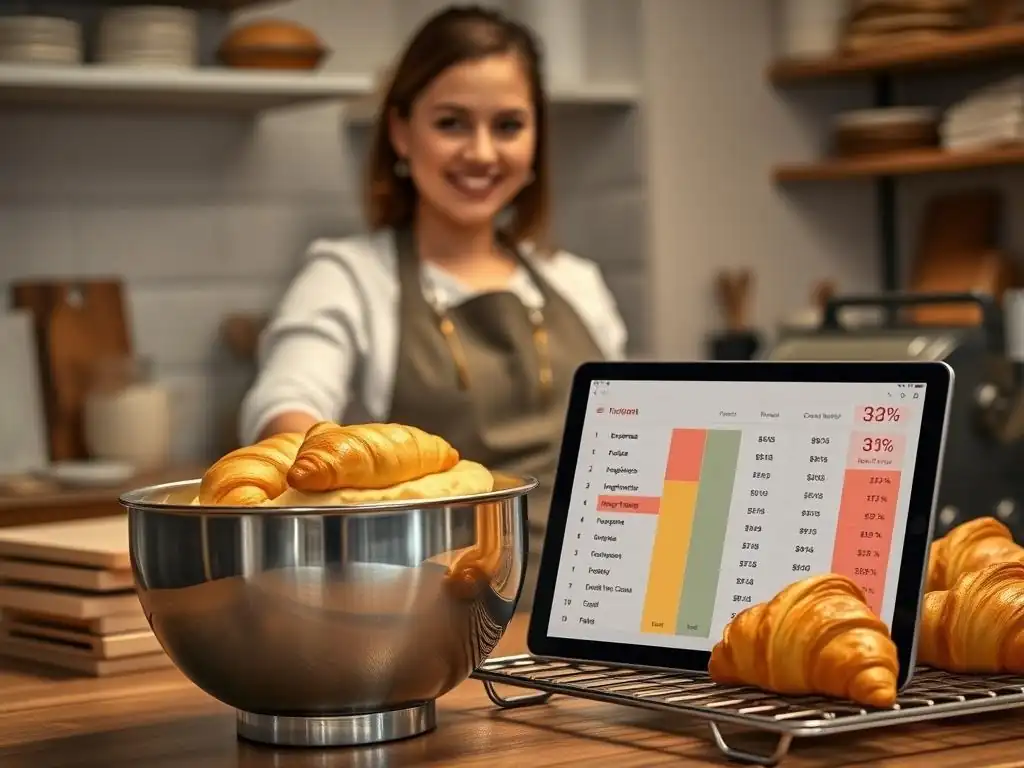
Calculating the raw profit figures (gross and net) is a great start, but expressing them as a percentage provides a more standardized metric that allows for easier comparison over time and across different products or industries. The home bakery profit margin percentage tells you, for every dollar of revenue, how many cents you keep as profit.
Understanding your profit margin percentage is key to making strategic pricing and cost-management decisions. It helps you assess the efficiency and profitability of your entire operation.
Understanding What a "Good" Profit Margin Looks Like in the Baking Industry
What constitutes a "good" home bakery profit margin percentage can vary significantly based on factors like the type of baked goods sold, location, business model (e.g., wholesale vs. retail), and scale. Generally, gross profit margins in the food industry can range from 40% to 70% or even higher, especially for items with relatively low ingredient costs compared to their selling price (like simple bread or cookies).
Net profit margins are significantly lower because they include all overheads. A healthy net profit margin for a small food business might fall anywhere from 10% to 20% or even higher for highly efficient and well-priced operations. However, these are just benchmarks. The best "good" margin for your home bakery is one that allows you to cover all your expenses, pay yourself a reasonable wage (which should also be factored into costs eventually), and reinvest in your business for growth. Regularly tracking your own margins over time is more valuable than comparing directly to others without context.
Factors Affecting Your Home Bakery's Profit Margin
Numerous factors can influence your home bakery profit margin, and understanding these levers allows you to actively work towards improving profitability. These factors are often interconnected, and adjustments in one area can impact others.
Actively managing these factors is crucial for optimizing your home bakery's financial performance. It requires ongoing attention to sourcing, pricing, and operational efficiency.
Ingredient Costs and Sourcing Strategies
Ingredient costs are typically the largest component of direct costs and have a direct impact on your gross profit margin. Fluctuations in commodity prices (like flour, sugar, or butter) can significantly affect profitability. Your sourcing strategy plays a big role here. Buying ingredients in bulk from wholesalers is often cheaper per unit than buying small quantities from local grocery stores, potentially increasing your profit margin.
However, sourcing decisions also involve trade-offs, such as quality versus cost, or supporting local producers versus getting the lowest price. Finding the right balance for your brand and target market is key. Regularly reviewing ingredient prices and exploring different suppliers can help manage this critical cost factor and protect your home bakery profit margin.
Pricing Strategies for Maximizing Profit
Your pricing strategy is one of the most powerful tools you have for influencing your home bakery profit margin. Pricing too low will result in thin margins, making it hard to cover costs and generate a sustainable profit, no matter how many items you sell. Pricing too high might deter customers. Effective pricing considers not only your costs (direct and indirect) but also the perceived value of your products, competitor pricing, and your target market's willingness to pay.
Value-based pricing, where you price based on what customers are willing to pay for your unique or high-quality products, can often lead to higher profit margins than simply using a cost-plus approach (cost of ingredients + a fixed markup). Regularly reviewing and potentially adjusting your prices based on cost changes and market demand is essential for maximizing your home bakery profit margin.
Waste Reduction Techniques
Waste directly erodes your home bakery profit margin because it represents money spent on ingredients and labor that doesn't result in a salable product. This includes spoiled ingredients, over-baked or under-baked goods, dropped items, or excess trimmings. Implementing strong inventory management practices, such as using the oldest ingredients first (FIFO - First-In, First-Out), helps reduce spoilage.
Optimizing your recipes and baking processes to minimize scraps and errors also contributes significantly to waste reduction. Careful planning of production batches based on orders helps avoid overproduction. Even small reductions in waste, consistently applied, can have a noticeable positive impact on your overall home bakery profit margin over time.
Tools and Resources for Tracking Home Bakery Finances
Managing the finances of your home bakery, including calculating your home bakery profit margin, can feel overwhelming, but several tools and resources are available to simplify the process. Utilizing the right tools can save you time, improve accuracy, and provide valuable insights into your business's performance.
Choosing the right tools depends on your budget, technical comfort level, and the complexity of your business. Starting simple and upgrading as your business grows is often a good approach.
Spreadsheet Templates for Profit Margin Calculation
For many home bakers, a simple spreadsheet (like those in Excel or Google Sheets) is an excellent and cost-effective way to start tracking finances and calculating profit margins. You can create columns for date, product, quantity sold, revenue per item, total revenue, ingredient costs, packaging costs, and allocate a portion of your estimated indirect costs.
Numerous free or low-cost spreadsheet templates specifically designed for small food businesses or bakeries are available online. These templates often have built-in formulas to automatically calculate your gross profit, net profit, and profit margin percentages once you input your data. They provide a visual way to see your income and expenses side-by-side.
Accounting Software Options for Small Baking Businesses
As your home bakery grows, you might find that a dedicated accounting software program offers more robust features than a spreadsheet. Software like QuickBooks, Xero, or Wave (which offers a free version) can automate tasks like expense categorization, invoicing, and payment tracking.
These programs can generate detailed financial reports, including profit and loss statements, which clearly show your revenue, expenses, and net profit over a specified period. While there's a learning curve, using accounting software can provide deeper insights into your home bakery profit margin and overall financial health, making tax preparation easier as well.
Online Resources for Pricing and Financial Management
The internet is a treasure trove of resources for home bakers looking to improve their financial management skills. Websites dedicated to small business development often offer articles, webinars, and calculators specifically for pricing baked goods and understanding profitability.
Many bakery-specific blogs and forums feature discussions and shared tools for calculating costs and setting prices. While generic business advice is helpful, seeking resources tailored to the unique aspects of a food business, especially one operated from home, can provide more relevant guidance on calculating your home bakery profit margin effectively.
Increasing Your Home Bakery's Profitability: Practical Tips

Calculating your home bakery profit margin is just the first step; the real value comes from using that information to make changes that increase your profitability. There are several practical strategies you can implement to improve your margins without necessarily raising prices drastically or sacrificing quality.
Focusing on efficiency, cost control, and smart marketing are key levers for boosting your home bakery profit margin.
Optimizing Recipes for Cost-Effectiveness
Review your recipes with an eye towards cost. Are there ingredients that are particularly expensive? Could a less costly, but still high-quality, alternative be used? For example, substituting some butter with oil in certain cakes or muffins might reduce cost without significantly impacting taste or texture. Could you adjust portion sizes slightly if they are overly generous?
Also, consider recipes that utilize common ingredients you buy in bulk, allowing you to maximize the cost savings from bulk purchasing. Optimizing recipes doesn't mean compromising on quality, but rather finding smart ways to manage ingredient costs per serving, directly impacting your home bakery profit margin.
Streamlining Baking Processes for Efficiency
Time is money, especially in a home bakery. Inefficient processes increase labor costs (even if you're not paying yourself an hourly wage yet, your time has value) and can lead to errors or waste. Look for ways to streamline your workflow. Can you bake multiple items simultaneously? Can you prep ingredients in larger batches?
Organizing your kitchen space for efficiency, using timers effectively, and developing repeatable systems for common tasks like packaging or decorating can significantly reduce the time spent on production. Increased efficiency means you can produce more in less time, or free up time for other business activities, ultimately improving your effective home bakery profit margin.
Effective Marketing Strategies to Increase Sales Volume
Increasing your sales volume, assuming your pricing is set correctly and covers your costs, will directly increase your total profit. Effective marketing doesn't have to be expensive. Utilizing social media to showcase your products with high-quality photos, engaging with your local community, attending farmers' markets or local events, and encouraging word-of-mouth referrals are all low-cost ways to reach more potential customers.
Building a small email list for promotions or new product announcements can also drive repeat business. More sales, built upon a foundation of accurate cost tracking and pricing that ensures a healthy home bakery profit margin per item, leads to greater overall profitability for your business.
Avoiding Common Pitfalls That Impact Home Bakery Profit Margins
Even with good intentions, home bakers can fall into common traps that severely depress their profit margins. Being aware of these pitfalls is the first step to avoiding them and protecting the financial health of your business.
Proactive management and attention to detail are essential for steering clear of these common issues and maintaining a healthy home bakery profit margin.
Underpricing Your Baked Goods
Perhaps the most common mistake home bakers make is underpricing their products. This often stems from a lack of confidence, fear of not getting sales, or simply not knowing how to calculate costs accurately. Underpricing means you're not covering all your expenses, including the value of your time, which leads to a very low or even negative home bakery profit margin.
It's crucial to price your goods based on their true cost (ingredients + packaging + a portion of overhead + labor) plus a reasonable profit margin. Don't be afraid to charge what your products are worth, considering their quality, uniqueness, and the convenience you provide. Researching competitor pricing is useful, but focus on your costs and value proposition.
Failing to Account for All Expenses
As discussed earlier, neglecting to track and allocate all expenses, particularly indirect costs like utilities, equipment wear, or even small things like tape and printer ink for labels, gives a distorted view of your home bakery profit margin. These seemingly small costs add up over time.
Develop a system for tracking every single business-related expense, no matter how small. Review bank statements and receipts regularly to ensure nothing is missed. A comprehensive understanding of all costs is fundamental to calculating an accurate and meaningful home bakery profit margin.
Neglecting Inventory Management and Waste
Poor inventory management can lead to wasted ingredients, which directly reduces your profit margin. Buying too much of a perishable item that spoils before use, or not knowing what you have on hand and buying duplicates, are common issues.
Implement a system for tracking your inventory. Know what ingredients you have, their quantities, and their expiration dates. Use older ingredients first. Plan your baking schedule based on orders and ingredient availability to minimize the risk of spoilage and reduce the amount of waste generated during production. Efficient inventory management is a quiet but powerful way to protect your home bakery profit margin.
Case Study: Improving Profit Margins in a Home Bakery

[Home Bakery Specializing in Vegan Cupcakes]
Meet "Sweet Earth Treats," a hypothetical home bakery specializing in gourmet vegan cupcakes, run by a passionate baker named Anya. Anya started her business because of a love for creating delicious plant-based treats and noticed a demand in her local community. Initially, sales were good, but Anya felt like she wasn't making much money despite working long hours. Her calculated home bakery profit margin was lower than she expected.
[High Ingredient Costs and Low Order Volume]
Anya's analysis revealed two primary issues impacting her home bakery profit margin: high ingredient costs and relatively low order volume. Vegan specialty ingredients (like certain egg substitutes, alternative milks, and specialty flours) were more expensive than conventional baking ingredients. She was buying these in smaller quantities from local health food stores, which added to the cost per cupcake. Additionally, while she had repeat customers, she wasn't consistently getting enough new orders to achieve economies of scale or maximize her production batches, meaning her indirect costs were spread thin across fewer sales.
To address these challenges and improve her home bakery profit margin, Anya took two key actions. First, she researched and found a supplier of bulk vegan baking ingredients who could deliver to her home at a lower cost per unit than her local stores. This significantly reduced her direct ingredient costs. Second, she implemented a more targeted social media marketing strategy, focusing on local vegan and allergy-aware community groups online. She also started offering weekly "sampler boxes" to encourage new customers to try multiple flavors, planning these batches to maximize efficiency.
[Increased Profit Margin and Order Volume]
After three months of implementing these changes, Anya recalculated her home bakery profit margin. The bulk ingredient sourcing reduced her direct costs per cupcake by approximately 15%. The targeted marketing led to a 25% increase in weekly orders, allowing her to bake in larger, more efficient batches and spread her indirect costs across more sales. Her net home bakery profit margin increased by several percentage points, making her business significantly more sustainable. Anya now feels more confident in her pricing and sees a clearer path to growth.
Key Takeaways: Ensuring Long-Term Financial Success for Your Home Bakery
Understanding and actively managing your home bakery profit margin is not a one-time task but an ongoing process. Consistent effort in tracking finances and making informed decisions is the bedrock of a successful and sustainable home baking business.
By staying on top of your numbers, you empower yourself to make strategic choices that lead to greater profitability and long-term success.
Regularly Monitor and Adjust Your Pricing
Your costs can change (ingredients fluctuate, utility rates shift), and market conditions evolve. Don't set your prices once and forget them. Regularly review your cost calculations and your desired home bakery profit margin. Be prepared to make small adjustments to your pricing as needed to reflect changes in your expenses or the value you provide. Communicating any necessary price changes transparently with your customers is also important.
Continuously Seek Ways to Reduce Costs
Make cost control a habit. Regularly review your ingredient suppliers, look for opportunities to buy in bulk (where practical and cost-effective), and minimize waste in every step of your baking process. Small savings on costs, consistently applied across all your production, can add up to a significant improvement in your overall home bakery profit margin.
Invest in Efficient Processes and Equipment
As your business grows, consider investing in equipment that can save you time or reduce labor costs, or in systems (like accounting software or inventory apps) that improve efficiency and accuracy. While these are upfront costs, they can pay off in the long run by increasing your productivity and providing better financial insights, ultimately contributing to a healthier home bakery profit margin and freeing up your time.
Frequently Asked Questions
How do I calculate my home bakery's profit margin?
To calculate your profit margin, subtract your total costs (ingredients, packaging, utilities) from your total revenue (sales). Then, divide that difference by your total revenue and multiply by 100 to get the percentage. This reveals your profit margin percentage.
Hidden costs often include utility bills (electricity for the oven), marketing expenses (website fees, flyers), and depreciation of equipment (mixer, baking pans). Don't forget to factor in your own labor cost, even if you're not paying yourself an hourly wage.
What is a good profit margin for a home bakery?
A good profit margin for a home bakery typically falls between 10% and 30%. However, this can vary depending on your product mix, operating costs, and pricing strategy. Aim for a margin that allows for sustainable growth and reinvestment.
How can I increase my home bakery's profit margin?
Strategies include optimizing your recipes to reduce ingredient costs, negotiating better prices with suppliers, and increasing your prices strategically. You can also focus on high-margin products and efficient production methods.
Why is understanding profit margin so crucial for a home bakery?
Understanding your profit margin helps you determine if your business is financially sustainable. It allows you to make informed decisions about pricing, cost management, and growth strategies, ensuring your long-term success and profitability.
Final Reflection: Baking Dreams into Reality: Profit and Passion
The pursuit of turning a passion for baking into a profitable home bakery is a tempting dream, but the reality often requires a sharp eye on the bottom line. Many aspiring bakers underestimate the true cost of ingredients, time, and overhead, leading to disappointing financial results. This article highlighted the crucial role of accurate profit margin calculation in ensuring the sustainability and success of any home-based baking business.
The impact of understanding profit margins extends far beyond simple financial accounting; it's about valuing your time, skill, and the ingredients you meticulously source. It's about recognizing that passion alone isn't enough to sustain a business. The difference between ordinary and extraordinary is that little extra.
– Jimmy Johnson. This quote perfectly encapsulates the dedication and attention to detail required to transform a hobby into a thriving enterprise. Ignoring the financial realities can lead to burnout and ultimately, the abandonment of a cherished dream.
So, what's next? Take a moment to revisit your own baking endeavors. Carefully analyze your costs, from flour and sugar to electricity and packaging. Don't be afraid to adjust your pricing to reflect your true value and ensure a healthy profit margin. Remember, a sustainable home bakery isn't just about delicious treats; it's about building a business that allows you to continue sharing your passion with the world, while also ensuring your financial well-being. Embrace the numbers, refine your strategies, and bake your way to success!
Unlock Your Bakery's True Potential: Profitable Baking Starts Now!
Thanks for taking the time to dive into the world of bakery profitability! We hope you gained valuable insights into calculating your margins and identifying areas for growth. Now it's time to put that knowledge to work.
- Calculate your profit margins today: Grab your notebook and financial records. Let's pinpoint those areas where you can maximize your profits. This is the most crucial step to take based on today's article.
- Share your biggest takeaway: What surprised you most about calculating your bakery's profit margins? Share your "aha!" moment in the comments below! Let's learn from each other.
- Explore our free bakery budgeting template: (While not directly related to calculating margins, this is a suggested next step). Download it to easily track your expenses and income for future profit analysis!
So, what's your first step towards a more profitable and fulfilling baking journey?