
When & How to Raise Your Prices Without Losing Customers


Welcome to BakeWithEase, where we empower you to unlock your baking potential! Are you a home baker navigating the tricky world of pricing? You're in the right place. Ever wondered when and how to implement a raising baked goods pricing strategy without sending your valued customers running for the hills? Keep reading – we'll reveal the secrets to pricing your creations fairly and profitably, so you can continue doing what you love without compromising your bottom line.
- Understanding the Need for a Baked Goods Pricing Strategy Adjustment
- Key Factors Triggering a Price Increase in Your Home Baking Business
- Preparing Your Customers for a Price Increase: Transparency and Communication
- Implementing a Strategic Price Increase for Baked Goods
- Maintaining Customer Loyalty After Raising Prices on Baked Goods
- Avoiding Common Mistakes When Increasing Baking Prices
- Long-Term Strategies for Sustainable Pricing in Your Home Baking Business
- Example: Case Study of a Successful Baking Price Increase
- Conclusion: Mastering the Art of Pricing Your Baked Goods Effectively
- Frequently Asked Questions
- Final Reflection: The Sweet Science of Pricing Baked Goods
- Ready to Bake Bigger Profits?
Understanding the Need for a Baked Goods Pricing Strategy Adjustment
Running a home baking business is a labor of love, but it's also a business that needs to be profitable to be sustainable. As your business grows, costs change, and market conditions shift, the initial pricing you set might no longer reflect the true value of your products or cover your expenses adequately. This is where understanding and potentially adjusting your baked goods pricing strategy becomes essential.
Ignoring the need to review and update your prices can lead to shrinking profit margins, making it difficult to reinvest in your business or even cover your basic costs. A proactive approach ensures your passion remains a viable source of income.
A thoughtful raising baked goods pricing strategy isn't just about charging more; it's about ensuring your business health. It involves analyzing your costs, understanding your market, and communicating value to your customers. Think of it as optimizing your financial foundation. Without a robust strategy for pricing your baked goods, you risk leaving money on the table or, worse, operating at a loss without realizing it until it's too late. Regularly reviewing and refining your pricing is a cornerstone of successful business management in the competitive world of home baking.
Why Reviewing Your Current Baked Goods Pricing is Crucial
Regularly reviewing your baked goods pricing is absolutely vital for the long-term health and profitability of your home baking business. Costs are not static; they fluctuate over time. Ingredients, packaging, utilities, and even the value of your own time all change.
If your prices remain the same while these costs increase, your profit margin shrinks. For instance, if your flour costs increase by 10% and butter by 15% over a year, and these are significant components of your popular cookie recipe, your previous price might no longer cover the cost of goods sold plus provide a reasonable profit. A regular review, perhaps annually or semi-annually, helps you catch these shifts and adjust your prices accordingly before they significantly impact your bottom line.
Beyond just covering costs, reviewing your baked goods pricing allows you to assess whether your prices accurately reflect the value you provide. Have you improved your recipes? Are you using higher-quality ingredients? Have you invested in better packaging or streamlined your ordering process?
These enhancements add value for your customers and may justify a higher price point. For example, if you've transitioned to using organic, locally sourced berries in your pies, which cost 30% more than conventional ones, your pie price should reflect this increased ingredient cost and the added value of organic, local sourcing, which many customers are willing to pay a premium for. Failing to review means missing opportunities to align your prices with the quality and experience you offer.
Identifying the Right Time to Increase Prices on Your Baked Goods
Determining the opportune moment for raising baked goods pricing requires careful consideration of several factors. One clear indicator is when your profit margins are consistently lower than desired, despite healthy sales volume. This suggests your current prices aren't keeping pace with your expenses.
For example, if your goal is a 40% gross profit margin on a cake, but recent calculations show it's closer to 30% due to rising costs, it's a strong signal that a price adjustment is necessary. Another prime time is when demand significantly outstrips your supply capacity, leading to long waiting lists. This indicates that customers perceive high value in your products and are willing to wait, suggesting they might also be willing to pay a little more.
Major business milestones or changes can also be ideal times for implementing your raising baked goods pricing strategy. For instance, if you are expanding your product line, upgrading your equipment (perhaps a new, larger oven that increases efficiency but represents a significant investment), or moving to a dedicated commercial kitchen space, these are all valid reasons to re-evaluate and potentially increase prices.
Customers often understand that growth and investment come with increased costs. Additionally, aligning your price increase with broader economic trends, such as general inflation, can make it feel less abrupt to customers, as they may already be seeing price increases elsewhere.
Key Factors Triggering a Price Increase in Your Home Baking Business
Several internal and external factors can necessitate a price increase for your baked goods. Recognizing these triggers is the first step in developing a sound raising baked goods pricing strategy. It's not just about wanting more profit; it's often about responding to real changes in your business environment and operational costs. Understanding these drivers helps you justify the price change to yourself and, eventually, to your customers.
Increased Ingredient Costs: A Primary Driver for Price Hikes
One of the most common and impactful reasons for raising baked goods pricing is the rise in ingredient costs. The price of staples like flour, sugar, butter, eggs, and chocolate can fluctuate significantly due to weather, global supply chain issues, or market demand. For example, the price of butter might jump by 25% in a few months due to dairy shortages, or cocoa prices could surge by 30% because of poor harvests.
Since ingredients often represent a large portion of a home baker's expenses, even a moderate increase in key ingredients can dramatically reduce profit margins if prices aren't adjusted. If you use 5 pounds of butter per week for various bakes, and the price per pound increases by $1.50, that's an extra $7.50 per week in cost just for that one ingredient, adding up significantly over a year.
Furthermore, if you source specialty, organic, or locally-produced ingredients, their costs can be even more volatile or inherently higher than conventional options. As your business grows, you might also find yourself buying ingredients in larger quantities, but even bulk purchasing doesn't always negate the impact of market-wide price increases.
Tracking your ingredient costs meticulously, perhaps calculating the cost per serving or per item for your most popular products, is crucial. When this cost percentage starts creeping up significantly (e.g., the cost of ingredients for a dozen cupcakes rises from $4.00 to $4.80), it's a clear signal that your pricing needs to be reviewed as part of your raising baked goods pricing strategy.
Rising Operational Expenses: Factoring in Utilities and Packaging
Beyond ingredients, the operational costs of running your home baking business also contribute to the overall expense structure and can trigger the need for a price increase. These include essentials like electricity and gas for your oven and mixers, water usage, and internet/phone bills. As you bake more, these utility costs naturally rise.
For instance, if your electricity bill increases by 18% over the past year, a portion of that increase is attributable to your baking activities and needs to be factored into your pricing. Packaging materials – boxes, parchment paper, ribbons, labels, bags – also represent a significant, often underestimated, expense that can increase over time due to material costs or supply chain issues. If the cost of a standard cake box goes up by $0.50, and you sell 20 cakes a month, that's an extra $10 monthly cost just for boxes.
Other operational expenses include the cost of cleaning supplies, small equipment maintenance (like mixer repairs), software subscriptions for order management or marketing, and transportation costs for ingredient pickups or deliveries. Even the increased wear and tear on your home appliances due to business use could be considered an operational cost over time. A comprehensive raising baked goods pricing strategy considers all these fluctuating expenses.
Regularly reviewing your utility bills and tracking packaging costs per order or per batch helps provide concrete data points to support a price increase. If your total monthly non-ingredient operational costs rise by $50-$100 consistently, spreading that increase across your products necessitates a price adjustment.
Increased Demand for Your Baked Goods: Capitalizing on Popularity
Paradoxically, increased demand is a strong indicator that you can and perhaps should consider raising baked goods pricing. When your calendar is consistently booked weeks in advance, you have a waiting list, or you are frequently turning down orders because you've reached capacity, it signals that customers perceive your products as highly desirable and valuable. This high demand indicates a willingness to pay a premium.
It's basic economics: high demand relative to supply often justifies a higher price point. For example, if your custom decorated cookies are consistently booked solid two months out, while local competitors have availability within a week, it suggests your unique skill or quality is commanding a higher perceived value.
Using increased demand as a trigger for raising baked goods pricing isn't about taking advantage of customers; it's about aligning your price with the market value of your sought-after creations. It also helps manage demand to a more sustainable level if you're feeling overwhelmed.
If you increase the price of your popular celebration cakes by 10% and still maintain a strong booking rate, it confirms the market supports the new price and improves your profitability per cake. Conversely, if demand significantly drops after the increase, it suggests the price point might be too high relative to perceived value or competitor pricing, requiring a re-evaluation of your raising baked goods pricing strategy.
Market Analysis: Staying Competitive with Updated Pricing
Regular market analysis is crucial for any business, including a home baking business, and it can reveal the need for a price increase. This involves understanding what competitors in your area (both home-based and brick-and-mortar bakeries) are charging for similar products.
If you find that your prices are significantly lower than those of bakeries offering comparable quality and service, you might be undervaluing your work and leaving potential revenue on the table. For instance, if other local bakers are charging $45-$50 for a standard 8-inch cake, and you're still charging $35, even if your costs are covered, you're not maximizing your earning potential or aligning with market expectations for quality cakes.
Market analysis also involves understanding what customers in your specific demographic are willing to pay for premium baked goods. A home bakery serving an affluent suburban area might command higher prices than one in a more price-sensitive market, even for similar products. Staying competitive doesn't always mean being the cheapest; it means pricing your products appropriately based on your costs, value, and the local market rate.
If you haven't reviewed competitor pricing in over a year, it's definitely time to see where you stand. Your raising baked goods pricing strategy should always be informed by the real-world market landscape you operate within.
Preparing Your Customers for a Price Increase: Transparency and Communication
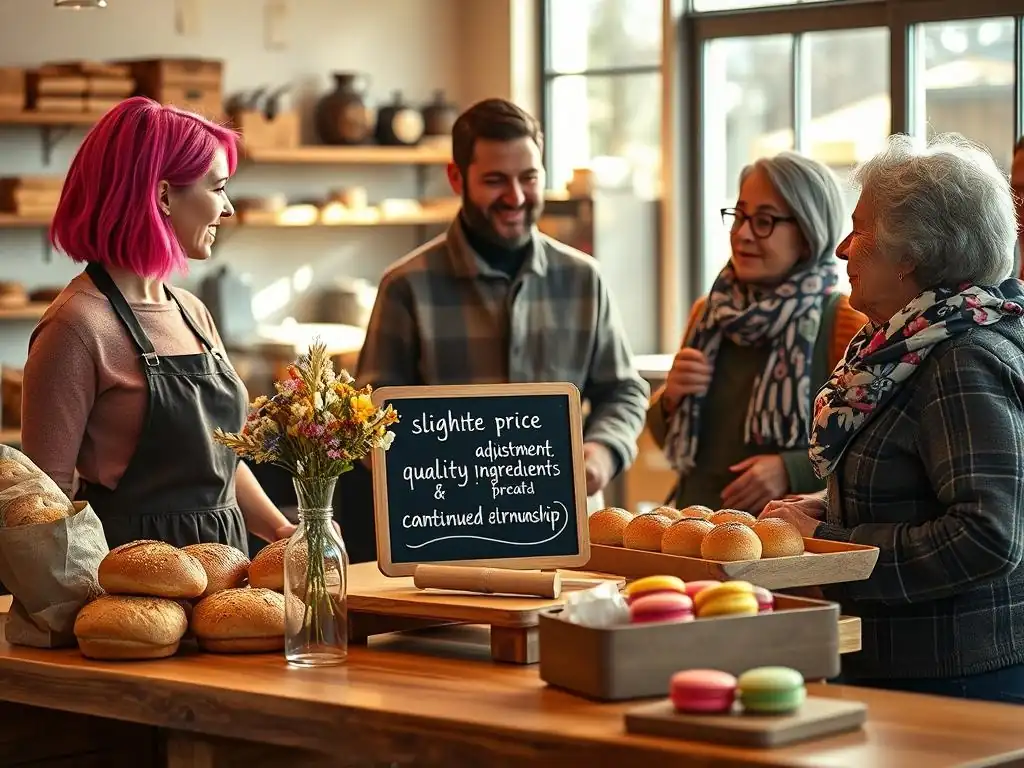
Raising prices can be a sensitive topic for customers who are used to paying a certain amount. However, with careful planning and transparent communication, you can implement a price increase while maintaining customer loyalty. The key is to inform your customers properly, explain the reasons behind the change, and reinforce the value they receive.
Announcing Price Changes: Timing and Channels
Strategic timing and channel selection are critical when announcing changes to your baked goods pricing. Avoid surprising customers with increased prices on their next order without prior notice. A good rule of thumb is to provide at least 2-4 weeks' notice before the new prices take effect. This gives customers time to place orders at the current price if they wish and adjust to the upcoming change. Announcing too far in advance might cause confusion or prompt customers to rush orders unnecessarily, while too little notice can feel abrupt and inconsiderate.
Use multiple communication channels to ensure your message reaches as many customers as possible. Email is often the most direct way to inform your existing customer base. A clear, concise email explaining the upcoming changes is essential. Social media posts (on platforms like Instagram or Facebook) are also effective for broader announcements, but be prepared for potential comments or questions.
Updating your website or online store with a banner or dedicated page about the price change is also crucial for customers placing new orders. Consider including a small note or flyer in packaging for orders going out in the weeks leading up to the change as an additional reminder. Consistency across all platforms is key to a smooth transition for your raising baked goods pricing strategy.
Explaining the Value Proposition: Reinforcing Quality and Ingredients
When announcing a price increase, simply stating "prices are going up" is insufficient and can alienate customers. Instead, focus on explaining why the increase is happening and, more importantly, reinforcing the value and quality that justify the new price. Customers are generally more understanding if they know the increase is necessary due to factors outside your control, such as rising ingredient costs or increased operational expenses, especially if you highlight your commitment to maintaining or improving quality. Frame the increase as a way to continue providing the high-quality products they love.
Emphasize the premium ingredients you use (e.g., real butter, free-range eggs, imported chocolate) and the care and skill that go into each bake. Remind them that they are not just paying for flour and sugar, but for artisanal quality, attention to detail, and the unique flavors you offer.
For example, you might say, "To continue using the finest Belgian chocolate and organic berries you love, which have seen significant price increases, we are making a small adjustment to our prices." This approach connects the price increase directly to the quality they value, making the raising baked goods pricing strategy feel less like a simple cost hike and more like an investment in maintaining excellence.
Highlighting Improvements: Justifying the Higher Cost
If the price increase coincides with improvements you've made to your business or products, be sure to highlight these changes as further justification for the higher cost. Customers are more accepting of paying more when they see tangible benefits. Have you refined a popular recipe to make it even better? Introduced new, premium flavors or product lines? Upgraded your packaging to be more secure or aesthetically pleasing? Invested in new equipment that ensures more consistent results? Improved your ordering system to make it easier for them? These enhancements add value to the customer experience.
For instance, you could announce, "Along with necessary price adjustments due to ingredient costs, we're also excited to introduce our new eco-friendly packaging, ensuring your treats arrive safely while being better for the planet." Or, "We've perfected our sourdough starter over the last year, resulting in an even more flavorful loaf, reflected in the updated price."
By linking the price change to positive developments in your business, you demonstrate that the increased cost is part of your ongoing effort to improve and provide the best possible product and service. This proactive communication is a vital part of a successful raising baked goods pricing strategy.
Implementing a Strategic Price Increase for Baked Goods
Once you've decided when and why to raise prices and prepared your customers, the next step is how to implement the change effectively. A strategic approach minimizes negative impact and helps retain your customer base.
Gradual Price Adjustments: Minimizing Customer Shock
Instead of implementing a large, sudden price hike across all products, consider a more gradual approach to your raising baked goods pricing strategy. A significant jump in price can be jarring for customers and might prompt them to look elsewhere. For example, increasing the price of a dozen standard cupcakes from $30 to $40 overnight (a 33% increase) is likely to cause sticker shock. A softer approach might involve increasing the price by $3-$5 initially, waiting several months, and then implementing another small increase if necessary.
Alternatively, you could phase in increases by product category or popularity. Start with your least popular items, then move to moderately popular ones, and finally adjust the prices of your bestsellers. This allows customers to adjust over time. If a large increase is unavoidable due to substantial cost jumps, clearly explain the necessity using the transparency tactics mentioned earlier. A gradual raising baked goods pricing strategy allows customers to adapt and helps you gauge their reaction to smaller changes before committing to larger ones.
Tiered Pricing: Offering Options at Different Price Points
Implementing tiered pricing is another effective way to introduce higher price points without alienating your entire customer base. This involves offering different versions of a product or service at varying price levels, often based on complexity, ingredients, or customization. For instance, for cakes, you could offer a "Standard" tier with basic flavors and designs at a lower price, a "Premium" tier with specialty flavors and more intricate decoration options at a mid-range price, and a "Luxury" tier for highly custom, elaborate designs at the highest price point.
This strategy allows price-sensitive customers to still purchase from you at a lower tier, while customers who desire more elaborate or premium options are available to pay more. It effectively segments your market and caters to different budgets and needs. For your raising baked goods pricing strategy, you might increase the prices across all tiers proportionally, or you could introduce a new, higher-priced premium tier while keeping the base tier price relatively stable (or with a smaller increase), thereby offering customers a choice and justifying the higher price through added features or complexity in the upper tiers.
Bundling Strategies: Combining Products for Perceived Value
Bundling products can be a clever way to increase the average order value and introduce a slightly higher overall cost to the customer while offering perceived value. Instead of simply raising the price of individual items, you can create curated bundles or packages that offer a slight discount compared to purchasing each item separately at the new individual price.
For example, if you're raising the price of both cookies and brownies, you could create a "Mixed Treat Box" bundle that includes a dozen cookies and a dozen brownies at a price slightly higher than the old combined price but less than the new combined individual price.
This strategy works because customers often focus on the value of the bundle rather than the individual price increases. They feel they are getting a good deal by purchasing the package. It also encourages customers to try a wider variety of your products. While it doesn't directly increase the price of a single item, it increases the total revenue per transaction and can be part of a broader raising baked goods pricing strategy aimed at improving overall profitability without a direct, item-by-item price hike that might cause resistance.
Launching new, premium-priced products is an excellent way to introduce higher price points into your offering without changing the prices of your existing, familiar items. These new products can feature more expensive ingredients, require more intricate techniques, or offer unique flavor profiles that inherently command a higher price. For example, if your current offerings are standard cakes and cupcakes, you could introduce French macarons or complex entremets, which are naturally priced higher due to the skill and ingredients involved.
This allows you to attract customers willing to pay more for gourmet or specialty items. The higher price point for the new items is justified by their premium nature, not by an increase in the cost of existing, familiar items.
This strategy can also help segment your customer base, appealing to those looking for something special and willing to pay for it. Over time, as customers become accustomed to the higher price points of your premium offerings, you may find less resistance if you eventually need to make small adjustments to the prices of your core products as part of your ongoing raising baked goods pricing strategy.
Maintaining Customer Loyalty After Raising Prices on Baked Goods

Raising prices is only part of the equation; keeping your customers happy and loyal afterward is just as important. A successful raising baked goods pricing strategy doesn't end with the price change; it continues with nurturing customer relationships.
Exceptional Customer Service: Going the Extra Mile
Providing exceptional customer service becomes even more critical after implementing a price increase. Customers need to feel that the increased cost is matched by an elevated experience.
This means being responsive to inquiries, being flexible where possible (within reason), handling any issues promptly and courteously, and generally making the ordering and pickup/delivery process as smooth and pleasant as possible. For instance, if a customer has a minor issue with an order, resolving it quickly and generously (e.g., offering a small discount on a future order or a complimentary item) can turn a potential complaint into a positive experience and reinforce their decision to continue supporting your business despite the higher price.
Going the extra mile can also include personalized touches, like remembering customer preferences, writing thank-you notes, or offering helpful suggestions. These small gestures build rapport and make customers feel valued. In a home baking business, the personal connection is often a key differentiator. Maintaining that strong connection and providing outstanding service helps justify your prices and encourages repeat business. Your raising baked goods pricing strategy should be supported by a commitment to excellence in every customer interaction.
Loyalty Programs and Discounts: Rewarding Repeat Business
Implementing loyalty programs or offering exclusive discounts to repeat customers is a powerful way to show appreciation and incentivize continued patronage after a price increase. This helps offset the impact of the higher prices for your most valued customers. A simple loyalty program could be a punch card system (buy 9 dozen cupcakes, get the 10th free, based on the new price) or a points system based on total spending.
Offering occasional exclusive discounts to your email subscribers or followers on social media (e.g., "10% off for our loyal customers this week!") can also encourage orders. These programs make customers feel recognized and rewarded for their loyalty, making them less likely to seek cheaper alternatives after the price change. While offering discounts might seem counterintuitive after raising prices, the goal is to maintain overall customer lifetime value by retaining your core customer base. Integrating loyalty initiatives into your raising baked goods pricing strategy helps soften the impact of the increase for your biggest fans.
Gathering Feedback: Understanding Customer Perception
Actively seeking and listening to customer feedback is essential after implementing a price increase. This helps you understand how the change is being perceived and identify any areas of concern before they escalate. You can solicit feedback through various channels: a simple question in a follow-up email after an order, a poll on social media (though be cautious with public polls on pricing), or direct conversations with customers during pickup.
Pay attention to any decline in order frequency from loyal customers or any direct comments about the price. While not all feedback will be positive, understanding the sentiment allows you to address concerns, clarify your value proposition further, or even identify if the price increase was too steep for your market.
For example, if multiple customers mention that a specific item now feels too expensive compared to its size, you might consider slightly adjusting that item's price or finding ways to increase its perceived value. Using feedback to refine your raising baked goods pricing strategy demonstrates that you value your customers' opinions.
Continuous Improvement: Refining Products and Services
Commitment to continuous improvement is key to long-term customer loyalty, especially after a price increase. Customers are more willing to pay a premium if they see that you are constantly working to enhance your products and services. This could involve refining existing recipes based on feedback, experimenting with new techniques, sourcing even higher-quality ingredients, improving your packaging, or streamlining your ordering process.
Showcasing these improvements through your communication channels reinforces the idea that your business is evolving and that the value you offer is increasing. For instance, sharing photos of a new, more intricate decoration technique you've mastered or announcing that you've switched to compostable packaging adds value beyond just the taste of the bake. By consistently striving for excellence and demonstrating that commitment to your customers, you build a strong case for your pricing and foster loyalty. A successful raising baked goods pricing strategy is supported by visible, ongoing efforts to improve every aspect of the customer experience.
Avoiding Common Mistakes When Increasing Baking Prices
Raising prices can be tricky, and several common pitfalls can lead to customer dissatisfaction or loss of business. Being aware of these mistakes is crucial for a smooth transition.
Underestimating Costs: Accurate Calculation is Key
One of the most significant mistakes is failing to accurately calculate your costs before setting new prices or raising existing ones. Many home bakers focus primarily on ingredient costs but overlook other crucial expenses like utilities, packaging, marketing, labor (your time! ), and the cost of running your business (licenses, insurance, software). Underestimating these costs means your new, higher price might still not be enough to cover everything and provide a sustainable profit margin. For example, if you calculate your labor at minimum wage but your skilled decorating time is worth significantly more, you're undervaluing your product.
A thorough cost analysis should include direct costs (ingredients, packaging) and indirect costs (utilities, overhead, labor). Calculate the cost per batch and then per item. Ensure your raising baked goods pricing strategy is built on a solid understanding of your true expenses, not just a rough estimate.
If your cost for a dozen cookies is $6.50 (including ingredients, packaging, and a portion of utilities/labor), and you were selling them for $18, your gross profit is $11.50. If costs rise to $7.50, you need to raise the price to maintain that $11.50 profit margin or increase it. Without accurate cost tracking, you're guessing.
Ignoring Competitor Pricing: Maintaining Market Awareness
Another common error is increasing prices in isolation without considering what competitors are charging for similar products in your area. If your new prices are significantly higher than comparable local offerings without a clear, demonstrable difference in quality or value, customers may simply switch to a competitor. While you shouldn't necessarily match the lowest price, you need to understand where your pricing fits within the local market landscape.
Regularly check the websites, social media, or even visit local bakeries to get an idea of their pricing for items similar to yours (e.g., a basic dozen cupcakes, a standard 8-inch cake, decorated cookies). If your new price for a dozen standard cupcakes is $45, but every other local bakery charges $30-$35 for a similar product, you need a very strong justification based on superior quality, unique flavors, or exceptional service to support that higher price point. Your raising baked goods pricing strategy must acknowledge the competitive environment you operate in.
Failing to Communicate Effectively: Keeping Customers Informed
As discussed earlier, poor or absent communication about a price increase is a major misstep. Surprising customers with higher prices, or not clearly explaining the reasons behind the change, can lead to frustration and a feeling of being taken advantage of. Avoid vague announcements or burying the information where customers won't see it.
Effective communication involves:
- Giving sufficient notice (e.g., 2-4 weeks).
- Using multiple channels (email, social media, website).
- Clearly stating which prices are changing and when.
- Briefly and honestly explaining the primary reasons (e.g., rising ingredient costs, investment in quality).
- Reiterating the value and quality customers receive.
Failing to communicate effectively can erode trust and make customers question your transparency. A well-executed raising baked goods pricing strategy includes a robust communication plan.
Not Justifying the Value: Highlighting Quality and Benefits
A price increase must be supported by the perceived value customers receive. If you raise prices without reinforcing the quality of your ingredients, the skill involved in your baking, the care taken in packaging, or the overall positive experience of ordering from you, customers may feel they are simply paying more for the same thing. This can lead to resentment and a search for cheaper alternatives.
Constantly remind customers of what makes your baked goods special. Use your social media and website to showcase your beautiful creations, highlight the quality of your ingredients (e.g., "Made with real Madagascar vanilla! "), share your baking process, and feature positive customer testimonials. This ongoing effort to demonstrate value strengthens your brand and makes future price adjustments easier to justify. Your raising baked goods pricing strategy is more successful when customers understand and appreciate the value behind the price tag.
Long-Term Strategies for Sustainable Pricing in Your Home Baking Business

Implementing a price increase is often a necessary step, but sustainable profitability requires a long-term view of your pricing and business operations.
Cost Optimization: Streamlining Operations
While raising prices can compensate for increased costs, actively working to optimize your costs is equally important for long-term sustainable pricing. This involves streamlining your operations to reduce waste and increase efficiency. Can you negotiate better prices with suppliers for bulk orders? Are there ways to reduce energy consumption in your baking process? Can you optimize your baking schedule to use oven space more efficiently? Is there unnecessary waste in your packaging or ingredient usage?
For example, planning your baking schedule to bake multiple items requiring similar oven temperatures consecutively can save on electricity or gas. Buying flour in 25lb bags instead of 5lb bags might offer a significant per-pound discount. Implementing systems to track inventory closely can reduce spoilage. These cost-saving measures directly improve your profit margins without requiring a price increase. Integrating cost optimization into your overall raising baked goods pricing strategy ensures you're addressing profitability from both revenue and expense angles.
Building a Strong Brand: Creating Perceived Value
A strong brand is invaluable when it comes to sustainable pricing. A well-regarded brand built on reputation for quality, consistency, and excellent customer service can command higher prices than a generic one. Customers are often willing to pay a premium for a brand they trust and feel connected to. Invest time and effort in developing your brand identity, sharing your story, consistently producing high-quality products, and providing memorable customer experiences.
Your brand is more than just your logo; it's the entire perception customers have of your business. Positive word-of-mouth, beautiful presentation, engaging social media content, and consistent quality all contribute to building a strong brand. When customers associate your brand with excellence and reliability, they are less likely to object to price increases because they trust they are getting superior value. Building a strong brand is a fundamental component of a successful long-term raising baked goods pricing strategy.
Monitoring Market Trends: Adapting to Changing Conditions
The market for baked goods is dynamic, with evolving trends in flavors, ingredients (e.g., demand for gluten-free, vegan options), and customer preferences. Staying aware of these trends allows you to adapt your offerings and pricing accordingly. Are customers in your area increasingly willing to pay more for ethically sourced ingredients? Is there growing demand for elaborate custom cakes that command higher prices?
Monitoring market trends also involves keeping an eye on economic conditions and competitor activities. If new bakeries open in your area, or if major ingredient costs are projected to rise further, being aware allows you to proactively adjust your raising baked goods pricing strategy rather than reactively scramble when profitability declines. Subscribe to industry newsletters, follow other bakers on social media, and pay attention to what's happening in the food scene to stay informed.
Investing in Marketing: Reinforcing Value and Attracting New Customers
Consistent marketing efforts are crucial for reinforcing the value of your baked goods and attracting new customers who are willing to pay your prices. Marketing isn't just about promotions; it's about telling your story, showcasing your quality, and building relationships. Share behind-the-scenes glimpses of your baking process, highlight the quality of your ingredients, post stunning photos of your finished products, and share positive testimonials.
Effective marketing helps potential customers understand why your baked goods are worth the price, even after an increase. It attracts customers who value quality and taste over being the absolute cheapest option. Investing in good photography, engaging social media content, or even local advertising can broaden your reach and bring in customers who are a good fit for your pricing structure. Marketing is an ongoing investment in your brand and customer base, supporting your raising baked goods pricing strategy by continually demonstrating value.
Example: Case Study of a Successful Baking Price Increase
Let's consider a hypothetical case study of a home baker, "Sweet Success Bakery," specializing in custom cupcakes and cookies.
Background and Challenges
Sweet Success Bakery had been operating for three years, building a loyal customer base through word-of-mouth and social media. The baker, Sarah, was known for her creative designs and delicious flavors. Her prices had remained the same for two years. However, over the last 18 months, Sarah noticed her profit margins shrinking. The cost of butter had increased by nearly 20%, eggs by 15%, and her preferred brand of food coloring for her intricate designs had also gone up by 10%.
Additionally, the cost of her custom-branded packaging had risen by 12%. Sarah was working longer hours but seeing less profit relative to her sales volume. Demand was high, with custom order slots often booked a month in advance. Her current raising baked goods pricing strategy was no longer sustainable.
| Expense Item | Old Cost (per dozen cupcakes) | New Cost (per dozen cupcakes) | % Increase |
|---|---|---|---|
| Key Ingredients | ~$6.00 | ~$7.10 | ~18% |
| Packaging (Box, Liner) | ~$1.50 | ~$1.68 | ~12% |
| Estimated Utilities | ~$1.00 | ~$1.15 | ~15% |
| Total Variable Cost | ~$8.50 | ~$9.93 | ~17% |
Sarah was selling a dozen standard cupcakes for $30, giving her a gross profit of $21.50 ($30 - $8.50). With the increased costs, her profit per dozen dropped to $20.07 ($30 - $9.93), a decrease of about 7% profit per dozen, which significantly impacted her overall earnings given her high volume. Local competitors were charging between $32 and $38 for similar quality custom cupcakes.
Implemented Strategies
Sarah decided she needed to adjust her raising baked goods pricing strategy. She performed a detailed cost analysis to understand the exact impact of rising expenses. She also researched competitor pricing, confirming she was on the lower end of the market.
She decided on a multi-pronged approach:
- Gradual Increase: Instead of jumping straight to $38, she decided to increase the price of her standard dozen cupcakes from $30 to $34 (an approx. 13% increase). This was still within the competitive range but significantly improved her margin.
- Tiered Pricing: She introduced a "Premium" tier for cupcakes featuring specialty flavors (like saffron-pistachio or Earl Grey lavender) and requiring more complex techniques, pricing these at $38-$42 per dozen depending on complexity. Her standard flavors remained in the "Classic" tier at the new $34 price.
- Communication: She sent out an email to her customer list and posted on social media two weeks before the price change. The message was friendly and transparent, explaining that ingredient and packaging costs had risen but emphasizing her commitment to using the same high-quality ingredients and providing the same level of service they expected. She highlighted the introduction of the new Premium tier as an exciting development.
- Loyalty Program: She introduced a digital punch card system where customers received a 10% discount on their 10th order.
- Highlighting Value: She increased her social media activity, posting more behind-the-scenes content showing the quality of her ingredients and the care that went into each bake.
Results and Lessons Learned
After implementing the price increase, Sarah saw a slight dip in orders for the first week, but demand quickly stabilized back to near previous levels. Some customers transitioned to the new Premium tier, increasing her average order value. The transparency in communication was generally well-received, with many customers expressing understanding. The loyalty program was popular and encouraged repeat business.
- Results:
- Gross profit per dozen standard cupcakes increased from ~$20.07 to ~$24.07 ($34 - $9.93), a significant improvement.
- Average order value increased due to the introduction and adoption of the Premium tier.
- Customer retention remained high, with only a minimal number of customers citing the price increase as a reason for not reordering (less than 5% based on tracking).
- Booking lead time remained consistent, indicating continued strong demand.
- Lessons Learned:
- Transparent communication is key to minimizing negative customer reaction.
- A gradual or tiered approach can be less jarring than a sudden, large increase.
- Customers who value quality are often willing to pay a fair price, especially when the value is clearly communicated.
- Loyalty programs help retain existing customers and soften the impact of higher prices.
- Regularly monitoring costs and market prices is essential for timely adjustments to your raising baked goods pricing strategy.
This case study, while illustrative, demonstrates how a well-planned and communicated raising baked goods pricing strategy can successfully increase profitability without alienating a loyal customer base.
Conclusion: Mastering the Art of Pricing Your Baked Goods Effectively
Mastering the art of pricing your baked goods is fundamental to building a sustainable and profitable home baking business. It's a dynamic process that requires regular review and thoughtful adjustment. Understanding the triggers for a price increase – from rising ingredient and operational costs to increased demand and market positioning – is the first step. Accurately calculating your expenses, including your time and overhead, ensures that your prices reflect the true cost and value of your work.
Implementing a raising baked goods pricing strategy is best approached with transparency and clear communication. Informing your customers in advance, explaining the reasons for the change, and continuously highlighting the quality and value they receive helps build trust and maintain loyalty. Strategic implementation methods like gradual adjustments, tiered pricing, or bundling can make the transition smoother for both you and your customers.
By avoiding common mistakes like underestimating costs or ignoring competitor pricing, and by focusing on long-term strategies like cost optimization, brand building, and continuous improvement, you can successfully navigate the challenges of raising prices. Ultimately, a well-executed raising baked goods pricing strategy ensures your passion for baking can continue to be a rewarding and financially viable endeavor.
Frequently Asked Questions
How often should I review my baked goods pricing?
You should review your pricing at least annually, but ideally every quarter. This allows you to account for changes in ingredient costs and market trends.
What are some key factors to consider before raising prices?
Consider your cost of goods sold (COGS), your competitor's pricing, and the perceived value of your baked goods. Understanding these factors will help you determine an appropriate price increase.
How can I justify a price increase to my customers?
Be transparent and communicate the reasons for the increase, such as rising ingredient costs or enhanced product quality. Emphasize the value your baked goods offer.
What are some alternatives to simply raising prices across the board?
Consider offering premium products at a higher price point or adjusting portion sizes. This allows you to increase revenue without significantly impacting existing customers.
What is the risk of waiting too long to raise prices?
Waiting too long can lead to decreased profitability and potentially force you to make drastic price increases later, which could alienate customers.
Final Reflection: The Sweet Science of Pricing Baked Goods
The art of pricing baked goods isn't just about profit; it's about sustainability and ensuring the continued enjoyment of delicious treats for everyone. In a world grappling with inflation and rising ingredient costs, understanding how to strategically raise prices without alienating your loyal customer base is more crucial than ever. This isn't simply a business decision; it's a vital component of long-term success in the baking industry.
The impact of transparent and well-executed pricing strategies extends far beyond the bottom line. It fosters trust between baker and customer, creating a sense of shared understanding and mutual respect. The price of a thing is what it costs you to get it.
– Henry David Thoreau. This quote, while seemingly simple, highlights the multifaceted nature of pricing. It's not just about the monetary value, but also the value of time, ingredients, skill, and passion poured into each creation. The ability to communicate this value effectively is paramount to maintaining a thriving business and a satisfied clientele.
Now, consider your own baking journey, whether it's a professional enterprise or a cherished hobby. How can you apply the principles discussed – transparent communication, value-driven pricing, and a focus on the customer experience – to your own pricing strategies? Take the time to analyze your costs, understand your market, and confidently communicate the value you offer. Don't be afraid to adjust your prices to reflect the true cost of your delicious creations. The future of your baking success depends on it. Embrace the challenge, and bake on!
Ready to Bake Bigger Profits?
Thanks for taking the time to learn how to confidently raise your prices! We hope you now feel empowered to make your baking business even more successful. Ready to put this knowledge into action?
- Implement your price increase this week. Choose a day and make the change. You've got this!
- Share your pricing strategy with other bakers in our online community forum. Let's support each other's growth!
- Consider offering a limited-time introductory offer for returning customers to soften the transition.
What small step will you take today to ensure your baking business thrives?