
KitchenAid Artisan vs. Professional Series: Which Mixer is Right for You?


Welcome to BakeWithEase, your baking journey starts here! Ever wondered if that KitchenAid Artisan is enough, or if you truly need the Professional Series? This guide delves deep into the key differences between these iconic mixers, helping you make the perfect choice for your baking needs. Discover which model aligns with your baking ambitions and unlock a world of effortless creations. Curious to know which KitchenAid mixer reigns supreme for your kitchen? Let's find out!
- KitchenAid Mixer Buying Guide: Choosing the Right Stand Mixer for Your Needs
-
KitchenAid Artisan Series: A Deep Dive into the Home Baker's Favorite
- Artisan Series Features: Power, Capacity, and Color Options
- Key Features of the KitchenAid Artisan: Tilt-Head Design, 325 Watts, 5-Quart Bowl, 10 Speeds, Over 40 Colors
- KitchenAid Artisan Attachments: Expanding Your Baking Possibilities
- Pros and Cons of the KitchenAid Artisan Series
- Who is the KitchenAid Artisan Series Best For? Casual Bakers and Smaller Kitchens
-
KitchenAid Professional Series: Power and Performance for Serious Bakers
- Professional Series Features: Bowl-Lift Design, Higher Wattage, and Larger Capacity
- Key Features of the KitchenAid Professional: Bowl-Lift Design, 575 Watts, 6-Quart Bowl, 10 Speeds, Stainless Steel Bowl
- KitchenAid Professional Attachments: Built for Heavy-Duty Tasks
- Pros and Cons of the KitchenAid Professional Series
- Who is the KitchenAid Professional Series Best For? Frequent Bakers and Larger Batches
- KitchenAid Artisan vs. Professional: A Side-by-Side Comparison Chart
- Making the Right Choice: A KitchenAid Stand Mixer Recommendation
- Maintaining Your KitchenAid Mixer: Ensuring Years of Baking Bliss
- KitchenAid Mixer Alternatives: Exploring Other Stand Mixer Brands
- Final Thoughts: Your KitchenAid Mixer Buying Guide
-
Frequently Asked Questions
- What are the main differences between the KitchenAid Artisan and Professional series mixers?
- Which KitchenAid mixer is better for making large batches of dough?
- Is the KitchenAid Artisan mixer suitable for beginner bakers?
- How does the motor power of the Artisan compare to the Professional series?
- Are attachments interchangeable between the KitchenAid Artisan and Professional series mixers?
- Final Reflection: Choosing Your Perfect Kitchen Companion
- Unlock Your Baking Potential: Choose Your Perfect Mixer!
KitchenAid Mixer Buying Guide: Choosing the Right Stand Mixer for Your Needs
Understanding Your Baking Needs: A KitchenAid Mixer Comparison
Choosing the right stand mixer is a crucial step in elevating your baking journey, whether you're whipping up occasional batches of cookies or tackling complex bread recipes weekly. Before diving into specific models, it's essential to assess your typical baking habits.
Consider the frequency of your baking, the types of recipes you most often prepare (light batters, stiff doughs, large quantities), and the volume of food you usually process at once. A casual baker making a cake or two a month will have vastly different requirements than someone regularly kneading multiple loaves of sourdough or whipping large quantities of meringue for an event.
Understanding these needs forms the foundation of a successful KitchenAid mixer buying guide. For instance, if you primarily make simple cake batters, whipped cream, or smaller cookie batches, a less powerful motor and smaller bowl capacity might suffice.
Conversely, if you envision yourself kneading dense rye bread dough, mixing large quantities of holiday cookie dough, or preparing substantial double or triple batches, you'll need a mixer with more power and a larger capacity to handle the load without straining the motor or overflowing the bowl. This initial self-assessment helps narrow down the options and ensures you invest in a KitchenAid stand mixer that aligns perfectly with your culinary aspirations.
Why KitchenAid Stand Mixers are a Baker's Best Friend: Durability and Performance
KitchenAid stand mixers have earned a reputation as a cornerstone in countless kitchens worldwide, largely due to their exceptional durability and consistent performance. Built with robust metal construction, these mixers are designed to withstand years, often decades, of rigorous use.
Unlike appliances with lighter, plastic components that may wear out quickly under stress, a KitchenAid mixer feels solid and stable, even when tackling demanding tasks like kneading heavy doughs. This longevity means that while the initial investment might be higher than some other brands, the mixer often becomes a reliable workhorse for a lifetime of baking projects, proving to be a cost-effective choice in the long run.
Beyond their sturdy build, KitchenAid mixers deliver reliable performance across a wide range of tasks. The planetary mixing action, where the beater rotates in one direction while orbiting in the other, ensures thorough incorporation of ingredients, scraping the sides of the bowl and leaving no dry pockets.
This efficient mixing is vital for achieving consistent results in everything from airy meringues and smooth frostings to perfectly developed bread doughs. The availability of multiple speeds allows precise control, whether you need a gentle stir or a high-speed whip, further enhancing their versatility and solidifying their place as an indispensable tool for any serious home baker looking for dependable and high-quality equipment.
KitchenAid Artisan Series: A Deep Dive into the Home Baker's Favorite
Artisan Series Features: Power, Capacity, and Color Options
The KitchenAid Artisan series is arguably the most popular choice among home bakers, striking a balance between capability and accessibility. A defining feature is its 325-watt motor, which provides ample power for most everyday baking tasks, including mixing cookie dough, cake batters, and whipping cream. While not designed for continuous heavy-duty kneading, it handles standard recipes comfortably. The standard Artisan model typically comes with a 5-quart stainless steel bowl, a versatile size suitable for single or double batches of many recipes, such as enough cookie dough for about 9 dozen cookies or batter for 4 1/2 loaves of bread.
What truly sets the Artisan apart for many is its stunning array of color options – often exceeding 40 different shades, ranging from classic Onyx Black and Empire Red to vibrant shades like Pistachio and Ice Blue. This extensive palette allows bakers to choose a mixer that not only performs well but also complements their kitchen decor, turning the appliance into a stylish statement piece.
Coupled with its practical tilt-head design and 10-speed control, the Artisan series offers a blend of functionality, capacity, and aesthetic appeal that resonates strongly with the needs and desires of the average home baking enthusiast.
Key Features of the KitchenAid Artisan: Tilt-Head Design, 325 Watts, 5-Quart Bowl, 10 Speeds, Over 40 Colors
The KitchenAid Artisan stand mixer is distinguished by several key features that contribute to its widespread appeal. Its signature tilt-head design allows easy access to the bowl and attached beater or whisk. By simply flipping a latch, the motor head lifts up, making it simple to add ingredients, scrape down the sides of the bowl, or change attachments. This design is particularly convenient for home bakers who frequently pause during mixing to incorporate additions or check consistency.
Powering the Artisan is a 325-watt motor, which is robust enough for the majority of typical home baking recipes, including mixing batters, doughs (though very stiff ones in large quantities can be challenging), and whipping ingredients. It is paired with a 5-quart stainless steel bowl, a size that comfortably accommodates standard recipe yields.
The mixer offers 10 distinct speeds, controlled by a sliding lever, providing precise control from a gentle stir (Speed 1) perfect for incorporating dry ingredients without making a mess, up to a fast whip (Speed 10) for aerating cream or egg whites. Finally, the sheer variety of colors available, often numbering over 40, makes the Artisan a favorite for those who view their appliances as part of their kitchen's aesthetic.
KitchenAid Artisan Attachments: Expanding Your Baking Possibilities
The versatility of the KitchenAid Artisan, like other KitchenAid models, is significantly enhanced by its power hub, which accepts a wide range of attachments. This single hub, located at the front of the mixer head, transforms the stand mixer from a baking tool into a multipurpose kitchen appliance. While the mixer comes standard with a flat beater, wire whip, and dough hook, the true magic lies in the optional attachments that unlock new culinary possibilities beyond mixing.
With the right attachments, your Artisan can perform tasks previously requiring separate gadgets. For instance, the pasta roller and cutter set allows you to effortlessly make fresh pasta sheets and noodles. The food grinder attachment can grind meats for burgers or sausages, or process vegetables.
For dessert lovers, the ice cream maker attachment turns your mixer into a frozen treat machine. These are just a few examples; with over a dozen different attachments available, from spiralizers and juicers to grain mills and slicers, the Artisan series mixer can become the central hub of your kitchen prep, making it a valuable investment that extends far beyond basic baking.
Must-Have Artisan Attachments: Pasta Roller & Cutter Set, Food Grinder, Ice Cream Maker
When building your collection of KitchenAid Artisan attachments, some stand out for their utility and ability to expand your baking and cooking repertoire significantly. The Pasta Roller & Cutter Set is often considered essential for anyone who enjoys fresh pasta; it allows you to roll dough to your desired thickness and cut it into popular shapes like fettuccine and spaghetti, a task that would be laborious by hand.
Another highly recommended attachment is the Food Grinder. This tool is incredibly versatile for processing ingredients like meats, vegetables, or even dried bread for breadcrumbs, opening up possibilities for homemade burgers, meatloaf, or fresh salsa. For those with a sweet tooth, the Ice Cream Maker attachment is a game-changer, allowing you to create homemade ice cream, gelato, or sorbet right in your KitchenAid bowl, offering control over ingredients and flavors not possible with store-bought options. Investing in these key attachments maximizes the value and functionality of your KitchenAid Artisan stand mixer.
Pros and Cons of the KitchenAid Artisan Series
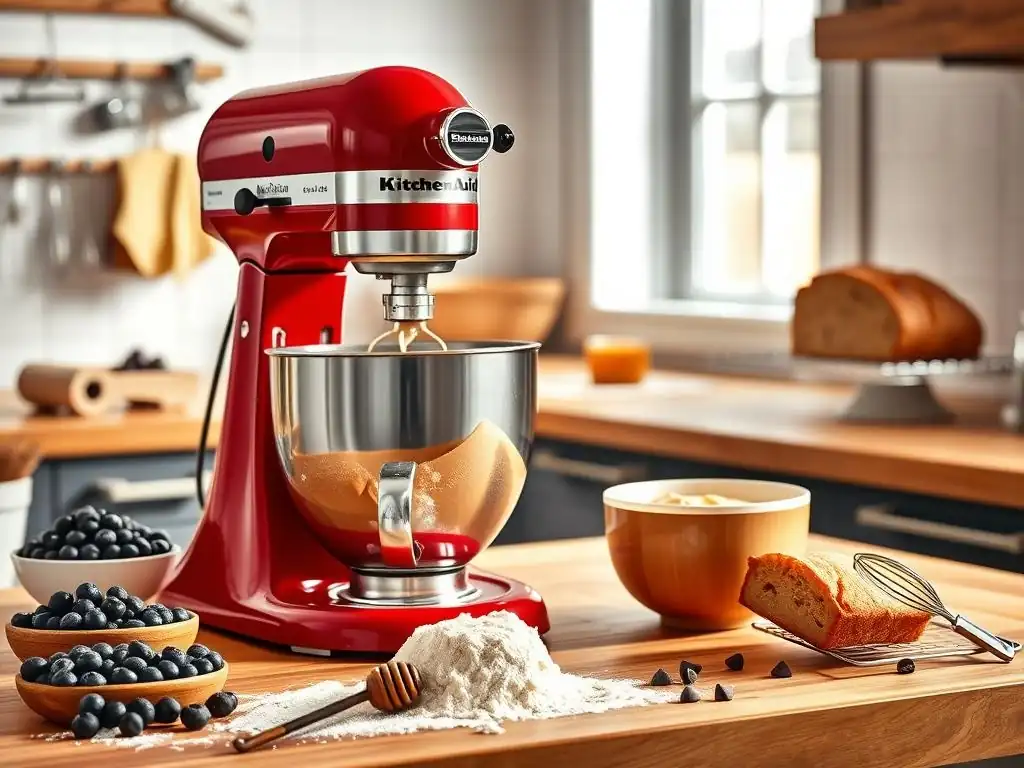
Artisan Pros: Wide Color Selection, Tilt-Head Design, More Affordable
The KitchenAid Artisan series boasts several distinct advantages that make it a beloved appliance for home bakers. Perhaps its most visually appealing pro is the extensive spectrum of colors available, allowing users to perfectly match their kitchen aesthetic or make a bold statement. This customization is unmatched by other stand mixer lines.
Functionality-wise, the tilt-head design is a significant benefit. It provides easy access to the mixing bowl and attachments, simplifying the process of adding ingredients, scraping the bowl, or swapping out accessories. From a practical standpoint, the Artisan series is generally more affordable than the Professional series, making it a more accessible entry point for many individuals seeking a reliable, high-quality stand mixer without the higher investment required for the larger, more powerful models.
Artisan Cons: Lower Wattage, Smaller Bowl, Can Struggle with Stiff Doughs
Despite its many strengths, the KitchenAid Artisan series does have limitations that might impact bakers with specific needs. The 325-watt motor, while sufficient for most tasks, has lower wattage compared to the Professional series. This can lead to the motor straining or overheating when attempting to knead very stiff doughs, such as dense whole wheat or multiple loaves of sourdough, especially over extended periods.
The standard 5-quart bowl size, while adequate for many recipes, may be limiting for those who frequently bake large batches of cookies, cakes, or bread for big families or events. Attempting to overfill the bowl can lead to inefficient mixing or ingredients spilling over. Consequently, bakers who regularly work with large volumes or demanding doughs might find the Artisan's capacity and power insufficient for their needs, potentially requiring them to mix in smaller batches or opt for a more robust model from the outset.
Who is the KitchenAid Artisan Series Best For? Casual Bakers and Smaller Kitchens
The KitchenAid Artisan series is ideally suited for the casual home baker who enjoys preparing standard recipes like cookies, cakes, brownies, and occasional yeast breads. Its 325-watt motor and 5-quart capacity are perfectly adequate for single or double batches of most common recipes. If you bake a few times a month, perhaps for family or friends, and typically follow recipes that don't involve very large quantities of extremely stiff dough, the Artisan will likely meet all your needs efficiently and reliably.
Furthermore, the Artisan's relatively compact size and tilt-head design make it a good fit for kitchens with limited counter space or lower cabinets. The ability to tilt the head makes it easier to manage under cabinets, and its overall footprint is slightly smaller than the bowl-lift Professional models. Coupled with its attractive price point and wide color selection, the Artisan series represents an excellent balance of performance, size, and cost for the average home baking enthusiast, making it a top consideration in any KitchenAid mixer buying guide for hobbyists.
KitchenAid Professional Series: Power and Performance for Serious Bakers
Professional Series Features: Bowl-Lift Design, Higher Wattage, and Larger Capacity
The KitchenAid Professional series is designed for bakers who require more power, capacity, and durability to handle frequent and demanding tasks. A key distinguishing feature is its bowl-lift design. Instead of the motor head tilting, the bowl is securely attached to arms and is raised or lowered by a lever to meet the beater. This design provides greater stability, particularly important when mixing heavy or large quantities of ingredients, as it prevents the mixer head from potentially bouncing or straining under load.
Professional series mixers typically feature more powerful motors, often ranging from 575 watts up to 750 watts or more depending on the specific model (like the Professional 600 or Pro HD). This increased wattage allows them to tackle much stiffer doughs, larger batches, and longer mixing times without overheating or showing signs of strain. Coupled with larger bowl capacities, commonly 6 quarts or even 7 or 8 quarts on some models, the Professional series is built to handle the volume and intensity required by avid bakers, those running small home businesses, or anyone who frequently bakes for large groups.
Key Features of the KitchenAid Professional: Bowl-Lift Design, 575 Watts, 6-Quart Bowl, 10 Speeds, Stainless Steel Bowl
The core features of the KitchenAid Professional series emphasize power, stability, and capacity. The defining characteristic is the bowl-lift mechanism, where the bowl is locked into place and raised via a lever. This design offers superior stability and support, making it ideal for handling very heavy loads like dense bread dough or large quantities of batter without the mixer rocking or the head flexing.
Professional models typically come equipped with a robust motor, often starting around 575 watts (though some models exceed 600 watts), providing significantly more power than the Artisan. This higher wattage allows the mixer to handle stiff doughs and larger volumes with greater ease and less strain. They commonly feature a 6-quart stainless steel bowl, a substantial size capable of mixing dough for up to 13 dozen cookies or kneading dough for 8 loaves of bread in a single batch, making it perfect for larger households or frequent bakers.
Like the Artisan, they offer 10 speeds for versatile mixing control. While the color selection is more limited than the Artisan, focusing on core colors like Red, Black, Silver, and sometimes Cobalt Blue, the emphasis is clearly on performance and capacity over decorative variety.
KitchenAid Professional Attachments: Built for Heavy-Duty Tasks
While the power hub on the Professional series accepts the same wide array of standard KitchenAid attachments as the Artisan, some attachments are particularly well-suited for or designed to be used with the higher power and stability of the Professional models. The robust motor and bowl-lift design mean these mixers can handle attachments that process larger volumes or require more sustained power.
For example, attachments that process large quantities of ingredients, such as the Metal Food Grinder (which is more durable than plastic versions), or those requiring consistent torque, perform exceptionally well. While any attachment can technically fit, using power-hungry attachments like the grain mill or sifter with scale attachment might be more efficient and less taxing on the motor of a Professional series mixer compared to the Artisan, especially when processing larger amounts. The stability of the bowl-lift design also makes it easier to use attachments that might involve more vibration or require steady pressure.
Professional-Grade Attachments: Precise Heat Mixing Bowl, Sifter + Scale Attachment, Metal Food Grinder
For serious bakers utilizing the power of a KitchenAid Professional mixer, certain attachments can further enhance their capabilities, especially for more complex or precise tasks. The Precise Heat Mixing Bowl, for instance, fits onto the Professional's base and allows for controlled heating while mixing, perfect for tempering chocolate or making Swiss meringue buttercream, processes that benefit greatly from stable temperatures.
The Sifter + Scale Attachment is another tool that pairs well with the Professional series, especially for bakers who prioritize accuracy and consistency. It sifts dry ingredients while weighing them directly into the bowl, ensuring precise measurements and lump-free results for large batches. Finally, for those who frequently grind ingredients, the Metal Food Grinder attachment offers enhanced durability and performance compared to its plastic counterpart, capable of handling larger volumes of meat or tough ingredients, aligning with the heavy-duty nature of the Professional mixer itself.
Pros and Cons of the KitchenAid Professional Series
Professional Pros: Powerful Motor, Large Bowl Capacity, Durable Construction
The KitchenAid Professional series is built with significant advantages for the serious baker. Its most notable pro is the powerful motor, typically 575 watts or higher, which provides the necessary torque to handle the toughest doughs, including dense rye or whole wheat bread, and mix large batches of ingredients without straining or overheating. This power is a game-changer for frequent bread bakers or those who mix large volumes regularly.
The large bowl capacity, commonly 6 quarts, is another major benefit. It allows bakers to prepare significantly larger quantities in a single batch compared to the Artisan, saving time and effort when baking for events, large families, or running a small home business. Furthermore, the Professional series features a robust, often heavier-duty construction, including the stable bowl-lift mechanism, which enhances durability and ensures the mixer remains stable and reliable even under continuous heavy loads, promising a long lifespan of performance.
Professional Cons: Larger Footprint, Higher Price Tag, Fewer Color Options
While powerful, the KitchenAid Professional series does come with some drawbacks that might influence a buyer's decision. One significant con is its larger footprint and height compared to the Artisan. The bowl-lift design, while stable, means the mixer doesn't tuck as neatly under standard kitchen cabinets when in use, and it generally takes up more counter space. This can be a consideration for those with limited kitchen real estate.
Another considerable factor is the higher price tag. Professional series mixers are a more significant investment than the Artisan models, reflecting their increased power and capacity. This higher cost might be prohibitive for casual bakers or those on a tighter budget. Lastly, the Professional series typically offers a much more limited selection of colors compared to the vibrant range of the Artisan, focusing more on classic, utilitarian finishes rather than decorative options.
Who is the KitchenAid Professional Series Best For? Frequent Bakers and Larger Batches
The KitchenAid Professional series is the ideal choice for passionate bakers who frequently tackle challenging recipes, work with stiff doughs, or regularly prepare large quantities of baked goods. If you are baking multiple loaves of bread weekly, making large batches of holiday cookies, or preparing cakes and pastries for events or sale, the increased power (575+ watts) and larger capacity (6 quarts and up) of the Professional mixer will be invaluable. It handles dense doughs and large volumes with relative ease, saving you time and preventing motor strain.
Its robust bowl-lift design provides the necessary stability for these demanding tasks. This mixer is built to be a workhorse, capable of sustained, heavy-duty use. If your baking goes beyond occasional hobby and enters the realm of serious passion or a small business, the performance and durability of the Professional series make it a worthwhile investment. It's the perfect fit for kitchens where the stand mixer is a frequently used and essential tool for producing significant volumes of baked goods, making it a key consideration in a comprehensive KitchenAid mixer buying guide for dedicated enthusiasts.
KitchenAid Artisan vs. Professional: A Side-by-Side Comparison Chart

Performance and Power Comparison: Artisan vs. Professional Wattage and Motor
When comparing the performance of the KitchenAid Artisan and Professional series, the motor's wattage is a primary differentiator. The Artisan typically features a 325-watt motor. This power level is sufficient for mixing standard batters, cookie doughs, and whipping ingredients. However, when faced with stiff bread doughs, especially in larger quantities, the Artisan's motor may struggle, potentially becoming warm or slowing down, requiring more careful monitoring or smaller batch sizes.
In contrast, the KitchenAid Professional series boasts a significantly more powerful motor, commonly starting at 575 watts and going up to 750 watts or more on certain models. This increased wattage provides the necessary torque to handle dense, heavy doughs, such as those for rye bread or multiple loaves of sourdough, with greater ease and efficiency. The Professional's motor is designed for more demanding and prolonged use, making it the superior choice for tasks that require sustained power and stability, directly impacting how easily and effectively you can process challenging recipes.
Capacity and Size Comparison: Choosing the Right Bowl for Your Baking Needs
The standard bowl capacity is another key difference between the KitchenAid Artisan and Professional series, directly impacting the volume of ingredients you can mix at once. The Artisan typically comes with a 5-quart stainless steel bowl. This size is well-suited for most standard home baking recipes, comfortably accommodating single or double batches of cookies, cakes, and everyday batters. It can handle dough for around 4-5 loaves of bread, depending on the recipe and loaf size.
The KitchenAid Professional series, on the other hand, usually includes a 6-quart or larger bowl (some models offer 7 or 8 quarts). This increased capacity allows for significantly larger batches – think dough for 8 or more loaves of bread, or enough cookie dough for over 10 dozen cookies in one go.
This larger size is a major advantage for bakers who frequently bake for large groups, run home-based baking businesses, or simply prefer to make larger quantities less often. However, the larger bowl also contributes to the Professional mixer's overall larger footprint, which requires more counter space and storage height compared to the more compact Artisan.
Price and Value Comparison: Which KitchenAid Mixer Offers the Best Bang for Your Buck?
Considering the price is a critical step in any KitchenAid mixer buying guide, and there's a notable difference between the Artisan and Professional series. The KitchenAid Artisan is generally positioned as the more affordable option, typically ranging from around $300 to $400 depending on sales, color, and specific model variations. This makes it a more accessible investment for casual bakers or those purchasing their first stand mixer. Its price point, combined with its sufficient capability for most home baking tasks and wide range of colors, offers excellent value for the average user.
The KitchenAid Professional series comes at a higher price, often starting around $400-$500 for entry-level Professional models and going up to $600 or more for higher-wattage versions. This higher cost reflects its increased power, larger capacity, and heavier-duty construction designed for more demanding use.
For serious, frequent bakers who will fully utilize the extra power and capacity for challenging doughs and large batches, the Professional series offers better long-term value due to its enhanced performance and durability under stress. The "best bang for your buck" ultimately depends on your specific baking volume and intensity – the Artisan offers great value for typical home use, while the Professional justifies its higher price for those needing a true baking workhorse.
Making the Right Choice: A KitchenAid Stand Mixer Recommendation
For the Casual Baker: Why the Artisan Might Be the Perfect Fit
If you identify as a casual baker – someone who enjoys baking periodically, perhaps a few times a month, for personal enjoyment or small gatherings – the KitchenAid Artisan series is likely the perfect fit for your needs. Its 325-watt motor and 5-quart bowl are more than capable of handling the typical volume and consistency of batters and doughs required for standard recipes like cakes, cookies, muffins, and occasional lighter bread doughs. You won't be straining the motor with everyday tasks.
Beyond its performance capabilities for casual use, the Artisan offers significant advantages in terms of aesthetics and kitchen integration. With its vast selection of colors, you can choose a mixer that truly reflects your personality and style, making it a welcome addition to your countertop.
Its tilt-head design is convenient for adding ingredients and scraping the bowl during less intensive mixing sessions, and its slightly smaller size compared to the Professional series means it requires less counter space and can often fit more easily under upper cabinets. For the baker prioritizing style, convenience, and sufficient power for standard recipes without the need for heavy-duty continuous use, the Artisan provides an excellent balance, making it a top recommendation in this KitchenAid mixer buying guide.
For the Serious Baker: Why the Professional Series is Worth the Investment
For the serious baker, the enthusiast who is frequently in the kitchen tackling complex recipes, kneading challenging doughs, or preparing large volumes for events or sale, the KitchenAid Professional series is undoubtedly worth the higher investment. Its core strength lies in its power; with motors typically rated at 575 watts and above, it can handle dense bread doughs like sourdough or whole wheat, and mix large quantities of stiff cookie dough without overheating or showing signs of strain. This means you can confidently take on recipes that might push the Artisan to its limits.
The larger 6-quart bowl capacity (or more) is another critical factor for the serious baker. It allows you to double or triple recipes with ease, significantly reducing the time and effort required compared to mixing multiple smaller batches in a smaller bowl.
The robust bowl-lift design provides essential stability, preventing the mixer from wobbling or lifting under heavy loads, ensuring consistent performance. While it costs more and offers fewer color choices, the Professional series is built for durability and performance under stress, making it a true workhorse capable of keeping up with the demands of frequent, high-volume, or heavy-duty baking, proving its value over time for the dedicated culinary artist.
Consider These Factors Before You Buy: Budget, Baking Frequency, and Kitchen Space
Before making your final decision in this KitchenAid mixer buying guide, take a moment to consider three key factors that will help you determine the best fit: your budget, your baking frequency and type, and your available kitchen space.
- [ ] Budget: KitchenAid mixers are an investment. Determine how much you are willing or able to spend. The Artisan series is generally more budget-friendly, while the Professional requires a higher upfront cost. Consider this not just as an expense, but as an investment in a tool that could last for many years.
- [ ] Baking Frequency and Type: Honestly assess how often you bake and what you typically bake. If it's occasional cakes and cookies, the Artisan is likely sufficient. If you bake multiple times a week, especially large batches or heavy bread doughs, the Professional's power and capacity will be a significant advantage and potentially save you frustration and time in the long run.
- [ ] Kitchen Space: Stand mixers take up counter space. Measure the area where you plan to keep the mixer and the height of any overhead cabinets. The Professional series is generally taller and has a larger footprint due to its bowl-lift design compared to the tilt-head Artisan. Ensure the model you choose will fit comfortably in your designated space, both in terms of width/depth on the counter and height, especially when the head is tilted (for the Artisan) or the bowl is lifted (for the Professional, though its height is more constant).
Maintaining Your KitchenAid Mixer: Ensuring Years of Baking Bliss

Cleaning and Care Tips for Your KitchenAid Stand Mixer
Proper cleaning and care are essential to ensure your KitchenAid stand mixer remains a reliable tool for years of baking bliss. Always unplug the mixer before cleaning. The main body of the mixer, which houses the motor, should be wiped clean with a damp cloth and mild soap. Never immerse the mixer base in water, as this can damage the electrical components. Any dried-on batter or dough should be gently scraped off before wiping.
The attachments (flat beater, wire whip, dough hook) and bowl require different cleaning approaches based on their material. Stainless steel bowls are typically dishwasher safe, though hand washing is recommended by some to maintain their shine. The coated flat beater and dough hook that come standard with most models are also usually dishwasher safe, but checking your specific model's manual is advised.
The wire whip often has an aluminum hub and stainless steel wires; the aluminum hub can discolor in the dishwasher, so hand washing the whip is generally recommended to keep it looking its best. Drying all parts thoroughly before reassembling or storing is important to prevent rust or damage.
Troubleshooting Common KitchenAid Mixer Issues
While KitchenAid mixers are known for their durability, occasionally you might encounter minor issues. One common concern is the mixer "walking" on the counter when kneading heavy dough; this usually indicates the dough hook is struggling with the load or the mixer isn't on a stable surface. Reducing the batch size or ensuring the mixer is on a non-slip mat can help.
Another issue is the mixer stopping mid-use; newer models have thermal protection and will shut off if they overheat, often from overworking stiff dough or large batches. If this happens, turn the mixer off, let it cool down for 20-30 minutes, reduce your batch size, or slightly increase the hydration of your dough if possible, then try again.
If the beater isn't reaching the bottom of the bowl or is scraping it, the "dime test" can help you adjust the beater-to-bowl clearance. With the mixer off and unplugged, place a dime in the bowl. Install the flat beater and lower the head (Artisan) or raise the bowl (Professional). Turn the mixer to Speed 1 for a moment.
If the beater doesn't move the dime around the bottom of the bowl, the clearance is too wide; if it jams the dime, it's too tight. Consult your manual for instructions on adjusting the screw on the mixer head to achieve the correct clearance. For persistent or complex issues, contacting KitchenAid customer support or a certified repair service is the best course of action.
Once you've used this KitchenAid mixer buying guide to decide which series is right for you, the next step is purchasing your mixer. You have several reliable options. Authorized retailers, such as major department stores (like Macy's, Kohl's), kitchen supply stores (like Williams Sonoma, Sur La Table), and large electronics retailers (like Best Buy), are excellent places to buy. Shopping at these stores allows you to see the mixers in person, compare sizes and colors, and sometimes benefit from in-store expertise or demonstrations. They often have sales events, particularly around holidays, which can offer significant savings.
Online options provide convenience and a wider selection, especially for specific colors or less common models. The official KitchenAid website is a direct source, often offering the full range of products and exclusive colors. Large online marketplaces (like Amazon, Walmart.com, Target.com) also carry a wide variety of KitchenAid mixers, frequently at competitive prices. When buying online, ensure you are purchasing from a reputable seller to guarantee you receive a genuine product with the manufacturer's warranty. Comparing prices across different retailers, both physical and online, is a smart strategy to find the best deal on your chosen KitchenAid stand mixer.
KitchenAid Mixer Alternatives: Exploring Other Stand Mixer Brands
Cuisinart: A Budget-Friendly Option for Beginners
While KitchenAid dominates the stand mixer market, other brands offer viable alternatives, particularly for those with different needs or budgets. Cuisinart is a popular choice, often positioned as a more budget-friendly option compared to KitchenAid, making it attractive for beginners or those who don't require the highest level of power or capacity. Cuisinart models, like the Precision Master series, typically offer sufficient power (often 500+ watts) and bowl capacity (often 5.5 quarts) for common home baking tasks such as mixing cake batters, cookie doughs, and whipping cream.
Cuisinart mixers often feature similar planetary mixing action and multiple speed settings. While they may not have the same iconic design aesthetic or the sheer breadth of attachment options as KitchenAid, they provide reliable performance for everyday baking. Their lower price point makes them an accessible entry into the world of stand mixers, offering good value for casual bakers who need a dependable appliance without the premium cost associated with a KitchenAid, serving as a practical alternative in a broader stand mixer comparison.
Ankarsrum Assistent Original: A High-End Option for Professional Bakers
At the opposite end of the spectrum from budget-friendly alternatives, the Ankarsrum Assistent Original represents a high-end, powerful alternative favored by some professional bakers and serious enthusiasts, particularly those focused on bread making. Originating in Sweden, this mixer has a distinct design where the bowl rotates while the arm with the attachment remains stationary or moves side-to-side. This unique action is particularly effective at kneading large quantities of heavy, dense dough, often considered superior to planetary mixers for this specific task.
The Ankarsrum boasts a powerful motor, large capacity bowls (often 7 liters, equivalent to over 7 quarts), and is built with extremely durable materials designed for heavy, continuous use. While it has a higher price point than even the KitchenAid Professional series and a learning curve due to its unconventional design, its performance in kneading and handling very large volumes of dough is exceptional. For bakers whose primary focus is high-volume bread baking or other demanding tasks, the Ankarsrum Assistent Original stands out as a premium, heavy-duty alternative to consider alongside the top-tier KitchenAid Professional models.
Final Thoughts: Your KitchenAid Mixer Buying Guide
Baking with Ease: Choosing the Right Mixer to Elevate Your Baking Game
Navigating the options in a KitchenAid mixer buying guide can seem daunting, but understanding the core differences between the Artisan and Professional series is key to making an informed decision that will truly elevate your baking game. Both are high-quality, durable machines from a trusted brand, but they cater to different needs and baking styles. The Artisan, with its 325 watts and 5-quart bowl, is a fantastic choice for the casual home baker who values style, convenience, and sufficient power for everyday recipes. It's accessible, comes in a rainbow of colors, and handles standard tasks beautifully.
The Professional series, featuring 575+ watts and a 6-quart or larger bowl, is the workhorse built for serious enthusiasts, frequent bakers, or those tackling large batches and challenging doughs. Its power, capacity, and stable bowl-lift design make it ideal for continuous, heavy-duty use.
Investing in the right KitchenAid stand mixer based on your specific baking habits, available space, and budget ensures you have a reliable partner in the kitchen, ready to help you bake with ease and achieve consistent, delicious results for years to come. Consider your personal baking journey, weigh the pros and cons outlined here, and choose the KitchenAid that will best empower your culinary creativity.
Frequently Asked Questions
What are the main differences between the KitchenAid Artisan and Professional series mixers?
The Artisan is generally smaller and less powerful, suitable for home bakers with lighter needs. The Professional series offers a larger capacity and more powerful motor, ideal for frequent and heavy-duty baking.
Which KitchenAid mixer is better for making large batches of dough?
The Professional series is better suited for larger batches due to its higher capacity bowl and stronger motor. This prevents strain and ensures thorough mixing.
Is the KitchenAid Artisan mixer suitable for beginner bakers?
Yes, the Artisan mixer is a great choice for beginners. It's user-friendly, more affordable, and perfectly capable of handling most common baking recipes for smaller households.
How does the motor power of the Artisan compare to the Professional series?
The Professional series typically boasts a more powerful motor, measured in horsepower, designed for handling tougher doughs and larger quantities compared to the Artisan.
Are attachments interchangeable between the KitchenAid Artisan and Professional series mixers?
While some attachments may be compatible, it's important to check the specific attachment and mixer compatibility. Bowl sizes and attachment hubs can differ between the series.
Final Reflection: Choosing Your Perfect Kitchen Companion
The quest for the perfect stand mixer is more than just a kitchen upgrade; it's an investment in culinary creativity and lasting joy. This buying guide has explored the compelling features of two KitchenAid titans – the Artisan and the Professional Series – highlighting their strengths and weaknesses to help you navigate the decision-making process. Ultimately, the "best" mixer depends entirely on your individual needs and baking ambitions.
The impact of a quality stand mixer extends far beyond mere functionality. It becomes a cherished tool, a symbol of home-baking traditions, and a source of pride in the kitchen. It's a testament to the enduring power of well-crafted appliances and the joy they bring to the process of creating something delicious. As Julia Child once wisely said, Find something you're passionate about and keep tremendously interested in it.
For many, that passion is found within the rhythmic whir of a stand mixer, transforming simple ingredients into culinary masterpieces.
Now, consider your own baking journey. What are your aspirations? What kind of baker are you – a weekend enthusiast or a dedicated pastry chef? Reflect on the features discussed: power, capacity, attachments, and durability. Don't just buy a mixer; choose a partner in your culinary adventures. One that will stand the test of time, inspire your creativity, and help you create lasting memories in the kitchen. The perfect mixer awaits – go find it!
Unlock Your Baking Potential: Choose Your Perfect Mixer!
Thanks for taking the time to explore the world of KitchenAid stand mixers with us! We hope you now feel confident in understanding the key differences between the Artisan and Professional models. Ready to take the next step?
- Order your dream mixer today: Don't just dream about perfect cakes and bread – make them a reality! Now's the perfect time to invest in the mixer that best suits your baking needs.
- Share your baking journey: Show us your creations! Share photos of your first masterpieces made with your new KitchenAid on social media using #BakeWithEase and #KitchenAidDreams. We’d love to see them!
- Explore our exclusive recipes: To help you get started, check out our curated collection of recipes specifically designed to showcase the capabilities of both KitchenAid mixer lines. These will unlock the true potential of your new purchase.
Which mixer will you choose, and what delicious creation will you bake first?