
Cake Turntables & Spatulas: Essential Tools Demystified

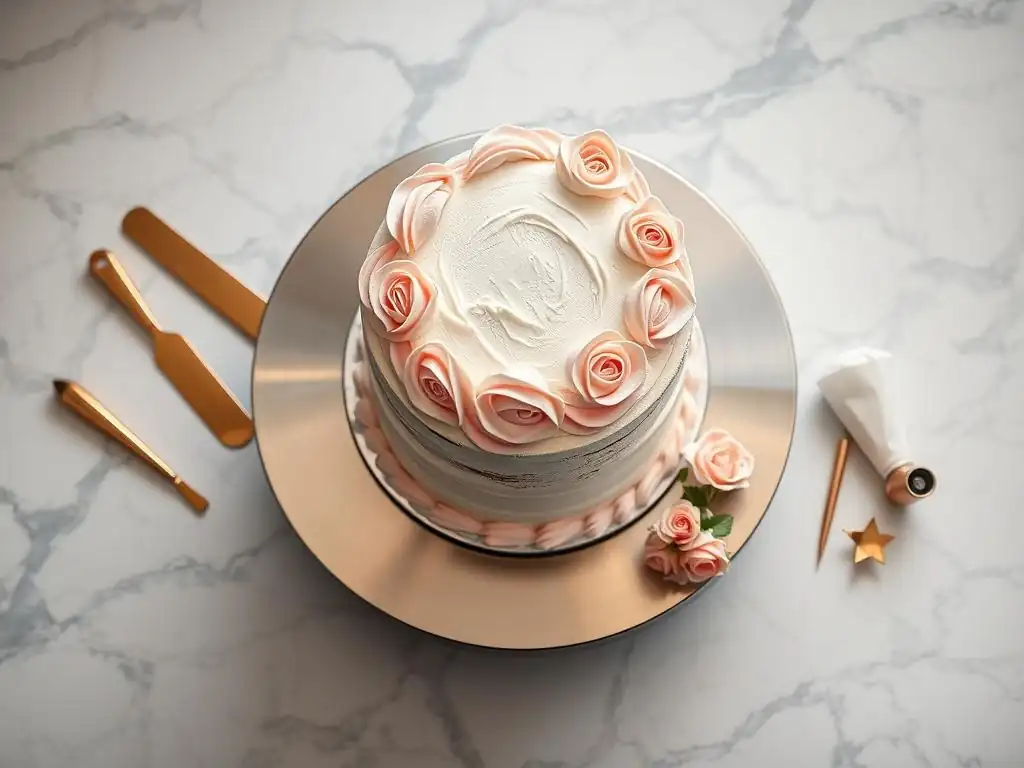
Welcome to BakeWithEase, your guide to creating delicious baked goods with confidence! Ever wondered how the pros achieve flawlessly smooth frosting and intricate designs? Today, we're diving deep into the essential tools that can transform your cake decorating game: cake turntables. Discover our top cake decorating turntable tips and learn how to wield these invaluable tools like a seasoned pastry chef. Intrigued? Let's get baking!
- Cake Turntables & Spatulas: Essential Tools Demystified for Cake Decorating
- Why a Cake Decorating Turntable and Spatula are Essential for Flawless Cakes
- Cake Decorating Turntables: A Buyer's Guide
- Spatulas for Cake Decorating: Mastering the Art of Frosting
-
Cake Decorating Turntable Tips and Techniques
- Centering Your Cake on the Turntable: A Crucial First Step
- Achieving a Smooth Crumb Coat: Setting the Foundation for Perfect Frosting
- Mastering the Piping Bag: Creating Beautiful Decorations
- Leveling Cakes for Cake Decorating: Achieving Flat Layers
- Tips for Cleaning and Maintaining Your Cake Decorating Turntable and Spatulas
- Maximizing Your Cake Decorating Potential with the Right Tools
-
Frequently Asked Questions
- What is a cake decorating turntable, and why is it essential?
- What are the key features to look for in a good cake decorating turntable?
- How do I choose the right size spatula for cake decorating?
- What are some basic cake decorating techniques I can practice with a turntable and spatula?
- Can I use a cake decorating turntable for things other than frosting cakes?
- Final Reflection: The Sweet Science of Cake Decorating
- Unleash Your Inner Cake Artist!
Cake Turntables & Spatulas: Essential Tools Demystified for Cake Decorating
Why a Cake Decorating Turntable and Spatula are Essential for Flawless Cakes
Level Up Your Cake Decorating: The Importance of Proper Tools
Achieving a professional finish on your cakes goes beyond just having a great recipe and delicious frosting. The right tools are fundamental to elevating your cake decorating skills. A quality cake decorating turntable allows you to easily rotate your cake as you work, providing consistent access to all sides and angles without having to awkwardly move the cake itself. This seamless rotation is crucial for applying frosting evenly, creating smooth surfaces, and piping intricate designs with precision. Without a turntable, frosting application can be uneven, and decorative elements may appear inconsistent.
Complementing the turntable, the correct spatulas are indispensable. They are designed specifically for handling frosting and batters, allowing for smooth spreading, leveling, and lifting. Using a standard kitchen knife or spoon simply won't give you the same level of control or the desired smooth finish. Investing in purpose-built spatulas, especially offset and straight varieties, significantly improves your ability to achieve that polished look, making the entire decorating process more efficient and enjoyable. These tools work together synergistically to transform a simple cake into a beautifully decorated masterpiece.
Achieving Smooth Frosting: How Turntables and Spatulas Help
The primary challenge for many bakers is achieving that perfectly smooth, flawless frosting surface. This is where the cake decorating turntable and spatulas truly shine. With the cake centered on a smoothly rotating turntable, you can hold your spatula steady against the side or top of the cake while slowly turning the table. This action allows the spatula to shave off excess frosting and fill in gaps, resulting in a level and smooth layer. It’s a technique that is incredibly difficult, if not impossible, to replicate by manually turning the cake.
Spatulas, particularly offset spatulas with their angled blades, provide the leverage and flexibility needed to glide over the frosting without your hand getting in the way. A long, straight spatula is excellent for leveling the top surface, ensuring it's perfectly flat. By using the turntable for rotation and the spatula for application and smoothing, you create a controlled environment that minimizes imperfections and allows you to build up layers of frosting or achieve a crisp crumb coat effortlessly. These cake decorating turntable tips are fundamental to achieving a professional-looking finish.
Cake Decorating Turntables: A Buyer's Guide
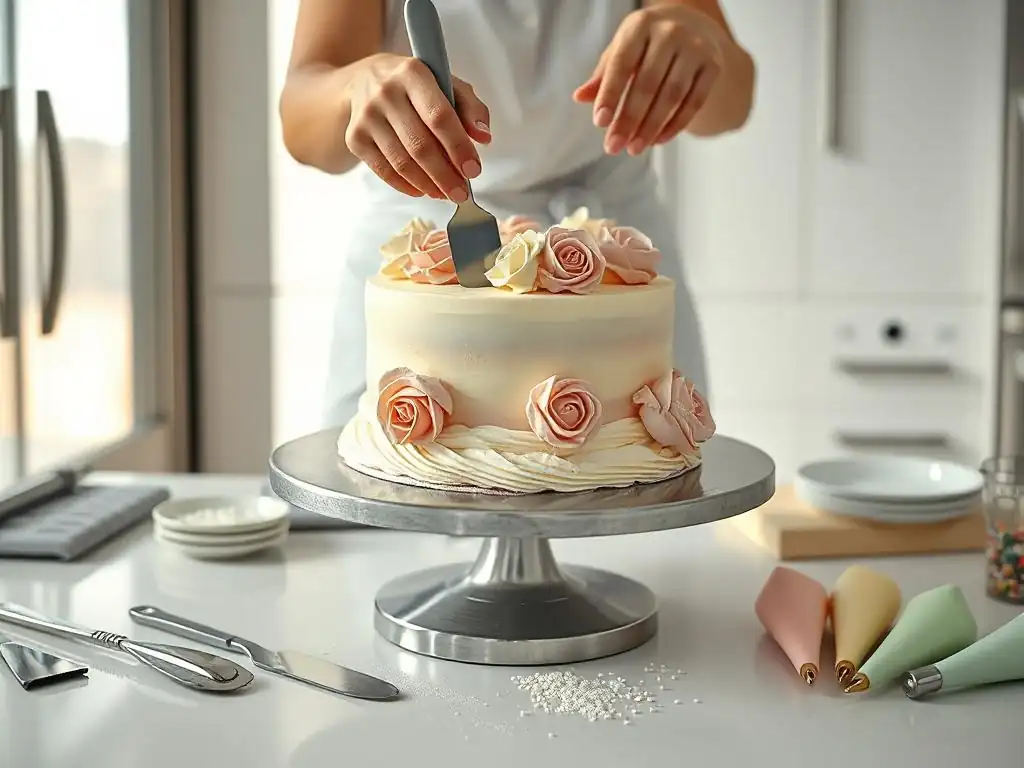
Understanding Different Types of Cake Turntables
Metal Turntables: Durability and Stability for Professional Results
Metal cake decorating turntables, often made from aluminum or stainless steel, are known for their robust construction and stability. They typically feature heavy bases and smooth-gliding ball bearings, which provide exceptional rotation and can handle heavier cakes without wobbling. Professional bakers often prefer metal turntables because of their durability and the consistent, effortless spin they offer, which is crucial for intricate piping and smoothing techniques. While they tend to be more expensive, usually ranging from $50 to over $100, their longevity and performance make them a worthwhile investment for serious or frequent decorators.
These turntables often have a non-slip surface or come with a non-slip pad to keep the cake board secure. The weight of the metal base contributes significantly to its stability, preventing the turntable from shifting on your countertop as you apply pressure with your spatula. The ball-bearing mechanism ensures a smooth, continuous spin, allowing for fluid movements when applying buttercream or creating decorative swirls. This type of cake decorating turntable is built to withstand years of use and is suitable for a wide range of cake sizes and weights.
Plastic Turntables: Affordable and Lightweight Options for Home Bakers
Plastic cake decorating turntables are a popular choice, especially for beginners or those who bake occasionally. They are significantly lighter and more affordable than metal options, often priced between $20 and $40. While they may not offer the same heavy-duty stability or ultra-smooth rotation as metal models, they are perfectly adequate for most home baking tasks. Many plastic turntables feature a non-slip ring on the base and a slightly textured surface on top to help keep the cake in place.
The primary advantage of plastic turntables is their ease of use and cleaning. They are lightweight enough to move around easily and can often be wiped clean quickly. While some cheaper models might have a slightly less smooth rotation, many mid-range plastic turntables incorporate internal ball bearings or smooth-gliding mechanisms that provide a decent spin for basic frosting and decorating. They are a great starting point for anyone exploring cake decorating without a significant upfront investment.
Rotating Cake Stand: A Multi-Purpose Tool for Baking and Display
Some turntables are designed with aesthetics in mind, doubling as both a decorating tool and a serving stand. These are often referred to as rotating cake stands and can be made from various materials including plastic, metal, glass, or even ceramic. Their primary function as a decorating aid is the rotating top, allowing for easy access to all sides of the cake during frosting and decorating. However, their design is also suitable for presenting the finished cake at parties or events.
While versatile, the focus on aesthetics might mean the rotation mechanism isn't as heavy-duty or smooth as a dedicated metal decorating turntable. However, many modern rotating cake stands feature hidden ball bearings that provide a surprisingly smooth spin. They are particularly useful for bakers who want to frost and then immediately display their creation on the same stand. Prices vary widely depending on material and design, typically ranging from $30 to $60 for functional decorating/display models.
Key Features to Look for in a Cake Decorating Turntable
Smooth Rotation: Achieving Even Frosting Application
The hallmark of a good cake decorating turntable is its ability to rotate smoothly and consistently. This is achieved through a well-engineered bearing system, often involving ball bearings. A smooth spin allows you to apply frosting in one continuous motion around the cake, minimizing stops and starts that can create ridges or uneven patches. When evaluating a turntable, consider how freely the top spins and whether the rotation is consistent throughout a full 360-degree turn.
A turntable with poor or jerky rotation makes achieving smooth frosting and precise piping incredibly difficult. It forces you to work in short bursts, leading to a less polished finish. Look for descriptions that specifically mention ball bearings or a smooth-gliding mechanism. Some manufacturers even specify the type or number of bearings used, which can be an indicator of quality rotation. This feature is paramount for executing effective cake decorating turntable tips.
Stable Base: Preventing Wobbling During Decoration
Stability is crucial for preventing frustration and potential accidents while decorating. A stable base ensures the turntable remains firmly planted on your work surface and doesn't wobble or tip, especially when you apply pressure while smoothing frosting or piping details. Turntables with heavier bases, particularly metal ones, generally offer superior stability. Plastic turntables should have a non-slip ring or feet to prevent sliding.
Wobbling not only makes precise work challenging but can also lead to uneven frosting layers or deformed decorations. Imagine trying to pipe a straight line or smooth a side when the cake is constantly shifting slightly. Look for turntables that feel solid and have a wide base relative to their height. Reading reviews often provides insight into a turntable's real-world stability under pressure.
Non-Slip Surface: Keeping Your Cake Secure
The top surface of the cake decorating turntable needs to securely hold the cake or cake board in place as you work. Many turntables feature a slightly textured surface, raised rings, or come with a separate non-slip silicone or rubber mat. This prevents the cake from sliding around during rotation, especially when you are applying frosting or making adjustments.
A sliding cake can ruin your frosting work and even cause the cake to fall. Ensure the turntable you choose has some mechanism to grip the cake board. If it doesn't, you can easily purchase a separate non-slip mat designed for turntables, which typically cost under $10-$15. This simple feature is essential for confidently using your cake decorating turntable tips.
Top Cake Decorating Turntable Recommendations
Ateco Revolving Cake Decorating Stand: A Durable and Reliable Choice
Features: Smooth rotation, heavy-duty construction, non-slip surface.
Price Point: $50-$75
Why We Recommend It: Ideal for frequent bakers and larger cakes.
The Ateco Revolving Cake Decorating Stand is a favorite among professional bakers and serious hobbyists. Its cast iron base provides significant weight and stability, ensuring it stays put even when working on tall or heavy cakes. The ball-bearing mechanism delivers an exceptionally smooth and effortless spin, allowing for precise frosting application and intricate piping work without any jerks or resistance.
This turntable is built to last, a true workhorse in the kitchen. It typically features a non-slip pad included, adding an extra layer of security for your cake. While it represents a higher initial investment compared to plastic models, its durability and superior performance make it a wise long-term purchase for anyone who bakes and decorates cakes regularly and wants to master advanced cake decorating turntable tips.
Wilton Cake Decorating Turntable: Budget-Friendly and Beginner-Friendly
Features: Lightweight, easy to clean, affordable price.
Price Point: $20-$30
Why We Recommend It: Perfect for beginners and occasional bakers.
The Wilton Cake Decorating Turntable is an excellent entry-level option. Made from durable plastic, it's lightweight and easy to handle, making it perfect for those just starting out. It features a non-slip base ring and a top with concentric circles to help center your cake. While the rotation might not be as buttery smooth as high-end metal models, it's more than adequate for practicing basic frosting techniques and simple decorations.
Its affordability makes it accessible to everyone wanting to try cake decorating without a significant commitment. It's also very easy to clean, usually just requiring a quick wipe down with a damp cloth. For bakers who make cakes occasionally or are learning the ropes of using a turntable, the Wilton model offers great value and functionality.
Kootek Rotating Cake Stand Turntable: Versatile Option for Baking and Display
Features: Durable construction, hidden ball bearings for smooth rotation, can be used as a serving platter.
Price Point: $30-$45
Why We Recommend It: Great for bakers who want a multi-functional tool.
The Kootek Rotating Cake Stand Turntable often comes as part of a set with spatulas and scrapers, offering good value. Made from sturdy plastic, it features a smooth rotation thanks to hidden ball bearings, providing a better spin than many basic plastic models. What sets it apart is its dual function – its clean design makes it suitable for both decorating and presenting your finished cake.
This turntable offers a good balance between performance and aesthetics. It's stable enough for most decorating tasks and looks attractive enough to serve guests directly from. It's a practical choice for home bakers who appreciate tools that serve multiple purposes and want to seamlessly transition from decorating to display.
Spatulas for Cake Decorating: Mastering the Art of Frosting
Different Types of Spatulas for Cake Decorating
Offset Spatulas: The Go-To Tool for Smooth Icing
Offset spatulas are instantly recognizable by their bent blade, which lifts the handle away from the working surface. This design is incredibly effective for frosting cakes because it prevents your knuckles from dragging through the icing as you smooth it. The blade's flexibility and shape allow you to apply even pressure and glide smoothly over the cake's surface, essential for achieving that desired professional, smooth finish.
Available in various lengths, from small 4-inch spatulas perfect for cupcakes or tight spots to long 12-inch spatulas ideal for frosting the sides of large cakes, offset spatulas are versatile tools. They are indispensable for applying the crumb coat, the initial thin layer of frosting that traps loose crumbs, and for applying the final layer of buttercream or ganache. No set of cake decorating tools is complete without a few well-chosen offset spatulas.
Why Offset Spatulas are Essential for Cake Decorating
Offset spatulas provide unmatched control and leverage when frosting cakes. The bend in the blade allows you to keep your hand elevated, giving you a clear view of your work and preventing accidental contact with the delicate frosting surface. This is particularly important when smoothing the sides of a cake on a rotating turntable, where a steady hand and unobstructed movement are key to achieving a uniform finish. They are also excellent for lifting and transferring delicate items like cookies or pastry layers.
Their design makes them the most efficient tool for spreading frosting quickly and evenly across large areas. Whether you're working with thick buttercream or a delicate glaze, the offset spatula allows you to manipulate the frosting with precision, pushing it into gaps and creating a level surface. Mastering the use of an offset spatula is a fundamental skill for anyone serious about cake decorating, and it works hand-in-hand with effective cake decorating turntable tips.
Using an Offset Spatula: Tips for Smooth Cake Frosting
To use an offset spatula for smooth frosting, start by applying a generous amount of frosting to the cake. For the top, place a dollop in the center and use the spatula to spread it outwards, using the bent handle to keep your hand clear. Rotate the cake on the turntable as you smooth, holding the spatula at a slight angle. For the sides, apply frosting all around the cake, then hold the spatula vertically against the side, maintaining a consistent angle and pressure, while slowly rotating the turntable.
Keep a bowl of warm water handy to dip and clean your spatula frequently. A clean, warm spatula glides more easily through frosting, helping to achieve a smoother finish. Don't be afraid to apply more frosting than you think you need initially; it's easier to smooth and remove excess than to add more to fill gaps. Practice holding the spatula at different angles and pressures to see how it affects the finish.
Straight Spatulas: Versatile for Leveling and Smoothing
Straight spatulas, also known as icing spatulas or palette knives (though technically different, the terms are often used interchangeably in baking), have a flat, unbent blade. While they lack the offset's hand clearance, they are incredibly useful for specific tasks. Their straight edge makes them ideal for leveling the top of a cake, ensuring it's perfectly flat before adding the next layer or final decorations.
They are also versatile for spreading batters in pans, mixing ingredients, or lifting delicate items. A long straight spatula is particularly effective for smoothing the top of a large cake or for scraping down the sides of a mixing bowl. While an offset spatula is the primary tool for side frosting, a straight spatula offers precision for flattening surfaces and other general baking tasks.
Icing Smoother/Scraper: Achieving Perfectly Straight Edges
An icing smoother or cake scraper is a rigid tool, often made of plastic or metal, with a perfectly straight edge. Its primary purpose is to create perfectly smooth sides and sharp corners on a frosted cake, especially when working with buttercream or ganache. While spatulas help apply and initially smooth the frosting, the scraper is used as the final step to refine the surface.
To use a scraper, hold it perpendicular to the cake's side, resting the bottom edge on the turntable or cake board. Apply gentle, consistent pressure and rotate the turntable slowly. The scraper will shave off excess frosting, filling in any small imperfections and leaving behind a smooth, straight surface. Different scrapers have various edge designs, including plain, serrated, or decorative patterns.
Choosing the Right Spatula Size and Material
Stainless Steel Spatulas: Durable and Easy to Clean
Stainless steel is the most common material for spatula blades due to its durability, resistance to rust, and ease of cleaning. Stainless steel blades are strong yet can be thin enough to offer flexibility, which is crucial for gliding smoothly over frosting. They don't react with food and can withstand high temperatures, although this is less relevant for frosting spatulas than for cooking spatulas.
When choosing a stainless steel spatula, look for one with a comfortable handle, often made of plastic, wood, or silicone, that provides a good grip. The blade should be securely attached to the handle. Stainless steel spatulas are a reliable, long-lasting choice that can handle frequent use and washing.
Silicone Spatulas: Heat-Resistant and Gentle on Non-Stick Surfaces
While less common for frosting application compared to stainless steel, silicone spatulas are invaluable for other baking tasks. They are heat-resistant, making them perfect for stirring hot custards or melting chocolate. Their flexible, non-scratch surface is ideal for scraping down bowls without damaging them and for working with non-stick bakeware.
Silicone spatulas are excellent for folding ingredients, scraping every last bit of batter or dough from a bowl, and even for applying softer frostings or ganaches where a very flexible tool is desired. They are easy to clean and come in a wide array of colors. While you'll likely need stainless steel spatulas for smoothing, a few silicone spatulas are essential for overall baking efficiency.
Top Spatula Recommendations
Wilton Angled Spatula Set: A Versatile Set for All Your Frosting Needs
Features: Different sizes for various tasks, comfortable grip, durable stainless steel.
Price Point: $15-$25
Why We Recommend It: A comprehensive set for beginners and experienced bakers alike.
The Wilton Angled Spatula Set typically includes spatulas of various sizes, such as 4.5-inch, 9-inch, and 13-inch blades, providing versatility for different cake sizes and tasks, from cupcakes to large tiered cakes. Made with stainless steel blades and comfortable plastic handles, these spatulas are designed for ease of use and durability.
This set is an excellent starting point for anyone building their cake decorating tool collection. Having multiple sizes allows you to choose the best tool for the job, whether it's frosting a small area or smoothing the entire side of a large cake. The range of sizes also makes practicing various cake decorating turntable tips easier.
Ateco Ultra Offset Spatula: Professional-Grade for Smooth Finishes
Features: Thin, flexible blade, comfortable handle, excellent control.
Price Point: $20-$35
Why We Recommend It: Ideal for achieving professional-looking frosting.
Ateco is a brand favored by professionals, and their Ultra Offset Spatulas are renowned for their quality. These spatulas feature thin, flexible stainless steel blades that provide exceptional feel and control, allowing you to create incredibly smooth frosting surfaces. The handles are typically made of wood or sturdy plastic and are ergonomically designed for comfort during extended use.
While pricier than basic options, the performance of an Ateco Ultra Offset Spatula is noticeable, especially when striving for a perfectly smooth finish. The flexibility of the blade allows it to conform slightly to the cake's surface, helping to eliminate ridges. It's a tool that significantly improves your ability to execute advanced cake decorating techniques and achieve salon-quality results.
Cake Boss Fondant Smoother: Achieving Professional-Looking Edges
Features: Comfortable grip, excellent for smoothing fondant and buttercream, great for creating sharp edges.
Price Point: $10-$20
Why We Recommend It: Perfect for bakers who want professional-looking edge.
While named a "Fondant Smoother," this tool is incredibly effective for smoothing buttercream and achieving sharp edges, especially when used with a cake decorating turntable. Made from sturdy plastic, its straight, rigid edge is designed to press firmly against the side and top of a cake.
Using the Cake Boss Smoother involves holding it at a 90-degree angle to the cake side (or top) while rotating the turntable. This action removes excess frosting and creates a flat, smooth surface and defined edges. Its comfortable grip makes it easy to maintain consistent pressure. It's an affordable tool that makes a significant difference in the final appearance of your frosted cakes.
Cake Decorating Turntable Tips and Techniques
Centering Your Cake on the Turntable: A Crucial First Step
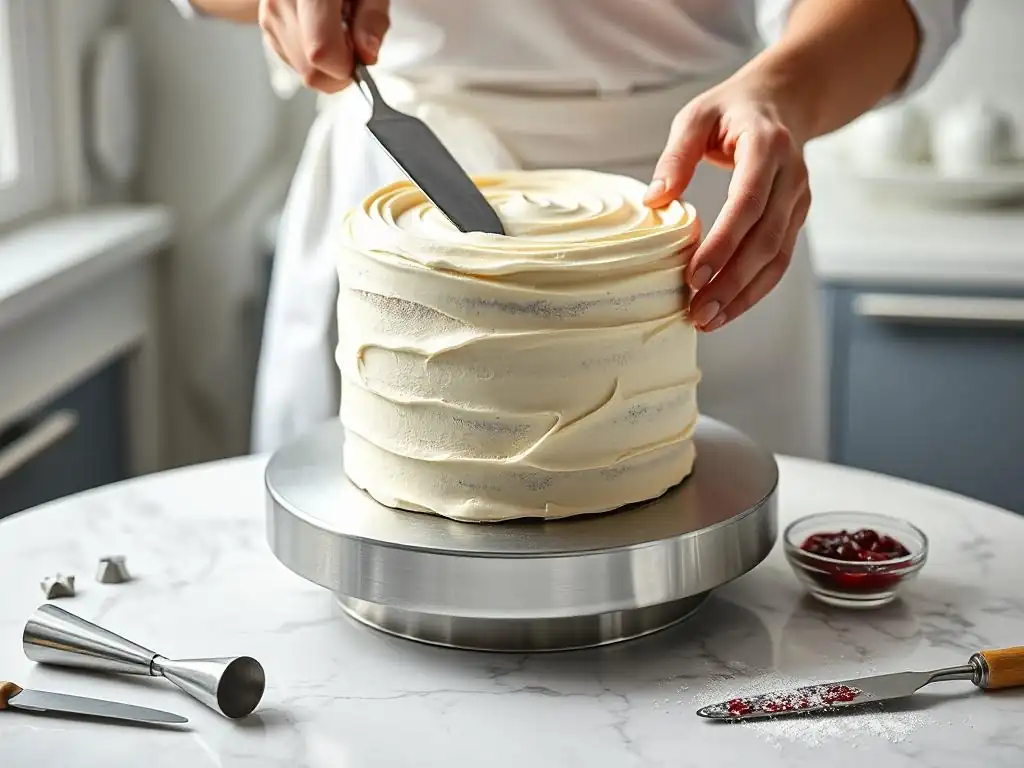
Properly centering your cake on the turntable is arguably the most important cake decorating turntable tip. If the cake is off-center, it will wobble as it rotates, making it nearly impossible to apply frosting or decorations smoothly and evenly. To center the cake, place a dab of frosting on the turntable surface where the cake board will sit. Place the cake board (with the cake already on it) onto the frosting.
Now, looking down from above, gently nudge the cake board until it appears perfectly centered on the turntable's rotation axis. Spin the turntable slowly to check if the cake appears stable and revolves evenly. If it seems off-balance or wobbly, adjust its position slightly. A well-centered cake is the foundation for all subsequent decorating steps and ensures your cake decorating turntable tips are effective.
Achieving a Smooth Crumb Coat: Setting the Foundation for Perfect Frosting
A crumb coat is a thin layer of frosting applied to the cake before the final frosting layer. Its purpose is to trap any loose crumbs, preventing them from showing up in your final, smooth coat. Apply a small amount of frosting to the top and sides of the cake. Using an offset spatula and rotating the turntable, spread the frosting thinly across the entire surface. Don't worry about making it perfectly smooth at this stage; the goal is just to cover the cake and trap crumbs.
Once the cake is fully covered in a thin layer, use your spatula or scraper to smooth it slightly and remove excess. The crumb coat should be thin enough to see the cake through it in some spots. Chill the cake in the refrigerator for at least 15-20 minutes, or until the crumb coat is firm to the touch. This chilling step is vital as it sets the crumb coat, creating a stable base for your final frosting layer and making subsequent cake decorating turntable tips easier to implement.
Mastering the Piping Bag: Creating Beautiful Decorations
The piping bag is a versatile tool for adding decorative elements, borders, and writing to your cakes. Fill a piping bag fitted with your desired tip no more than two-thirds full with frosting. Twist the top of the bag closed to prevent frosting from squeezing out the wrong end. Hold the twisted end firmly in your dominant hand and guide the tip with your other hand. Apply steady, even pressure with your dominant hand to push the frosting through the tip.
Practice piping lines, dots, and swirls on a piece of parchment paper before working on your cake. Consistency in pressure and movement is key to achieving uniform results. When piping around a cake on a turntable, use the rotation of the turntable to help guide your piping, especially for borders. This allows you to create continuous, seamless designs. Mastering piping bag control is essential for utilizing cake decorating turntable tips for intricate designs.
Using Piping Tips to Add Intricate Details to Your Cakes
Piping tips come in a vast array of shapes and sizes, each designed to create a specific effect, from simple stars and rosettes to intricate leaves, petals, and writing. Common tip types include round tips (for dots and lines), star tips (for stars and borders), open star tips (for swirls), leaf tips, and petal tips. To use a tip, insert it into the piping bag before filling it, or use a coupler which allows you to change tips on a single bag.
Experiment with different tips and frosting consistencies to see the variety of effects you can achieve. Stiffer frosting holds its shape better for defined details like stars or roses, while softer frosting is suitable for smoother lines or writing. When piping details around the cake, use the turntable to slowly rotate the cake, keeping your piping hand steady relative to the cake's surface. This allows for precise placement of details.
Leveling Cakes for Cake Decorating: Achieving Flat Layers
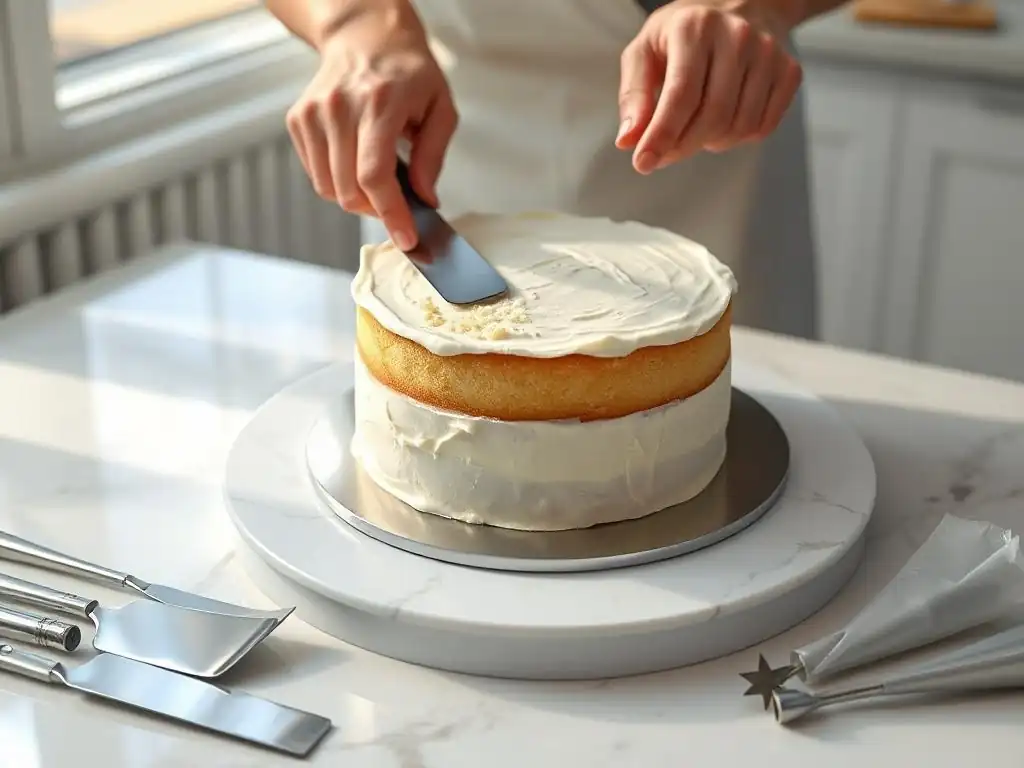
Before frosting, ensuring your cake layers are level is crucial for a stable and professional-looking finished cake. Cakes often dome slightly during baking. To level a cake, use a serrated knife or a cake leveler. Place the cake on your work surface and, if using a knife, hold it parallel to the counter and slowly saw through the cake, keeping your hand steady. If using a cake leveler, adjust it to the desired height and gently saw through the cake.
Ensure your cake is completely cooled before attempting to level it. Warm cakes are fragile and prone to crumbling. For very delicate cakes, chilling them slightly in the refrigerator for about 15-20 minutes can make them easier to level cleanly. Level layers stack neatly and provide a flat surface for frosting, which is essential for smooth results when using your cake decorating turntable tips.
Tips for Cleaning and Maintaining Your Cake Decorating Turntable and Spatulas
Proper cleaning and maintenance extend the life of your tools. For plastic turntables, simply wipe them clean with a damp cloth and mild soap after each use. Avoid abrasive cleaners that could scratch the surface. For metal turntables, follow the manufacturer's instructions; some might require hand washing and thorough drying to prevent rust, especially on bearings. Never submerge turntables with complex bearing systems unless specifically instructed.
Spatulas, whether stainless steel or silicone, should be washed immediately after use to prevent frosting from hardening on them. Hand washing with warm, soapy water is usually sufficient. For stubborn, dried-on frosting, a brief soak can help. Ensure stainless steel spatulas are dried completely to avoid water spots or rust, especially around the handle joint. Store tools in a clean, dry place.
Maximizing Your Cake Decorating Potential with the Right Tools
The Synergy Between Cake Turntables and Spatulas: A Winning Combination
The true power of these tools lies in their combined use. A cake decorating turntable provides the necessary rotation, while spatulas provide the means to apply, spread, and smooth frosting with precision. You hold the spatula steady, maintaining a consistent angle and pressure, while the turntable does the work of moving the cake smoothly beneath it. This synergy is what allows bakers to achieve incredibly smooth sides and level tops efficiently.
Trying to achieve the same results without a turntable is significantly more challenging and time-consuming. Likewise, a turntable alone is useless without the right spatulas to manipulate the frosting. They are a dynamic duo in the world of cake decorating, each enhancing the functionality of the other to make the process easier and the results more professional. Mastering the use of both together is key to unlocking advanced cake decorating turntable tips.
Investing in Quality Tools: A Worthwhile Investment for Serious Bakers
While it might be tempting to start with the cheapest tools available, investing in quality cake decorating turntables and spatulas is a decision that pays off, especially if you plan to decorate cakes regularly. Well-made tools are more durable, perform better, and make the decorating process more enjoyable and less frustrating. A smooth-spinning turntable and comfortable, flexible spatulas reduce the effort required and improve the consistency of your results.
Consider it an investment in your hobby or potential business. A reliable turntable that doesn't wobble and spatulas that feel comfortable in your hand will make you more likely to practice and improve. While a high-end metal turntable might cost $60-$80, and a good set of spatulas $20-$30, these tools can last for years, providing consistent performance that cheaper alternatives simply cannot match. It's about investing in the tools that enable you to achieve the beautiful cakes you envision.
Beyond the Basics: Exploring Advanced Cake Decorating Techniques
Once you've mastered the basics of using a cake decorating turntable and spatulas for smooth frosting and simple piping, these tools become the foundation for exploring more advanced techniques. Techniques like sharp buttercream edges using a bench scraper and turntable, creating textured frosting finishes with different spatulas or combs while rotating the cake, or executing complex multi-tiered designs all rely heavily on the control and stability provided by quality turntables and spatulas.
Your proficiency with these essential tools directly impacts your ability to tackle challenges like ganache drips, mirror glazes, or intricate piping work that wraps seamlessly around the cake. They allow you to work with precision and confidence, enabling you to push your creative boundaries and develop your unique cake decorating style. Continue practicing your cake decorating turntable tips, and you'll be amazed at what you can create.
Frequently Asked Questions
What is a cake decorating turntable, and why is it essential?
A cake decorating turntable is a rotating platform that allows you to easily access all sides of the cake while decorating. It's essential for achieving smooth frosting and precise decorations.
What are the key features to look for in a good cake decorating turntable?
Look for a turntable with smooth rotation, a stable base (preferably non-slip), and a durable material like stainless steel or heavy-duty plastic.
How do I choose the right size spatula for cake decorating?
The ideal spatula size depends on the size of your cakes. A longer offset spatula (around 10-12 inches) is generally recommended for larger cakes and applying the initial frosting layer.
What are some basic cake decorating techniques I can practice with a turntable and spatula?
Start with crumb coating (a thin layer of frosting to seal in crumbs), then practice smoothing the frosting using the turntable to rotate the cake while holding the spatula steady.
Can I use a cake decorating turntable for things other than frosting cakes?
Yes! Turntables are also great for assembling multi-layered desserts, decorating cookies, and even displaying finished cakes at parties.
Final Reflection: The Sweet Science of Cake Decorating
The seemingly simple act of cake decorating is, in reality, a precise and creative process elevated by the right tools. Mastering the art isn't just about frosting flowers; it's about understanding the foundational elements that allow your vision to take shape. This article has explored the crucial roles of cake turntables and spatulas, demonstrating how these seemingly humble tools are the unsung heroes of every beautifully decorated cake.
The impact of these tools extends far beyond the kitchen; they represent the power of preparation and the importance of the right instruments in achieving any goal. The smooth, even application of frosting, the precise placement of decorations – these are all made possible by understanding and utilizing these essential tools. As the saying goes, The difference between ordinary and extraordinary is that little extra.
And in cake decorating, that "little extra" often comes down to the quality and effective use of your turntable and spatulas. The subtle control they afford allows for a level of artistry that transforms a simple cake into a masterpiece.
Now, consider your own creative endeavors. What are the "cake turntables and spatulas" in your life – the essential tools that, when mastered, unlock your potential and allow you to achieve extraordinary results? Take a moment to reflect on this. Identify those tools, hone your skills in using them, and watch as your own creations blossom into something truly remarkable. The journey to mastering any craft begins with understanding the fundamentals, and with the right tools in hand, the possibilities are endless.
Unleash Your Inner Cake Artist!
Thanks for joining us on this delicious journey into the world of cake decorating! We hope you've gained a newfound appreciation for the power of the right tools. Now it's time to put that knowledge into action.
- Master the art of flawless frosting: Practice your swirling, piping, and smoothing techniques with your newfound knowledge of cake turntables and spatulas. Try a new design you've always wanted to perfect!
- Share your baking triumphs: Post a picture of your latest cake creation on social media and tag us @BakeWithEase – we’d love to see your masterpiece!
- Explore advanced techniques: Dive deeper into the world of cake decorating by researching different frosting styles or exploring unique spatula designs online.
What incredible cake creation will you bake next?