
Unlock Your Cake Decorating Potential: Essential Tools Guide

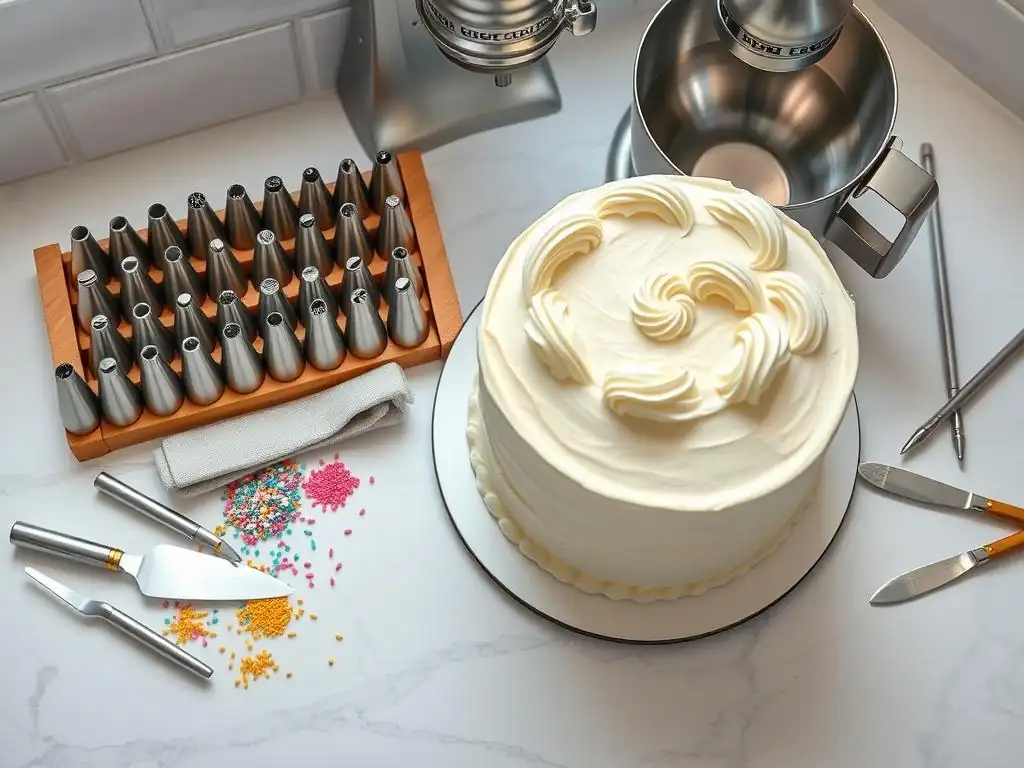
Welcome to BakeWithEase, your trusted companion in the delicious world of baking!
Ever dreamt of crafting cakes that are not only delicious but visually stunning? Our Cake Decorating Tools Guide is your starting point. Discover the essential implements that unlock your creative potential and transform ordinary cakes into edible masterpieces. Intrigued? Let's explore the world of cake decorating together and elevate your baking skills!
- Mastering Cake Decorating: A Tool-by-Tool Guide
- Essential Cake Decorating Tools for Beginners
- Elevating Your Cakes: Advanced Decorating Tools
- Icing and Frosting Mastery: A Tool Guide
- Fondant Sculpting: Tools and Techniques
- Perfect Finishes: Turntables, Levelers, and Presentation
- Precision Baking: Essential Measuring Tools
- Cleaning and Maintaining Decorating Tools
- Where to Buy Cake Decorating Tools
- Troubleshooting with the Right Tools
-
Frequently Asked Questions
- What are the absolute essential cake decorating tools a beginner should invest in?
- How do I choose the right piping tips for different cake decorating effects?
- What is the purpose of a cake turntable, and is it really necessary?
- What are some alternatives to expensive cake decorating tools if I'm on a budget?
- How do I properly clean and store my cake decorating tools to ensure they last?
- Final Reflection: The Sweetest Journey Begins with the Right Tools
- Unleash Your Inner Cake Artist!
Mastering Cake Decorating: A Tool-by-Tool Guide
Essential Cake Decorating Tools for Beginners
Why Quality Tools Matter in Cake Decorating
Investing in quality cake decorating tools is perhaps the most crucial first step for any aspiring baker looking to elevate their creations. While it might be tempting to opt for the cheapest tools available when starting out, durable and well-made tools significantly impact the ease of use and the final aesthetic of your decorated cakes. A high-quality offset spatula, for instance, often has a smooth, flexible blade and a comfortable handle, allowing for effortless frosting application and smoothing, which is far superior to a stiff, poorly balanced tool.
Furthermore, the longevity of quality tools means you won't need to replace them frequently, saving money in the long run. Tools made from food-grade stainless steel and sturdy plastics are designed to withstand repeated use and cleaning without rusting or degrading. This not only ensures your tools are always ready when inspiration strikes but also contributes to food safety. Think of your essential tools for cake decorating as an investment in your craft; they empower you to execute techniques more precisely and achieve consistently better results.
Starting Your Journey: Must-Have Beginner Tools
Embarking on your cake decorating adventure requires a foundational set of tools that are versatile and easy to master. At the top of the list are spatulas: both straight and offset spatulas, typically ranging from 6 to 10 inches in blade length. These are indispensable for applying and smoothing frosting. You'll also need piping bags (reusable silicone or disposable plastic are good options) and a basic set of piping tips, often including round tips (sizes #3, #12) for outlines and dots, star tips (sizes #18, #21) for borders and rosettes, and maybe a petal tip (#104) for simple flowers.
A set of couplers is also essential if you plan to change tips frequently without changing bags. Don't forget a cake scraper or smoother, a simple plastic or metal tool critical for achieving smooth, even sides on your frosted cakes. While not strictly a decorating tool, a good cake leveler or serrated knife is vital for torting (splitting) cake layers evenly, a fundamental step for building stable, professional-looking cakes. These initial beginner cake decorating tools provide the foundation for countless techniques.
Elevating Your Cakes: Advanced Decorating Tools
Specialized Tools for Advanced Techniques
Once you've mastered the basics laid out in a beginner's cake decorating tools guide, you'll likely want to explore more intricate designs and techniques. This is where specialized tools come into play. For detailed piping work, consider investing in a wider range of specific tips, such as basketweave tips, leaf tips, or specialized flower-making tips like the 2D drop flower tip. Veining tools and modeling sticks become crucial for adding realistic textures to fondant or gumpaste decorations, like leaves or petals.
Another advanced area is stencil work. Acrylic or plastic stencils, used with royal icing or buttercream, can create intricate patterns around the sides or top of a cake. Airbrushing equipment, while a larger investment, opens up possibilities for gradient colors, shading, and quick coverage of large areas. For delicate sugar flowers, specialty tools like ball tools, impression mats, and floral wire are indispensable for achieving lifelike results. Expanding your collection of essential tools for cake decorating allows you to push creative boundaries.
Achieving Professional Results: Essential Tools
Moving towards professional-level cake decorating requires not just skill but also precision and the right equipment. Beyond specialized tips and modeling tools, certain items become non-negotiable for achieving polished finishes. A high-quality cake turntable with smooth rotation is paramount for achieving perfectly smooth sides and sharp edges on your frosting. Metal bench scrapers or smoothers are often preferred over plastic for their weight and rigidity, helping to create those sought-after crisp edges.
Precision cutting tools, like exacto knives or specialized craft knives used only for cake decorating, are essential for intricate fondant or gumpaste cutouts. Investing in a reliable stand mixer (like a KitchenAid or similar) is also key for consistently whipping up large batches of perfectly aerated buttercream or meringue, vital components of many professional finishes. These professional cake decorating tools streamline complex processes and elevate the overall quality of your work.
Icing and Frosting Mastery: A Tool Guide
Achieving Smooth Finishes: Spatulas and Smoothers
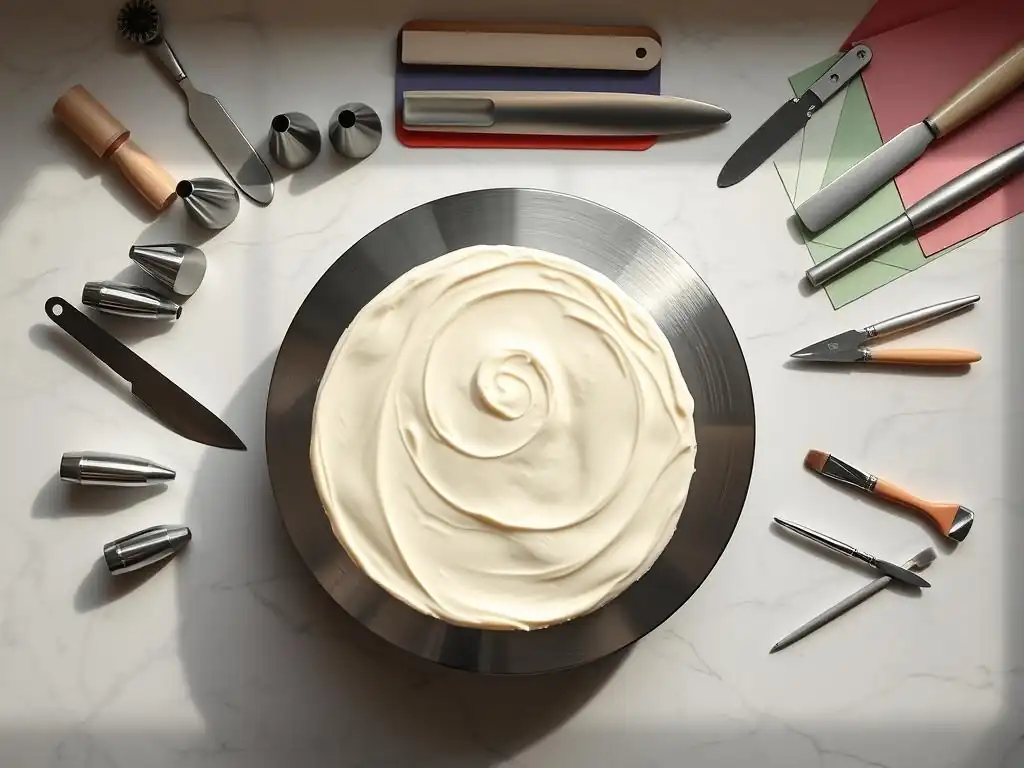
The hallmark of a beautifully decorated cake is often a perfectly smooth frosting finish. This is primarily achieved through the skillful use of spatulas and smoothers. Offset spatulas, with their angled blades typically ranging from 4 to 12 inches, are ideal for applying frosting to the top and sides of a cake without your knuckles dragging in the icing. The flexibility of the blade allows you to gently smooth and level the surface.
For the sides, a bench scraper or cake smoother is indispensable. These tools, often rectangular and made of plastic or metal, are held against the side of the rotating cake (usually on a turntable) to scrape away excess frosting and create a smooth, even surface. Using a metal scraper slightly warmed can help achieve an even glossier finish on buttercream. Mastering these simple cake decorating tools is fundamental to achieving a professional look.
Intricate Designs: Piping Bags and Nozzles
Piping bags and a variety of nozzles (or tips) are the primary tools for adding decorative elements, borders, text, and intricate patterns to cakes. Piping bags come in different materials and sizes, from small 8-inch bags for fine detail work to large 16-inch bags for filling or covering large areas. Reusable silicone or nylon bags are eco-friendly and durable, while disposable plastic bags offer convenience and easy cleanup.
Nozzles are available in hundreds of shapes and sizes, each designed for a specific purpose. Round tips create dots, lines, and lettering. Star tips produce star shapes, rosettes, and shell borders. Petal tips form flower petals and ruffles. Leaf tips create realistic leaves. Basketweave tips produce woven patterns. Using a coupler allows you to switch between different tips using the same bag and color of frosting, making your workflow much more efficient when using your essential tools for cake decorating.
Airbrushing Techniques: Achieving Stunning Effects
Airbrushing is a technique that allows for smooth, seamless color application, gradients, shading, and stenciled designs on cakes, offering effects difficult to achieve with traditional frosting methods. An airbrush system typically consists of an air compressor, an airbrush gun, and food-grade edible airbrush colors. The compressor provides a steady stream of air, which atomizes the liquid color in the airbrush gun, creating a fine mist.
This technique is particularly useful for covering large cakes quickly with an even layer of color, creating ombre effects, or adding depth and dimension through shading. Stencils can be placed on the cake surface, and airbrush color sprayed over them to transfer intricate patterns. While requiring some practice to control the spray and avoid overspray, airbrushing is a powerful addition to your cake decorating tools guide repertoire for creating visually striking cakes.
Fondant Sculpting: Tools and Techniques
Perfect Finishes: Fondant Smoothers and Cutters
Working with fondant requires a specific set of tools to achieve that signature smooth, flawless finish. Fondant smoothers are essential for covering a cake evenly. These paddle-like tools, often made of plastic, are used to gently rub over the surface of the fondant once it's applied to the cake, pressing out any air bubbles and creating sharp edges, particularly at the base and top of the cake. Using two smoothers simultaneously (one on top, one on the side) helps achieve crisp 90-degree angles.
Various cutters are also indispensable for fondant work. Beyond simple circle or square cutters, you'll need specialty cutters for specific shapes like flowers, leaves, or geometric patterns. Plunger cutters are popular as they cut the shape and often emboss details before ejecting the piece. Using a rotary cutter or pizza wheel designated only for fondant helps cut straight lines and trim excess fondant neatly around the base of the cake. These cake decorating tools simplify the process of covering and shaping.
Realistic Decorations: Modeling Tool Essentials
To bring fondant and gumpaste figures and decorations to life, a set of modeling tools is absolutely essential. These tools come in various shapes – balls, cones, points, knives, and star shapes – each designed for a specific purpose. A ball tool is used for thinning the edges of petals or creating indentations. Cone tools help shape centers of flowers or create ruffled edges. Pointed tools are great for detailing, like making veins on leaves or adding texture.
The knife and shell tool is versatile for cutting, marking lines, and creating shell borders. A veining tool is specifically designed to imprint realistic vein patterns onto leaves or petals. A set typically includes 8-10 different double-ended tools, offering a wide range of options for sculpting, shaping, and adding texture to your edible creations. These essential tools for cake decorating allow for intricate, lifelike details in your fondant art.
Gumpaste Artistry: Essential Tools
Gumpaste is a sugar paste that dries harder and more brittle than fondant, making it ideal for creating delicate, freestanding decorations like realistic flowers, figures, and intricate structures. Working with gumpaste requires many of the same modeling tools used for fondant, but also benefits from some specialized equipment. A pasta machine, while a kitchen tool, is invaluable for rolling gumpaste to a consistent, paper-thin thickness, which is crucial for realistic petals.
Floral wire, typically 20-30 gauge, is inserted into gumpaste pieces (like petals or leaves) before they dry, allowing you to assemble flowers and arrange them naturally. Floral tape is used to wrap the wired stems together. Foam pads (like a ball tool foam pad or a flower shaping pad) are used to soften and shape gumpaste pieces, giving petals a natural curve. A drying rack or formers (like flower formers or drying cups) are necessary to hold gumpaste pieces in shape while they dry. These cake decorating tools are specific to the delicate nature of gumpaste work.
Perfect Finishes: Turntables, Levelers, and Presentation
The Benefits of a Cake Turntable
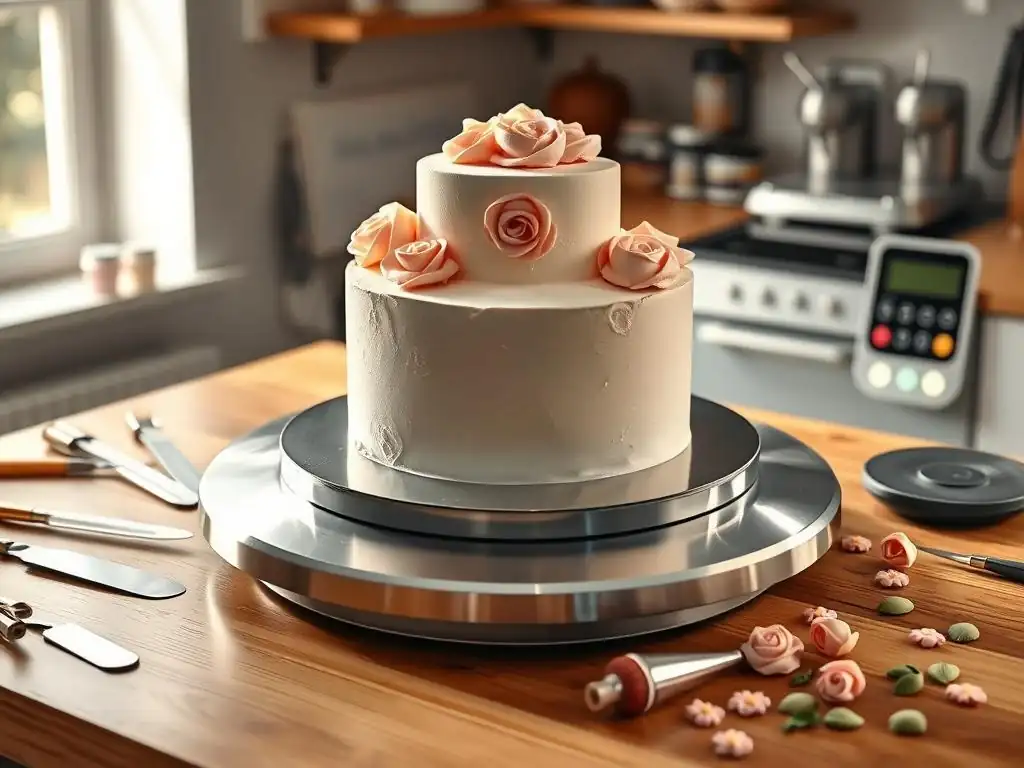
A cake turntable, also known as a revolving cake stand, is one of the most fundamental cake decorating tools for achieving smooth, professional-looking finishes. Its primary benefit is allowing you to easily rotate the cake while applying frosting or decorating, providing seamless access to all sides without having to constantly move yourself or the cake. This continuous motion is essential for applying even layers of frosting and creating smooth surfaces with spatulas or scrapers.
Turntables come in various materials, including plastic, metal, and glass. Those with ball bearings offer the smoothest rotation, which is particularly helpful for detailed piping work or achieving razor-sharp edges on buttercream. Using a turntable significantly reduces the time and effort required to frost and decorate a cake evenly, making the process more efficient and enjoyable, and ultimately leading to a more polished final product.
Achieving Level Cakes for Professional Results
Starting with level cake layers is non-negotiable for a stable, professional-looking tiered cake. Even if your cake bakes with a slight dome, tools exist to correct this. A simple serrated knife can be used to carefully slice off the dome, but it requires a steady hand to ensure a level cut. For more consistent results, a cake leveler is highly recommended.
Cake levelers typically consist of a wire or blade stretched between two adjustable feet. You can set the desired height and simply saw through the cake, ensuring a perfectly even layer every time. Some bakers also use baking strips wrapped around cake pans during baking to promote more even heat distribution and reduce doming, which can minimize the need for leveling. Using these essential tools for cake decorating ensures your foundation is solid.
Cake Boards and Presentation: Choosing the Right Support
Cake boards are not just for presentation; they provide essential support for decorated cakes, making them easy to move, transport, and serve. Choosing the right type and size of cake board is crucial. Single-wall cardboard circles are suitable for lighter cakes or those being placed on a more substantial base. For heavier or tiered cakes, thicker drum boards (often 1/2 inch thick) or multiple layers of cardboard glued together provide necessary rigidity.
The size of the board should generally be 2-4 inches larger in diameter than the cake itself, providing a border for decoration or handling. For tiered cakes, each tier is often placed on its own board (usually the same size as the cake tier) for support and easier assembly/dismantling. Covering the cake board with fondant, wrapping paper, or ribbon can enhance the overall presentation and complete the professional look of your decorated creation.
Precision Baking: Essential Measuring Tools
Ensuring Accuracy: Measuring Cups and Spoons
While technically part of the baking process rather than decorating, accurate measuring is the foundation for a successful cake that is stable and suitable for decorating. Using standard dry measuring cups and spoons is essential for ingredients like flour, sugar, cocoa powder, and baking powder. Dry ingredients should be scooped and leveled off with a straight edge, not packed down (except for brown sugar).
Liquid measuring cups, typically clear with a spout, are used for liquids like milk, oil, and water. They should be placed on a flat surface, and you should read the measurement at eye level to ensure accuracy. Using a set of clearly marked measuring cups (1 cup, 1/2 cup, 1/3 cup, 1/4 cup) and spoons (1 tbsp, 1 tsp, 1/2 tsp, 1/4 tsp) ensures that your cake batter has the correct ratio of ingredients, leading to a reliable texture and structure.
Consistent Results: Digital Scales
For the highest level of accuracy and consistency in baking, particularly with professional recipes or when working with ingredients where density varies (like flour), a digital kitchen scale is invaluable. Measuring by weight rather than volume eliminates inconsistencies that can arise from how ingredients are scooped or packed. For example, a cup of flour can vary in weight by as much as 20% depending on how it's measured by volume.
Digital scales typically measure in grams (g) and ounces (oz), often with precision down to 0.1g or 1g. Many professional recipes provide ingredient weights for this reason. Using a digital scale ensures that every time you make a recipe, you are using the exact same amount of each ingredient, leading to perfectly consistent results batch after batch. This precision is a key part of a comprehensive cake decorating tools guide that starts with the bake.
Perfect Temperatures: Thermometers
Temperature plays a critical role in baking and certain decorating techniques, making thermometers essential tools. An oven thermometer is crucial to verify that your oven is actually heating to the temperature it indicates, as oven temperatures can vary significantly (sometimes by 25-50°F or more). Baking cakes at the correct temperature ensures even cooking and proper rise.
For specific decorating elements like Italian or Swiss meringue buttercreams, a candy or digital thermometer is necessary to heat sugar syrups to precise temperatures (e.g., 240°F for soft ball stage). For tempering chocolate, a digital probe thermometer offers the accuracy needed to hit specific temperature ranges (e.g., heating to 115-120°F, cooling to 80-82°F, reheating to 88-90°F for milk/dark chocolate). Having the right thermometer is vital for successful execution of these techniques.
Cleaning and Maintaining Decorating Tools
Proper Cleaning for Longevity
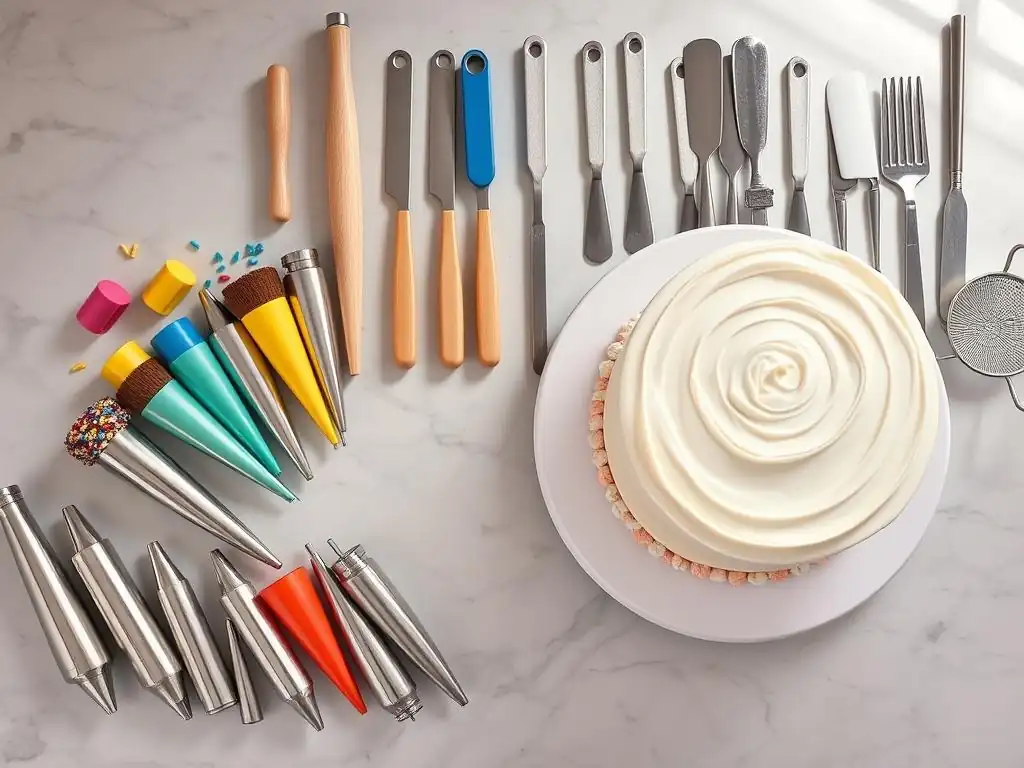
Proper cleaning is essential to maintain your cake decorating tools in good condition and ensure food safety. As soon as you finish using a tool, especially those used with buttercream or royal icing, rinse off as much residue as possible with warm water. This prevents icing from hardening and becoming difficult to remove. Piping tips and bags should be thoroughly rinsed and then washed with warm, soapy water. Using a small brush designed for cleaning pastry tips can help remove stubborn bits of frosting from intricate designs.
Metal tools, like spatulas and scrapers, should be washed and dried immediately to prevent rust. Disposable piping bags should be discarded. Reusable bags, especially fabric or silicone ones, need careful washing inside and out, often requiring soaking or multiple rinses to remove all grease and color. Ensuring all essential tools for cake decorating are spotless before storage extends their lifespan and keeps them hygienic.
Safe Storage Practices
Storing your cake decorating tools properly helps protect them from damage, keeps them organized, and ensures they are clean and ready for your next project. Piping tips can be stored in dedicated tip organizers or small containers with dividers to keep them sorted by size or type. Piping bags can be folded or rolled and stored in drawers or containers.
Spatulas, scrapers, and larger tools can be stored in utensil crocks, drawers, or hung on hooks. Delicate items like gumpaste tools or small cutters should be stored in protective cases or boxes to prevent them from bending or breaking. Keeping tools dry before storage is crucial, especially for metal items, to avoid rust or mildew. An organized storage system makes finding the right tool quick and easy.
Maintaining Tool Sharpness
Some cake decorating tools, particularly those used for cutting fondant or gumpaste (like exacto knives, rotary cutters, or modeling tools with cutting edges), may require occasional maintenance to stay sharp. While you won't be sharpening piping tips or spatulas, keeping cutting blades sharp is important for clean, precise cuts in sugar paste.
Exacto knife blades are typically disposable and should be replaced when they become dull. Rotary cutter blades can often be replaced or, in some cases, lightly sharpened with a honing tool if they are metal. Modeling tools with knife edges should be handled carefully to avoid dulling them on hard surfaces. Always use cutting mats when using sharp tools to protect your work surface and the blade itself. Proper care ensures your cake decorating tools guide you to success every time.
Where to Buy Cake Decorating Tools
Top Online Retailers
The internet offers a vast selection of cake decorating tools, from basic sets to highly specialized equipment. Large online marketplaces like Amazon offer a wide range of brands and price points, often with customer reviews that can help inform your decision. Specialty online baking supply stores often carry a deeper inventory of professional-grade tools, specific brands, and hard-to-find items.
Websites dedicated to cake decorating supplies, such as Wilton, Ateco, or Fante's Kitchen Wares, provide access to their full product lines and often offer educational content or kits tailored to specific techniques. Shopping online provides convenience and access to a global market, allowing you to compare prices and find exactly the essential tools for cake decorating you need, often with detailed product descriptions and specifications.
Local Baking Supply Stores
Visiting a local baking supply store offers a different kind of experience when building your collection of cake decorating tools. You have the opportunity to see and handle the tools before purchasing, assessing their quality, weight, and feel. Staff at these stores are often experienced bakers or decorators and can provide valuable advice, recommendations, and guidance on choosing the right tools for your skill level and projects.
Local stores may also carry unique items or ingredients not readily available online. While prices might occasionally be slightly higher than online retailers due to overhead, the ability to get immediate expert advice and physically inspect the tools can be invaluable, especially when you're starting out and navigating your first cake decorating tools guide. Supporting local businesses also contributes to your community.
Investing in Quality: Durability and Reliability
When deciding where to buy your cake decorating tools, consider prioritizing quality and durability, especially for frequently used items like spatulas, piping tips, and turntables. While budget-friendly options are available, tools made from sturdy materials like food-grade stainless steel, heavy-duty plastic, or silicone tend to last longer, perform better, and withstand rigorous cleaning.
Investing in reliable tools minimizes frustration caused by flimsy equipment that bends, breaks, or rusts easily. A high-quality piping tip, for example, will maintain its shape under pressure and produce consistent designs for years, whereas a cheap one might deform after a few uses. Think of the long-term value and the impact on your decorating success when choosing your essential tools for cake decorating.
Troubleshooting with the Right Tools
Repairing Mistakes: Tools for Fixing Imperfections
Even experienced decorators encounter mishaps, but the right cake decorating tools can often help fix imperfections. For minor dents or smudges in buttercream, a small offset spatula or a clean bench scraper can often be used to carefully smooth the area. If an air bubble appears under fondant, a fine pin or needle tool can be used to carefully prick the bubble and release the air, followed by gentle smoothing with a fondant smoother.
For small tears or cracks in fondant, a tiny amount of shortening or edible glue can sometimes be used to "glue" the edges back together, followed by gentle smoothing. If a piped border isn't perfect, a small offset spatula can carefully scrape it away, allowing you to re-pipe the section. Having a selection of small, precise essential tools for cake decorating on hand is key to making quick repairs.
Preventing Common Problems
Using the correct cake decorating tools from the start is often the best way to prevent common problems. Using a cake leveler prevents lopsided layers. Using a good quality turntable and scraper helps prevent uneven frosting. Using the correct consistency of icing for your piping tips prevents blowouts or messy designs.
Properly kneading and rolling fondant to an even thickness prevents tearing. Using a digital scale for ingredients helps ensure your cake bakes correctly, reducing issues like sinking or uneven texture that can make decorating difficult. Following a reliable cake decorating tools guide and technique helps preempt many potential issues.
Bubbles in Fondant & The Needle Tool
One common frustration when covering a cake with fondant is the appearance of air bubbles trapped underneath. These bubbles can ruin the smooth finish. The simplest and most effective tool for addressing this is a fine pin or a dedicated needle tool.
- How it works: Gently insert the tip of the needle tool into the side of the bubble, as close to the cake surface as possible. This creates a small, discreet hole.
- Fixing: Once the air is released, gently smooth the area around the pinhole with your finger or a fondant smoother to flatten the fondant back down. The elasticity of the fondant often allows the small hole to disappear or become nearly invisible. This quick fix with a simple tool saves your smooth finish.
Uneven Frosting & The Offset Spatula
Achieving perfectly smooth frosting on the top and sides of a cake can be challenging without the right technique and tool. Uneven frosting is a common beginner problem. The offset spatula is your best friend here.
- How it works: The angled blade lifts the handle away from the cake surface, preventing your hand from dragging through the frosting. Using a sweeping motion from the center outwards for the top, and holding the spatula against the side of the cake while rotating the turntable for the sides allows for controlled application and smoothing.
- Fixing: If you notice an uneven patch, add a little more frosting to that area and use the offset spatula to gently blend it into the surrounding frosting, smoothing it out as you go. For sides, run the bench scraper around again after adding more frosting to the low spot. This iterative process with the offset spatula is key to a flawless finish.
Frequently Asked Questions
What are the absolute essential cake decorating tools a beginner should invest in?
A beginner should start with a basic piping bag and tips, a cake smoother, and an offset spatula. These tools will cover fundamental decorating techniques.
How do I choose the right piping tips for different cake decorating effects?
Consider the desired effect. Star tips create textured designs, round tips are for writing and outlining, and petal tips create realistic flower petals. Experimentation is key!
What is the purpose of a cake turntable, and is it really necessary?
A cake turntable allows for smooth and even frosting application, making it easier to achieve a professional finish. While not strictly necessary, it significantly improves the decorating process.
What are some alternatives to expensive cake decorating tools if I'm on a budget?
You can use ziplock bags with the corner snipped off as piping bags, and parchment paper to create piping cones. A butter knife can substitute for an offset spatula in a pinch.
How do I properly clean and store my cake decorating tools to ensure they last?
Wash tools with warm, soapy water immediately after use. Ensure they are completely dry before storing them in an airtight container to prevent rust and damage.
Final Reflection: The Sweetest Journey Begins with the Right Tools
Unlocking your cake decorating potential isn't just about frosting roses; it's about embracing creativity and finding joy in the process. This guide has explored the essential tools that can transform a simple cake into a masterpiece, highlighting the importance of choosing quality equipment that fits your skill level and aspirations. The right tools are not merely accessories; they are the keys to unlocking your unique artistic voice.
The impact of cake decorating extends far beyond the kitchen; it's a powerful form of self-expression and a way to connect with others. It's a craft that transcends generations, fostering creativity and providing a tangible outlet for emotions. The joy of creating something beautiful, something edible, and something deeply personal is a powerful experience. The best things in life are the people we love, the places we've been, and the memories we've made along the way.
While this quote doesn't directly relate to cake decorating, it speaks to the heart of the experience – creating lasting memories and sharing joy through a tangible creation.
Now, it's your turn. Don't let fear or a lack of equipment hold you back. Start small, explore the tools discussed in this guide, and discover the unique baker within. Embrace the mess, celebrate the successes, and learn from the imperfections. The journey of mastering cake decorating is a sweet one, filled with endless possibilities and the rewarding satisfaction of creating something truly special. So, gather your tools, let your imagination run wild, and begin your delicious adventure today.
Unleash Your Inner Cake Artist!
Thanks for taking the time to explore the world of cake decorating with us! We hope you've discovered some amazing tools to elevate your baking game. Now it's time to put that knowledge into action.
- Start your next baking masterpiece today! Choose your favorite recipe and try out one of the new techniques or tools you learned about. Let your creativity flow!
- Share your creations: Show off your baking prowess on social media using #BakeWithEase and tag us – we'd love to see your stunning results!
- Explore our other helpful guides: Discover more tips, tricks, and recipes on BakeWithEase to continue your cake decorating journey.
Ready to transform your kitchen into a cake decorating wonderland? What's the first amazing cake you're going to create?