
The Art of Scooping Cookie Dough for Beginners


Welcome to BakeWithEase, your haven for all things baking! Ever wondered if there's a secret to achieving perfectly uniform cookies? There is! This week, we're diving deep into the art of scooping cookie dough. Discover how mastering this seemingly simple technique can elevate your baking game and ensure consistent, delicious results every time. Are you ready to unlock the secrets to perfecting your cookie dough scooping technique? Let's get baking!
- Mastering Cookie Dough Scooping: Bake Consistently Delicious Cookies
- Introduction to Consistent Cookie Dough Scooping
- Essential Tools for Precise Cookie Dough Scooping
- Step-by-Step Guide to Professional Cookie Dough Scooping
- Achieving Uniform Cookie Sizes: Techniques and Precision
- Troubleshooting Common Scooping Challenges
- Baking Your Perfectly Portioned Cookies: Achieving Optimal Results
- Advanced Cookie Dough Scooping Techniques
- Conclusion: Elevating Your Cookie Baking
- Frequently Asked Questions
- Final Reflection: The Sweet Science of the Perfect Scoop
- Unlock Your Inner Cookie Dough Artist!
Welcome to the wonderful world of cookie baking! There's nothing quite like the aroma of fresh cookies filling your kitchen, or the joy of biting into a perfectly baked treat. While recipes provide the ingredients and steps, mastering certain techniques can truly elevate your results from good to absolutely amazing. One such fundamental skill, often overlooked, is the art of scooping your cookie dough.
Achieving uniform size and shape through consistent scooping might seem like a small detail, but it has a massive impact on the final outcome of your cookies. This guide is designed specifically for beginners, walking you through everything you need to know about perfecting cookie dough scooping technique, ensuring every cookie you bake is a testament to your growing baking skills.
Why Uniform Scooping is Crucial for Even Baking
Imagine a baking sheet filled with cookies of vastly different sizes. What happens when you put them in the oven? The smaller cookies will bake and potentially burn much faster than the larger ones, which might still be raw in the center.
This inconsistency is the primary reason why uniform scooping is absolutely crucial for even baking. When all your cookies are roughly the same size and thickness, they will require the same amount of time in the oven to bake through perfectly, resulting in a batch where every single cookie is golden brown on the edges and wonderfully soft or chewy in the middle, just as intended.
Beyond just even baking, consistent scooping also contributes to a predictable yield from your recipe. If a recipe promises "about 2 dozen cookies," using a standard scoop size (like a 1.5-inch or 2-tablespoon scoop) helps you get close to that number every time. This uniformity makes planning easier, whether you're baking for a small family treat or a larger event. It’s a foundational step in perfecting cookie dough scooping technique that pays off in delicious, consistent results.
Perfecting cookie dough scooping technique is truly the foundation upon which a perfect bake is built. It ensures that the heat from your oven is distributed evenly across all the cookies on the baking sheet. Think of it like assembling building blocks – if the base blocks aren't uniform, the whole structure can be wobbly. Similarly, if your dough portions aren't consistent, your baking results will be unpredictable. This attention to detail is what separates a good baker from a great one.
Furthermore, uniformly scooped cookies look professional and appealing. Whether you're sharing them with friends, family, or simply admiring your own handiwork, a batch of consistently sized, beautifully baked cookies is incredibly satisfying. It shows care and precision in your baking process. Mastering this technique early in your baking journey will set you up for success with countless cookie recipes down the line, from simple chocolate chip to delicate shortbread.
While you can technically scoop dough with just two spoons, having the right tools makes the process significantly easier, faster, and more consistent. Investing in a quality cookie scoop is one of the best things a beginner baker can do to improve their cookie game. Let's explore the options available and why they are so helpful in perfecting cookie dough scooping technique.
Beyond dedicated scoops, there are other methods and tools that can help you achieve precise portions, each with its own advantages. Understanding these options allows you to choose the best approach based on the type of dough you're working with and your personal preference for precision and speed. Having the right tools at your disposal is a key part of mastering this essential baking skill.
Cookie scoops come in various sizes, typically measured by volume (tablespoons) or diameter (inches). Common sizes include 1 tablespoon (often for smaller, thinner cookies), 1.5 tablespoons (a versatile standard, yields about 30-36 cookies per batch), and 2 tablespoons (for larger, chewier cookies, yielding about 24 cookies). The size you choose depends on the recipe and your desired cookie size. A standard size like 1.5 or 2 tablespoons is a great starting point for most classic cookie recipes.
Most cookie scoops feature a spring-loaded mechanism that scrapes the dough cleanly from the scoop and releases it with a simple squeeze of the handle. There are different types of release mechanisms, including squeeze handles and thumb levers. Squeeze handles are often preferred for comfort and ease of use, especially when scooping a large batch of dough. Look for a sturdy, stainless steel scoop that feels comfortable in your hand – it will be your best friend in perfecting cookie dough scooping technique.
While a cookie scoop is ideal for consistency, you can certainly scoop dough using alternatives. The most common method is using two spoons: one spoon to scoop the dough and the other to gently push it off onto the baking sheet. This method works reasonably well, though achieving perfectly uniform sizes can be more challenging and may require practice and a good eye. It's a perfectly valid approach, especially if you're just starting out and don't want to invest in a scoop immediately.
Another excellent alternative, especially for precision bakers, is to weigh your cookie dough portions. While slower than scooping, weighing ensures absolute consistency in size. For example, you might weigh each portion to be exactly 30 grams. This method guarantees that every cookie will bake identically. For recipes where precision is paramount, like delicate shortbread or macarons, weighing is often the preferred technique for achieving uniform results.

Ready to put theory into practice? Let's break down the process of scooping cookie dough like a pro. Following these steps will help you achieve clean, consistent portions every time, setting you up for a successful bake. Perfecting cookie dough scooping technique involves a few key stages, from preparing the dough itself to the actual scooping and releasing.
This section will guide you through the practical steps, addressing common considerations like dough temperature and the physical motion of scooping. By paying attention to these details, you'll find that achieving uniform cookie sizes becomes second nature. Let's get started and turn that bowl of delicious dough into perfectly portioned spheres ready for the oven.
Preparing Your Dough: Temperature and Resting
The temperature of your cookie dough significantly impacts how easy it is to scoop and how the cookies spread while baking. Most cookie recipes call for chilling the dough before scooping and baking. Chilling makes the dough firmer, which is essential for clean scooping and prevents excessive spreading in the oven. A chill time of at least 30 minutes, or even overnight, is often recommended. Dough that is too warm will be sticky and difficult to portion cleanly with a scoop, leading to inconsistent shapes and sizes.
Conversely, dough that is too cold and hard can also be challenging to scoop. If your dough has been chilling for a long time and is very firm, let it sit at room temperature for 10-15 minutes to soften slightly before scooping. The ideal consistency for scooping is firm but pliable, similar to playdough. This balance ensures the scoop cuts through the dough cleanly without it sticking excessively or being too hard to manage. Proper dough temperature is a critical first step in perfecting cookie dough scooping technique.
Mastering the Scoop: Technique for Clean Portions
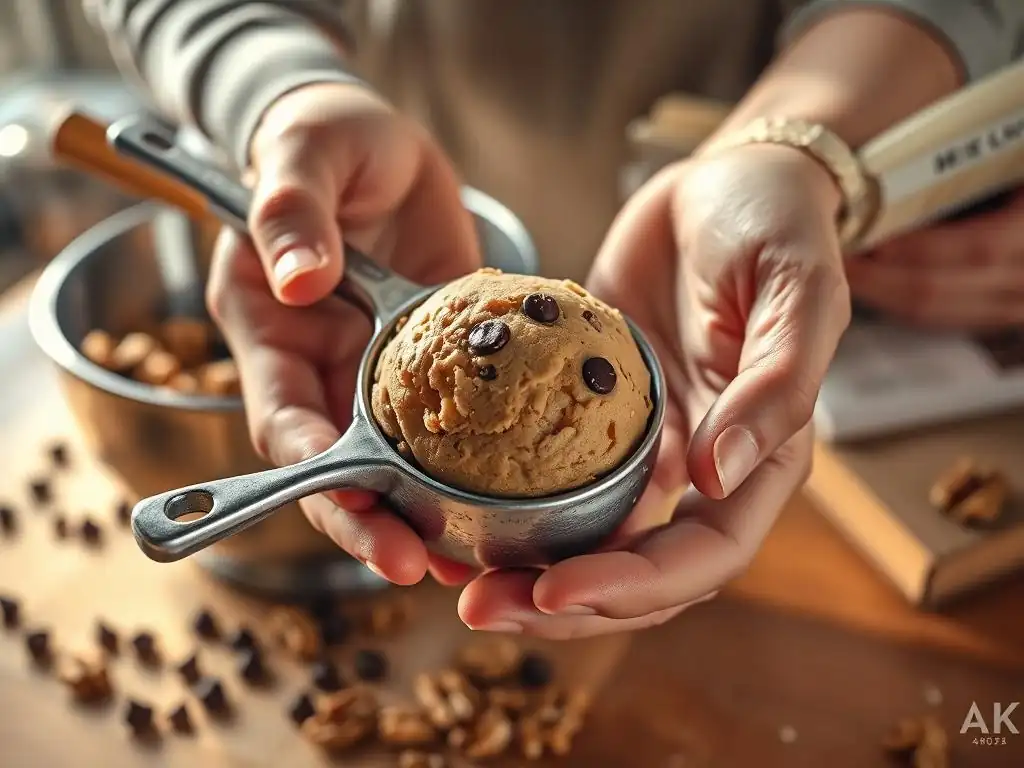
Once your dough is at the right temperature, it's time to scoop. For a standard spring-loaded scoop, plunge the scoop firmly into the dough, ensuring you get a full, level portion. Scrape the top of the scoop against the edge of the bowl or the surface of the dough to remove any excess, creating a smooth, rounded top. This action helps create a consistent volume in each scoop. Don't just lightly dip the scoop; make sure it's completely filled and leveled off.
Hold the scoop with the release mechanism facing upwards towards your thumb or hand. For squeeze handles, grip the handle firmly. For thumb levers, use your thumb to push the lever. Aim for a single, fluid motion when scooping and leveling. Practicing this motion a few times will help you get a feel for it. This technique ensures that each scoop holds roughly the same amount of dough, which is fundamental to perfecting cookie dough scooping technique.
Releasing the Dough: Ensuring Smooth Transfer
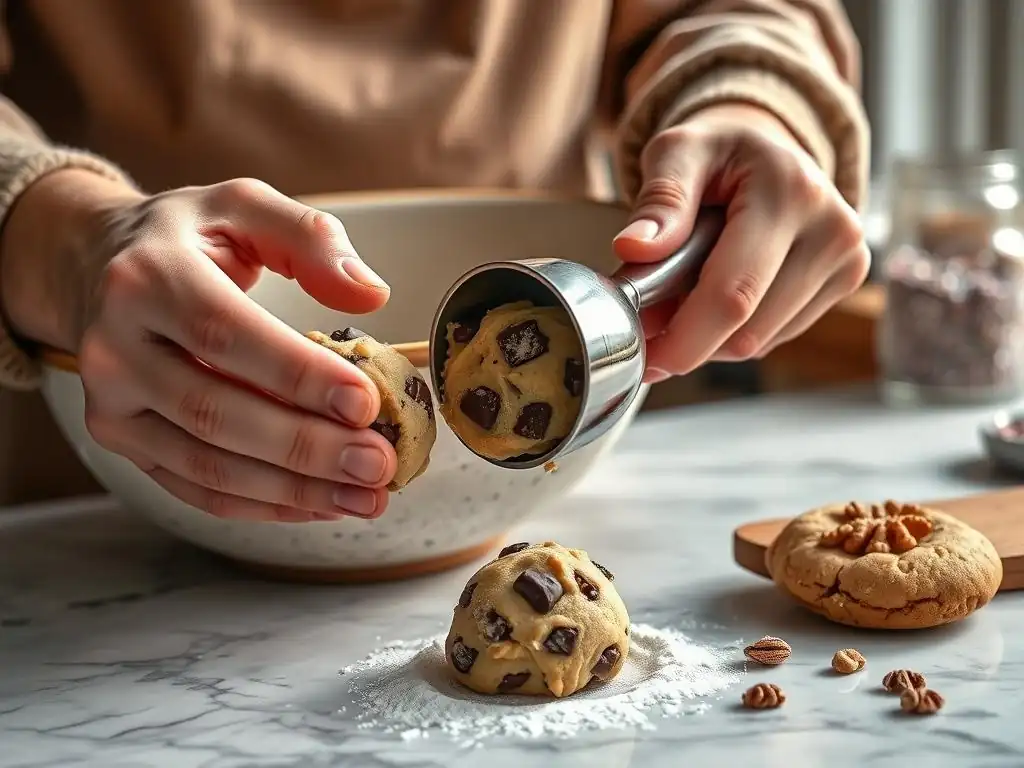
After scooping a level portion of dough, position the scoop directly over the spot on the baking sheet where you want the cookie to sit. Press the release mechanism (squeeze the handles or push the thumb lever) firmly and steadily. The spring-loaded sweep should cleanly push the dough ball out of the scoop. If the dough sticks, a slight twist of the wrist as you release can sometimes help.
The goal is for the dough ball to land smoothly on the baking sheet, ideally maintaining its rounded shape. This shape encourages the cookie to spread evenly into a nice circle as it bakes. If the dough looks messy or uneven after releasing, gently reshape it with your fingers if necessary, but ideally, the clean release technique minimizes the need for reshaping. A smooth, consistent release is the final step in perfecting cookie dough scooping technique for perfectly formed cookies.
Consistency in cookie size is the hallmark of a skilled baker. Whether you're aiming for perfectly matched pairs for sandwich cookies or simply want every cookie in the batch to bake identically, achieving uniform size is key. We've touched on this already, but let's delve deeper into the specific techniques that guarantee precision, moving beyond just basic scooping.
Perfecting cookie dough scooping technique isn't just about using a scoop; it's about understanding how different methods can deliver varying levels of precision. From the convenience of a scoop to the exactitude of a scale, choosing the right technique for your recipe and goals is part of the art.
As discussed, a cookie scoop is the easiest way to achieve consistent sizing quickly. By using the same scoop for every portion and ensuring each scoop is filled and leveled off the same way, you inherently create dough balls that are very close in volume. While not as precisely uniform as weighing, this method is significantly more consistent than using spoons freehand.
For best results when using a scoop, try to maintain a steady pace and consistent pressure. Avoid overpacking the scoop, which can lead to denser centers, or underfilling it. A level scoop is your goal every time. Most bakers find that after scooping a few cookies, they develop a rhythm that naturally promotes consistency, further perfecting cookie dough scooping technique through repetition and muscle memory.
Weighing Dough: The Precision Baker's Secret
For ultimate precision, weighing each portion of cookie dough is the gold standard. This is particularly useful for recipes sensitive to slight variations in size, like detailed cut-out cookies or recipes where spread is critical. You'll need a digital kitchen scale for this method. First, determine the target weight for each cookie (a recipe might specify this, or you can weigh a few scooped portions and average them).
Using a spoon or small scoop, place dough onto the scale until it reaches the target weight. Then, gently roll the weighed dough into a ball before placing it on the baking sheet. This method ensures that every single cookie has the exact same mass, guaranteeing the most uniform baking results possible. While more time-consuming than simply scooping, weighing is invaluable for perfecting cookie dough scooping technique when absolute consistency is paramount.
Visual Estimation: Developing an Accurate Eye
While less precise than using a scoop or scale, developing a good eye for visual estimation is a skill that improves with practice. If you're in a pinch without a scoop or scale, you can still aim for consistency by trying to make each dough portion look roughly the same size. This is easiest with doughs that are rolled into balls.
Take portions of dough and roll them between your palms, trying to make each ball look like its predecessor. Place them side-by-side on the baking sheet before baking to compare sizes and adjust if necessary. While this method is the least precise, it's better than simply dropping uneven blobs. It requires focus and attention to detail but can be a useful skill to develop alongside your scoop-based perfecting cookie dough scooping technique.
Troubleshooting Common Scooping Challenges
Even with the right tools and techniques, you might encounter a few hiccups when scooping cookie dough. Dough can be sticky, dense, or just plain tricky. Knowing how to address these common challenges will save you frustration and help you maintain consistency throughout the batch. Let's look at some typical issues and how to overcome them.
Troubleshooting is a normal part of the baking process. Identifying why your dough isn't scooping cleanly or consistently is the first step to fixing it. With a few simple adjustments, you can handle these challenges and get back to perfecting cookie dough scooping technique without a hitch.
Sticky Dough: Preventing Adhesion
Sticky dough is a common problem, often caused by the dough being too warm or having too much moisture relative to dry ingredients. If your dough is sticking excessively to the scoop or your hands:
- Chill the dough longer: This is usually the easiest fix. Return the dough to the refrigerator for another 30-60 minutes. Colder dough is less sticky.
- Lightly flour the scoop: For very sticky doughs, a very light dusting of flour on the inside of the scoop can help the dough release cleanly. Wipe away any excess flour so it doesn't affect the recipe too much.
- Work quickly: Try to scoop the entire batch relatively quickly before the dough warms up from your hands or the room temperature.
Addressing stickiness ensures cleaner scoops and prevents the dough from deforming as you try to release it, which is crucial for perfecting cookie dough scooping technique.
Dense Dough: Scooping Strategies
Some doughs, especially those with lots of mix-ins like nuts or chocolate chips, or doughs that have been chilled for a long time, can be quite dense and hard to scoop. Trying to force a scoop through very stiff dough can be tough on your hands and the scoop.
- Let it soften slightly: If the dough is rock hard from chilling, let it sit at room temperature for 10-15 minutes before scooping to make it more pliable.
- Use a sturdy scoop: This is where a good quality, strong metal scoop pays off. Plastic scoops might break or bend under the pressure of dense dough.
- Apply firm, steady pressure: Instead of trying to scoop quickly, apply firm, steady pressure to push the scoop through the dough. You might need to use both hands.
Handling dense dough requires a bit more effort, but adjusting your approach allows you to maintain consistency and continue perfecting cookie dough scooping technique even with challenging textures.
Inconsistent Scoops: Refining Your Technique
If you're finding that despite using a scoop, your dough portions are still uneven, it's time to refine your technique. This usually comes down to how you're filling and leveling the scoop.
- Ensure the scoop is full and level: Don't just partially fill the scoop. Plunge it deep enough to get a full scoop and use the edge of the bowl to level off the top, removing any excess dough.
- Maintain consistent pressure: Try to use the same amount of pressure each time you scoop. Inconsistent pressure can lead to varying amounts of dough being packed into the scoop.
- Practice makes perfect: Like any skill, perfecting cookie dough scooping technique takes practice. Pay attention to how the scoop feels when it's full and level, and try to replicate that feeling with each scoop.
By focusing on filling and leveling consistency, you'll quickly see an improvement in the uniformity of your cookie dough portions, leading to better baking results.
You've mastered the art of scooping and have a tray of perfectly uniform dough balls ready to go. Now it's time for the grand finale: baking! Even with perfectly scooped dough, how you bake them makes a difference in achieving those optimal results. Proper baking ensures that your consistent portions translate into consistent, delicious cookies.
This stage is where all your hard work in perfecting cookie dough scooping technique truly shines. Uniformly sized cookies are primed for uniform baking, but attention to oven setup and handling post-bake is still necessary to get the best texture and appearance.
Even Baking: Positioning and Heat Distribution
For the most even baking, especially when baking multiple trays, consider these tips:
- Use one baking sheet at a time: If possible, bake one sheet of cookies at a time on the center rack of your oven. This ensures the most consistent heat distribution.
- Rotate trays: If you must bake two trays at once, place them on different racks (e.g., middle and upper-middle) and rotate them halfway through the baking time (swap their positions and turn each tray 180 degrees). This helps compensate for hot spots in your oven.
- Space cookies evenly: Leave enough space (usually 2 inches or more) between each scooped dough ball on the baking sheet. This allows air to circulate around each cookie and prevents them from merging as they spread. A standard baking sheet typically holds about 12 cookies using a 1.5-inch scoop.
Following these placement and rotation tips maximizes the benefits of your perfectly portioned dough, ensuring every cookie bakes evenly to a golden perfection.
Cooling and Storing: Maintaining Freshness
Once your perfectly baked cookies come out of the oven, handling them correctly during cooling is important for their final texture and structure.
- Cool on the baking sheet briefly: Let the cookies cool on the hot baking sheet for 5-10 minutes (check your recipe for specific times). This allows them to set up slightly without breaking.
- Transfer to a wire rack: After the initial cooling period, carefully transfer the cookies to a wire cooling rack to cool completely. Air circulation on all sides prevents them from getting soggy bottoms.
- Store properly: Once completely cool, store cookies in an airtight container at room temperature to maintain their freshness and texture. Different types of cookies have different storage needs, but airtight is key for most.
Proper cooling and storage preserve the quality of your cookies, ensuring that the delicious results of your perfecting cookie dough scooping technique and careful baking last as long as possible (or until they're all eaten! ).
You've mastered the basics of perfecting cookie dough scooping technique and are consistently baking uniform cookies. Ready to explore some more advanced applications? Scooping isn't just about making simple round balls; the technique can be adapted for different dough types and even used to create visually interesting effects or prepare dough for future baking.
Pushing your skills further involves understanding how to handle less conventional doughs and utilizing the scooping method for efficiency and creativity. These advanced techniques build upon the foundation you've established, opening up new possibilities in your cookie baking journey.
Handling Various Dough Textures: Soft, Stiff, and Chunky
Different cookie recipes yield doughs with varying textures, and perfecting cookie dough scooping technique means adapting to these differences.
- Very Soft/Wet Doughs: For doughs that are too soft to hold their shape even when chilled (like some drop cookie batters), a scoop is essential. Ensure the dough is well-chilled. You might need to dip the scoop briefly in warm water or cooking spray between scoops if it's particularly sticky, wiping off excess moisture.
- Stiff/Dry Doughs: Doughs like shortbread or some sugar cookies can be very stiff. These might be easier to portion by rolling the dough into a log and slicing, or pressing into a pan, rather than scooping. However, if scooping, ensure the dough is slightly softened from chilling and use a sturdy scoop with steady pressure, as discussed earlier.
- Chunky Doughs: Doughs with large mix-ins like whole nuts, large chocolate chunks, or dried fruit can be tricky. Ensure the mix-ins are evenly distributed throughout the dough. When scooping, you might need to use your fingers or a small spoon to gently coax stubborn chunks into the scoop or press them into the surface of the scooped ball.
Adapting your scooping motion and dough preparation based on texture is a sign of advanced perfecting cookie dough scooping technique.
Creating Decorative Effects: Marbling and Layering
While standard scooping yields a simple ball, you can use scooping techniques to create decorative effects before baking.
- Marbling: If you have two different colored doughs (like vanilla and chocolate), you can achieve a marbled effect. Place small, alternating scoops or pieces of each dough into the scoop before leveling and releasing. As the cookie bakes and spreads, the colors will swirl together.
- Layering: For a layered effect, place one small scoop of dough in the scoop, then top it with a scoop of a different dough, or even a filling like caramel or peanut butter, before leveling the top with more dough. This creates a surprise center or distinct layers in the baked cookie.
These techniques show that perfecting cookie dough scooping technique can extend beyond mere portioning into the realm of artistic presentation.
Freezing Scooped Dough: Baking on Demand
One of the most practical advanced uses of scooping is preparing dough for freezing. Scooping dough before freezing allows you to bake just a few cookies at a time whenever a craving strikes, without thawing and handling a large block of dough.
- Scoop and Freeze on a Tray: Scoop dough balls onto a baking sheet lined with parchment paper, just as you would for baking. Place the entire tray in the freezer until the dough balls are solid (about 1-2 hours).
- Transfer to a Container: Once frozen solid, transfer the dough balls to a freezer-safe zip-top bag or airtight container. Label with the cookie type and baking instructions.
- Bake from Frozen: To bake, place frozen dough balls on a baking sheet and bake according to the recipe, adding a few extra minutes to the baking time. No need to thaw!
This method is incredibly convenient and relies entirely on your ability to consistently scoop uniform portions beforehand, making it a key strategy for perfecting cookie dough scooping technique for efficiency.
You've journeyed through the essential steps and advanced nuances of perfecting cookie dough scooping technique. From understanding why consistency matters to selecting the right tools, mastering the scooping motion, troubleshooting challenges, and even using scooping for advanced applications, you've gained valuable knowledge. This skill is a cornerstone for baking consistently delicious cookies, batch after batch.
Remember that baking is a journey of continuous learning and practice. Every batch of cookies is an opportunity to refine your skills and produce something wonderful. Don't be discouraged by initial inconsistencies; focus on improving with each attempt.
Continuous Improvement: Refining Your Skills
Perfecting cookie dough scooping technique, like any baking skill, improves with practice. Pay attention to your dough's texture, how your scoop feels, and the consistency of the portions you're creating. Try different scoop sizes to see how they affect bake time and spread. Experiment with weighing dough for certain recipes to feel the difference in precision.
Keeping a baking journal can be helpful – note the dough temperature, the scoop size used, and the resulting bake time and spread. This data will help you understand what works best for different recipes and conditions, continuously refining your perfecting cookie dough scooping technique.
The ultimate reward for perfecting cookie dough scooping technique and baking delicious cookies is the joy of sharing them. There's a special warmth that comes from offering homemade treats to friends and family. Your consistently baked, beautiful cookies are sure to bring smiles.
Whether you're bringing them to a gathering, packing them in a lunchbox, or simply enjoying them with a cup of tea, the effort you put into each step, including the careful scooping, makes the final product all the more satisfying.
Your Journey to Baking Excellence
Mastering techniques like perfecting cookie dough scooping technique is a significant step on your journey to baking excellence. It demonstrates attention to detail and a commitment to quality that will shine through in all your baked goods. Keep exploring new recipes, keep practicing your skills, and most importantly, keep having fun in the kitchen. Happy baking!
Frequently Asked Questions
The best tool is often a cookie scoop or a spring-loaded ice cream scoop. These tools ensure uniform cookie sizes, leading to even baking.
Uniform scooping ensures even baking and consistent results. This prevents some cookies from being burnt while others are underbaked, leading to a perfect batch.
Yes, you can use a spoon, but it's harder to achieve consistent size. Try to use a measuring spoon and level it off for more accuracy.
Try dipping the scoop in warm water between scoops. Also, ensuring your cookie dough is properly chilled can help prevent sticking.
Proper scooping ensures consistent size and shape, which impacts baking time and texture. A well-scooped cookie will bake more evenly and have a better overall appearance.
Final Reflection: The Sweet Science of the Perfect Scoop
Mastering the art of scooping cookie dough isn't just about uniform cookies; it's about precision, consistency, and ultimately, the joy of baking. The seemingly simple act of scooping dough holds the key to unlocking perfectly baked treats, from evenly browned edges to consistent baking times. This seemingly small detail significantly impacts the final product, transforming a haphazard baking experience into a precise and satisfying one.
The impact of a well-executed scoop extends beyond the individual baker; it speaks to a broader appreciation for detail and craftsmanship in the culinary arts. It's a testament to the power of technique, reminding us that even the most basic tasks can be elevated through mindful practice. As Julia Child once wisely said, Find something you're passionate about and keep tremendously interested in it.
For me, that passion lies in the meticulous process of creating perfectly uniform cookie dough scoops, a small act that yields immense satisfaction.
Now, it's your turn. Consider the seemingly mundane tasks in your own life – are there areas where precision and attention to detail could elevate the outcome? Take a moment to reflect on how a focused approach, much like perfecting your cookie dough scooping technique, can bring unexpected joy and satisfaction to even the simplest activities. Embrace the art of the perfect scoop, not just in baking, but in all aspects of your life.
Thanks for joining us on this delicious journey into the world of cookie dough scooping! We hope you've gained some valuable tips and tricks to elevate your baking game. Ready to put your newfound skills to the test?
- Master the Perfect Scoop: Practice your scooping technique with your favorite dough recipe. Aim for consistency and enjoy the process! This is your chance to really refine your skills.
- Share Your Creations: Show off your perfectly-scooped cookies (or dough!) on social media using #BakeWithEaseScoops – let's inspire each other!
- Experiment with Flavors: Don't be afraid to get creative! Try adding different extracts or mix-ins to your dough for unique flavor combinations. What unexpected flavor will you try next?