
The Science Behind Baguette Crumb and Crust

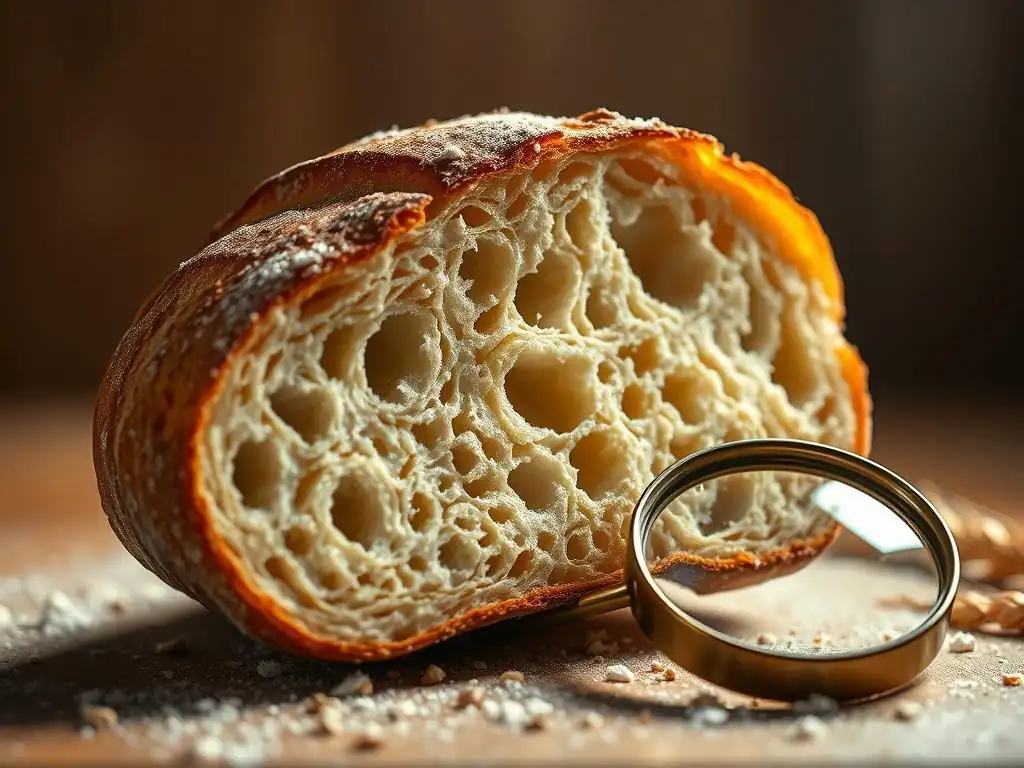
Welcome to BakeWithEase, where we demystify the delicious world of baking! Ever wondered what makes a perfect baguette so irresistible? Get ready to uncover the secrets! This week, we're diving deep into baguette crumb texture science, exploring the fascinating chemistry and techniques that create that airy, irregular interior and that satisfyingly crisp crust. Prepare to elevate your bread baking game and unlock the secrets to a truly exceptional baguette. Curious to learn more? Let's get baking!
- The Science Behind Baguette Crumb and Crust: Achieving the Perfect Texture
- Understanding the Importance of Baguette Crumb Texture Science
- The Science of Baguette Crumb Formation
- Mastering Baguette Crust Formation: A Scientific Approach
- Factors Affecting Baguette Crumb Texture Science: Troubleshooting
- Advanced Techniques for Enhancing Baguette Crumb
- Achieving the Ideal Baguette Crumb: A Summary of Key Scientific Principles
-
Frequently Asked Questions
- What factors contribute to the characteristic open crumb structure of a baguette?
- How does flour type impact the final crumb texture of a baguette?
- What role does fermentation play in developing the flavor and texture of a baguette crumb?
- How does oven temperature affect the crust and crumb of a baguette?
- What are some common mistakes that lead to a dense or gummy baguette crumb, and how can they be avoided?
- Final Reflection: The Enduring Allure of the Perfect Baguette Crumb
- Unleash Your Inner Boulanger: Master the Art of the Crumb
The Science Behind Baguette Crumb and Crust: Achieving the Perfect Texture
Understanding the Importance of Baguette Crumb Texture Science
Why Crumb Texture Matters in Baguettes
The interior structure of a baguette, often called the 'crumb', is a defining characteristic of a truly exceptional loaf. When we talk about baguette crumb texture science, we're exploring the intricate network of air pockets and gluten strands that give a baguette its light, airy, and slightly irregular interior.
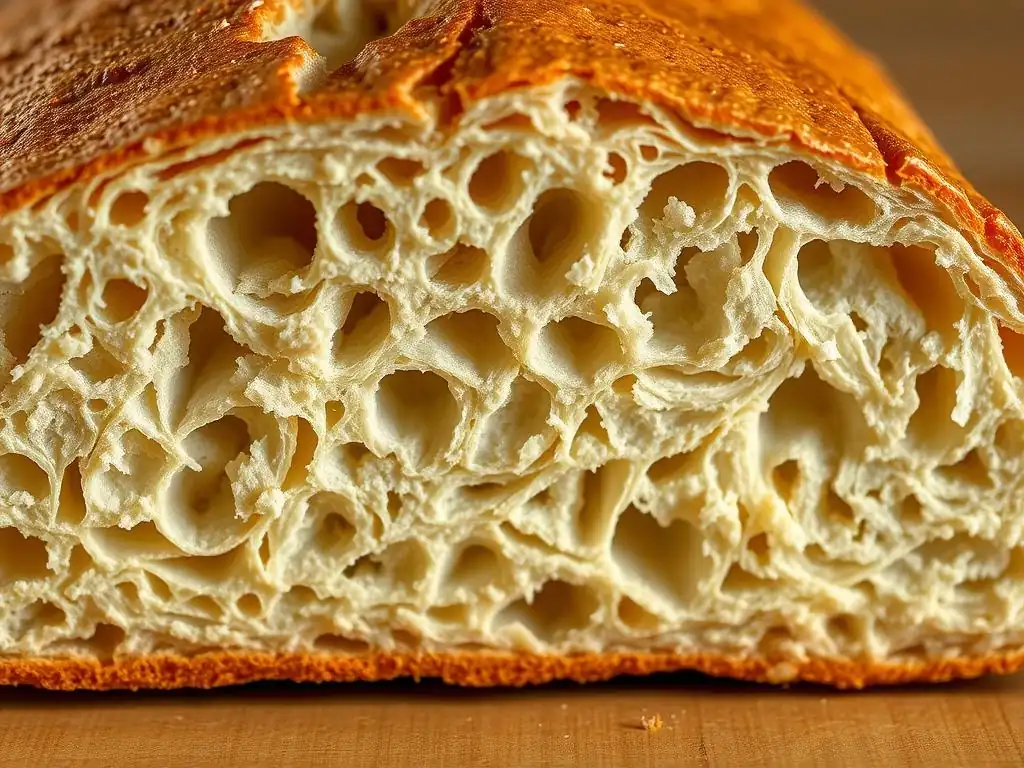
A well-developed crumb should have a beautiful open structure, with varying sizes of alveoli (the technical term for the air pockets) that are evenly distributed throughout the loaf, though a classic baguette often features larger pockets towards the center and smaller ones near the crust. This open texture contributes significantly to the overall eating experience, providing a pleasant mouthfeel and allowing the flavors of the bread to shine.
Beyond aesthetics and mouthfeel, the crumb texture directly impacts how the baguette absorbs spreads or sauces, and how it interacts with other ingredients in a meal. A dense, tight crumb can make the baguette feel heavy and doughy, lacking the characteristic lightness expected. Conversely, an overly fragile crumb might collapse too easily. Achieving the ideal baguette crumb texture is a goal for many bakers and involves understanding the scientific principles behind ingredient interactions, fermentation, and baking techniques. This understanding is key to consistently producing baguettes that delight with every slice and every bite.
The Relationship Between Crust and Crumb in a Baguette
The perfect baguette is a study in contrasts: a shatteringly crisp crust giving way to a soft, airy, and flavorful crumb. This harmonious relationship isn't coincidental; the formation of one heavily influences the other. The development of a thin, crisp crust during baking acts as a protective shell, trapping steam released from the dough within the loaf.
This trapped steam is crucial for allowing the interior to expand fully in the initial phase of baking (known as oven spring), which directly contributes to the development of that desirable open crumb structure. Without adequate steam and a rapidly setting crust, the loaf's expansion is inhibited, often resulting in a denser crumb.
Furthermore, the chemical reactions that create the crust, such as the Maillard reaction and caramelization, also subtly influence the flavor profile of the entire loaf. The heat transfer from the oven through the crust to the interior affects the final texture and moisture content of the crumb. A crust that is too thick can lead to a dry interior, while a crust that is too thin might not provide sufficient structural integrity or steam retention for optimal crumb development. Mastering the interplay between crust and crumb formation is central to the science of baking a perfect baguette.
The Science of Baguette Crumb Formation
The Role of Flour in Baguette Crumb Development
Flour is the foundational ingredient in any bread, and its composition critically influences baguette crumb texture science. Specifically, the protein content, primarily gluten-forming proteins like glutenin and gliadin, is paramount. When flour is mixed with water, these proteins hydrate and, through mechanical action like kneading, link together to form a complex, elastic network called gluten.
This network is capable of trapping the carbon dioxide gas produced by yeast fermentation, allowing the dough to rise and create the characteristic open structure of the baguette crumb. The type of flour used, typically bread flour with a protein content around 11-13%, provides the necessary protein structure for a strong, extensible gluten network capable of supporting a delicate, open crumb.
Beyond protein, starch is the most abundant component of flour, making up around 70-80%. During baking, in the presence of moisture and heat, starch granules absorb water and swell, a process called gelatinization. This process rigidifies the crumb structure as the loaf cools, contributing to its final texture and stability. The interaction between the developed gluten network and the gelatinized starch forms the matrix of the baguette crumb. Understanding the properties of the specific flour being used – its protein content, absorption rate, and starch characteristics – is vital for predicting and controlling the final baguette crumb texture.
Gluten Development and its Impact on Crumb Structure
Gluten development is the engine behind the open structure of a baguette crumb. As flour and water are combined and worked, the glutenin and gliadin proteins begin to hydrate and align, forming long, interconnected chains. Kneading or folding the dough strengthens these bonds and organizes the network into a more elastic and extensible structure.
This developed gluten network is what allows the dough to stretch and expand as yeast produces gas, creating the bubbles that become the alveoli in the crumb. Insufficient gluten development results in a weak network that cannot hold the gas effectively, leading to a dense, tight crumb.
Conversely, over-development of gluten can make the dough tough and difficult to handle, sometimes leading to a crumb that is also tight or rubbery. Techniques like autolyse (mixing flour and water and letting it rest before adding other ingredients) or using lower protein flours for part of the dough can help manage gluten development for specific desired crumb characteristics. For a classic baguette crumb texture science emphasizes achieving a balance: enough gluten development for extensibility and strength to support an open structure, but not so much that it becomes tough.
Starch Gelatinization and its Effect on Crumb
Starch gelatinization is a critical phase during baking that transforms the dough from a pliable mass into the solid structure of the baked crumb. As the internal temperature of the loaf rises, typically above 140°F (60°C), the starch granules in the flour, having absorbed water during mixing and fermentation, begin to swell rapidly and burst. This process releases amylose and amylopectin molecules, which form a gel-like matrix that surrounds and stabilizes the gluten network. This gelatinized starch provides rigidity and structure to the crumb as the bread cools, locking the air pockets in place.
The degree of starch gelatinization affects the final crumb texture and moisture retention. Sufficient gelatinization is necessary for a stable and pleasing crumb. If the loaf doesn't reach the necessary internal temperature or lacks sufficient moisture, gelatinization may be incomplete, resulting in a crumb that is dry and potentially crumbly. The interaction between the hydration level of the dough, the baking temperature, and the duration of baking all influence the extent of starch gelatinization, playing a direct role in the final baguette crumb texture science aims to understand.
Water's Impact on Crumb Texture
Water is far more than just a liquid in bread making; it's a solvent that activates the yeast, hydrates the flour proteins for gluten development, and facilitates starch gelatinization. The amount of water used, known as the hydration level, is a primary determinant of baguette crumb texture.
Baguettes are typically made with relatively high hydration doughs, often ranging from 70% to 80% hydration (meaning the weight of water is 70-80% of the weight of the flour). Higher hydration levels generally lead to a more open and airy crumb structure because the extra water makes the dough more extensible, allowing the gas bubbles to expand more freely during fermentation and baking.
However, working with high-hydration dough requires specific handling techniques, as the dough is stickier and less structured initially. Bakers must develop the gluten sufficiently through methods like stretching and folding rather than aggressive kneading. The hydration level must also be balanced with the flour type; a higher protein flour can absorb more water than a lower protein one. Getting the hydration right is a crucial step in mastering the baguette crumb texture science.
Hydration Levels and Their Influence
The hydration level of baguette dough directly impacts the dough's consistency, the rate of fermentation, and ultimately, the crumb structure. A dough at 65% hydration will feel firm and easy to handle, likely producing a tighter crumb with smaller, more uniform holes. Increasing the hydration to 75% will result in a much wetter, stickier dough, requiring gentle handling to maintain the developing gluten network.
This higher hydration promotes the formation of larger, more irregular air pockets, characteristic of a traditional artisan baguette crumb. For example, a classic Parisian baguette often uses hydration levels approaching 75% or even higher to achieve its signature open structure.
The amount of water also affects the dough's temperature and, consequently, the fermentation speed. Warmer water speeds up fermentation, while colder water slows it down. Bakers often adjust water temperature based on the ambient temperature or desired fermentation time. The hydration level is a fundamental variable in baguette crumb texture science, requiring careful consideration and adjustment based on flour type, environmental conditions, and desired outcome.
Water Temperature Considerations
The temperature of the water used in mixing the dough has a significant, albeit indirect, impact on the final baguette crumb texture. Water temperature is a primary factor in controlling the dough's initial temperature, which in turn dictates the pace of yeast activity and fermentation. Yeast is most active within a specific temperature range, roughly 75-85°F (24-30°C).
Using warmer water will raise the dough temperature, accelerating fermentation, which can be useful in colder environments or when a faster process is desired. However, excessively warm water can over-activate the yeast initially, potentially leading to inconsistent gas production later or even damaging the yeast.
Conversely, using cooler water slows down fermentation. This is often preferred for longer fermentation processes, like overnight cold proofs, where slow, steady gas production builds complex flavors and contributes to a stronger gluten structure capable of supporting a more open crumb. The target dough temperature after mixing is often around 75-78°F (24-26°C) for many baguette recipes, achievable by adjusting the water temperature based on the temperature of the flour and the ambient environment. Controlling water temperature is a subtle yet important aspect of managing the fermentation process, which is integral to successful baguette crumb texture science.
Yeast and Fermentation: Key to Baguette Crumb
Yeast is the biological leavening agent responsible for producing the gas (primarily carbon dioxide) that inflates the dough and creates the air pockets within the baguette crumb. During fermentation, yeast consumes sugars present in the flour and produces CO2 gas and alcohol. This gas is trapped by the elastic gluten network, causing the dough to rise.
The rate and duration of fermentation are critical for developing both the desired crumb structure and the complex flavors characteristic of a great baguette. Sufficient fermentation allows the gluten network to relax and become more extensible, better able to expand and hold larger gas bubbles.
Different types of yeast (active dry, instant, fresh) and varying amounts will affect the speed of fermentation. The temperature of the dough and the environment also play major roles; warmer temperatures speed up fermentation, while colder temperatures slow it down. A long, slow fermentation, often involving refrigeration (cold proofing), is particularly beneficial for developing a strong gluten structure and enhancing flavor, leading to a more desirable baguette crumb texture. Understanding yeast activity and managing fermentation time and temperature are central tenets of baguette crumb texture science.
The Fermentation Process and Flavor Development
Fermentation is not just about leavening; it's a complex biochemical process that profoundly impacts the flavor, aroma, and structure of the baguette crumb. As yeast consumes sugars, it produces not only CO2 but also a variety of organic acids and alcohols. These byproducts contribute significantly to the nuanced, slightly tangy or complex flavor profile of a well-fermented baguette.
Longer fermentation times, especially cold fermentation (proofed in the refrigerator, often for 12-24 hours), allow these flavor compounds to develop more fully. The slower activity of yeast and enzymatic breakdown of starch into simpler sugars during cold fermentation also contributes to better browning of the crust and improved moisture retention in the crumb.
Simultaneously, fermentation helps to strengthen and condition the gluten network. The acids produced slightly modify the gluten proteins, making the dough more extensible and easier to handle without tearing. This relaxed yet strong network is essential for achieving that characteristic open and irregular crumb structure. Managing the fermentation process – controlling time, temperature, and the amount of yeast – is therefore paramount for both flavor development and achieving the desired baguette crumb texture.
How Yeast Affects Crumb Openness
The activity of yeast directly dictates the volume and distribution of gas within the dough, which is the primary driver of crumb openness. As yeast ferments, it produces CO2 gas, which accumulates within the pockets formed by the gluten network. A vigorous fermentation, with sufficient yeast activity, will produce ample gas, leading to significant dough expansion during proofing and oven spring.
This expansion stretches the gluten network, creating larger alveoli (air pockets) and a more open crumb. If yeast activity is too low (due to insufficient yeast, cold temperatures, or expired yeast), insufficient gas will be produced, resulting in a dense, tight crumb.
However, too much yeast or overly rapid fermentation can also negatively impact crumb openness. Rapid fermentation can exhaust the dough's available sugars too quickly, leaving insufficient energy for oven spring. It can also lead to a weak gluten structure that collapses rather than expands.
Finding the right balance of yeast quantity and controlling fermentation temperature and time are key to managing gas production effectively and achieving the desired open baguette crumb texture science teaches us. For example, using a small amount of yeast for a long, slow proof (like 0.2% instant dry yeast by flour weight for an overnight cold proof) typically yields a more open and flavorful crumb than using a larger amount for a quick proof.
Mastering Baguette Crust Formation: A Scientific Approach
The Maillard Reaction and Baguette Crust Color
The beautiful golden-brown color and complex flavors of a baguette crust are largely due to the Maillard reaction, a complex series of chemical reactions that occur between amino acids and reducing sugars when heated. This reaction begins to occur significantly at temperatures above 280°F (140°C) and is responsible for the myriad of flavor and aroma compounds found in baked goods, roasted meats, and many other foods.
In the context of a baguette, the Maillard reaction creates hundreds of different compounds, contributing to the savory, slightly sweet, and toasted notes of the crust. The intensity of the color and flavor developed through this reaction is influenced by temperature, time, pH, and the availability of sugars and amino acids in the dough.
Simultaneously, caramelization, the browning of sugars when heated to high temperatures (around 320°F or 160°C and above), also contributes to the crust's color and flavor, adding sweet, nutty notes. While distinct reactions, the Maillard reaction and caramelization often occur together during baking and are essential for developing the desirable characteristics of a baguette crust, complementing the internal baguette crumb texture.
Temperature's Role in Maillard Reaction
Temperature is the most critical factor influencing the rate and extent of the Maillard reaction in the baguette crust. The reaction proceeds slowly at lower temperatures but accelerates significantly as the temperature rises, particularly above 300°F (150°C). Baguettes are typically baked at high temperatures, often starting around 450-480°F (230-250°C), to quickly set the crust and initiate rapid Maillard browning. The high heat ensures that the surface of the dough reaches the necessary temperature threshold for these reactions to occur effectively.
Baking temperature also affects the rate at which moisture evaporates from the crust. For the Maillard reaction and caramelization to proceed maximally, the surface needs to dry out sufficiently. High initial temperatures help achieve this quickly, allowing the crust to brown and crisp up before the interior is fully baked. Managing oven temperature throughout the bake is therefore crucial for achieving the desired crust color, flavor, and crispness, all of which are linked to the baguette crumb texture science by influencing oven spring and moisture retention.
Sugars and Amino Acids: The Fuel for Flavor
The availability of reducing sugars and amino acids in the baguette dough is essential for the Maillard reaction to occur. During fermentation, enzymes in the flour and yeast break down complex carbohydrates (starches) into simpler reducing sugars like glucose and fructose. Similarly, proteins are broken down into amino acids. A longer fermentation time, especially cold fermentation, increases the concentration of these simpler sugars and amino acids in the dough, providing more "fuel" for the Maillard reaction during baking. This is one reason why baguettes made with long, slow fermentation often have deeper, richer crust colors and more complex flavors.
The type of flour also plays a role; flours with higher enzymatic activity can produce more reducing sugars during fermentation. A small amount of added sugar (though not traditional in classic baguettes) would also accelerate the Maillard reaction, but this would alter the characteristic flavor. The interplay between fermentation time, enzymatic activity, and baking temperature determines the extent of the Maillard reaction and, consequently, the flavor and color of the crust, complementing the internal baguette crumb texture.
Steam's Crucial Role in Crust Development
Steam is arguably the single most important factor for achieving a thin, crisp, and nicely colored baguette crust. When baguettes are first placed in a hot, steamy oven, the moist environment on the surface of the dough prevents the crust from setting too quickly. This keeps the surface pliable, allowing the loaf to expand fully during oven spring – the rapid rise that occurs in the first 10-15 minutes of baking. This full expansion is vital for developing an open crumb structure; without adequate oven spring, the crumb will likely be dense.
As the baking continues and the steam dissipates (or is vented from the oven), the surface temperature of the loaf can rise rapidly, allowing the Maillard reaction and caramelization to occur, creating the desired color and flavor. The presence of steam also helps to keep the crust surface moist for a longer period, promoting a more even browning and contributing to a thinner, crisper crust compared to baking in a dry oven.
Techniques for generating steam, such as using a baking stone or steel with a tray of water, or using a Dutch oven, are fundamental to baking high-quality baguettes.
Creating a Steamy Oven Environment
Creating and maintaining a steamy environment in a home oven during the initial phase of baguette baking is essential for proper crust development. One common method involves preheating a baking stone or steel at a high temperature. Just before loading the baguettes, a pan of hot water or ice cubes is placed on a lower rack or poured into a hot cast-iron pan placed below the baking surface. The resulting steam fills the oven cavity. This steam needs to be present for the first 10-15 minutes of baking, the period of maximum oven spring.
Another effective method is using a Dutch oven or cloche. The preheated vessel traps the moisture released by the dough itself, creating a perfectly steamy microenvironment around the loaf. After the initial steaming period (usually 15-20 minutes), the lid is removed to allow the crust to dry out and brown. Regardless of the method, generating sufficient steam is non-negotiable for achieving the characteristic thin, crisp baguette crust that contrasts beautifully with the open baguette crumb texture.
The Impact of Steam on Crust Crispness
Steam plays a direct role in the final crispness of the baguette crust. In a dry oven, the crust forms almost immediately, becoming thick and hard, which restricts oven spring and often results in a dull, thick crust rather than a thin, crisp one. The presence of steam keeps the crust surface moist and pliable during the critical expansion phase. This allows the gluten network to stretch maximally.
As the steam dissipates and the crust temperature rises above the boiling point of water (212°F or 100°C), the remaining moisture rapidly evaporates. This rapid drying process, occurring on a thin layer that was kept extensible by the steam, is what allows the crust to become incredibly thin and brittle upon cooling.
The starches on the surface undergo dextrinization (a form of caramelization) in the presence of heat, contributing to the crispness and golden color. Thus, steam is not just for oven spring; it's vital for achieving that signature, satisfying crack when you slice into a perfect baguette, a key part of the baguette crumb texture science.
Factors Affecting Baguette Crumb Texture Science: Troubleshooting
Common Baguette Crumb Problems and Solutions
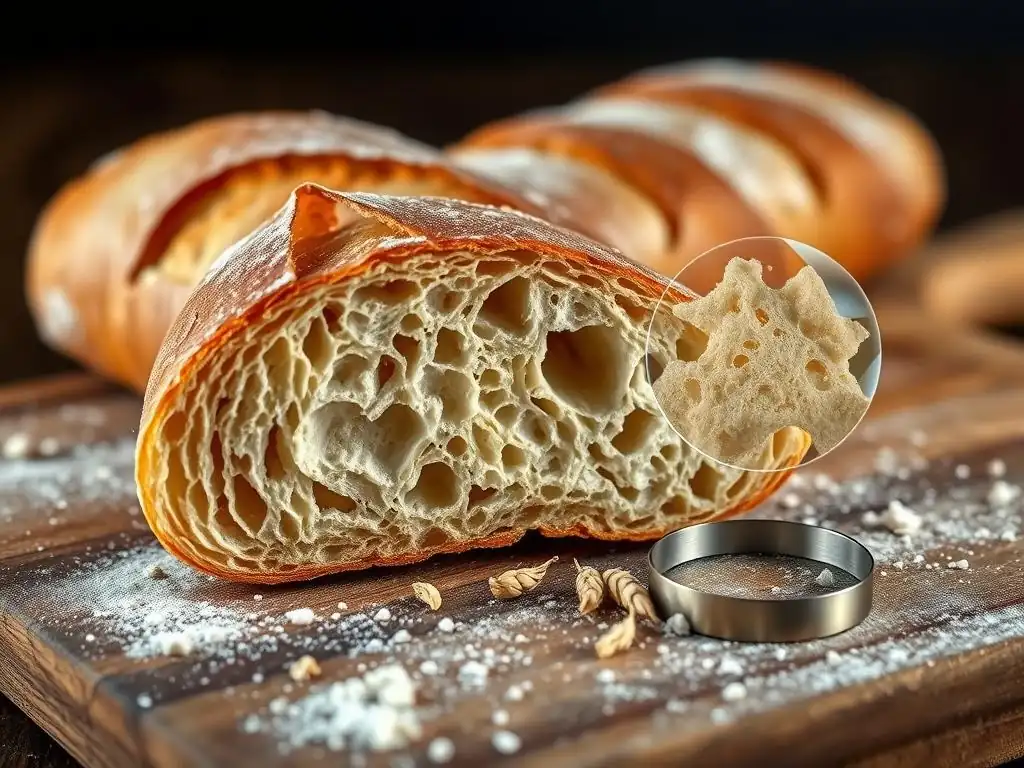
Many factors can lead to less-than-ideal baguette crumb texture, ranging from ingredient issues to technique errors. A common problem is a dense, tight crumb with small, uniform holes, lacking the desired openness. This is often caused by insufficient gluten development, inadequate fermentation time (leading to insufficient gas production), or insufficient oven spring (perhaps due to lack of steam or improper scoring). Another issue is a gummy or wet crumb, which can result from underbaking, too high hydration for the flour used, or insufficient starch gelatinization.
Conversely, a crumb that is too dry or crumbly might be due to overbaking, too low hydration, or using flour with insufficient protein. Large, uneven holes concentrated in one area, often with dense spots elsewhere, can indicate uneven gas distribution due to poor shaping, insufficient dough handling, or a weak gluten network that couldn't support the expanding gas evenly. Understanding the science behind each potential issue allows bakers to diagnose problems and adjust their process to improve the baguette crumb texture.
Dense Crumb Causes and Remedies
A dense baguette crumb, characterized by small, uniform air pockets and a heavy feel, is a frustrating but common problem. The primary culprits are typically: 1) insufficient gluten development, meaning the dough couldn't stretch enough to trap gas; 2) inadequate fermentation, resulting in too little gas production; 3) insufficient oven spring, where the loaf didn't expand properly in the oven's heat; or 4) proofing too long, causing the gluten network to collapse. To remedy this, ensure you are using bread flour with adequate protein (around 12%).
If using commercial yeast, ensure it's active and fresh. For natural levain, ensure it's ripe and active. Try increasing the fermentation time, perhaps incorporating a cold proof period (e.g., 12-18 hours at 38-40°F / 3-4°C) to build strength and flavor. During mixing and initial fermentation, use gentle stretching and folding techniques over an hour or two to develop the gluten without tearing it. Finally, guarantee sufficient steam in the oven during the first 15 minutes of baking to maximize oven spring. These adjustments, rooted in baguette crumb texture science, can significantly improve crumb openness.
Large, Uneven Holes in Crumb: Identifying the Issue
While large, open holes are desirable in a baguette crumb, excessively large, uneven holes, sometimes with dense areas around them or concentrated in one part of the loaf, indicate a different problem than simple density. This issue often stems from poor handling or shaping techniques that trap large gas bubbles unevenly, or from a gluten network that is strong in some areas but weak in others. For instance, if large bubbles are not gently degassed or distributed during shaping, they can remain as huge voids in the final crumb.
Another cause can be insufficient overall gluten development combined with vigorous gas production; the weak network breaks under the pressure of large gas bubbles, creating collapses. To address this, focus on your shaping technique: ensure you are gently but effectively degassing the dough slightly during pre-shaping and final shaping to create a more uniform structure before the final proof. Also, ensure the gluten network is adequately developed through proper mixing and folding during the bulk fermentation. Consistent and gentle handling is key to achieving a beautiful, evenly distributed open baguette crumb texture.
Optimizing Your Technique for Perfect Crumb
Achieving the ideal baguette crumb texture requires meticulous attention to detail throughout the entire process, from mixing to baking. Beyond controlling ingredients and fermentation, specific techniques play a crucial role. Proper dough handling during bulk fermentation, such as gentle stretching and folding every 30-60 minutes for the first few hours, builds strength and structure in the gluten network without damaging it. This intermittent handling also helps equalize the dough temperature and distribute yeast activity and gas production more evenly, contributing to a consistent crumb.
Shaping is another critical stage. Learning to shape baguettes firmly enough to create surface tension and structure, but gently enough not to expel all the gas, is essential for a good crumb. Scoring the loaf correctly just before baking allows for controlled expansion during oven spring, directing the energy of the expanding gases and preventing the crust from cracking haphazardly. The depth, angle (around 30 degrees), and overlap of the scores directly influence how the loaf opens and the resulting baguette crumb texture.
Scoring Techniques for Even Expansion
Scoring, or making incisions on the surface of the shaped dough just before baking, is a vital technique for controlling oven spring and influencing the final baguette crumb texture. As the dough enters the hot oven, the trapped gases expand rapidly. Without scoring, the crust would simply burst at its weakest point, often resulting in an uneven shape and a less attractive crumb. Proper scoring provides weak points where the dough can expand in a controlled manner, allowing the loaf to achieve maximum volume and promoting an open, airy interior.
For a traditional baguette, multiple overlapping diagonal cuts are made along the length of the loaf using a sharp blade (a lame). The cuts should be deep enough (about 1/2 inch or 1-1.5 cm) to penetrate the surface tension but not so deep as to compromise the structure entirely. The angle of the blade (held at about 30 degrees to the dough surface) is crucial for creating a 'lip' that peels back beautifully as the loaf expands. Consistent, evenly spaced scores lead to even expansion and a more uniform, open baguette crumb structure.
Baking Time and Temperature Adjustments
Precise control of baking time and temperature is the final step in setting the baguette crumb texture and developing the crust. Baguettes are typically baked at high temperatures, often starting around 450-480°F (230-250°C). This high initial heat, combined with steam, promotes rapid oven spring and quickly sets the crust. After the initial steaming period (10-15 minutes), the temperature is often reduced slightly (e.g., to 425°F or 220°C) to ensure the interior bakes through without the crust becoming too dark or burnt.
The total baking time for a standard baguette is usually between 20 and 30 minutes, depending on its size and the oven. Underbaking can lead to a gummy crumb with incomplete starch gelatinization, while overbaking results in a dry, tough crumb and an excessively hard crust. Bakers often look for a deep golden-brown crust color and listen for a hollow sound when tapping the bottom of the loaf to determine doneness. Adjusting time and temperature based on observation is key to achieving the perfect balance between a crisp crust and a tender, open baguette crumb texture.
Advanced Techniques for Enhancing Baguette Crumb
Pre-Ferments and Their Impact on Crumb
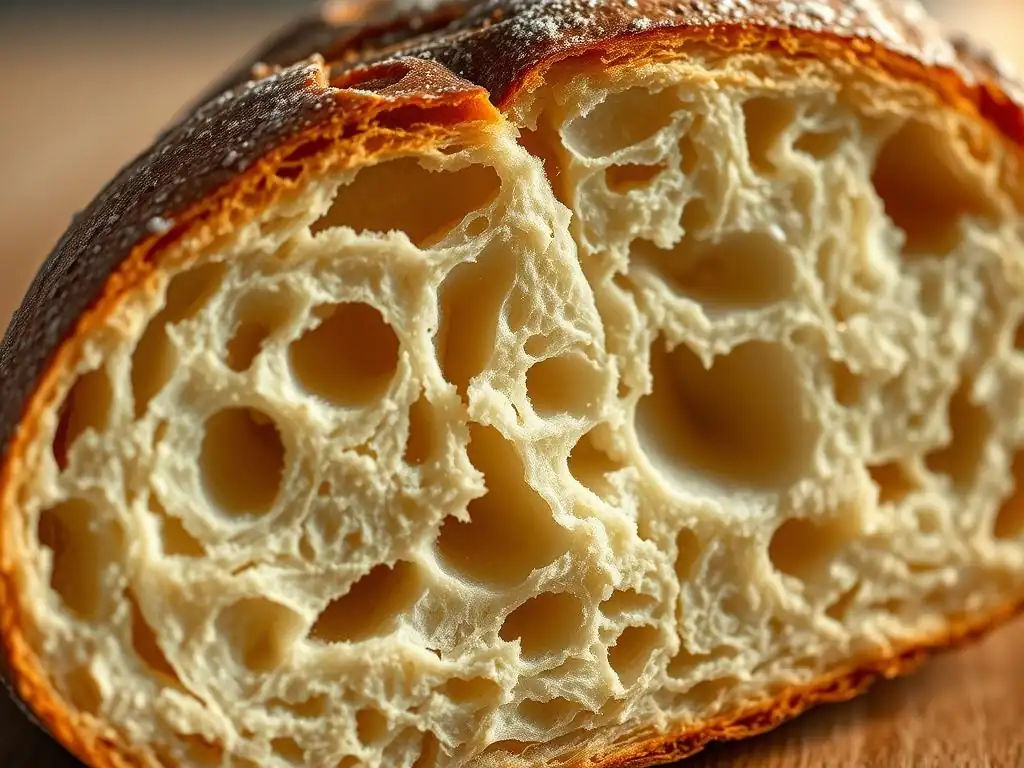
Incorporating a pre-ferment, such as a poolish or biga, into a baguette dough is a common technique used by artisan bakers to enhance both flavor and crumb structure. A pre-ferment is a portion of the flour, water, and yeast from the main recipe that is mixed together and allowed to ferment for several hours or even overnight before being added to the final dough. This initial fermentation allows yeast and enzymatic activity to begin breaking down starches and proteins, producing organic acids and alcohols that contribute to a more complex flavor profile.
Furthermore, the partial gluten development and enzymatic breakdown that occur in the pre-ferment condition the flour, often leading to a more extensible dough. When the pre-ferment is incorporated into the final dough, it jump-starts fermentation and contributes to a stronger, more developed gluten network capable of supporting a more open and irregular crumb structure. Using a pre-ferment is a valuable technique for elevating the quality of your baguette crumb, adding depth to the baguette crumb texture science.
Poolish and Biga: Improving Crumb Complexity
Poolish and biga are two popular types of pre-ferments used in baguette making, each with a distinct impact on the final crumb. A poolish is a liquid pre-ferment, typically made with equal weights of flour and water and a small amount of yeast. It is fermented until very bubbly and active, often for 12-16 hours at room temperature or longer in the refrigerator. The high hydration of a poolish contributes to dough extensibility and promotes an open, airy crumb with irregular alveoli. The extended fermentation develops significant flavor complexity.
A biga, on the other hand, is a stiffer pre-ferment, usually made with a lower hydration (e.g., 50-60% water relative to flour weight). It is also fermented for several hours or overnight. The lower hydration of a biga contributes more strength and structure to the final dough, leading to a slightly different crumb structure – often more regular but still open. Both poolish and biga enhance the baguette crumb texture by improving dough handling, extensibility, and fermentation activity, while also significantly boosting flavor compared to a straight dough method.
Autolyse: Maximizing Water Absorption
Autolyse is a simple yet powerful technique involving mixing just the flour and water from a recipe and letting the mixture rest for 20 minutes to several hours before adding the yeast and salt. During this resting period, two key processes occur enzymatically: the flour fully hydrates, and protease enzymes begin to break down the protein network. This enzymatic breakdown, while seemingly counterintuitive, actually allows the gluten network to develop more easily and efficiently during subsequent mixing or folding, without the need for vigorous kneading.
By allowing the flour to fully hydrate without the presence of salt (which tightens the gluten) or yeast (whose activity can complicate hydration), the dough becomes incredibly extensible and easier to handle. This improved extensibility directly benefits the baguette crumb texture, allowing the dough to expand more readily during fermentation and oven spring, leading to a more open and tender interior. Autolyse is a technique that enhances the dough's inherent properties to optimize the final baguette crumb structure.
Autolyse Duration and Flour Types
The optimal duration for an autolyse depends on the type of flour being used. For typical bread flour with a moderate protein content (around 11-13%), an autolyse of 20-30 minutes is often sufficient to achieve significant benefits in terms of hydration and extensibility. During this time, you will notice the dough become smoother and more pliable. For flours with higher protein content or those that are less refined, a longer autolyse, perhaps up to an hour or even longer, can be beneficial to allow for more complete hydration and enzymatic activity.
Conversely, for very low-protein flours or doughs with a high proportion of whole grains (which have more enzymatic activity), a shorter autolyse might be necessary to prevent excessive protein breakdown. The temperature of the water and ambient temperature also influence the rate of enzymatic activity during autolyse; warmer conditions speed up the process. Experimenting with autolyse duration based on your specific flour and environmental conditions is part of refining your baguette crumb texture science.
Achieving the Ideal Baguette Crumb: A Summary of Key Scientific Principles
Consistent Crumb: The Importance of Precision
Achieving a consistently ideal baguette crumb texture is the hallmark of a skilled baker and relies heavily on precision in executing the scientific principles discussed. Every step, from accurately weighing ingredients (using grams is highly recommended for consistency, e.g., 500g flour, 375g water for 75% hydration) to controlling fermentation temperatures (e.g., bulk ferment at 75°F / 24°C, cold proof at 38°F / 3°C), impacts the final outcome. The hydration level must be precise for the flour used; a difference of just 1-2% can significantly alter dough feel and crumb structure.
Consistent dough handling – performing the same number of folds at regular intervals during bulk fermentation, and shaping with consistent tension – ensures uniform gluten development and gas distribution. Precise scoring allows for predictable oven spring. Finally, maintaining consistent oven temperature and steam levels during baking ensures the crust develops correctly and supports optimal crumb expansion. Precision in every detail, guided by an understanding of baguette crumb texture science, is the path to repeatable success.
Experimentation and Observation: Refining Your Baking
While understanding the science provides a strong foundation, refining your ability to achieve the perfect baguette crumb texture ultimately comes down to experimentation and careful observation. No two flours are exactly alike, ovens vary, and ambient conditions change daily. A recipe provides a roadmap, but learning to read your dough and adjust your process based on its behavior is crucial. Does the dough feel too stiff or too slack after mixing? Is the fermentation proceeding faster or slower than expected? Is the dough holding its shape well after proofing?
Keep detailed notes of your baking sessions, recording variables like ingredient weights, water temperature, dough temperature throughout fermentation, ambient temperature, proofing times, scoring patterns, and baking times/temperatures. Compare the results (crumb structure, crust quality, flavor) to your notes. This iterative process of baking, observing, analyzing, and adjusting is how you translate theoretical baguette crumb texture science into practical mastery. Don't be discouraged by less-than-perfect loaves; each bake is a learning opportunity on the journey to your ideal baguette.
Frequently Asked Questions
What factors contribute to the characteristic open crumb structure of a baguette?
The open crumb is primarily due to high hydration doughs, proper fermentation, and gentle handling during shaping. These elements allow for gas bubbles to form and expand during baking.
How does flour type impact the final crumb texture of a baguette?
Using high-protein flour, like bread flour, is crucial. It provides the gluten development necessary for trapping gases and creating a chewy yet airy crumb structure.
What role does fermentation play in developing the flavor and texture of a baguette crumb?
Long fermentation, especially with a poolish or levain, develops complex flavors. More importantly, it allows for gluten development and the production of gases that contribute to the crumb's texture.
How does oven temperature affect the crust and crumb of a baguette?
A high oven temperature with steam is essential. This creates a crisp, golden crust and allows the crumb to expand rapidly before setting, resulting in a more open structure.
What are some common mistakes that lead to a dense or gummy baguette crumb, and how can they be avoided?
Over-mixing, under-proofing, and using too little water are common culprits. Ensure proper gluten development, adequate rise time, and correct hydration levels for optimal crumb texture.
Final Reflection: The Enduring Allure of the Perfect Baguette Crumb
The science of baguette crumb structure isn't just about achieving the perfect texture; it's a window into the intricate interplay of nature and human ingenuity. Understanding the complex processes behind that airy interior and satisfyingly crisp crust allows us to appreciate the artistry involved in baking, and to better understand the impact of seemingly minor variables on the final product. This knowledge, far from being niche, is increasingly relevant in a world that values both culinary excellence and sustainable food production.
The pursuit of the perfect baguette crumb has captivated bakers for centuries, reflecting a deeper human desire for both sensory pleasure and mastery over our environment. The quest for that ideal texture – a balance between airy lightness and satisfying chew – speaks to our innate appreciation for craftsmanship and the transformative power of simple ingredients. As the great French chef Fernand Point once said, Cooking is at once child's play and adult joy. And cooking done with care is an act of love.
This sentiment perfectly encapsulates the dedication and passion that go into creating a truly exceptional baguette, a dedication driven by the pursuit of the perfect crumb.
Consider the next baguette you encounter. Take a moment to appreciate the science behind its creation – the careful fermentation, the precise hydration, the delicate balance of gluten and starch. Don't just eat it; understand it. By appreciating the intricate processes that contribute to its texture, you'll not only deepen your enjoyment of this everyday staple but also gain a new perspective on the wonders of food science and the enduring power of culinary tradition. Let the next bite be a testament to the fascinating world hidden within the seemingly simple crumb of a baguette.
Unleash Your Inner Boulanger: Master the Art of the Crumb
Thanks for joining us on this delicious journey into the science of baguette baking! You've now unlocked the secrets to crafting that perfect crust and airy crumb. Ready to put your newfound knowledge to the test?
- Bake your own masterpiece! Try our recommended recipe (found on our Recipe page) and experiment with different flours and hydration levels to see how it affects the crumb and crust. This is where the real fun begins!
- Share your baking triumphs (and challenges)! Post a photo of your baguette on social media using #BakeWithEaseBaguette and tag us – we love seeing your creations!
- Dive deeper into bread science: Explore our other articles on sourdough starters and advanced baking techniques.
What unique twist will you add to your next baguette creation? Let us know in the comments below!