
The Baker's Dozen: 12 Essential Tools for Artisan Bread Success

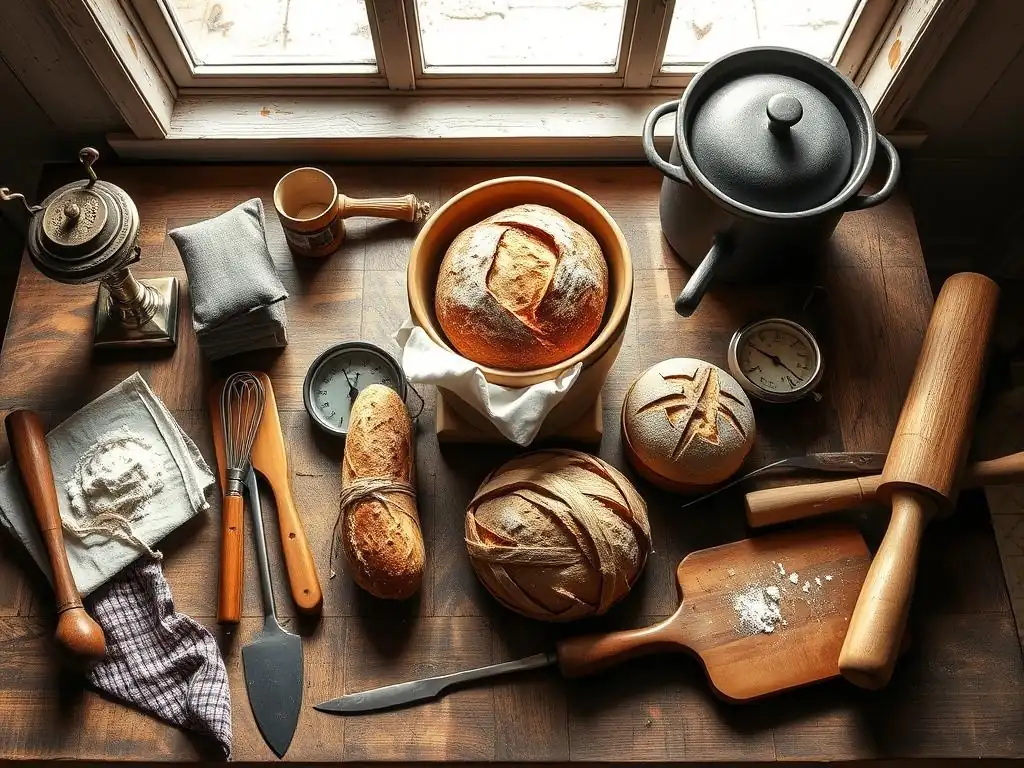
Welcome to BakeWithEase, your guide to unlocking the secrets of delicious home baking! Are you ready to elevate your bread-making game? Dive into our guide to discover the essential artisan bread baking tools that will transform your kitchen into a bakery. Intrigued to know which 12 tools are indispensable for achieving that perfect crust and airy crumb? Read on to find out!
- Mastering Artisan Bread Baking: Your Tool Essentials
- 1. The Digital Kitchen Scale: Precise Measurements for Perfect Bread
- 2. Dough Whisk (Danish Dough Whisk): Gentle Mixing for Optimal Texture
- 3. Bench Scraper (Dough Scraper): Taming Sticky Dough
- 4. Proofing Baskets (Banneton Baskets): Shaping and Support
- 5. Lame (Bread Scoring Tool): Creating Beautiful Crusts
- 6. Dutch Oven: The Key to Oven Spring and Crust
- 7. Baking Stone or Baking Steel: Even Heat Distribution
- 8. Cooling Rack: Preventing Soggy Bottoms
- 9. Thermometer (Instant-Read): Ensuring Perfect Doneness
- 10. Bread Knife: Slicing with Precision
- 11. Dough Storage Container: Maintaining Dough Quality
- 12. Bread Proofer: Controlling Fermentation
-
Frequently Asked Questions
- What are the most essential tools for someone starting out in artisan bread baking?
- Why is a digital scale so important for artisan bread baking?
- What makes a dutch oven a beneficial tool for artisan bread baking?
- Besides a bench scraper, what other tools help with dough handling?
- Where can I find high-quality tools for artisan bread baking?
- Final Reflection: The Flour Power Within: Mastering Artisan Bread
- Unleash Your Inner Baker: Craft Your Bread Dreams!
Mastering Artisan Bread Baking: Your Tool Essentials
Elevating Your Bread Game with the Right Equipment
Embarking on the journey of baking beautiful, crusty artisan bread at home is incredibly rewarding. While passion and practice are paramount, having the right artisan bread baking tools can significantly impact your results, transforming a good loaf into a truly exceptional one. Think of these essential baking tools for artisan bread not just as gadgets, but as extensions of your hands, designed to tackle specific challenges in the bread-making process, from precise measurement to achieving that coveted golden crust and airy crumb.
Choosing the right artisan bread equipment can feel overwhelming initially, but focusing on a core set of reliable tools is key. These aren't necessarily the most expensive items, but rather those that perform specific tasks crucial for the nuances of artisan bread. For instance, achieving proper hydration and gluten development relies heavily on careful handling, often aided by specific tools. Similarly, consistent heat is vital for oven spring, which specialized equipment helps deliver. Investing in these fundamental tools for artisan bread is a foundational step towards mastering the craft and consistently producing loaves you'll be proud to share.
1. The Digital Kitchen Scale: Precise Measurements for Perfect Bread
Why Accurate Measurements Matter in Artisan Baking
In artisan bread baking, precision is king, and that's where a digital kitchen scale becomes indispensable. Unlike volume measurements (cups and spoons) which can vary wildly based on how ingredients are scooped or packed, weighing ingredients ensures consistency down to the gram.
For example, a cup of flour can weigh anywhere from 120g to 150g depending on its density and how it's measured. This variance might seem small, but in a recipe with a hydration level calculated to the percentage point, a difference of 20-30 grams of flour can significantly alter the dough's consistency, affecting everything from kneading time to final texture.
Professional bakers and serious home enthusiasts rely on scales for 'baker's percentages,' a system where all ingredients are measured relative to the weight of the flour. If a recipe calls for 1000g of flour, 70% hydration means adding exactly 700g of water. This level of accuracy is crucial for replicating successful bakes and troubleshooting when things don't go as planned. Without a reliable scale, achieving the specific hydration needed for a high-hydration sourdough or a delicate enriched dough becomes a matter of guesswork rather than precision, making consistent results with your artisan bread baking tools much harder to attain.
2. Dough Whisk (Danish Dough Whisk): Gentle Mixing for Optimal Texture
The Secret to Lighter, Airier Dough
The Danish dough whisk is a simple yet incredibly effective tool specifically designed for mixing wet, shaggy doughs, common in many artisan bread recipes. Its unique open coil design allows it to cut through thick dough and incorporate ingredients with minimal effort and without overworking the mixture early on. Unlike a wooden spoon or spatula which can gum up and struggle with sticky doughs, the whisk makes quick work of combining flour and water, creating a rough, hydrated mass ready for the autolyse or initial kneading stage.
This gentle mixing action is particularly beneficial for doughs that benefit from minimal handling, such as no-knead or very wet doughs. By efficiently bringing the ingredients together without developing too much gluten prematurely, the dough whisk helps set the stage for better gluten development later through folds or a brief knead. It minimizes the dough sticking to the tool and to your hands during the initial phase, making the process cleaner and more manageable. For anyone serious about mastering their artisan bread baking tools, this often-overlooked whisk is a game-changer for starting your dough off right.
3. Bench Scraper (Dough Scraper): Taming Sticky Dough
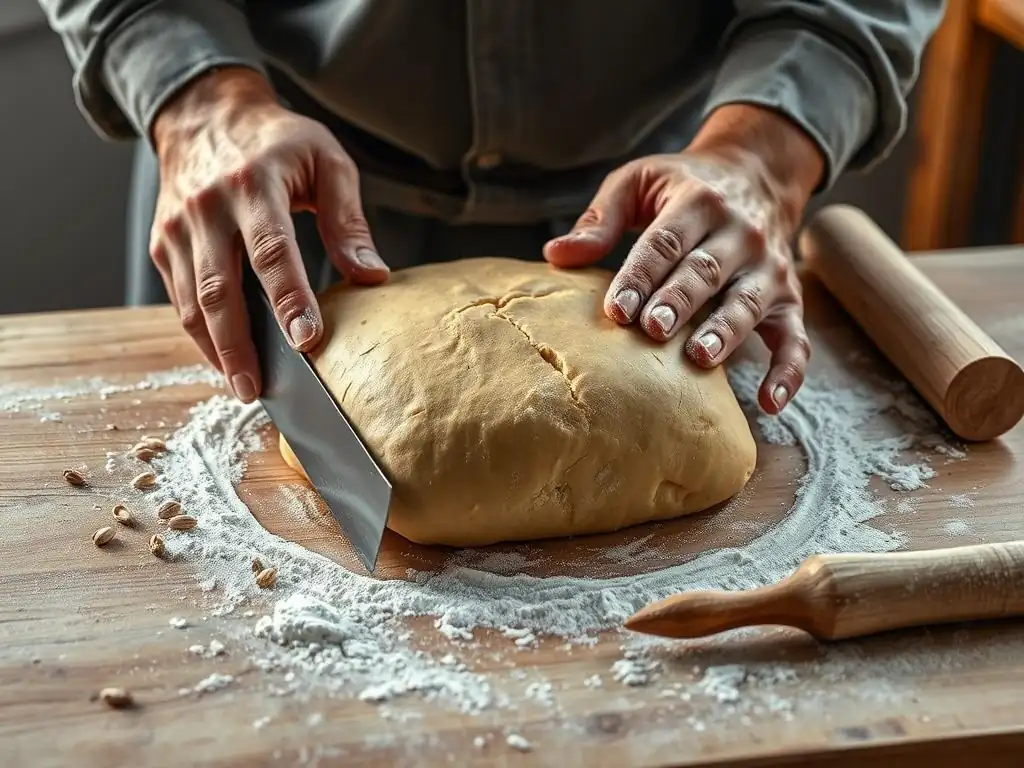
The Baker's Best Friend for Handling and Dividing Dough
A bench scraper, typically a flat piece of metal or plastic with a handle, is an unsung hero among artisan bread baking tools. Its primary function is to help you manage sticky dough on your work surface. When working with high-hydration doughs, which are common for achieving an open crumb structure, the dough can cling tenaciously to counters. A bench scraper allows you to easily lift, turn, and clean your surface, keeping things tidy and preventing dough from becoming irrevocably stuck.
Beyond cleanup, the bench scraper is essential for dividing dough into portions for rolls, baguettes, or multiple smaller loaves. Its straight edge allows for clean, precise cuts without tearing the gluten structure excessively, which can happen with a knife. You can also use it to help shape loaves, nudging and folding the dough on the bench.
Many bakers use the metal version with a sharp edge to scrape dried dough off surfaces, making cleaning much faster. For just a few dollars, this tool dramatically improves the ergonomics and efficiency of handling dough, proving its worth in any set of tools for artisan bread.
4. Proofing Baskets (Banneton Baskets): Shaping and Support
Achieving That Signature Artisan Bread Shape
Proofing baskets, or bannetons, are vital for giving your shaped dough structure and support during its final rise (proofing). Available in various shapes – round (boule), oval (bâtard), or longer (baguette) – they hold the dough's form, preventing it from spreading outwards as it expands. This upward rise helps build tension in the dough, which translates to better oven spring when baked. Bannetons are typically made from rattan cane or coiled wood pulp, and their texture can imprint a beautiful pattern on the dough's surface, a hallmark of artisan loaves.
To use a banneton, it's usually dusted generously with flour (rice flour is popular as it doesn't absorb moisture and stick) before the shaped dough is placed seam-side up or down, depending on whether you want the seam or the basket pattern on the final crust. As the dough proofs, the basket wicks away a small amount of moisture from the surface, creating a slightly drier skin.
This skin helps the loaf hold its shape when transferred to the oven and contributes to a crispier crust. Owning a few different shapes allows you to experiment with various loaf styles, making them key artisan bread baking tools for achieving professional-looking results.
5. Lame (Bread Scoring Tool): Creating Beautiful Crusts
Mastering the Art of Scoring Your Loaf
A bread lame (pronounced "lahm") is a razor blade holder used to score the surface of a loaf just before baking. This isn't just for aesthetics; scoring serves several crucial purposes in artisan bread baking. As the loaf bakes and expands rapidly in the oven (oven spring), the scores provide weak points where the dough can tear predictably. Without scoring, the loaf might burst randomly in undesirable places, resulting in a less attractive and potentially denser loaf.
Different scoring patterns allow bakers to control the expansion and also add their unique artistic signature. A single, deep slash down the middle (like on a bâtard) encourages a large ear, while multiple shallow cuts (like on a boule) can create intricate patterns. The incredibly sharp blade of a lame makes a clean cut that promotes optimal oven spring and a beautiful bloom or ear.
Using a proper lame, rather than a knife, ensures you don't drag or tear the delicate surface of the proofed dough, which could deflate it. It's one of the essential tools for artisan bread that allows you to guide the final shape and appearance of your crust.
6. Dutch Oven: The Key to Oven Spring and Crust
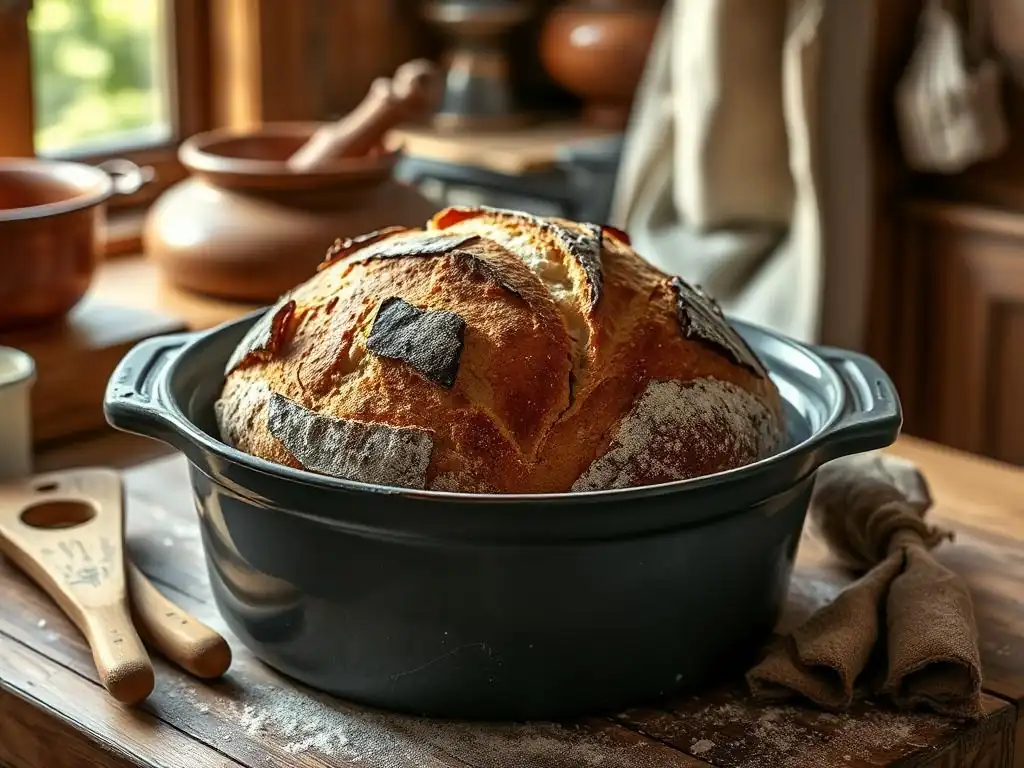
Baking Like a Pro with a Dutch Oven
The Dutch oven is arguably the most transformative tool for baking artisan bread at home, especially for achieving a crust and oven spring comparable to professional deck ovens. Its heavy cast-iron construction heats evenly and, most importantly, traps steam released by the dough as it bakes. This trapped steam keeps the surface of the loaf moist initially, allowing it to expand fully before the crust sets. This period of expansion is what bakers call "oven spring," and it's crucial for achieving a light, airy crumb.
After the initial 20-30 minutes of baking with the lid on, the lid is removed. The moist surface, now having completed its expansion, is exposed to the dry heat, allowing the crust to brown and crisp up beautifully. Using a preheated Dutch oven (often heated to 450-500°F or 230-260°C) mimics the conditions of a professional steam-injected oven on a smaller scale. This simple piece of artisan bread equipment is a must-have for anyone serious about baking high-quality, crusty loaves like sourdough or country bread at home.
7. Baking Stone or Baking Steel: Even Heat Distribution
Achieving a Crispy Crust with Consistent Baking
A baking stone or baking steel is another excellent tool for promoting even heat distribution and achieving a superior crust, particularly on the bottom of your loaf. Placed on an oven rack and preheated for a significant time (often 45-60 minutes or more at high temperatures like 450-500°F / 230-260°C), they absorb and retain a large amount of thermal energy. When the dough is placed directly onto the hot surface, it receives an intense burst of heat from below.
This rapid heat transfer to the base of the loaf encourages strong oven spring and helps set the bottom crust quickly, preventing a pale, soggy bottom. Baking steels, typically made of steel, heat up faster and retain heat more effectively than ceramic stones, making them particularly good for achieving maximum oven spring. While a Dutch oven is fantastic for creating a steamy environment, a stone or steel is perfect for baking loaves that don't fit in a Dutch oven, like baguettes, or for adding versatility to your set of artisan bread baking tools.
8. Cooling Rack: Preventing Soggy Bottoms
Allowing Your Bread to Cool Properly
After the effort of baking a beautiful loaf, the last step before slicing is cooling, and a cooling rack is essential for this phase. Placing a hot loaf directly onto a solid surface like a counter or cutting board traps steam underneath, leading to a soggy bottom crust. A cooling rack elevates the loaf, allowing air to circulate freely around all sides.
This airflow facilitates the release of internal steam, which continues even after the bread is out of the oven. Proper cooling on a rack for the recommended time (often 1-2 hours for larger loaves) is crucial for the internal structure and flavor to set. Slicing into hot bread can compress the crumb, resulting in a gummy texture. Using a simple wire rack ensures your perfectly baked crust stays crisp and the crumb develops its final texture, making it an indispensable part of your tools for artisan bread.
9. Thermometer (Instant-Read): Ensuring Perfect Doneness
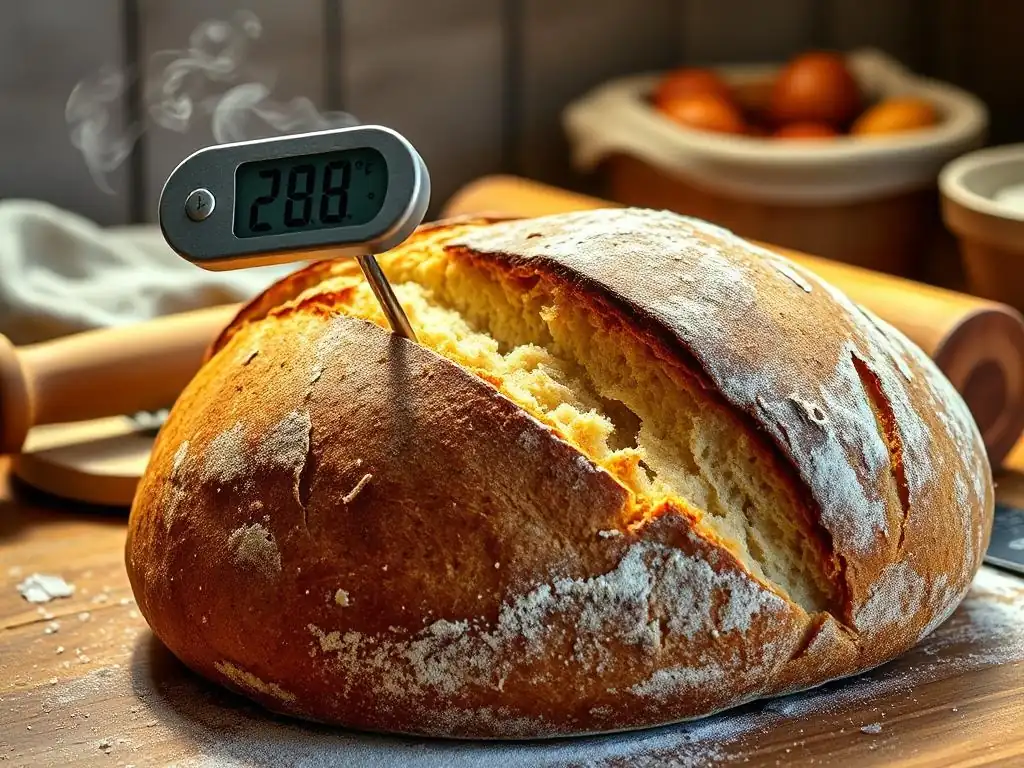
Knowing When Your Bread is Perfectly Baked
For consistently baked bread, an instant-read thermometer is one of the most reliable artisan bread baking tools you can own. While visual cues like crust color are helpful, the internal temperature is the most accurate indicator of doneness. For most lean artisan bread (like sourdough or rustic country loaves), a fully baked loaf will register an internal temperature between 200°F and 210°F (93°C to 99°C).
Simply insert the probe into the center of the loaf from the bottom or side, avoiding any large air pockets, and wait a few seconds for the reading. This takes the guesswork out of baking, preventing underbaked, gummy interiors or overbaked, dry results. For enriched breads containing milk, eggs, or sugar, the target temperature might be slightly lower, around 190-195°F (88-91°C). Using a thermometer guarantees you pull your bread from the oven at its peak, ensuring a perfect crumb every time.
10. Bread Knife: Slicing with Precision
The Right Tool for Beautiful Bread Slices
Once your glorious artisan loaf has cooled completely, you need the right tool to slice it without crushing its delicate structure. A good bread knife, characterized by its serrated blade, is designed specifically for this purpose. The serrations grip the crust and allow the blade to saw through it cleanly, then slice through the soft interior without tearing or compressing the crumb.
Attempting to slice a crusty loaf with a straight-edged knife often results in a squashed loaf and uneven slices. A long blade (typically 8-10 inches) is preferable as it allows you to slice across most loaves with a single, smooth stroke. Investing in a sharp, high-quality bread knife preserves the integrity of your hard-earned bake, ensuring you get beautiful, even slices perfect for sandwiches, toast, or simply enjoying with butter. It's the final, essential piece of artisan bread equipment for enjoying the fruits of your labor.
11. Dough Storage Container: Maintaining Dough Quality
Keeping Your Dough Fresh for Optimal Fermentation
For artisan bread bakers, especially those working with sourdough or long fermentation schedules, a reliable dough storage container is crucial. These containers, often clear food-grade plastic tubs with airtight lids, allow dough to undergo extended bulk fermentation or cold proofing in the refrigerator. The airtight seal prevents the dough from drying out and developing a tough skin, while the clear sides allow you to easily monitor the dough's activity and rise without disturbing it.
Specific containers, like those with straight sides and volume markings, are particularly useful for tracking the dough's expansion, making it easy to tell when it has doubled or tripled, as often required in recipes. Proper storage at cool temperatures significantly slows fermentation, allowing complex flavors to develop over 12 to 48 hours or even longer. Having containers that fit conveniently in your refrigerator is key for planning your bake schedule and ensuring your dough is perfectly proofed when you're ready to bake, making them practical artisan bread baking tools.
12. Bread Proofer: Controlling Fermentation
Ensuring Consistent Results in Any Climate
While not strictly essential for everyone, a bread proofer offers unparalleled control over the fermentation process, making it a valuable addition to the artisan bread equipment list for dedicated bakers. Fermentation is highly sensitive to temperature; a few degrees difference can drastically alter proofing time and flavor development. A proofer provides a stable, warm, and often humid environment, typically maintained between 75°F and 85°F (24°C to 30°C), ideal for consistent fermentation regardless of your kitchen's ambient temperature.
This controlled environment is particularly beneficial in cold climates where dough might otherwise take many hours to proof, or in hot, dry conditions where dough might dry out. Some proofers also allow for lower temperatures suitable for retarding dough (cold proofing), offering versatility. By eliminating temperature variables, a proofer helps achieve predictable rise times and flavor profiles batch after batch. While you can improvise a proofing environment (e.g., oven with the light on), a dedicated proofer provides precision that significantly contributes to consistently excellent artisan bread baking tools results.
Frequently Asked Questions
What are the most essential tools for someone starting out in artisan bread baking?
A great starting point includes a good quality digital scale for accuracy, a dutch oven for creating steam, and a bench scraper for handling dough. These will significantly impact your bread's quality.
Why is a digital scale so important for artisan bread baking?
Precision is key! A digital scale ensures you use the exact ingredient ratios specified in recipes, which is crucial for consistent results in artisan bread baking.
What makes a dutch oven a beneficial tool for artisan bread baking?
The dutch oven traps steam during baking, creating a crispy crust and soft interior, mimicking the conditions of a professional bread oven. This is vital for achieving that artisan quality.
Besides a bench scraper, what other tools help with dough handling?
A proofing basket (banneton) helps the dough maintain its shape during the final rise, and a lame allows for scoring the dough before baking, controlling its expansion.
Where can I find high-quality tools for artisan bread baking?
While BakeWithEase.com doesn't directly sell tools, we recommend looking for durable, reliable brands at specialty kitchenware stores or reputable online retailers that cater to baking enthusiasts.
Final Reflection: The Flour Power Within: Mastering Artisan Bread
The pursuit of perfect artisan bread is not just about technique; it's about connection—a connection to tradition, to the earth, and to the simple joy of creating something beautiful and delicious from humble ingredients. This article explored twelve essential tools that elevate the home baker's experience, transforming the process from a potentially frustrating endeavor into a rewarding and creative journey. But the tools themselves are only half the equation; the other half, and arguably the more important one, lies within you.
The impact of artisan bread baking extends far beyond the kitchen. It's a practice that fosters mindfulness, patience, and a deep appreciation for the process of creation. It connects us to a rich history of food production, reminding us of the simple pleasures that can be found in slowing down and engaging our senses. Bread is the staff of life,
they say, and I believe it. It's more than sustenance; it's a symbol of nourishment, both for the body and the soul.
Now, consider your own baking journey. What tools resonate most with you? Which ones are you eager to explore further? Remember, the best tool is the one you use most effectively, and the most rewarding experience comes from the passion and intention you bring to the process. Don't be afraid to experiment, to embrace imperfection, and to find joy in the kneading, the rising, and the glorious aroma that fills your kitchen. The perfect loaf awaits – not just in the recipe, but in your own hands.
Unleash Your Inner Baker: Craft Your Bread Dreams!
Thanks for joining us on this delicious journey into the world of artisan bread! We hope you’ve gained valuable insights into the tools that can elevate your baking game. Now it's time to put that knowledge into action!
- Master a new bread recipe: Choose one recipe that excites you and put your newfound tool knowledge to the test. Don't be afraid to experiment! This is your chance to shine!
- Share your baking journey: Snap a photo of your masterpiece and share it on social media – tag us at BakeWithEase (we love seeing your creations! ).
- Challenge a friend to bake along: Find a friend, family member, or fellow baking enthusiast and challenge them to bake along with you – you can compare notes and celebrate successes together!
Ready to transform your kitchen into a bread-baking haven? What delicious loaf will you craft first?