
The Ultimate Guide to Troubleshooting Choux Pastry Problems

Welcome to BakeWithEase, your trusted companion on your baking journey! Ever wondered why your éclairs deflate or your cream puffs lack that perfect puff? Dive into our comprehensive guide and unlock the secrets to mastering choux pastry. We’ll reveal essential choux pastry troubleshooting tips that will transform your baking, turning frustrating flops into delightful successes. Are you ready to bake with confidence? Let's begin!
- Introduction to Choux Pastry Troubleshooting
-
Common Choux Pastry Problems and Their Solutions
- Problem 1: Choux Pastry Dough Too Runny - Causes and Solutions
- Problem 3: Choux Pastry Not Puffed Up - Troubleshooting Inflation Issues
- Problem 4: Choux Pastry Collapsing After Baking - Preventing Deflation
- Problem 5: Choux Pastry Shells Too Dark or Burnt - Controlling Browning
- Problem 6: Choux Pastry Shells Too Pale - Achieving Golden Perfection
- Problem 7: Uneven Shapes and Sizes - Creating Uniform Choux Pastry
- Problem 8: Hollow Centers Not Forming - Ensuring Proper Cavity Formation
- Mastering Choux Pastry: Advanced Troubleshooting Tips
- Choux Pastry Troubleshooting Chart: A Quick Reference Guide
- Conclusion: Confidently Bake Perfect Choux Pastry.
-
Frequently Asked Questions
- What is the most common problem people face when making choux pastry, and how can it be avoided?
- Why does my choux pastry sometimes collapse after baking?
- How do I know if I've added enough eggs to my choux pastry dough?
- My choux pastry dough is too stiff. What can I do?
- Can I make choux pastry ahead of time, and if so, how should I store it?
- Final Reflection: Mastering the Art of Choux Pastry Perfection
- Unlock Your Perfect Choux Pastry: Master the Art of Puffs!
Introduction to Choux Pastry Troubleshooting
Choux pastry, or pâte à choux, is a fundamental dough in classical French baking, known for its ability to puff dramatically in the oven, creating airy shells perfect for filling with sweet or savory delights like éclairs, cream puffs, profiteroles, and gougères. While seemingly simple – typically just water, butter, flour, and eggs – mastering choux can be tricky. Many bakers encounter common issues that prevent their creations from achieving that signature light, hollow structure.
Understanding the science behind choux pastry is key to successful baking, and being prepared with effective choux pastry troubleshooting tips can turn potential failures into triumphs. This guide will walk you through identifying and fixing the most frequent problems, helping you bake perfect choux pastry every time.
Tackling choux pastry challenges requires patience and attention to detail. Each step, from heating the liquid and adding the flour to incorporating the eggs and baking, plays a crucial role in the final outcome. Even slight deviations in temperature, mixing technique, or ingredient ratios can lead to disappointing results. But don't be discouraged! Most problems have straightforward solutions. By learning these essential choux pastry troubleshooting tips, you'll build confidence and improve your baking skills. Let's dive into the common pitfalls and how to overcome them, ensuring your next batch of choux pastry is light, airy, and delicious.
Common Choux Pastry Problems and Their Solutions
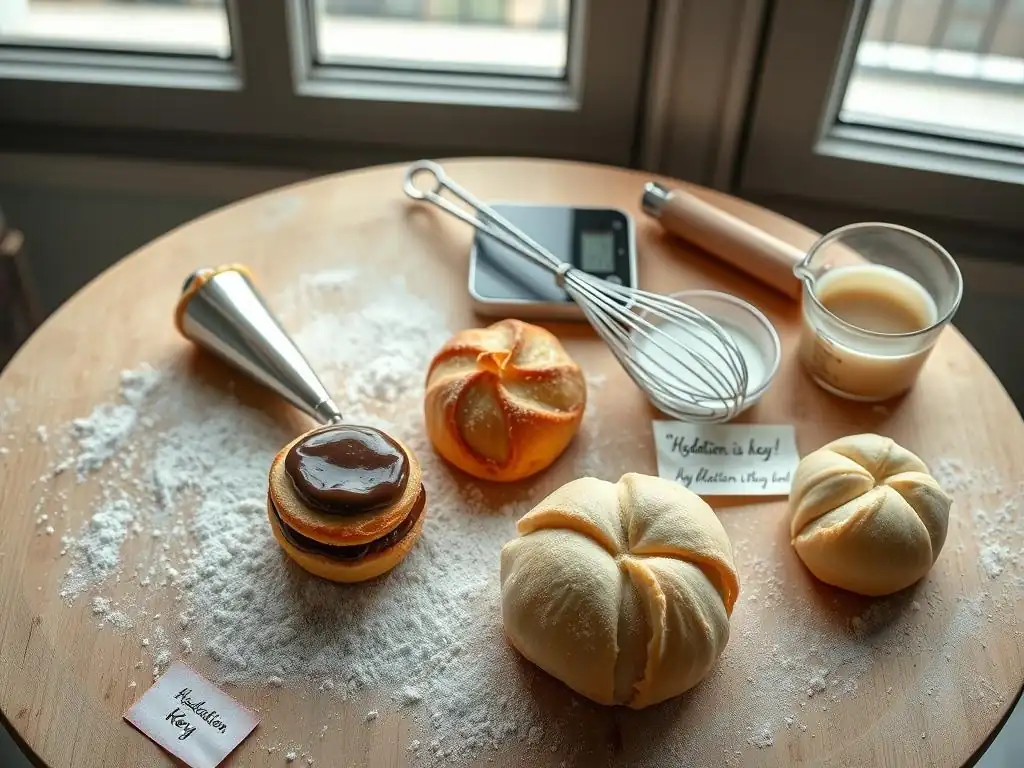
Problem 1: Choux Pastry Dough Too Runny - Causes and Solutions
When your choux dough is too liquid, it lacks the structure needed to hold its shape when piped and won't puff properly in the oven. This is often a result of adding too many eggs relative to the amount of flour and liquid used initially. The goal is a dough that is smooth and glossy but still holds a firm peak when lifted with a spoon or spatula, often described as having a "dolphin's tail" consistency.
Identifying overly liquid choux dough is crucial; it will be difficult to pipe cleanly, spreading out rather than maintaining a defined shape on the baking sheet. This issue prevents the necessary steam from building inside the pastry during baking, which is the primary leavening agent for choux.
Adjusting the liquid to flour ratio is critical from the start. Standard recipes typically use a 1:1 ratio of water/milk to flour by weight, with butter usually around half the weight of the liquid. For example, 250g water, 250g flour, 125g butter. The eggs are then added incrementally to achieve the correct consistency.
If you've already added too many eggs, salvaging runny choux pastry dough can be difficult, but not impossible for small adjustments. You can try gently heating the dough in a saucepan over low heat for a minute or two, stirring constantly, to evaporate some moisture. However, be careful not to cook the eggs.
A more reliable method, if you have the ingredients, is to make a small second batch of the initial flour/liquid/butter paste (without eggs) and gradually beat it into the runny dough until the desired consistency is reached. This effectively rebalances the ratio. Prevention is the best strategy here; always add eggs one at a time, mixing thoroughly after each addition, and stop as soon as the dough reaches the correct texture.
Conversely, choux pastry dough that is too stiff or dry will be hard to pipe and may not expand fully in the oven. This usually happens when not enough eggs have been added, or the eggs were too small, relative to the initial paste. Recognizing stiff or dry choux dough is easy: it will be difficult to stir after adding the eggs, will look lumpy or curdled, and when lifted, it will break off in clumps instead of flowing smoothly.
A stiff dough lacks the necessary moisture content and elasticity provided by the eggs, which are essential for creating the steam and structure needed for puffing. This is a common issue addressed by effective choux pastry troubleshooting tips.
Adding moisture back into stiff choux pastry is much easier than fixing runny dough. You can simply beat in an extra egg (or even just an egg yolk or a splash of milk for very small adjustments) a little at a time until the dough reaches the correct consistency. Break the egg into a separate bowl first and whisk it, then add it gradually to the dough while mixing vigorously.
Achieving the ideal dough texture means it should be smooth, glossy, and fall from a spoon or spatula in a V-shape or "dolphin's tail." It should be pliable enough to pipe but firm enough to hold its shape on the baking sheet. Don't be afraid to add a little more egg if needed; it's better to err on the side of slightly too wet (which is fixable) than too dry.
Problem 3: Choux Pastry Not Puffed Up - Troubleshooting Inflation Issues
One of the most frustrating problems is when your choux pastry doesn't puff up into those lovely hollow shells. Why your choux pastry isn't rising can be due to several factors. Insufficient heat in the oven is a major culprit; the initial blast of high heat is crucial for generating steam rapidly inside the dough, which forces it to expand.
If the oven is too cool, the surface of the pastry sets too slowly, and not enough steam is produced to create a significant cavity. Another common issue is opening the oven door too early during baking; this causes a sudden drop in temperature, which can prevent the pastry from rising or even cause it to collapse.
Oven temperature and its impact on puff cannot be overstated. Many recipes call for starting at a high temperature, around 400-425°F (200-220°C), for the first 10-15 minutes, then reducing the heat to around 350-375°F (175-190°C) to allow the pastries to dry out and become crisp without burning. Using an oven thermometer is highly recommended to ensure your oven is accurately calibrated. Egg incorporation techniques for maximum lift are also vital. The eggs must be added one by one to the warm (but not hot enough to scramble the eggs) paste and beaten in completely after each addition. This develops the gluten structure and creates an emulsion that helps the steam expand evenly. The dough should be smooth and elastic before piping. Ensuring the dough is the correct consistency (not too stiff or too runny) and baking at the proper temperature are key choux pastry troubleshooting tips for achieving maximum lift.
Problem 4: Choux Pastry Collapsing After Baking - Preventing Deflation
You've watched your choux puff beautifully in the oven, only to see them deflate as they cool. Understanding why choux pastry deflates is essential for preventing it. The most common reason is under-baking. The pastry needs to bake long enough for the internal structure to set and the shells to dry out completely. If the inside is still moist, the structure is weak and cannot support the shell's weight as the steam dissipates upon cooling. Rapid cooling can also contribute to deflation; a sudden temperature change can cause the warm, expanded structure to contract too quickly.
Baking long enough to avoid collapse means the choux should be golden brown and feel light and hollow when lifted. They should sound hollow when tapped on the bottom. This often takes 25-35 minutes or even longer, depending on the size of the pastries and your oven.
Some bakers recommend turning off the oven and leaving the pastries inside with the door slightly ajar for 5-10 minutes after the main baking time to allow them to dry out further and cool down gradually. Cooling techniques to maintain structure are also important. Once out of the oven (after the potential drying period), cool the choux on a wire rack to allow air circulation around them.
Resist the urge to move them too soon. If you plan to fill them immediately, you can pierce the bottom of each pastry with a small knife or skewer right after taking them out of the oven to allow steam to escape, which can also help prevent deflation and make filling easier. These are important choux pastry troubleshooting tips.
Problem 5: Choux Pastry Shells Too Dark or Burnt - Controlling Browning
Sometimes your choux pastry bakes up beautifully in shape and size, but the shells turn too dark or even burn before the inside is fully cooked and dry. Addressing over-browning often points to the oven temperature being too high or the baking time being too long for the temperature used. While an initial high heat is necessary for puff, maintaining that high temperature for the entire baking time can scorch the outside before the inside has a chance to cook through and set properly.
Adjusting baking time and temperature is the primary solution. If your recipe calls for a high temperature throughout, try reducing the temperature after the initial puffing phase (typically 10-15 minutes). For example, if you start at 425°F (220°C), drop it to 375°F (190°C) or even 350°F (175°C) for the remaining time. If the tops are browning too quickly but the pastries aren't done, you can protect from excessive heat by loosely covering the baking sheet with aluminum foil for the last part of the baking time.
Also, consider where your baking sheet is placed in the oven; if it's too close to the top heating element, move it to a lower rack. Using a silicone baking mat or parchment paper can also help prevent the bottoms from burning compared to baking directly on a metal sheet. These are valuable choux pastry troubleshooting tips for managing oven heat.
Problem 6: Choux Pastry Shells Too Pale - Achieving Golden Perfection
On the flip side, choux pastry shells that are too pale after baking often indicate they haven't baked long enough or the oven temperature was too low, especially during the crucial initial phase. Ensuring adequate browning is important not just for appearance but also for texture; a pale shell is likely under-baked and will be soft, possibly chewy, and prone to collapsing. The golden-brown color signifies that the shell has dried out and developed a crisp exterior.
Using egg wash for enhanced color is a common technique. Before baking, brush the tops of the piped choux shapes with a mixture of beaten egg and a little water or milk. This encourages a richer, more even golden-brown color and a slightly shinier finish. Optimizing oven conditions is also key.
Make sure your oven reaches the specified temperature, ideally confirmed with an oven thermometer. If your pastries are consistently pale, try increasing the initial baking temperature slightly (by 10-15°F or 5-10°C) or baking them for a few minutes longer. Remember, the goal is golden brown and firm, not just puffed. These choux pastry troubleshooting tips focus on achieving the desired color and texture through proper baking.
Problem 7: Uneven Shapes and Sizes - Creating Uniform Choux Pastry
Achieving uniformly shaped and sized choux pastry is important for even baking and attractive presentation, especially for items like éclairs or profiteroles stacked in a croquembouche. Uneven shapes and sizes often result from inconsistent piping techniques. Some pastries might be larger or smaller, thicker or thinner, leading to some being over-baked while others are under-baked on the same tray.
Techniques for consistent piping are essential. Start by practicing on parchment paper without dough to get a feel for the pressure needed. Using a piping bag effectively allows for much greater control than using spoons. Fill the piping bag about two-thirds full, twist the top to secure it, and apply steady, even pressure from the top down.
Hold the bag perpendicular to the baking sheet for round shapes (like cream puffs) or at a consistent angle for elongated shapes (like éclairs), lifting straight up or pulling away cleanly at the end of each shape. Achieving uniform size and shape ensures that all pastries on the tray bake at the same rate, leading to consistent results. Using a template drawn on the underside of the parchment paper can be very helpful for maintaining consistent size and spacing, especially for éclairs or specific pastry sizes like 2-inch diameter cream puffs.
Problem 8: Hollow Centers Not Forming - Ensuring Proper Cavity Formation
The hallmark of successful choux pastry is a large, hollow cavity inside, perfect for filling. If your choux are dense or have very small cavities, several factors could be at play. The importance of hollow centers lies in their function as a vessel for fillings and their contribution to the pastry's light texture. A dense choux indicates insufficient steam production or inadequate drying during baking.
Proper baking techniques for hollow shells are critical. As discussed earlier, the initial high heat creates the steam that forces the dough to expand and form the cavity. Baking long enough at a lower temperature then dries out and sets this structure. If the dough is too wet initially (too many eggs), it can hinder cavity formation.
If the oven temperature is too low, the steam production is insufficient. If the oven door is opened too early, the sudden temperature drop can prevent the cavity from setting. Achieving the perfect hollow interior requires the right dough consistency, the correct two-stage baking temperature approach (high heat to puff, lower heat to dry), and sufficient baking time until the shells are light and crisp. These choux pastry troubleshooting tips emphasize the baking process.
Mastering Choux Pastry: Advanced Troubleshooting Tips
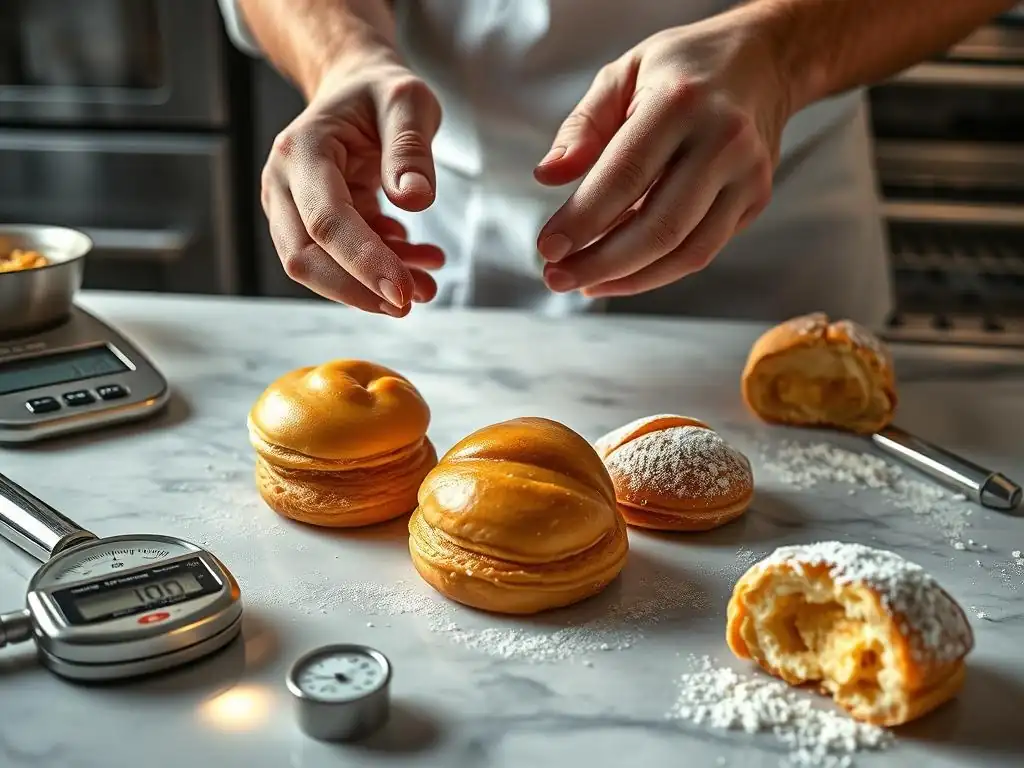
Troubleshooting Cream Puff Problems Specific to Fillings
Cream puffs are typically filled after baking and cooling. A common issue is the filling making the shells soggy, especially if filled too far in advance or with a very wet filling. Preventing soggy cream puffs involves several strategies. Firstly, ensure your baked choux shells are completely cooled and thoroughly dried out inside; under-baked shells are more prone to absorbing moisture.
Choosing the right filling consistency is crucial. Pastry cream (crème pâtissière) is a classic choice because it's relatively stable, but ensure it's well-chilled and firm. Whipped cream is lighter but can make shells soggy faster. For best results, fill cream puffs as close to serving time as possible.
Sealing shells for optimal freshness is also important if you aren't filling immediately; store unfilled shells in an airtight container at room temperature (unless humidity is very high). If you must fill in advance, consider coating the inside of the shell with a thin layer of melted chocolate before adding the filling; this creates a barrier against moisture. These are practical choux pastry troubleshooting tips for filled pastries.
Troubleshooting Eclair Problems Specific to Glazes
Éclairs present their own challenges, particularly with glazing. Achieving a smooth and shiny glaze is key to their elegant appearance. Common issues include a dull finish, uneven coverage, or the glaze cracking or melting. A classic éclair glaze is a simple icing made from powdered sugar and liquid (water, milk, or coffee), sometimes enriched with butter or chocolate.
Applying glaze evenly requires the right consistency – thick enough to coat but thin enough to flow smoothly. Dip the top of each cooled éclair into the glaze, letting the excess drip off, or spread it smoothly with a small offset spatula. Prevent glaze from cracking or melting by ensuring the éclairs are completely cool before glazing. Applying warm glaze to warm pastries will cause it to melt or become dull.
If using a chocolate glaze, temper the chocolate properly for a shiny, stable finish that won't melt easily at room temperature. Storing glazed éclairs in a cool, dry place is best; refrigeration can sometimes cause condensation that dulls the glaze, though it's necessary if the filling requires it. For refrigerated éclairs, it's often best to glaze just before serving. These choux pastry troubleshooting tips are specific to the finishing touches.
Choux Pastry Troubleshooting Chart: A Quick Reference Guide
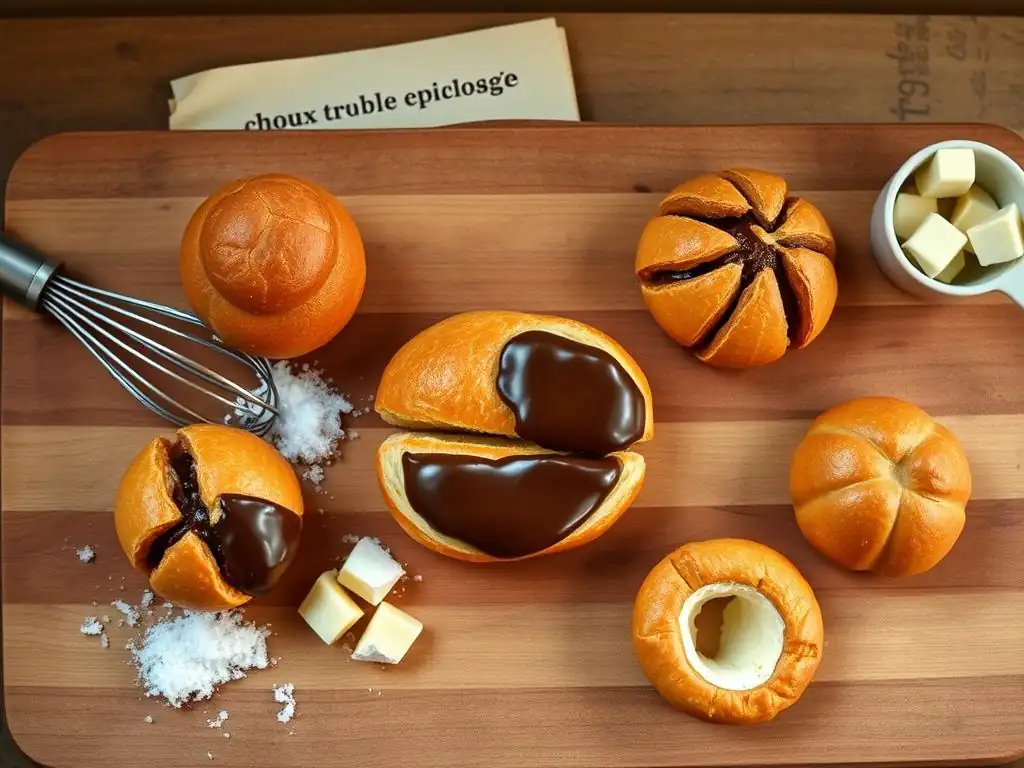
Summary of Common Problems and Solutions
Here is a quick summary of the most frequent choux pastry problems and their corresponding choux pastry troubleshooting tips:
- Problem: Dough too runny
- Cause: Too many eggs
- Solution: Add a small amount of extra paste (water/butter/flour cooked together) or bake off as is (they will likely be flat).
- Problem: Dough too stiff
- Cause: Not enough eggs
- Solution: Beat in a little more egg, milk, or water gradually until correct consistency is reached.
- Problem: Not puffed up
- Cause: Oven too cool, oven door opened too early, dough too stiff/runny, insufficient egg incorporation.
- Solution: Check oven temp with thermometer, do not open oven door for at least 20-25 mins, ensure correct dough consistency, beat eggs in thoroughly.
- Problem: Collapsing after baking
- Cause: Under-baked, removed from oven too soon, cooled too quickly.
- Solution: Bake until golden brown and light, leave in oven with door ajar after baking, cool on wire rack.
- Problem: Shells too dark/burnt
- Cause: Oven too hot, baked too long at high temp, too close to heating element.
- Solution: Reduce temp after initial puff, cover with foil, move to lower rack.
- Problem: Shells too pale
- Cause: Oven too cool, not baked long enough.
- Solution: Check oven temp, bake longer until golden brown, use egg wash.
- Problem: Uneven shapes/sizes
- Cause: Inconsistent piping technique.
- Solution: Practice piping, use steady pressure, use a template.
- Problem: Hollow centers not forming
- Cause: Under-baking, oven temp issues, incorrect dough consistency.
- Solution: Ensure proper two-stage baking, check oven temp, ensure correct dough consistency.
- Problem: Filled pastries getting soggy
- Cause: Under-baked shells, wet filling, filled too early.
- Solution: Ensure shells are fully baked/dried, use firmer fillings, fill just before serving, consider moisture barrier (chocolate).
- Problem: Glaze dull/cracking/melting
- Cause: Glazed warm pastries, incorrect glaze consistency, improper storage.
- Solution: Glaze only completely cooled pastries, adjust glaze consistency, store in a cool, dry place.
Conclusion: Confidently Bake Perfect Choux Pastry.
Mastering choux pastry is a rewarding journey. While initial attempts may present challenges, armed with these comprehensive choux pastry troubleshooting tips, you can confidently tackle common problems. Remember that baking is a science, but also an art that improves with practice. Pay close attention to your ingredients, temperatures, and technique, and don't be afraid to experiment and learn from each batch.
By understanding the causes behind issues like dough consistency, puffing failures, or deflation, you can apply the right choux pastry troubleshooting tips to correct them. Whether you're aiming for delicate profiteroles, classic éclairs, or savory gougères, consistent results are within reach. Keep this guide handy, and you'll be well on your way to baking perfect, airy, golden choux pastry shells every time, ready to be filled with your favorite sweet or savory creations. Happy baking!
Frequently Asked Questions
What is the most common problem people face when making choux pastry, and how can it be avoided?
The most common problem is a pastry that doesn't puff up properly. This is often due to insufficient cooking of the pâte à choux before adding the eggs, resulting in insufficient steam generation. Ensure the dough is cooked until a film forms on the bottom of the pot and it pulls away from the sides.
Why does my choux pastry sometimes collapse after baking?
Collapsing can be caused by removing the pastry from the oven too early, before it's fully set. The internal structure hasn't solidified, and the steam escapes, causing collapse. Allow the baked choux pastry to cool in the oven with the door slightly ajar to prevent this.
How do I know if I've added enough eggs to my choux pastry dough?
The correct consistency is crucial. You've added enough eggs when the dough is smooth, glossy, and forms a "ribbon" that slowly falls from the spatula when lifted. Adjust the amount of egg used based on the humidity and flour type.
My choux pastry dough is too stiff. What can I do?
A stiff dough is likely caused by overcooking the pâte à choux before adding the eggs, or not adding enough eggs. You can gradually add a small amount of beaten egg until the dough reaches the correct consistency.
Can I make choux pastry ahead of time, and if so, how should I store it?
Yes, you can. The pâte à choux can be stored in the refrigerator for up to 24 hours in a piping bag. However, it is best to bake the pastry immediately for optimal results. You can also freeze baked, un-filled shells.
Final Reflection: Mastering the Art of Choux Pastry Perfection
The seemingly simple choux pastry, with its delicate balance of flour, water, butter, and eggs, continues to challenge even the most experienced bakers. Its capricious nature, prone to deflating, cracking, or simply refusing to rise, makes mastering it a true testament to baking skill. Yet, understanding the underlying principles, as explored in this guide, unlocks the potential for consistently flawless results, transforming frustration into the joy of perfectly puffed pastries.
The journey of learning to make choux pastry is a microcosm of the larger creative process; it's about embracing failure as a stepping stone to success. The only true wisdom is in knowing you know nothing.
- Socrates. This quote resonates deeply because each failed batch of choux revealed a new facet of the process, a new variable to control, a new technique to refine. The imperfections, the soggy bottoms, the collapsed puffs – they all contributed to a deeper understanding and ultimately, to the triumph of a perfectly golden, airy choux.
Now, I invite you to take what you've learned and apply it to your own baking endeavors. Don't be afraid to experiment, to tweak the ratios, to adjust your technique based on your own oven's quirks. Remember the lessons learned here – about the importance of precise measurements, the significance of a well-hydrated dough, and the delicate art of incorporating the eggs.
With patience, practice, and a dash of culinary courage, you too can master the art of choux pastry and create delectable éclairs, cream puffs, and profiteroles that will impress even the most discerning palates. The journey is yours to embark on; the delicious rewards await.
Unlock Your Perfect Choux Pastry: Master the Art of Puffs!
Thanks for joining us on this choux pastry journey! You've now armed yourself with the knowledge to conquer those frustrating baking mishaps. Ready to put your newfound expertise to the test?
- Bake your masterpiece! Try the recipe you've been eyeing – those perfect éclairs or airy cream puffs are within reach!
- Share your choux creations with us on social media using #BakeWithEaseChoux – we can't wait to see your success!
- Explore our other baking guides for more tips and tricks to elevate your baking game.
What delicious choux pastry adventure will you embark on first?