
Take the Guesswork Out: Using Pricing Calculators for Your Bakes

Welcome to BakeWithEase, your companion on the baking journey! Are you ready to finally understand the true cost of your delicious creations? Dive into our latest guide and learn how to leverage our free baking pricing calculator templates to transform your passion into a profitable home baking business. Unlock the secrets to pricing your goods effectively and say goodbye to undercharging - read on and discover how!
- Introduction: Why Pricing Matters for Your Baking Business
- Understanding the Core Components of a Baking Pricing Calculator
- Free Baking Pricing Calculator Templates: Where to Find Them
- Using a Baking Pricing Calculator Template: A Step-by-Step Guide
- Beyond the Template: Customizing Your Baking Pricing Strategy
- Baking Pricing Calculator Excel: Customization and Advanced Features
- Free Baking Pricing Calculator Printable: A Quick Reference Guide
- Mastering Baking Pricing: Tips and Best Practices
- Conclusion: Empowering Your Baking Business with Accurate Pricing
-
Frequently Asked Questions
- How can a baking pricing calculator help my home baking business?
- Where can I find free baking pricing calculator templates?
- What key factors should a baking pricing calculator include?
- Are baking pricing calculators only useful for selling baked goods?
- How do I adjust a template to fit my specific baking needs?
- Final Reflection: Baking Success: From Recipe to Revenue
- Unlock Your Baking Pricing Power!
Introduction: Why Pricing Matters for Your Baking Business
Starting a home baking business is a delicious adventure! You pour your passion, skill, and love into every cake, cookie, and loaf of bread. But turning that passion into a sustainable business requires more than just fantastic recipes; it requires smart pricing. Getting your pricing right is foundational to profitability and ensures your hard work pays off, allowing you to keep doing what you love.
The Importance of Accurate Pricing for Baked Goods
Setting the right price for your baked goods is crucial for several reasons. Firstly, it ensures you cover all your costs – not just ingredients, but also your time, utilities, and other business expenses. Many home bakers underestimate these hidden costs. Secondly, accurate pricing determines your profit margin. Without a healthy margin, your business isn't sustainable in the long run. Finally, consistent and fair pricing builds customer trust and positions you professionally in the market, showing that you understand the value of your creations.
Consider a small batch of artisanal cupcakes. If your ingredient cost is $5, but you sell them for $6, you've only covered ingredients. What about the hours spent mixing, baking, decorating, and packaging? What about the electricity used or the cost of your cupcake liners and boxes? Accurate pricing accounts for all these factors, ensuring that the price you charge reflects the true cost and value, leading to a realistic profit.
Common Pricing Mistakes Home Bakers Make
Many enthusiastic home bakers fall into common pricing traps. One of the most frequent is pricing too low, often based on what competitors charge or simply guessing what customers might pay. This race to the bottom ignores your unique costs and value proposition. Another mistake is only accounting for ingredient costs and forgetting about labor and overhead. Your time is valuable, and the electricity bill for running your oven isn't free!
Another pitfall is inconsistent pricing, where similar items are priced differently without a clear reason, confusing customers and potentially eroding trust. Forgetting to factor in packaging costs is also common; those pretty boxes and ribbons add up quickly. For example, a baker might price a loaf of sourdough based only on flour, water, and salt, forgetting the cost of the proving basket liners (perhaps $0.50 per loaf), the parchment paper ($0.10), and the paper bag it's sold in ($0.25). These small forgotten costs can significantly impact the final profit margin, potentially turning a perceived profit into a loss.
How a Baking Pricing Calculator Can Help BakeWithEase Readers
This is where a baking pricing calculator becomes an invaluable tool for BakeWithEase readers. It takes the guesswork out of the equation. Instead of pulling numbers out of thin air or relying on intuition, a calculator provides a structured way to input all your costs – from a pinch of salt to the hours spent decorating. It helps you see, clearly and objectively, what each item truly costs you to produce.
By using a baking pricing calculator, you can ensure that every single item you sell contributes positively to your bottom line. It helps you understand not just the total cost, but also the cost per serving or per item, which is essential for setting retail prices. For someone exploring baking pricing calculator templates free online, this tool offers a clear path to understanding profitability, making informed decisions about pricing adjustments, and ultimately building a more sustainable and successful home baking business.
Understanding the Core Components of a Baking Pricing Calculator
A reliable baking pricing calculator breaks down the total cost of a baked good into its fundamental components. Think of it like dissecting a recipe to understand each ingredient's role; here, we're dissecting the cost to understand where every penny goes. Knowing these core components is essential whether you're using a sophisticated software tool or a simple free baking pricing calculator template.
Identifying All Ingredient Costs for Accurate Baking Pricing
Ingredients are often the most obvious cost, but it's crucial to be precise. This means not just listing the ingredients, but calculating the cost of the exact amount used in a recipe. You need to know the unit cost of your bulk ingredients (e.g., cost per pound of flour, cost per dozen eggs) and then calculate the cost of the portion required for a specific bake. Don't forget smaller items like leaveners, vanilla extract, or even sprinkles – they add up!
For example, if a 5lb bag of flour costs $4.00, the cost per pound is $0.80. If your recipe uses 2 cups of flour, and 1 cup of flour weighs approximately 4.25 ounces (0.265 lbs), the cost of flour for that recipe is 0.265 lbs * $0.80/lb = $0.21. You need to do this for every ingredient.
A recipe for a dozen cookies might use $1.50 worth of butter, $0.80 of sugar, $0.20 per egg (so $0.40 for two), $0.30 of chocolate chips, plus fractions of a cent for vanilla, baking soda, and salt. Summing these up precisely gives you your total ingredient cost, say $3.25 for that batch of cookies.
Calculating Labor Costs for Your Home Baking Business
Your time is a valuable resource, and it absolutely needs to be factored into your pricing. Calculating labor isn't just about the time spent with hands in dough; it includes all the time dedicated to fulfilling an order: sourcing ingredients, mixing, baking, cooling, decorating, packaging, communicating with the customer, and even cleanup. Estimate the total time spent on a specific bake from start to finish.
Once you have the total time, you need to assign an hourly rate for yourself. This rate should reflect your skill level and what you'd ideally like to earn. Some bakers start by aiming for minimum wage plus a bit, while others base it on professional pastry chef rates.
If you decide your time is worth $20 per hour, and a batch of cookies takes you 45 minutes (0.75 hours) from prep to packaging, your labor cost for that batch is $20/hour * 0.75 hours = $15.00. Adding this to the ingredient cost ($3.25 + $15.00 = $18.25) shows a much more realistic cost base than ingredients alone.
Factoring in Overhead Expenses: Utilities, Packaging, and Marketing
Overhead costs are the less direct expenses required to run your business. These include utilities (electricity, gas, water), rent (if you have a separate kitchen space), equipment maintenance, insurance, packaging materials (boxes, bags, labels), marketing efforts, website fees, and even cleaning supplies. These costs aren't tied to a single bake but are necessary for the business to operate.
To factor overhead into the cost of a single item, you typically calculate your total monthly overhead and divide it by the number of items you produce in that month, or allocate it as a percentage of your total costs or revenue. A simpler method often used in baking pricing calculator templates free is to estimate overhead as a percentage of your ingredient or total direct costs. For instance, you might estimate that overhead adds 15% to your combined ingredient and labor costs.
Using our cookie example ($3.25 ingredients + $15.00 labor = $18.25 direct costs), a 15% overhead would add $18.25 * 0.15 = $2.74. Now the total cost for that batch is $18.25 + $2.74 = $20.99. This comprehensive view is essential for accurate baking pricing.
Free Baking Pricing Calculator Templates: Where to Find Them
Getting started with cost calculation doesn't require expensive software. Many excellent resources offer baking pricing calculator templates free of charge, providing a solid foundation for understanding your costs. These templates are often available in spreadsheet formats, making them accessible to most home bakers.
Exploring Free Baking Pricing Calculator Templates Online
The internet is a treasure trove of resources for home business owners, and finding free baking pricing calculator templates is relatively easy. Many baking blogs, small business resource websites, and even some ingredient suppliers offer downloadable templates. A quick search for "baking pricing calculator templates free" will yield numerous results. These templates vary in complexity, from simple spreadsheets with basic input fields for ingredients and labor to more detailed versions that include sections for packaging and overhead percentages.
When exploring options, look for templates that are clear, easy to understand, and allow you to input costs per unit (like per cup, per pound, per egg). Some templates might even include instructions or examples to help you get started. While they might not have all the bells and whistles of paid software, a good free baking pricing calculator template is a fantastic starting point for any home baker serious about understanding their finances.
BakeWithEase Recommended Free Pricing Calculator Templates
While BakeWithEase doesn't host downloadable files directly (per these instructions! ), we can recommend the types of free baking pricing calculator templates that are most helpful. Look for templates that:
- Have clear sections for Ingredients, Labor, and Overhead.
- Allow you to input ingredient costs by weight or volume and automatically calculate cost per unit.
- Provide space to estimate your hourly labor rate and the time spent on a bake.
- Include a method for adding overhead (either a fixed amount or a percentage).
- Ideally, calculate a suggested wholesale and retail price based on desired profit margins.
Many useful templates can be found on reputable small business advisory sites or through well-known baking business coaches who often provide them as lead magnets. Searching for "free baking pricing calculator template spreadsheet" often brings up these types of resources that are well-structured and user-friendly.
Understanding the Limitations of Free Baking Pricing Calculators
While incredibly useful, it's important to be aware that free baking pricing calculator templates often have limitations. They might not be able to handle complex pricing structures, like tiered pricing for different order sizes or automatic adjustments for bulk discounts. Updating ingredient costs requires manual entry whenever prices change.
Furthermore, free templates typically lack advanced features such as inventory management integration or detailed sales tracking. They are primarily tools for calculating the cost and suggesting a price for individual items or batches. For a growing business, you might eventually need to move to a more robust solution, but for understanding the basics and getting started with accurate baking pricing, a free baking pricing calculator template is an excellent and cost-effective first step. They provide a solid foundation upon which you can build your pricing knowledge and strategy.
Using a Baking Pricing Calculator Template: A Step-by-Step Guide
Once you've found a suitable free baking pricing calculator template, the next step is to put it to work! Using the calculator effectively requires a little preparation and attention to detail, but the insights you gain are invaluable for your baking business.
Gathering Your Cost Information: Ingredients, Labor, and Overhead
Before you even open the template, you need to gather your data. Start with ingredients. Keep track of your grocery receipts and note the price and quantity of everything you buy. Calculate the cost per unit for frequently used items (e.g., cost per ounce of butter, cost per cup of sugar). A small kitchen scale can be helpful for accurately measuring ingredient weights to calculate costs precisely, as volume measures (like cups) can vary.
Next, estimate your labor time. Time yourself while you prepare a batch of a specific item, from gathering ingredients to final packaging. Do this a few times to get an average. Decide on a reasonable hourly rate for your time. Finally, tally up your monthly overhead expenses: electricity, gas, water, internet, phone, packaging supplies purchased, cleaning supplies, etc. If these vary, take an average over a few months. Having these numbers ready makes filling out the baking pricing calculator template much faster and more accurate.
Inputting Data into Your Chosen Baking Pricing Calculator
Now, open your free baking pricing calculator template. Most templates will have clear sections for inputting your data.
- Ingredients: Enter each ingredient used in the recipe. Input the quantity used and the cost per unit you calculated earlier. The template should automatically calculate the total ingredient cost for that item. For example, if the template has columns for "Ingredient," "Quantity Used," "Unit," "Cost per Unit," it might look like this for flour:
Flour | 2 | cup | 0.21. - Labor: Input the estimated time spent on this specific bake (e.g., 0.75 hours) and your chosen hourly rate (e.g., $20). The template will calculate the labor cost.
- Overhead: The template might ask for a total monthly overhead figure and your estimated monthly production volume to calculate an overhead cost per item. Alternatively, it might ask for a percentage (e.g., 15%) to apply to your direct costs (ingredients + labor).
Fill in all the necessary fields accurately. Double-check your entries to avoid errors, as mistakes here will lead to inaccurate pricing suggestions.
Interpreting the Results: Understanding Your Profit Margin
Once all your data is entered into the baking pricing calculator template, it will typically provide you with a total cost per item or per batch. This is your baseline – the minimum amount you need to charge just to break even. But you're not in business just to break even; you need to make a profit!
The calculator will likely then allow you to input a desired profit margin percentage (e.g., 30% or 50%). Based on your total cost and desired margin, it will suggest a wholesale price (cost + profit) and potentially a retail price (wholesale price marked up further, often for selling directly to consumers). Understanding these numbers is key:
Total Cost = Ingredient Costs + Labor Costs + Overhead CostsWholesale Price = Total Cost / (1 - Desired Profit Margin %)Retail Price = Wholesale Price * Markup Factor (e.g., 2)
If the suggested price seems too high for your market, you might need to look for ways to reduce costs (e.g., source ingredients differently, streamline processes) or adjust your desired profit margin. If it seems too low, you might be underselling yourself! The calculator gives you the data needed to make informed decisions about your baking pricing strategy.
- Gather all ingredient costs per unit.
- Estimate time spent per bake and set an hourly rate.
- Calculate or estimate your monthly overhead expenses.
- Input data into the baking pricing calculator template.
- Review the calculated total cost per item.
- Determine your desired profit margin.
- Analyze the suggested wholesale and retail prices.
- Adjust pricing strategy based on the results.
Beyond the Template: Customizing Your Baking Pricing Strategy
While a baking pricing calculator template provides a crucial starting point by giving you your cost base, pricing is also a strategic decision. You can't just calculate your cost and add a standard profit margin; you need to consider external factors and your business goals.
Adjusting Prices Based on Market Demand and Competition
Your calculated cost gives you a floor for your pricing, but the market helps determine the ceiling. Research what similar baked goods are selling for in your area or online. Are your creations unique or premium? You might be able to command a higher price. Is the market saturated? You might need to price competitively. Consider the perceived value of your product – artisanal bread with high-quality ingredients can often be priced higher than a standard loaf.
For example, if your baking pricing calculator template free suggests a minimum price of $25 for a custom cake based on costs, but similar cakes from reputable local bakers sell for $40-$50, you have room to price higher than your minimum, increasing your profit margin significantly. Conversely, if the market average is only $30, you might need to re-evaluate your costs or accept a lower profit margin on that item, perhaps making up for it on higher-margin products.
Factoring in Special Requests and Customizations
Custom orders and special requests often require extra time, unique ingredients, or additional complexity. Your standard cost calculation for a basic item won't apply. It's essential to have a system for adding surcharges or calculating costs specifically for these unique bakes. This ensures you are fairly compensated for the extra effort.
When a customer requests gluten-free ingredients, organic produce, intricate piping work, or delivery across town, these all add to your cost and time. A good practice is to use your baking pricing calculator template to calculate the base cost of the standard item, then add specific line items for the extra costs associated with the customization. This could be the higher cost of specialty flour ($1.50 more per cake? ), the extra labor time for decoration (+$10 for 30 minutes? ), or a delivery fee ($5-$10?). Don't absorb these extra costs; pass them on fairly to the customer.
Creating Pricing Tiers for Different Product Offerings
Not all your baked goods will have the same profit margin, and that's okay. It's strategic to have a mix of products. Some might be high-volume, lower-margin items (like basic cookies) that attract customers, while others are lower-volume, higher-margin items (like custom celebration cakes or intricate pastries) that significantly boost profitability.
Using your baking pricing calculator template for each individual product helps you understand which items are your biggest money-makers and which are less so. You can then create pricing tiers or categories. For instance:
- Everyday Treats: Standard cookies, brownies, simple muffins (moderate margin).
- Specialty Items: Unique flavor combinations, decorated cupcakes, artisanal loaves (higher margin).
- Custom Orders: Cakes, elaborate dessert tables (highest margin, priced individually).
This tiered approach, informed by your cost calculations, allows you to cater to different customer needs and price points while ensuring overall business profitability.
Baking Pricing Calculator Excel: Customization and Advanced Features
While many free baking pricing calculator templates come as Excel or Google Sheets files, leveraging the full power of a spreadsheet program allows for significant customization and more advanced analysis beyond simple cost calculation.
Leveraging Excel for Advanced Baking Cost Analysis
Using Excel as your baking pricing calculator provides flexibility that static templates might lack. You can create detailed cost breakdowns, analyze profitability trends over time, and even forecast costs based on potential ingredient price fluctuations. You can set up sheets to track ingredient inventory and automatically update costs per unit as you purchase supplies at different prices.
For example, you could create a master ingredient cost list in one sheet and use lookups ( VLOOKUP or XLOOKUP) in your recipe cost sheets to pull current prices automatically. If the cost of butter changes, you update it in one place, and all your recipe calculations update instantly. This level of detail, while requiring a bit more setup than a basic free baking pricing calculator template, provides a powerful tool for truly understanding the financial health of your baking business.
Creating Custom Formulas for Specific Ingredients or Processes
Excel allows you to build custom formulas tailored to your specific baking processes. Do you make your own vanilla extract? You can create a formula to calculate its cost based on the beans and alcohol used. Do you have a multi-step process for a specific pastry that involves significant cooling or resting time where the oven isn't running but your time is still engaged? You can refine your labor cost calculations to reflect this nuanced time usage.
You can build formulas to calculate yields precisely (e.g., how many usable cookies come from a batch, accounting for breakage) and calculate the cost per usable item. You can also create formulas to apply variable overhead percentages based on the type of bake (e.g., higher utility overhead for bakes requiring long oven times). This level of customization goes beyond simple baking pricing calculator templates free online and allows for highly accurate cost attribution.
Using Excel to Track and Analyze Your Baking Business Profitability
Beyond just calculating the cost of a single item, an Excel-based baking pricing calculator can evolve into a comprehensive financial tracking tool. You can add columns to track sales data alongside your cost data for each order. This allows you to calculate the actual profit made on every single sale.
Over time, you can use this data to analyze which products are most profitable, which customers are ordering frequently, and how changes in ingredient costs affect your margins. You can create charts and graphs to visualize your sales and profitability trends. This analytical capability, built upon accurate cost data from your detailed baking pricing calculator setup, empowers you to make data-driven decisions to grow your baking business effectively.
Free Baking Pricing Calculator Printable: A Quick Reference Guide
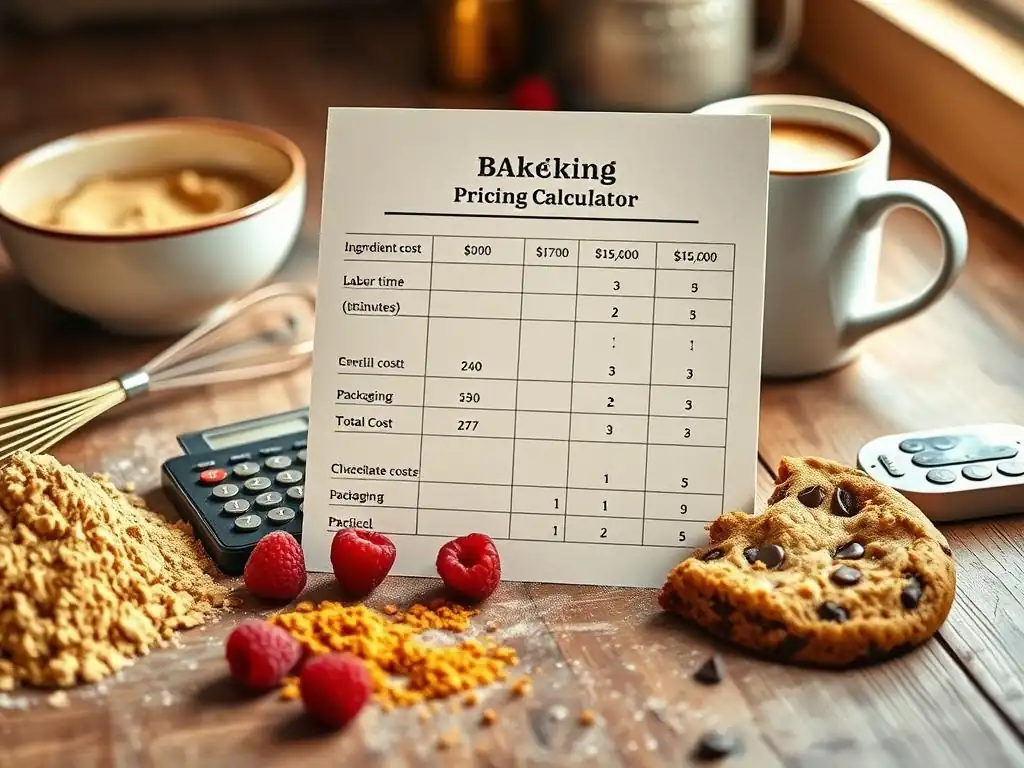
For bakers who prefer pen and paper or need a quick reference in the kitchen, a printable baking pricing calculator offers a convenient alternative to digital spreadsheets. While less automated, it serves the same fundamental purpose of ensuring you consider all costs.
Benefits of Using a Printable Baking Pricing Calculator
A printable version of a baking pricing calculator template free you found online offers several advantages. It's accessible even without a computer or internet connection, making it perfect for kitchens where screens might get messy. It provides a tangible record of your calculations that you can keep in a binder or recipe book. For those who are just starting out or only bake occasionally for sale, a simple printable template might feel less intimidating than a complex spreadsheet.
It forces you to manually write down each cost, which can sometimes help reinforce the importance of every expense. Plus, having a physical template allows you to quickly scribble notes or adjustments as you go, acting as a handy reference while you are actively baking and packaging.
How to Create Your Own Printable Template
You can design your own printable baking pricing calculator template based on the principles discussed earlier. Use a word processor or spreadsheet program to create a simple table. Include clear sections for:
- Recipe Name/Item: (e.g., Chocolate Chip Cookies - Dozen)
- Ingredient Costs:
- List of Ingredients (e.g., Flour, Butter, Sugar, Eggs)
- Quantity Used
- Unit (e.g., cup, gram, each)
- Cost per Unit
- Total Ingredient Cost (Quantity * Cost per Unit)
- Labor Costs:
- Estimated Time (e.g., 0.75 hours)
- Your Hourly Rate
- Total Labor Cost (Time * Rate)
- Overhead Costs:
- Method (e.g., % of Direct Costs, Fixed amount per batch)
- Calculation/Amount
- Total Overhead Cost
- Summary:
- Total Cost (Ingredients + Labor + Overhead)
- Number of Items/Servings in Batch
- Cost Per Item/Serving (Total Cost / # Items)
- Desired Profit Margin %
- Suggested Selling Price Per Item/Serving
Save this as a PDF or print it directly. You can find many examples by searching for "baking pricing calculator template free printable" online and adapt one that suits your needs.
Tips for Efficiently Using a Printable Calculator for BakeWithEase Readers
To get the most out of a printable baking pricing calculator:
- Keep a Cost Log: Maintain a separate notebook or sheet to record the purchase price and quantity of your bulk ingredients. This makes calculating "Cost per Unit" for your template much easier.
- Use a Timer: Get into the habit of timing yourself when making different recipes to accurately estimate labor.
- Allocate Overhead: Decide on a consistent method for allocating overhead (e.g., a percentage) and stick to it for comparison.
- Organize: Keep your printed templates organized by recipe or date so you can refer back to them easily.
- Review Regularly: Even with a printable, make a point to revisit your costs periodically, as ingredient prices can change.
Using a printable baking pricing calculator template free of charge is a straightforward way to start incorporating cost analysis into your baking routine, ensuring you're not just baking delicious treats but also making smart business decisions.
Mastering Baking Pricing: Tips and Best Practices
Using a baking pricing calculator is a fundamental step, but mastering your pricing strategy involves ongoing effort and adherence to best practices. It's about balancing profitability with market perception and the value you provide.
Regularly Review and Update Your Pricing
Ingredient costs fluctuate. Utility rates change. Your efficiency in baking might improve over time, or perhaps you invest in new equipment. For all these reasons, your costs are not static, and neither should your prices be indefinitely. Make it a practice to review your cost calculations using your baking pricing calculator template or tool at least every 6-12 months, or whenever there's a significant change in your costs (e.g., the price of butter doubles).
Updating your prices might seem daunting, but it's essential for maintaining profitability. If your costs have risen by 10% but your prices haven't changed in two years, your profit margin is shrinking. Communicate any necessary price increases clearly and professionally to your customers, explaining that they reflect the quality of your ingredients and service.
Don't Undersell Your Skills and Expertise
This is a common pitfall for home bakers. You might feel guilty charging for your time or worry that your prices are too high compared to a large commercial bakery. Remember, customers are often choosing you for a reason: your personal touch, fresh ingredients, unique recipes, or the ability to create custom orders. Your skills, creativity, and dedication have value, and that value should be reflected in your price.
Your labor cost calculation in your baking pricing calculator template isn't just about minimum wage; it should factor in your expertise. If you've spent years perfecting sourdough techniques or mastering intricate cake decorating, your time is worth more than someone just starting out. Be confident in the quality you provide and price accordingly. Underselling yourself not only harms your profitability but can also devalue your craft in the eyes of customers.
Prioritize Profitability Without Sacrificing Quality
The goal of using a baking pricing calculator is to ensure profitability, but this should never come at the expense of the quality that defines your brand. Don't switch to cheaper, inferior ingredients just to lower your costs and increase your margin if it compromises the taste or texture of your bakes. Customers choose you for quality; maintain it.
Focus instead on efficiency in your processes, smart ingredient sourcing (buying in bulk when appropriate and possible), minimizing waste, and accurate cost tracking. A well-used baking pricing calculator helps you find the sweet spot where your prices cover your costs, provide a healthy profit, and reflect the high-quality product your customers expect from BakeWithEase-inspired creations.
Conclusion: Empowering Your Baking Business with Accurate Pricing
Taking the step to accurately price your baked goods using tools like a baking pricing calculator is one of the most impactful actions you can take for your home baking business. It moves you from hobbyist to professional, providing clarity and control over your finances.
Taking Control of Your Baking Business Finances
Understanding your costs is the bedrock of financial control. A baking pricing calculator template provides that essential understanding, showing you exactly where your money is going – on ingredients, labor, and overhead. This knowledge empowers you to make informed decisions, whether it's setting prices, identifying areas for cost reduction, or determining which products are most profitable. It transforms the daunting task of pricing into a clear, data-driven process, giving you confidence in the value you offer and the prices you charge.
Finding the Right Baking Pricing Calculator for Your Needs
Whether you opt for a simple free baking pricing calculator template downloaded online, build a customized system in Excel, or prefer the tangible nature of a printable version, the key is to choose a tool that works for you and use it consistently. Start simple if needed, and gradually incorporate more detail as your business grows. The best calculator is the one you will actually use to track your costs accurately.
Remember that many useful resources, including various formats of baking pricing calculator templates free to use, are available to help you get started. Don't be afraid to try a few different templates to see which format clicks best with your way of working.
BakeWithEase Resources for Continued Baking Business Success
BakeWithEase is here to support you on your baking journey, from mastering recipes to building a thriving business. Accurate pricing is a vital ingredient in that success. By consistently using a baking pricing calculator and applying smart pricing strategies, you can ensure your passion for baking translates into a sustainable and profitable venture. Keep refining your skills, keep delighting your customers, and keep those numbers crunched – your business will thank you!
Frequently Asked Questions
How can a baking pricing calculator help my home baking business?
A baking pricing calculator helps you determine a fair and profitable price for your baked goods by factoring in ingredients, labor, and overhead. This helps ensure you're not undervaluing your time and effort.
Where can I find free baking pricing calculator templates?
Websites like BakeWithEase.com may offer free baking pricing calculator templates. You can also search online for spreadsheet templates designed for small businesses.
What key factors should a baking pricing calculator include?
A good calculator should include fields for ingredient costs, estimated labor time (and your hourly rate), packaging expenses, and any overhead costs like rent or utilities. It should also allow you to add a profit margin.
Are baking pricing calculators only useful for selling baked goods?
No, even if you're not selling, a pricing calculator can help you understand the true cost of your baking hobby. This can help you budget your baking activities and appreciate the value of your creations.
How do I adjust a template to fit my specific baking needs?
Customize the template by adding or removing fields to reflect your unique ingredient costs and labor time. Don't be afraid to modify the formulas to calculate your costs accurately.
Final Reflection: Baking Success: From Recipe to Revenue
The ability to accurately price baked goods is no longer a luxury, but a necessity for bakers of all levels. In today's competitive market, understanding your costs and applying a fair profit margin is the difference between a hobby and a thriving business. This article explored the power of pricing calculators, demonstrating how these simple tools can transform the often-guesswork-filled process of pricing your creations into a strategic and profitable endeavor.
The impact of accessible pricing tools extends far beyond individual bakers. It empowers home bakers to confidently transition to selling their goods, fostering a vibrant community of entrepreneurs. It also allows established businesses to optimize their pricing strategies, ensuring sustainability and growth. The ease of use and accessibility of these tools democratize the baking industry, making it possible for anyone with a passion and a recipe to pursue their dreams. The greatest glory in living lies not in never falling, but in rising every time we fall.
- Nelson Mandela. This resilience, bolstered by smart pricing, is key to success in any creative venture.
Now, it's your turn. Consider the recipes you cherish, the time and effort you invest, and the joy you bring to others through your baking. Download a free pricing calculator template today, and begin the journey of transforming your passion into a profitable and sustainable business. Don't let guesswork hold you back – take control of your pricing, and bake your way to success!
Unlock Your Baking Pricing Power!
Thanks for taking the time to learn how pricing calculators can transform your baking business! You've now got the tools to confidently price your delicious creations and ensure profitability. Ready to put your new knowledge into action?
- Calculate the price of your next masterpiece: Use the pricing strategies discussed to create a detailed cost breakdown for one of your most popular items. Then, adjust your pricing based on your desired profit margin. This is your primary step to success!
- Share your pricing wins (or challenges!): Join our BakeWithEase community forum and share your experiences—what worked, what didn’t, and what questions you still have. Let's learn from each other!
- Experiment with different pricing models: Try out a few different pricing strategies from the article on a smaller batch of your baked goods to see which generates the best customer response. This lets you test in a safe, low-risk manner.
So, what delicious item will you be pricing next? Let us know in the comments!