
Understanding Baker's Percentage for Croissant Dough (Simplified)

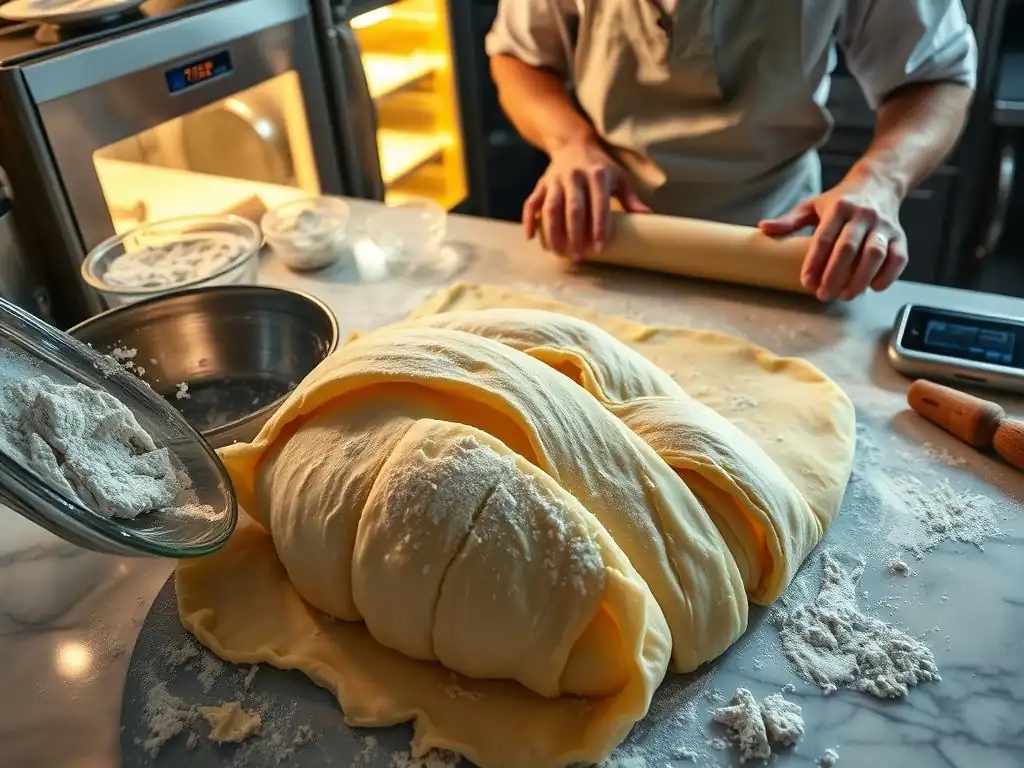
Welcome to BakeWithEase, where we demystify the delicious world of baking! Ever wondered how professional bakers achieve consistently perfect results? The secret often lies in baker's percentage. Dive into our guide to unlock the secrets of a baker's percentage croissant dough recipe, simplified for home bakers. Ready to elevate your croissant game and understand the science behind the flake? Let's get baking!
- Understanding Baker's Percentage for Croissant Dough
- Introduction to Baker's Percentage in Croissant Dough Recipes
- What is Baker's Percentage?
- Baker's Percentage Croissant Dough Recipe: A Step-by-Step Breakdown
- Benefits of Using Baker's Percentage for Croissant Dough
- Converting a Standard Croissant Recipe to Baker's Percentage
- Mastering Croissant Dough Hydration with Baker's Percentage
- Troubleshooting Common Croissant Dough Issues Using Baker's Percentage
- Advanced Techniques with Baker's Percentage in Croissant Baking
- Conclusion: Embrace Baker's Percentage for Superior Croissant Results
-
Frequently Asked Questions
- What is baker's percentage, and why is it important for croissant dough?
- How does baker's percentage simplify creating a croissant dough recipe?
- What are the essential ingredients typically expressed as a percentage in a croissant dough recipe using baker's percentage?
- Can I use baker's percentage to adjust the flakiness of my croissants?
- Where can I find a simplified baker's percentage croissant dough recipe on BakeWithEase.com?
- Final Reflection: Mastering the Art of Croissant Dough
- Unleash Your Inner Croissant Master!
Understanding Baker's Percentage for Croissant Dough
Introduction to Baker's Percentage in Croissant Dough Recipes
Why Baker's Percentage Matters for Consistent Croissant Baking
Achieving that flaky, airy perfection in croissants is a baker's dream, and consistency is the key. Baker's percentage provides a universal language for recipes, allowing bakers to replicate results precisely every single time, regardless of batch size. Imagine trying to scale a recipe that calls for "3 cups of flour" and "1.5 sticks of butter." The volume of ingredients like flour can vary significantly based on how packed it is. Using weights eliminates this variability.
Furthermore, understanding baker's percentage allows you to analyze and compare different croissant dough recipes scientifically. You can see at a glance the ratio of water to flour (hydration), fat to flour, or sugar to flour. This insight helps you understand why a recipe behaves the way it does and predict the outcome, moving beyond just following instructions to truly mastering the craft. It's the foundation for developing your own signature baker's percentage croissant dough recipe.
BakeWithEase: Your Guide to Mastering Croissant Dough
At BakeWithEase, we believe that mastering baking should be accessible and enjoyable for everyone. Tackling croissant dough might seem intimidating, but with the right techniques and understanding, it becomes a rewarding process. We break down complex concepts like baker's percentage into simple, actionable steps.
Our goal is to empower you to bake with confidence. By learning how to use baker's percentage for your croissant dough, you gain control over the texture, flavor, and structure of your pastries. We'll walk you through the fundamentals, provide clear examples, and share tips to help you achieve bakery-quality croissants right in your own kitchen. Let's unlock the secrets behind a perfect baker's percentage croissant dough recipe together!
What is Baker's Percentage?
Defining Baker's Percentage: The Key to Precise Baking
Baker's percentage is a method of expressing ingredient quantities in a recipe as a percentage of the total flour weight. In this system, the weight of the flour is always considered 100%. Every other ingredient, including water, yeast, salt, sugar, butter, and eggs, is then calculated as a percentage of that flour weight. For example, if a recipe uses 1000 grams of flour and 600 grams of water, the hydration is 60% (600g / 1000g * 100%).
This system provides an incredibly precise way to formulate recipes, ensuring that the ratios between ingredients remain constant, regardless of the batch size. It's widely used in professional bakeries because it simplifies scaling recipes up or down and makes it easy to understand the fundamental structure of a dough. When you encounter a baker's percentage croissant dough recipe, you're looking at the backbone of the formula.
How Baker's Percentage Differs from Standard Recipes
Standard recipes often list ingredients by volume (cups, teaspoons, tablespoons) or sometimes by weight in fixed units (grams, ounces). While this works for many home bakers, it lacks the inherent ratio information provided by baker's percentage. A recipe calling for "4 cups flour, 1 cup water" doesn't immediately tell you the hydration percentage without knowing the weight of those volumes, which can vary.
Baker's percentage, conversely, focuses purely on the relationship between ingredients relative to the flour. A baker's percentage croissant dough recipe will list everything as a percentage of the flour weight (100%). This makes it instantly clear, for instance, if a dough has a high or low hydration, or how much fat is being incorporated. It shifts the focus from absolute quantities to relative proportions, making analysis, comparison, and scaling much more intuitive and accurate.
Baker's Percentage Croissant Dough Recipe: A Step-by-Step Breakdown
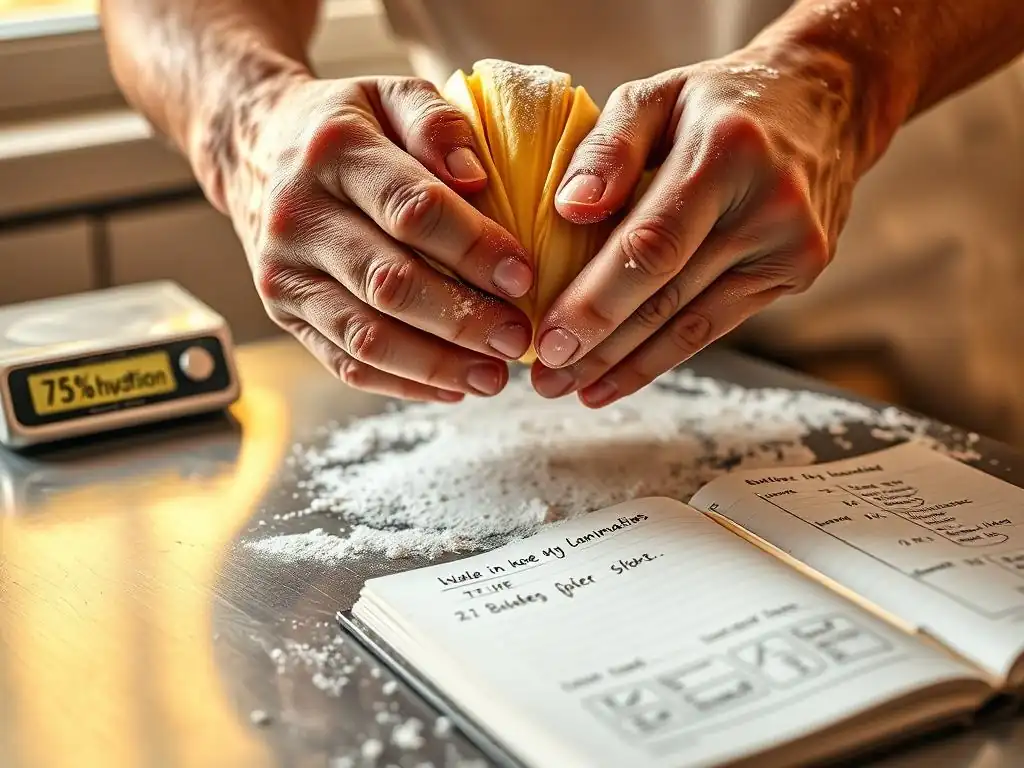
Essential Ingredients for Perfect Croissant Dough (Using Baker's Percentage)
Crafting exceptional croissant dough requires a few key ingredients, each playing a crucial role. Using baker's percentage helps us define their precise relationship to the flour. The foundation is strong bread flour, typically around 100% of the formula. Water or milk (often a combination) is essential for hydration, usually ranging from 50% to 60%. This liquid activates the gluten and allows the dough to develop structure.
Yeast, either active dry or instant, provides the leavening power, typically used at a rate of 1% to 3% depending on the proofing time and temperature. Salt is vital for flavor and controlling yeast activity, usually around 1.5% to 2%. Sugar adds a touch of sweetness, aids browning, and feeds the yeast, often between 5% and 15%.
Eggs, if used, add richness and tenderness, usually around 5% to 10%. Finally, the star of the show for lamination is the butter block, which is added after the initial dough mix and is typically 30% to 50% of the flour weight for the dough itself. A classic baker's percentage croissant dough recipe will clearly list these components.
Calculating Ingredient Weights Using Baker's Percentage for Croissants
Once you have a baker's percentage formula, calculating the exact weight for each ingredient is straightforward. First, decide on the total weight of flour you want to use – this will be your 100% base. Let's say you want to use 500 grams of flour for your batch. For a formula like: Flour 100%, Water 55%, Sugar 10%, Yeast 2%, Salt 1.5%, Butter (for dough) 5%, Butter (for lamination) 40%.
You simply multiply the desired flour weight by the percentage for each ingredient (as a decimal).
- Flour: 500g * 1.00 = 500g
- Water: 500g * 0.55 = 275g
- Sugar: 500g * 0.10 = 50g
- Yeast: 500g * 0.02 = 10g
- Salt: 500g * 0.015 = 7.5g
- Butter (for dough): 500g * 0.05 = 25g
- Butter (for lamination): 500g * 0.40 = 200g
This calculation ensures that the ratios remain perfect, whether you're making a small batch with 250g flour or a large one with 2000g flour. This is the power of using baker's percentage for your croissant dough recipe.
Sample Baker's Percentage Croissant Dough Formula
Here is a common starting point for a baker's percentage croissant dough recipe:
Ingredient       | Baker's Percentage
-----------------|--------------------
Strong Bread Flour | 100%
Water            | 50%
Milk             | 5%
Granulated Sugar | 10%
Fresh Yeast      | 3%
Fine Sea Salt    | 1.8%
Softened Butter  | 5%
Lamination Butter  | 40%
This formula represents a standard approach to croissant dough. The 50% water and 5% milk combine for a total hydration of 55%. The 10% sugar provides sweetness and assists fermentation. The 3% fresh yeast (or about 1.5% active dry/instant) ensures a good rise. Salt is crucial for flavor and structure. The 5% softened butter in the dough adds richness before lamination, and the 40% lamination butter is key to creating those signature layers. This specific baker's percentage croissant dough recipe provides a solid foundation to work from.
Benefits of Using Baker's Percentage for Croissant Dough
Achieving Consistency with Baker's Percentage: Eliminating Guesswork
One of the most significant advantages of using baker's percentage, especially for sensitive doughs like croissants, is the unparalleled consistency it provides. Measuring ingredients by weight is inherently more accurate than measuring by volume. A cup of flour can weigh anywhere from 120g to 160g depending on how it's scooped and settled, leading to wildly different hydration levels and dough consistencies if using a volume-based recipe.
By fixing the flour weight as 100% and calculating all other ingredients based on that, you ensure that the fundamental ratios of your dough are always the same. This means that if you follow your process correctly, your baker's percentage croissant dough will behave predictably batch after batch, leading to consistently flaky layers and a tender crumb. It takes the guesswork out of scaling and measurement errors.
Scaling Croissant Dough Recipes Easily with Baker's Percentage
Scaling recipes is where baker's percentage truly shines. Whether you need to make a small batch for a weekend treat or a large quantity for a special event, scaling a baker's percentage croissant dough recipe is as simple as multiplying each percentage by your desired total flour weight. If your standard recipe uses 500g flour and you need to make three times the amount, you just use 1500g flour as your new 100% base and calculate all other ingredients accordingly.
This ease of scaling is crucial for both home bakers who might want to adjust batch sizes and professional bakeries that need to produce varying quantities daily. There's no need to convert cups to gallons or try to accurately measure small volumes for large batches; it's all proportional weight measurement. This efficiency makes managing a baker's percentage croissant dough recipe much simpler and more adaptable.
Adapting Croissant Dough Recipes to Your Preferences Using Baker's Percentage
Understanding baker's percentage empowers you to become an active participant in the recipe development process, rather than just a follower. Want a slightly richer dough? Increase the butter percentage. Prefer a softer crumb? Try increasing the hydration slightly. Want a less sweet croissant? Reduce the sugar percentage.
By seeing the recipe as a set of ratios, you can confidently make small adjustments to the percentages to tailor a baker's percentage croissant dough recipe to your specific taste, desired texture, or even environmental conditions (like adjusting hydration in very dry or humid climates). This ability to tweak and experiment based on a solid understanding of the dough's composition is a hallmark of experienced bakers.
Converting a Standard Croissant Recipe to Baker's Percentage
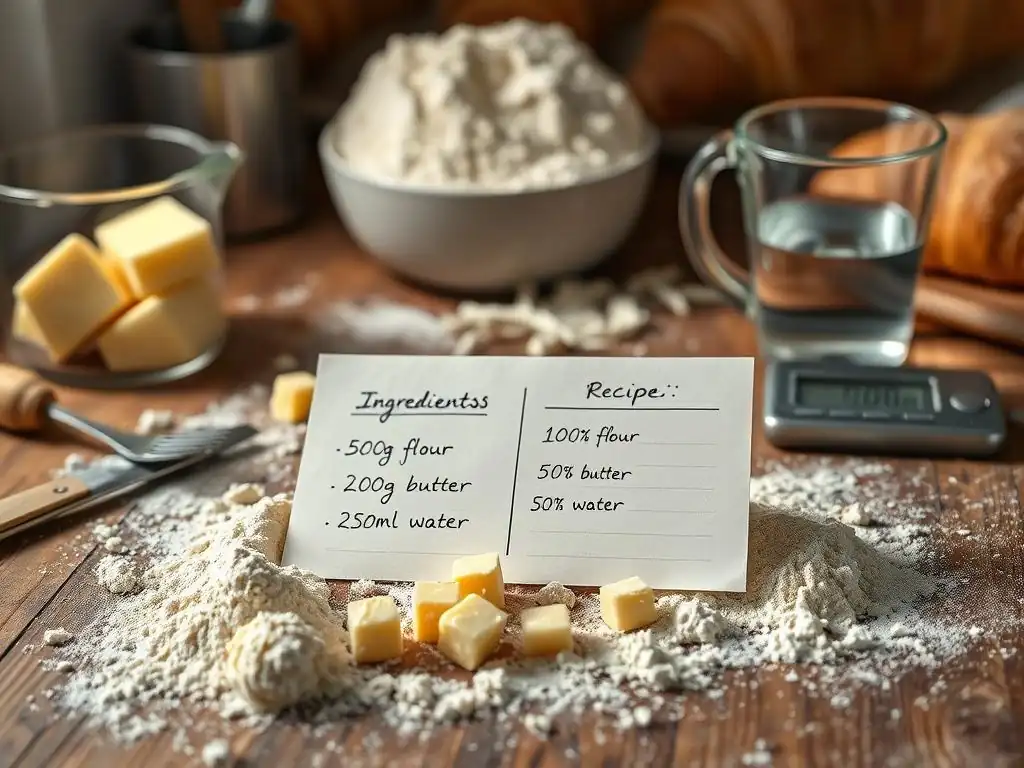
Step-by-Step Guide: Converting Grams and Ounces to Baker's Percentage
Converting a standard recipe that lists ingredients by weight (grams or ounces) into baker's percentage is a straightforward process.
- Identify the Flour Weight: Find the ingredient listed as flour (bread flour, all-purpose, etc.) and note its weight. This weight will be your 100%.
- Record All Ingredient Weights: List all other ingredients and their corresponding weights as given in the recipe.
- Calculate Percentage for Each Ingredient: For each ingredient other than flour, divide its weight by the flour weight and multiply the result by 100.
Percentage = (Ingredient Weight / Flour Weight) * 100
- List the Baker's Percentages: Compile a new list with Flour at 100% and all other ingredients listed with their calculated percentages.
Remember that the lamination butter is often listed separately and is also calculated as a percentage of the initial dough's flour weight. This method gives you the baker's percentage croissant dough recipe format.
Example: Converting a Classic French Croissant Recipe to Baker's Percentage
Let's take a hypothetical classic French croissant recipe listed in grams:
- Bread Flour: 500g
- Water: 250g
- Milk: 50g
- Sugar: 60g
- Fresh Yeast: 15g
- Salt: 10g
- Softened Butter (in dough): 25g
- Cold Butter (for lamination): 200g
Now, let's convert this to baker's percentage using 500g as our 100% flour base:
- Flour: (500g / 500g) * 100 = 100%
- Water: (250g / 500g) * 100 = 50%
- Milk: (50g / 500g) * 100 = 10%
- Sugar: (60g / 500g) * 100 = 12%
- Fresh Yeast: (15g / 500g) * 100 = 3%
- Salt: (10g / 500g) * 100 = 2%
- Softened Butter (in dough): (25g / 500g) * 100 = 5%
- Cold Butter (for lamination): (200g / 500g) * 100 = 40%
So, the baker's percentage croissant dough recipe for this formula is: Flour 100%, Water 50%, Milk 10%, Sugar 12%, Fresh Yeast 3%, Salt 2%, Softened Butter 5%, Lamination Butter 40%. This format is much easier to analyze and scale.
Mastering Croissant Dough Hydration with Baker's Percentage
Understanding the Role of Hydration in Croissant Texture
Hydration, expressed as the percentage of water (and sometimes other liquids like milk) relative to the flour weight, is a critical factor in any dough, and especially for croissants. It directly impacts the dough's consistency, gluten development, and ultimately, the final texture of the baked good. Higher hydration doughs are typically stickier and harder to handle initially but can result in a more open, airy crumb structure.
For croissant dough, hydration levels usually fall within a narrow range, often between 50% and 60%. Lower hydration (closer to 50%) results in a firmer dough that can be easier to handle and laminate, which is beneficial for creating distinct layers. Higher hydration (closer to 60%) can yield a more tender interior crumb but requires more careful handling during lamination to prevent tearing. Finding the right hydration for your baker's percentage croissant dough recipe is key.
Adjusting Hydration Levels Using Baker's Percentage for Optimal Results
Once you understand hydration as a percentage, adjusting it in your baker's percentage croissant dough recipe becomes simple and precise. If your standard formula has a hydration of 55% (e.g., 550g liquid for 1000g flour), and you find the dough too stiff to laminate easily in your kitchen environment, you might try increasing the hydration to 57% (570g liquid for 1000g flour).
Conversely, if your dough is consistently too sticky and difficult to work with, reducing the hydration to 53% (530g liquid for 1000g flour) might solve the problem. Because you are working with percentages, you know exactly how much more or less liquid you are adding relative to the flour, allowing for controlled experimentation and optimization of your baker's percentage croissant dough recipe based on your specific conditions and preferences.
Troubleshooting Common Croissant Dough Issues Using Baker's Percentage
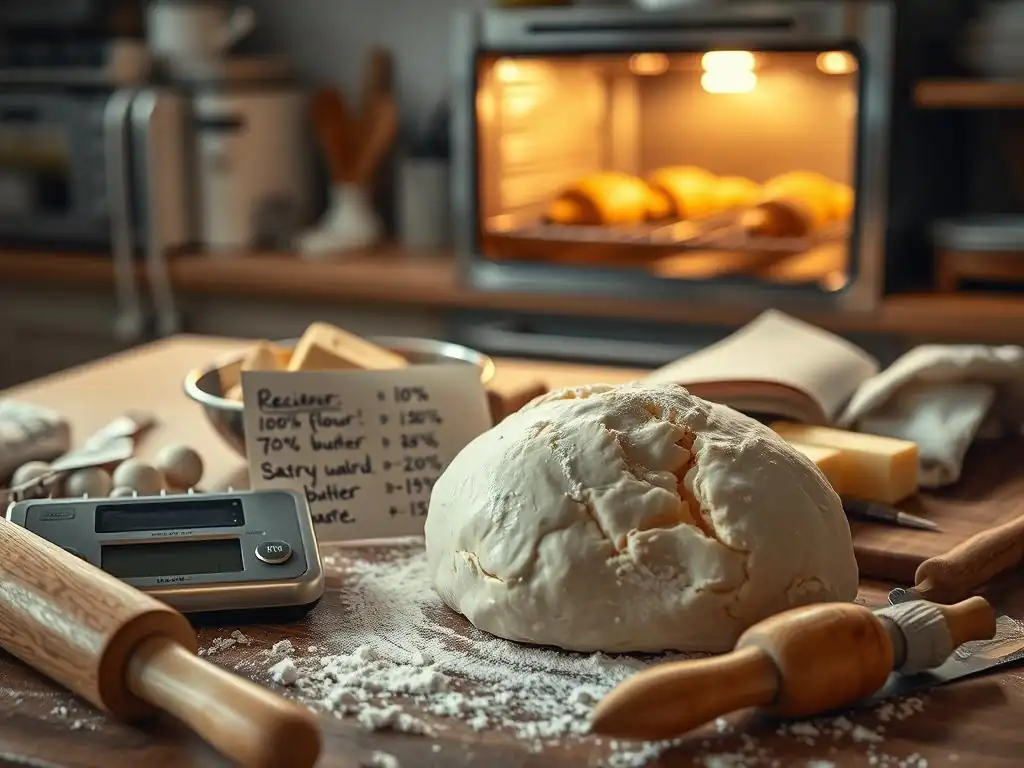
Dry Dough: How to Adjust Water Percentage
If your baker's percentage croissant dough feels too dry, stiff, and difficult to bring together during the initial mixing phase, or tears easily during lamination, it's likely an issue with insufficient hydration. Using baker's percentage makes it easy to diagnose and fix this. Look at your hydration percentage (total liquid weight / flour weight * 100).
A typical hydration for croissant dough is around 55%. If your recipe is significantly lower, say 50%, that could be the cause. To correct this for your next batch, simply increase the water (or milk/liquid) percentage in your baker's percentage croissant dough recipe by 1-3 percentage points (e.g., from 50% to 52% or 53%). For a 1000g flour batch, this means adding an extra 20-30g of liquid. Make the adjustment in small increments until you achieve a dough consistency that is pliable but not sticky.
Sticky Dough: Balancing Flour and Liquid
Conversely, if your baker's percentage croissant dough is excessively sticky, difficult to handle, and seems to resist forming a smooth ball, the hydration might be too high. While higher hydration can yield a more open crumb, too much liquid makes lamination incredibly challenging as the dough can tear and the butter can squeeze out.
Check your hydration percentage. If it's above 60% or even in the high 50s and you're struggling, try reducing the liquid percentage in your baker's percentage croissant dough recipe by 1-3 percentage points for the next batch. For a 1000g flour batch, this means reducing the total liquid by 10-30g. Remember that factors like flour type (different flours absorb liquid differently) and ambient humidity can also affect dough consistency, but adjusting hydration using baker's percentage is the most direct way to address stickiness.
Weak Gluten Development: Using Baker's Percentage to Correct the Problem
Weak gluten development in croissant dough can manifest as a lack of elasticity, difficulty stretching without tearing, and a final product that is dense rather than airy and layered. While mixing time and technique are crucial, the ingredients defined by baker's percentage also play a role. Ensure you are using a strong bread flour (typically 12-14% protein content), which is the foundation (100%) of your baker's percentage croissant dough recipe.
Salt content, usually 1.5% to 2% in a baker's percentage formula, is also vital for strengthening the gluten network. Ensure you haven't accidentally omitted or significantly reduced the salt. Additionally, proper hydration (not too dry or too wet) allows gluten to develop effectively. If using a very low hydration (below 50%), the dough might be too stiff for gluten strands to form properly. Adjusting these percentages within the standard range can help improve gluten structure.
Advanced Techniques with Baker's Percentage in Croissant Baking
Experimenting with Different Flours and their Impact on Baker's Percentage
The type of flour you choose significantly impacts your baker's percentage croissant dough recipe. Different flours have varying protein contents and absorption rates. A high-protein bread flour (12-14%) is standard for its strong gluten-forming potential, essential for the structure needed to support the many layers. However, some bakers experiment with blends, perhaps adding a small percentage of softer flour (like pastry flour, 8-10% protein) for tenderness.
When substituting or blending flours, you may need to adjust the hydration percentage in your baker's percentage formula. A flour with higher absorption will require more liquid to achieve the same dough consistency as one with lower absorption. For instance, a whole wheat flour (though less common in classic croissants) absorbs significantly more water than white bread flour. Using baker's percentage allows you to make these calculated adjustments rather than guessing, ensuring your modified baker's percentage croissant dough recipe maintains the correct feel.
Incorporating Add-ins and their Effect on the Formula
Once you're comfortable with a basic baker's percentage croissant dough recipe, you might want to experiment with add-ins like cocoa powder, activated charcoal (for black croissants), or even small amounts of whole wheat flour for flavor variation. When adding dry ingredients like cocoa powder, consider their absorption rate. Cocoa powder absorbs liquid, so you might need to slightly increase the hydration percentage in your formula to compensate.
Similarly, if you incorporate ingredients that add moisture or fat, like egg yolks (beyond what's in the base recipe) or fruit purées, these will affect the overall hydration and fat content. Using baker's percentage helps you quantify the impact of these additions relative to your base flour weight. You can calculate the percentage of the add-in (Add-in Weight / Flour Weight * 100) and understand how it's changing the overall composition of your baker's percentage croissant dough recipe, allowing for more predictable results when innovating.
Conclusion: Embrace Baker's Percentage for Superior Croissant Results
BakeWithEase's Final Thoughts on Baker's Percentage and Croissant Dough
Mastering croissant dough is a journey, and understanding baker's percentage is an invaluable tool on that path. It transforms a seemingly complex recipe into a logical set of ratios, demystifying the process and putting you in control. By using weight measurements and calculating percentages based on flour, you gain precision, consistency, and the ability to confidently scale and adapt recipes.
At BakeWithEase, we encourage you to embrace this powerful technique. It's not just for professionals; it's a skill that elevates your home baking, especially for delicate laminated doughs like croissants. Practice with a reliable baker's percentage croissant dough recipe, pay attention to the feel of the dough at different hydration levels, and don't be afraid to make small, calculated adjustments based on your experience. The results – consistently flaky, delicious croissants – are well worth the effort.
Download our Free Baker's Percentage Croissant Recipe!
Ready to put baker's percentage into practice? We've prepared a special baker's percentage croissant dough recipe just for you! It's designed with the home baker in mind, providing clear percentages and instructions to help you create stunning croissants from scratch. Follow along, measure by weight, and see the difference that precision makes. This free resource is your next step towards croissant perfection.
Frequently Asked Questions
What is baker's percentage, and why is it important for croissant dough?
Baker's percentage expresses ingredients as a percentage of the flour weight. It allows for consistent scaling and easy adjustments to recipes, crucial for the delicate balance of croissant dough.
How does baker's percentage simplify creating a croissant dough recipe?
Using baker's percentage makes it easier to scale recipes up or down without recalculating every ingredient. You simply multiply the flour weight by each ingredient's percentage to get the required amount.
What are the essential ingredients typically expressed as a percentage in a croissant dough recipe using baker's percentage?
Common ingredients include flour (always 100%), water, butter, sugar, salt, and yeast. Each is represented as a percentage relative to the flour weight, enabling precise control over the dough's hydration and flavor.
Can I use baker's percentage to adjust the flakiness of my croissants?
Yes, baker's percentage helps you adjust the butter content in relation to the flour, impacting flakiness. Higher butter percentage generally leads to more flaky layers in the finished croissant.
Where can I find a simplified baker's percentage croissant dough recipe on BakeWithEase.com?
BakeWithEase.com provides a detailed guide titled "Understanding Baker's Percentage for Croissant Dough (Simplified)". It offers a step-by-step recipe with easily accessible ingredients and clear explanations of the baker's percentage concept.
Final Reflection: Mastering the Art of Croissant Dough
Understanding baker's percentage is not just a technical skill; it's the key to unlocking the secrets of consistently perfect croissants. This seemingly simple concept, when applied to croissant dough, transforms the baking process from a frustrating guessing game into a precise and repeatable art. The ability to adjust hydration and ingredient ratios based on baker's percentage allows for incredible flexibility and control, leading to superior results every time.
The impact of understanding baker's percentage extends far beyond just croissants. It represents a fundamental shift in how we approach baking, moving from reliance on arbitrary recipes to a deeper understanding of ingredient interactions. This knowledge empowers bakers to experiment, innovate, and truly personalize their creations. As the renowned pastry chef, Michel Roux, once said: Baking is a science, but it's also an art. The science gives you the foundation, the art gives you the soul.
Mastering baker's percentage provides that crucial scientific foundation, allowing the artistic expression to flourish.
Now, it's your turn. Don't just bake another croissant; engineer it. Experiment with different flour types, adjust the hydration based on your climate and flour, and observe the subtle changes in texture and flavor. Embrace the precision of baker's percentage, and you'll not only create stunning croissants, but you'll also deepen your understanding and appreciation for the entire baking process. The journey to mastering croissant dough, and indeed all baking, begins with a single, well-understood percentage.
Unleash Your Inner Croissant Master!
Thanks for diving into the world of baker's percentages – we hope you now feel more confident tackling croissant dough! Ready to put your newfound knowledge to the test?
- Bake your own croissants! Use this newfound understanding of baker's percentage to experiment with different flour types and hydration levels. Document your journey – you might discover your new signature croissant!
- Share your baking triumphs (and even your mishaps!) on social media using #BakeWithEaseCroissants. Let’s build a community of croissant enthusiasts!
- Explore more advanced baking techniques on BakeWithEase.com (imagine the possibilities! ).
What unique twist will you add to your next batch of croissants?