
Understanding Bloom Strength: A Baker's Deep Dive into Gelatin Grades


Welcome to BakeWithEase, your trusted companion in the delightful world of baking! Ever wondered about the secret behind perfectly set mousses, shimmering glazes, and flawlessly textured desserts? Unlock the mystery with our guide to understanding gelatin bloom strength, a critical, yet often overlooked, aspect of advanced baking. Prepare to delve into the science behind this essential ingredient and elevate your creations to new heights. Curious to learn more? Let's get baking!
- Mastering Gelatin: A Guide to Bloom Strength for Baking Excellence
- Introduction to Gelatin Bloom Strength in Baking
- Decoding Gelatin Bloom Strength: A Detailed Explanation
- Gelatin Bloom Strengths and Their Baking Applications
- Gelatin Bloom Strength Guide: A Quick Reference
- Selecting the Ideal Gelatin Bloom Strength for Your Recipe
- Converting Gelatin Types: Sheets vs. Powder and Bloom Strength
- Troubleshooting Gelatin-Based Recipes: Bloom Strength Issues
- Advanced Techniques: Using Bloom Strength for Unique Textures
- Achieving Consistent Results with Gelatin: Tips and Tricks
- Conclusion: Enhancing Your Baking with Gelatin Bloom Knowledge
-
Frequently Asked Questions
- What exactly is gelatin bloom strength, and why is it important in baking?
- How does the bloom strength of gelatin affect the final product in a recipe?
- Where can I typically find the bloom strength information on my gelatin packaging?
- What are the common bloom strength grades, and what are their typical uses in baking?
- If a recipe doesn't specify a gelatin bloom strength, which strength should I generally use as a default?
- Final Reflection: The Bloom of Understanding: Unlocking Gelatin's Potential
- Unlock Your Baking Potential: Mastering Gelatin Grades
Mastering Gelatin: A Guide to Bloom Strength for Baking Excellence
Introduction to Gelatin Bloom Strength in Baking
Why Bloom Strength Influences Texture and Stability
The texture and stability of many beloved desserts – from silky panna cotta to bouncy gummies and airy mousses – hinge significantly on a key property of gelatin: its bloom strength. Bloom strength is essentially a measure of gelatin's gelling power, indicating how firm a gel it will form and how quickly it will set. A higher bloom strength means the gelatin is more potent, requiring less product to achieve a desired firmness compared to a lower bloom gelatin.
This is critical in baking because it directly impacts the mouthfeel, structural integrity, and overall success of your creations. Using a gelatin with an inappropriate bloom strength can result in desserts that are too soft, too rubbery, or simply fail to hold their shape.
Understanding gelatin bloom strength allows bakers to achieve consistent, predictable results every time. For instance, a delicate mousse requires a specific level of stability without becoming overly rigid, which might necessitate a medium bloom gelatin. In contrast, a firm gummy candy needs significant elasticity and structure, often achieved with a high bloom gelatin. The subtle differences in bloom values, typically measured in grams, translate into tangible differences in the final product's texture. Mastering this aspect of gelatin use is a fundamental step for anyone looking to elevate their baking techniques and confidently tackle a wider range of recipes.
Understanding Gelatin Grades for Consistent Results
Gelatin is graded based on its bloom strength, which is determined through a standardized test using a Bloom Gelometer. This test measures the weight in grams required for a probe to depress the surface of a set gelatin gel by a specific distance (usually 4mm). The resulting number, the bloom value, typically falls within a range of about 50 to 300. These values are then categorized into general grades: low bloom (around 50-125), medium bloom (around 125-225), and high bloom (around 225-300+). Knowing the bloom grade of the gelatin you are using is paramount for recipe consistency.
Different manufacturers may produce gelatin with slight variations in bloom within a specific grade, but understanding the general categories provides a solid framework. Recipes often specify the type of gelatin (e.g., "leaf gelatin" or "powdered gelatin") but may not always state the exact bloom strength.
As a baker, knowing the typical bloom ranges for commonly available gelatins, such as those found in standard supermarket packets (often around 200-250 bloom for powdered) or different grades of leaf gelatin, allows for informed substitutions and adjustments. Relying on a consistent supplier or understanding how to interpret gelatin specifications helps ensure that your results are repeatable, saving you from unexpected textural failures.
Decoding Gelatin Bloom Strength: A Detailed Explanation
Defining Bloom: Quantifying Gelatin's Gelling Capacity
Bloom is the standard international measure used to quantify the gelling strength of gelatin. Developed by Oscar T. Bloom in 1925, the Bloom test provides a numerical value that represents the cohesive strength of a gelatin gel. The test is performed under strictly controlled conditions: a 6.67% solution of gelatin is prepared, allowed to set at 10°C (50°F) for 17 hours, and then the force required to depress the surface of the gel by 4mm using a 12.7mm diameter plunger is measured in grams.
A higher Bloom number signifies a stronger gel. For example, a gelatin with a 250 Bloom value will form a much firmer gel at the same concentration than a gelatin with a 100 Bloom value.
This quantifiable measure is essential because it allows both manufacturers and users to compare different batches and types of gelatin objectively. Without the Bloom test, specifying gelatin requirements in recipes would be incredibly difficult and inconsistent. A recipe calling for "a packet of gelatin" is inherently imprecise because standard packet sizes and their corresponding bloom strengths can vary slightly between brands or regions.
However, if a recipe specifies a certain weight of gelatin with a stated bloom value (e.g., "10g of 220 Bloom gelatin"), a baker can confidently use a gelatin of a similar bloom strength, adjusting the weight if necessary, to achieve the intended texture. This precision is why the Bloom value is the cornerstone of any comprehensive gelatin bloom strength guide.
The Science Behind Gelatin Bloom and its Effects on Baked Goods
Gelatin's gelling ability, measured by its bloom strength, stems from its protein structure. Gelatin is a collagen derivative, composed of long protein chains. When hydrated in warm liquid, these chains separate and disperse. As the liquid cools, the protein chains re-associate, forming a complex 3D network that traps the liquid, creating a gel. The bloom strength is directly related to the average molecular weight and the distribution of these protein chains within the gelatin sample. Gelatin with a higher bloom value typically has longer, more uniform protein chains that can form a more robust, tightly-linked network upon cooling.
In baked goods and confectionery, this network structure dictates the final texture. A strong gel network (high bloom) results in a firm, elastic, and often chewy texture, ideal for items like gummy candies or firm jellies. A weaker gel network (low bloom) yields a softer, more delicate, and often melt-in-your-mouth texture, suitable for applications like some dairy desserts or glazes.
The rate at which the gel sets and melts is also influenced by bloom strength, though temperature plays a significant role as well. Understanding this underlying science helps bakers predict how different gelatins will behave in their specific recipes and troubleshoot issues related to setting time or final consistency.
Gelatin Bloom Strengths and Their Baking Applications

Low Bloom Gelatin (e.g., 125-175 Bloom): Applications and Characteristics
Low bloom gelatin, typically falling within the 125 to 175 Bloom range, is characterized by its relatively gentle gelling power. It requires a higher concentration compared to medium or high bloom gelatin to achieve a similar level of firmness. This type of gelatin produces a soft, tender gel that melts readily in the mouth, making it suitable for applications where a delicate texture is desired. It's less common in standard home baking supplies but is sometimes used in professional settings or specific recipes.
Applications for low bloom gelatin include certain types of dairy-based desserts where excessive firmness would be undesirable, such as some versions of panna cotta or mousses that prioritize a very light, airy feel. It can also be used in glazes or coatings where a soft set is needed, or in confectionery items where a melt-away texture is preferred over chewiness. Due to its lower gelling strength, recipes using low bloom gelatin often require longer setting times or lower temperatures to achieve sufficient firmness compared to recipes using higher bloom grades.
Medium Bloom Gelatin (e.g., 175-225 Bloom): Versatility in Baking
Medium bloom gelatin, typically ranging from 175 to 225 Bloom, is arguably the most versatile type for general baking and confectionery. It offers a good balance between gelling power and setting speed, producing gels that are firm yet still tender. This range encompasses many commonly available powdered gelatins found in supermarkets, making it a staple for home bakers. Its balanced properties make it suitable for a wide array of recipes.
Common applications for medium bloom gelatin include classic desserts like panna cotta, Bavarian creams, cheesecakes (no-bake types), and some fruit jellies. It provides enough structure to hold these items together while maintaining a pleasant, smooth texture. Many standard recipes for mousses and parfaits also rely on medium bloom gelatin to provide stability without becoming overly rubbery. If a recipe doesn't specify the bloom strength, a medium bloom gelatin is often a safe starting point, especially if using standard packet gelatin.
High Bloom Gelatin (e.g., 225-300 Bloom): Achieving Firmness and Structure
High bloom gelatin, typically falling between 225 and 300 Bloom (and sometimes higher), is the strongest grade available. It forms very firm, elastic gels even at low concentrations and sets relatively quickly. This potency makes it ideal for applications where significant structure, chewiness, or rapid setting is required. It's often favored in professional kitchens and for specific confectionery items.
Examples of applications requiring high bloom gelatin include chewy candies like gummies and marshmallows, where elasticity and resilience are key textural components. It's also used in some very firm jellies, aspics (though less common in modern baking), and sometimes in specialized dessert components where a very stable, sliceable gel is needed. Using high bloom gelatin requires careful measurement, as too much can easily result in an overly tough or rubbery texture. Its efficiency means less product is needed compared to lower bloom types, making it cost-effective for high-volume production of firm items.
Gelatin Bloom Strength Guide: A Quick Reference
Standard Bloom Strengths and Their Numerical Values
Gelatin bloom strength is quantified using a numerical value derived from the Bloom test, measured in grams. While the exact range can vary slightly by source or manufacturer, standard classifications generally adhere to the following ranges, providing a helpful gelatin bloom strength guide:
- Low Bloom: Approximately 50 - 125 Bloom
- Medium Bloom: Approximately 125 - 225 Bloom
- High Bloom: Approximately 225 - 300+ Bloom
It's important to note that within these ranges, specific bloom values exist. For instance, a gelatin might be specified as 150 Bloom (low-medium), 200 Bloom (medium), or 250 Bloom (high). Professional-grade gelatins often list the specific bloom value on the packaging, offering greater precision for bakers. Standard supermarket powdered gelatin is typically in the high end of the medium range or low end of the high range, often around 220-250 Bloom, though this can vary.
Bloom Strength Guide: Common Uses and Expected Results
This quick gelatin bloom strength guide summarizes typical applications based on the bloom value and the expected outcome:
- Low Bloom (50-125):
- Uses: Delicate dairy desserts, soft glazes, melt-away confections.
- Results: Very soft, tender gel; melts easily in the mouth; requires higher concentration or longer set time for firmness.
- Medium Bloom (125-225):
- Uses: Panna cotta, Bavarian cream, no-bake cheesecakes, standard jellies, mousses, parfaits.
- Results: Firm yet tender gel; provides good structure without being rubbery; versatile for many classic desserts.
- High Bloom (225-300+):
- Uses: Gummies, marshmallows, firm jellies, aspics, stable dessert components.
- Results: Very firm, elastic, and often chewy gel; provides maximum structure and stability; sets quickly; requires lower concentration.
This gelatin bloom strength guide serves as a handy reference when selecting gelatin for a recipe or troubleshooting textural issues. Understanding these categories helps predict how the gelatin will perform and allows for informed decisions when substitutions are necessary.
Selecting the Ideal Gelatin Bloom Strength for Your Recipe
Matching Bloom Strength to Desired Product Consistency
Choosing the correct gelatin bloom strength is paramount to achieving the desired texture in your baked goods and confections. The texture is often the defining characteristic of these items, whether it's the delicate wobble of a panna cotta, the firm chew of a gummy bear, or the airy stability of a chocolate mousse.
A high bloom gelatin will create a much firmer gel than a low bloom gelatin at the same concentration, meaning you need to adjust the amount based on the bloom value to get the right consistency. For example, if a recipe calls for 10g of 200 Bloom gelatin, you would need slightly less of a 250 Bloom gelatin (perhaps 8g) or slightly more of a 150 Bloom gelatin (perhaps 12-13g) to achieve a similar gelling effect.
Consider the end goal: do you want a dessert that holds its shape when sliced, or one that is just barely set and melts on the tongue? For a firm, sliceable terrine or a stable filling, a higher bloom gelatin (225-300 Bloom) is likely appropriate. For a very light, spoonable dessert like a delicate fruit jelly or a soft-set cream, a medium or even low bloom gelatin (150-200 Bloom) would be better suited.
Always check if the recipe specifies a bloom strength or gelatin type (powdered vs. leaf, as leaf types often correspond to specific bloom ranges). If not specified, understanding typical bloom values for common products and using this gelatin bloom strength guide will help you make the best choice.
Factors Affecting Gelatin Performance: Temperature, pH, and Ingredients
While bloom strength is the primary indicator of gelatin's gelling power, its actual performance in a recipe can be influenced by several other factors. Temperature plays a crucial role; gelatin needs to be heated sufficiently to dissolve and fully hydrate (typically above 40°C / 104°F) but then must be cooled adequately to set (ideally below 15°C / 59°F, with optimal setting often occurring around 4°C / 40°F). The final melting temperature of the gel is also related to bloom strength, with higher bloom gels generally having slightly higher melting points, though all gelatin gels melt below body temperature.
The pH level of the mixture can significantly impact gelatin's gelling ability. Highly acidic ingredients, such as citrus juices (lemon, lime) or vinegars, can weaken the gel structure, sometimes preventing it from setting properly, especially over time. This is why recipes with high acid content often require slightly more gelatin or a higher bloom strength to compensate.
Certain enzymes found in fresh fruits like pineapple, papaya, kiwi, and figs can also degrade gelatin proteins, preventing gelling entirely. These fruits must be cooked or canned to deactivate the enzymes before being combined with gelatin. Fat, sugar, and salt can also affect gelatin's performance, influencing setting time and firmness, adding further complexity to using your gelatin bloom strength guide effectively.
Converting Gelatin Types: Sheets vs. Powder and Bloom Strength
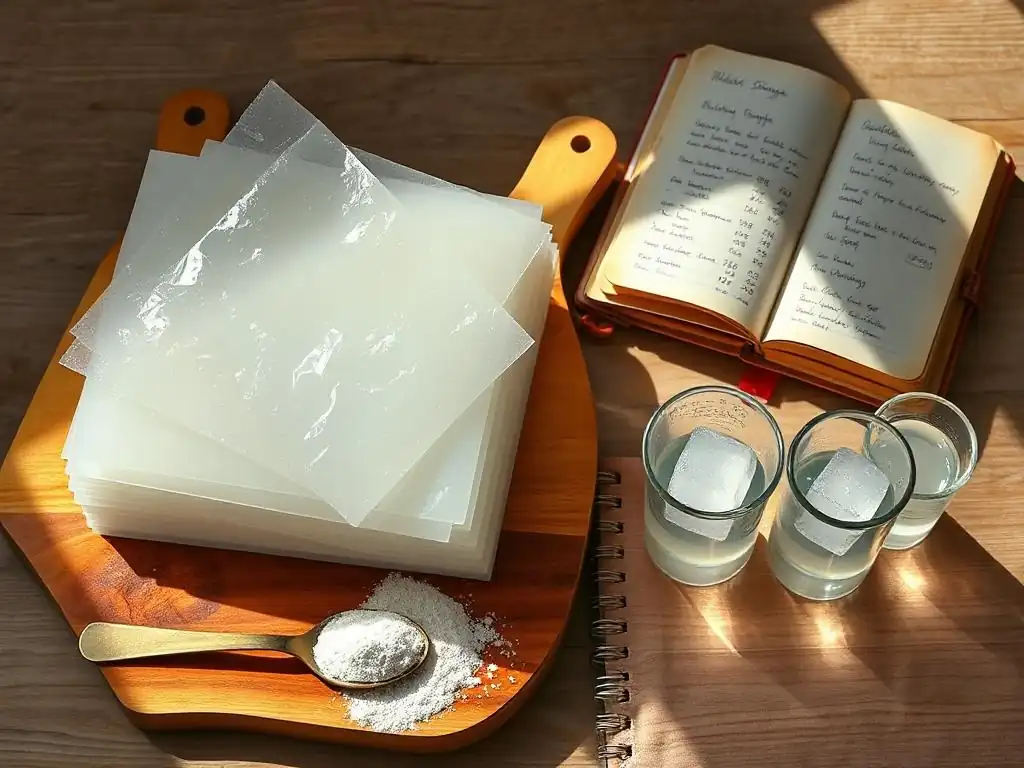
Gelatin Sheet Sizes and Bloom Strength Equivalencies
Gelatin is commonly available in two forms: powdered and sheets (or leaves). While powdered gelatin is measured by weight or volume (teaspoons/tablespoons), sheet gelatin is used by count. Gelatin sheets are rectangular leaves of dried gelatin, and their bloom strength is often indicated by their grade (e.g., Titanium, Bronze, Silver, Gold, Platinum). Different grades correspond to different bloom values and weights per sheet. For example, a typical Gold strength sheet often weighs around 2g and has a bloom strength of approximately 200-220 Bloom. A Platinum sheet might weigh 2.5g and have a higher bloom of around 230-250 Bloom.
Understanding the bloom strength and weight of your gelatin sheets is crucial for accurate conversions, especially when a recipe calls for powdered gelatin or a different sheet grade. Using a gelatin bloom strength guide for sheet equivalencies is vital.
If a recipe calls for a certain number of sheets of a specific grade (e.g., "4 Gold sheets"), you can determine the total weight and approximate bloom strength. If you only have a different grade (e.g., Silver sheets, which are typically 170 Bloom and weigh around 3.3g each), you would need to calculate how many Silver sheets are needed to equal the gelling power of the specified Gold sheets, taking both weight and bloom value into account.
Calculating Powdered Gelatin Amounts Based on Bloom Strength
Converting between powdered and sheet gelatin, or adjusting the amount of powdered gelatin when using a different bloom strength than specified, requires a simple calculation based on the bloom values. The general principle is that the total "bloom units" (weight x bloom value) should remain constant. For example, if a recipe calls for 10g of 200 Bloom powdered gelatin, the total bloom units are 10g * 200 = 2000 bloom units.
If you only have 250 Bloom powdered gelatin, you would need X grams such that Xg * 250 = 2000. Solving for X, you get X = 2000 / 250 = 8g. So, you would use 8g of 250 Bloom gelatin instead of 10g of 200 Bloom.
Similarly, if using 2g, 200 Bloom Gold sheets, each sheet provides 2g * 200 = 400 bloom units. If a recipe calls for 800 bloom units (e.g., 4g of 200 Bloom powdered), you would need 800 / 400 = 2 Gold sheets. This method, based on the gelatin bloom strength guide principle of total bloom units, allows for accurate conversion and substitution, ensuring your recipe performs as intended regardless of the gelatin type or specific bloom value you have on hand.
Troubleshooting Gelatin-Based Recipes: Bloom Strength Issues
Common Problems Caused by Incorrect Bloom Strength
Using the wrong gelatin bloom strength is a frequent cause of issues in gelatin-set recipes. If you use a gelatin with too low a bloom strength for the recipe's requirements, the most common problem is insufficient setting. Your mousse might be too runny, your panna cotta too soft to unmold, or your jelly might never fully firm up, remaining more like a syrup. This happens because the weaker gelatin requires a higher concentration to form a stable network, and the amount used based on a higher bloom recipe isn't enough.
Conversely, using a gelatin with too high a bloom strength can result in an overly firm or rubbery texture. A dessert that should be delicate and melt-in-your-mouth might become unpleasantly bouncy or tough. This is because the potent gelling power of high bloom gelatin creates a very tight network, and using the same weight as a lower bloom recipe results in excessive firmness.
Marshmallows might become too hard, or a panna cotta might resemble a solid block rather than a gently set cream. These issues highlight why understanding and correctly applying your gelatin bloom strength guide is essential for successful results.
Adjusting Recipes to Match Available Gelatin Bloom Strength
When you find yourself with a gelatin that has a different bloom strength than specified in a recipe, you can often adjust the amount to compensate. This requires knowing the bloom strength of the gelatin the recipe intended (or making an educated guess, often assuming medium-high bloom for standard recipes) and the bloom strength of the gelatin you have. As discussed earlier, the goal is to maintain the total "bloom units" (weight x bloom value).
Let's say a recipe calls for 5g of 220 Bloom powdered gelatin, but you only have 180 Bloom powdered gelatin.
- Calculate the total bloom units needed: 5g * 220 = 1100 bloom units.
- Calculate the amount of your 180 Bloom gelatin needed: Xg * 180 = 1100.
- Solve for X: X = 1100 / 180 ≈ 6.1g.
So, you would use approximately 6.1g of the 180 Bloom gelatin instead of 5g of the 220 Bloom. This adjustment is a key technique in a comprehensive gelatin bloom strength guide, allowing bakers flexibility and the ability to troubleshoot effectively when the exact specified ingredient isn't available.
Advanced Techniques: Using Bloom Strength for Unique Textures

Combining Different Bloom Strengths in Recipes
For experienced bakers looking to create highly specific or unique textures, combining gelatins of different bloom strengths can be a valuable technique. This allows for fine-tuning the gel's properties beyond what a single bloom strength can provide. For example, one might combine a medium bloom gelatin for overall structure with a small amount of high bloom gelatin to slightly increase elasticity or melting point without making the texture uniformly rubbery.
Consider a complex layered dessert where different components require slightly varied textures – perhaps a very soft, melt-in-your-mouth layer alongside a firmer, more stable layer. By carefully selecting and combining gelatins, you can achieve these distinct consistencies. While this requires a deeper understanding of how different bloom strengths interact and may involve some experimentation, it opens up possibilities for creating innovative textures in mousses, terrines, or multi-layered pastries. This advanced application goes beyond a basic gelatin bloom strength guide, delving into the nuanced control over gelling properties.
Exploring Bloom Strength Effects on Mousse, Jellies, and Pastries
The impact of bloom strength is particularly evident in delicate preparations like mousses and jellies, where texture is paramount. A mousse made with a medium bloom gelatin will typically be light and airy, with a gentle set.
Using a higher bloom gelatin in the same mousse recipe might result in a denser, bouncier texture that lacks the desired airiness. Similarly, a fruit jelly intended to be soft and spoonable will require a lower bloom gelatin or less of a medium bloom, whereas a jelly meant for cutting into shapes (like for a tart garnish) will need a higher bloom for structure.
In pastries, gelatin is often used in fillings, glazes, or as a stabilizer in creams. The bloom strength influences how these components behave when sliced or served. A glaze set with low bloom gelatin might be very soft and prone to melting, while one set with medium bloom would be more stable.
Understanding how different bloom strengths affect the final set, elasticity, and melting point in these specific applications is key to mastering gelatin use in a wide range of baking contexts. Experimenting with small batches using gelatins of known bloom values is an excellent way to build intuition for this crucial aspect of baking science, complementing your gelatin bloom strength guide knowledge.
Achieving Consistent Results with Gelatin: Tips and Tricks
Proper Hydration Techniques for Optimal Bloom Activation
Properly hydrating, or "blooming," gelatin is a fundamental step that significantly impacts its gelling performance, regardless of its bloom strength. Powdered gelatin must be sprinkled evenly over a cold liquid (like water, juice, or milk) and allowed to sit undisturbed for 5-10 minutes. This process allows the individual granules to absorb liquid and swell, preventing clumps from forming when heat is applied. Using hot liquid at this stage will cause the outside of the granules to dissolve too quickly, forming a barrier that prevents the inside from hydrating properly, resulting in grainy or weak gel.
Gelatin sheets also require hydration, typically by soaking them in a generous amount of cold water for 5-10 minutes until pliable. Once softened, they should be squeezed gently to remove excess water before being dissolved. After hydration, both powdered and sheet gelatin need to be dissolved in a warm liquid (usually around 40-60°C / 104-140°F).
Avoid boiling the mixture after adding the gelatin, as excessive heat can degrade the protein structure and weaken the final gel. Ensuring complete dissolution without overheating is critical for activating the gelatin's full bloom strength potential and achieving consistent results, as outlined in any reliable gelatin bloom strength guide.
Storing Gelatin to Preserve Bloom Strength and Quality
Proper storage is essential to maintain the gelling power and quality of your gelatin over time. Gelatin is a protein and is sensitive to moisture, heat, and light, which can all contribute to its degradation and a reduction in its bloom strength. It should always be stored in a cool, dry place, away from direct sunlight and strong odors. An airtight container is ideal to prevent moisture absorption.
Humidity is a particular enemy of powdered gelatin; if it absorbs moisture from the air, it can become clumpy and its gelling ability may be compromised. While gelatin has a relatively long shelf life if stored correctly (often several years), using older gelatin might require slightly more product to achieve the same gelling effect as fresh gelatin.
Always check the expiration date if available, and observe the gelatin's appearance – it should be free-flowing (if powdered) or intact (if sheets) and free from discoloration or off odors. Proper storage ensures that when you reach for your gelatin, its bloom strength is preserved, allowing you to rely on your gelatin bloom strength guide for accurate measurements and predictable outcomes.
Conclusion: Enhancing Your Baking with Gelatin Bloom Knowledge
Recap of Gelatin Bloom Strength and Its Importance
Understanding gelatin bloom strength is not just a technical detail; it's a fundamental aspect of mastering many classic and modern baking techniques. We've explored how bloom, measured in grams using a standardized test, quantifies gelatin's gelling power, directly influencing the texture, stability, and setting properties of your culinary creations. From low bloom's delicate set to high bloom's firm elasticity, each grade offers unique characteristics suited to different applications, as highlighted throughout this gelatin bloom strength guide.
Knowing the typical bloom ranges for different gelatin types (powdered vs. sheets) and grades allows for informed ingredient selection and crucial adjustments when substituting or troubleshooting. Factors like temperature, pH, and other ingredients also play a role, but bloom strength remains the primary determinant of gelling capacity. By paying attention to this property, bakers can move beyond guesswork and achieve consistent, professional-quality results in everything from airy mousses and stable cheesecakes to chewy marshmallows and vibrant jellies.
Resources for Advanced Gelatin Baking Techniques
For those looking to delve deeper into the fascinating world of gelatin and its properties, numerous resources are available. Culinary science texts and professional baking guides often provide detailed information on gelatin chemistry, bloom strength specifications for various commercial products, and advanced techniques for manipulating texture. Online forums and communities dedicated to molecular gastronomy or professional pastry arts can also be valuable sources of information and shared experiences regarding gelatin use.
Further experimentation in your own kitchen, using gelatins of known bloom strengths, is perhaps the most effective way to build practical knowledge. Try making the same recipe (like a simple panna cotta or jelly) using different bloom gelatins while adjusting the quantity based on a reliable gelatin bloom strength guide. Observing the differences in setting time, firmness, and melt-in-the-mouth quality will solidify your understanding and empower you to confidently select and use gelatin to achieve precisely the textures you desire in your baking endeavors.
Frequently Asked Questions
What exactly is gelatin bloom strength, and why is it important in baking?
Gelatin bloom strength is a measurement of the gelatin's gelling power. A higher bloom number indicates stronger gelling ability, crucial for textures in desserts.
How does the bloom strength of gelatin affect the final product in a recipe?
Using the wrong bloom strength can drastically alter the texture. A weaker bloom might result in a soft, unset dessert, while a stronger bloom could lead to a rubbery texture.
Where can I typically find the bloom strength information on my gelatin packaging?
The bloom strength is usually printed directly on the gelatin packaging, often near the weight or ingredients list. Look for a number followed by "Bloom" (e.g., "225 Bloom").
What are the common bloom strength grades, and what are their typical uses in baking?
Common grades include Bronze (around 125 Bloom), Silver (around 175 Bloom), Gold (around 200 Bloom), and Platinum (around 250 Bloom). Lower bloom strengths are suitable for softer desserts, while higher bloom strengths are used for firmer ones.
If a recipe doesn't specify a gelatin bloom strength, which strength should I generally use as a default?
If unspecified, using a Silver bloom gelatin (around 175 Bloom) is generally a safe starting point for many recipes. You can then adjust based on your desired texture.
Final Reflection: The Bloom of Understanding: Unlocking Gelatin's Potential
Understanding gelatin bloom strength is not merely a technical detail for bakers; it's the key to unlocking consistent, predictable, and ultimately, delicious results. The precise control offered by different bloom strengths allows for the creation of textures ranging from delicate mousses to firm jellies, impacting everything from the mouthfeel of a cake to the stability of a glaze. Mastering this knowledge elevates baking from a haphazard process to a precise art.
The journey through the world of gelatin bloom has been a fascinating one, revealing the subtle yet significant impact this seemingly simple ingredient has on the culinary landscape. From the airy lightness of a perfectly set panna cotta to the robust structure of a classic aspic, the right bloom strength is the invisible hand shaping the final product. As a baker, I've personally witnessed the transformative power of understanding bloom – moving from frustrating failures to consistent successes. The difference between something good and something great is attention to detail.
This quote resonates deeply, as the meticulous attention to bloom strength truly elevates the baking experience.
Now, it's your turn. Consider the recipes you create, the textures you desire, and the challenges you've faced. Take the knowledge gained from this guide and apply it to your next baking project. Experiment with different bloom strengths, observe the results, and refine your technique. The world of gelatin is vast and rewarding; embrace the journey of discovery, and unlock the full potential of this remarkable ingredient. Your next culinary masterpiece awaits.
Unlock Your Baking Potential: Mastering Gelatin Grades
Thanks for diving deep into the world of gelatin with us! You now have the knowledge to confidently select the perfect gelatin for your next baking masterpiece. Ready to put your newfound expertise to the test?
- Experiment with different gelatin grades: Try substituting your usual grade with a higher or lower bloom strength in a familiar recipe. Note the texture differences!
- Share your gelatin journey: Tell us about your experiences using different bloom strengths on our social media channels using #BakeWithEaseGelatin.
- Challenge yourself: Try a recipe that specifically calls for a certain bloom strength, and see if you can achieve those exact results.
What unexpected texture changes will you discover by experimenting with different gelatin grades?