
How Fat Quality Influences Artisan Bread Crumb and Crust

Welcome to BakeWithEase, your trusted guide to baking brilliance! Ever wondered how fat quality impacts the delicate dance between your artisan bread's crust and crumb? Discover the secrets to achieving that perfect, airy artisan bread crumb texture you've always dreamed of. Prepare to unlock the science behind baking and elevate your breadmaking game – your journey to baking perfection starts here!
Understanding the Role of Fat in Artisan Bread Baking
Fat plays a multifaceted role in the creation of artisan bread, extending far beyond just adding flavor. It's a fundamental ingredient that impacts the dough's handling characteristics, the bread's final volume, and significantly shapes the texture of both the interior crumb and the exterior crust. Unlike lean doughs, which rely primarily on flour, water, yeast, and salt, enriched artisan breads incorporate fat to achieve specific qualities, contributing to a softer, more tender result and influencing the overall artisan bread crumb texture.
The presence of fat in bread dough affects the interaction between water and flour proteins, specifically glutenin and gliadin, which form the gluten network. Fat molecules physically interfere with the formation of gluten strands or coat them, reducing their ability to link together tightly. This interference leads to a more relaxed, extensible dough that is easier to handle and less prone to tearing during shaping and proofing. Furthermore, fat helps to retain moisture within the dough and the final loaf, contributing to a longer shelf life and a pleasant mouthfeel in the artisan bread crumb.
The Impact of Fat on Artisan Bread Crumb Texture: A Detailed Look
The internal structure, or crumb, of artisan bread is a key indicator of quality, and fat is a major player in defining its appearance and feel. A desirable artisan bread crumb texture can range from fine and even to open and irregular, depending on the style of bread, and fat helps dictate this outcome.
How Fat Affects Gluten Development in Artisan Bread
Fat acts as a lubricant and a barrier in bread dough, significantly influencing the development of the gluten network. During mixing and kneading, fat molecules coat the individual flour particles and the developing gluten strands. This coating prevents the gluten proteins from fully hydrating and forming strong, continuous networks.
The result is a weaker, more extensible gluten structure compared to a lean dough. For instance, a brioche dough, which can contain 25% or more fat by flour weight, will develop a much weaker gluten network than a lean baguette dough, leading to a softer, more cake-like artisan bread crumb texture.
This reduced gluten development is precisely why fat is used in enriched breads – it inhibits the toughness that can result from strong gluten. While a strong gluten network is crucial for trapping gases and providing structure in lean breads, in enriched doughs, fat helps create a tender crumb by limiting the formation of long, tough gluten strands. The quality and type of fat, whether solid or liquid, also play a role; solid fats tend to have a more pronounced effect on gluten interference than liquid fats.
Fat's Influence on Air Cell Formation and Crumb Structure
Fat plays a vital role in stabilizing the air cells that form during fermentation and baking, directly impacting the artisan bread crumb texture. As yeast produces gas, these gases are trapped within the dough's gluten network, creating small bubbles. Fat, particularly solid fat that melts during baking, helps to reinforce the walls of these gas cells. This stabilization prevents the cells from collapsing as the dough proofs and expands in the oven.
The melting point of the fat is particularly relevant here. As the dough heats up in the oven, the fat melts and spreads, coating the interior of the air cells. This coating helps the cell walls stretch without breaking, leading to a more uniform distribution of air pockets and a finer, more regular artisan bread crumb texture. In contrast, lean doughs often have larger, more irregular air cells because the gluten network alone is responsible for trapping gas, and it can be less stable than when aided by fat.
Different Fats and Their Unique Effects on Crumb Texture
Not all fats influence the artisan bread crumb texture in the same way. The physical state of the fat at room temperature (solid vs. liquid) and its chemical composition (saturated vs. unsaturated) contribute to distinct outcomes. Solid fats like butter or lard, when creamed or cut into flour, create layers that separate the gluten network, resulting in a tender, sometimes flaky crumb structure, often seen in pastries or enriched breads.
Liquid fats, such as olive oil, tend to integrate more thoroughly into the dough matrix, lubricating the gluten strands rather than creating distinct layers. This lubrication promotes extensibility and can lead to a more open, irregular cell structure, characteristic of breads like ciabatta or focaccia. The specific fatty acid profile also influences how the fat interacts with other dough components, subtly altering the final artisan bread crumb texture and mouthfeel.
Fat's Role in Achieving the Perfect Artisan Bread Crust
While the crumb defines the interior, the crust provides the essential contrast in texture and flavor in artisan bread. Fat significantly influences the crust's appearance, thickness, and crispness.
Fat's Contribution to Crust Color and Crispness
Fat contributes to the desirable golden-brown color of artisan bread crust through its participation in the Maillard reaction and caramelization. The Maillard reaction, which occurs between amino acids and reducing sugars at temperatures above 140°C (284°F), is responsible for much of the crust's complex flavor and color. Fat helps distribute heat evenly across the surface, promoting uniform browning. Furthermore, the presence of fat inhibits moisture loss from the surface early in the bake, allowing the surface temperature to rise more quickly to the point where these browning reactions can occur effectively.
For crispness, fat plays a crucial role by preventing the crust from becoming too hard or chewy. As the bread bakes, moisture evaporates from the surface, creating a dry, brittle layer. Fat within the crust helps to tenderize this layer and, if present in sufficient quantity, can create a flaky or short texture rather than a glass-like crispness. For example, a bread enriched with butter will often have a softer, more tender crust compared to a lean, crispy baguette.
How Fat Impacts Crust Thickness and Chewiness
The amount and type of fat in a dough can influence the thickness and chewiness of the final crust. In lean doughs, the crust tends to be thicker and chewier because the strong gluten network and lack of fat allow for greater moisture loss from the surface, leading to a more robust structure.
In enriched doughs, fat helps retain moisture within the loaf, which can result in a thinner, less chewy crust. The fat essentially creates a barrier that slows down the rate of moisture migration from the interior to the surface during baking. This retained moisture keeps the crust more pliable for a longer period during the bake, preventing it from developing excessive thickness or chewiness. The specific melting point of the fat also matters; fats that melt at lower temperatures will distribute more thoroughly and affect crust development differently than those with higher melting points.
Choosing the Right Fat for Your Desired Crust Characteristics
Selecting the appropriate fat is key to achieving the desired crust on your artisan bread. If you're aiming for a very thin, crisp crust with an open artisan bread crumb texture, like a ciabatta, olive oil is often preferred. Its liquid nature and relatively low smoke point contribute to a desirable browning and texture.
For a softer, more tender crust often found on enriched loaves such as challah or milk bread, butter is the fat of choice. Its composition contributes to a richer flavor and a crust that is less prone to becoming hard and brittle. Lard or vegetable shortening can also produce tender crusts, often with a slightly different mouthfeel and browning profile than butter.
Exploring Different Types of Fats for Artisan Bread
The world of fats offers various options, each bringing unique properties to artisan bread baking, influencing both the artisan bread crumb texture and the crust.
Butter: Flavor, Texture, and Usage in Artisan Bread
Butter is a popular choice in enriched artisan bread doughs due to its rich flavor and its ability to create a tender crumb and crust. Composed of about 80-82% fat, 16-18% water, and 1-2% milk solids, its solid state at room temperature and relatively low melting point (around 30-35°C or 86-95°F) are key to its function.
When incorporated cold, it can be cut into the flour, creating layers that contribute to tenderness. As it melts during baking, the water content turns to steam, helping with oven spring, while the fat coats gluten strands and stabilizes air cells, leading to a fine, soft artisan bread crumb texture.
Butter is typically used in proportions ranging from 5% to 25% or more of the flour weight in doughs like brioche, challah, or soft rolls. Its distinct dairy flavor is a significant advantage. However, its relatively low smoke point compared to other fats means it can burn if the crust is baked at very high temperatures for extended periods.
Olive Oil: Enhancing Flavor and Moisture in Artisan Bread
Olive oil, particularly extra virgin olive oil, is a staple in many Mediterranean artisan breads like focaccia, ciabatta, and rustic loaves. As a liquid fat, it integrates differently into the dough than solid fats. It lubricates the gluten network, promoting extensibility and contributing to a more open, irregular artisan bread crumb texture. Its monounsaturated fat content helps retain moisture, leading to a moist crumb and a crust that remains relatively soft underneath a crisp exterior.
Olive oil imparts a distinct fruity or peppery flavor depending on its quality, which is highly desirable in certain bread styles. It is typically added directly to the dough mixture and can range from 2% to 15% or more of the flour weight. Its higher smoke point compared to butter makes it suitable for breads baked at higher temperatures, often resulting in a lovely golden-brown crust.
Lard: Traditional Uses and Effects on Artisan Bread Quality
Lard, rendered pork fat, is a traditional fat used in some regional bread varieties. It is a solid fat at room temperature, primarily composed of saturated and monounsaturated fats. Like butter, it interferes with gluten development, producing a very tender crumb and crust. Lard has a higher melting point than butter (around 35-45°C or 95-113°F) and contains no water, which can result in a slightly different texture profile.
Lard contributes a mild, sometimes savory flavor and is known for producing exceptionally tender pastries and breads. It can be used in similar proportions to butter in enriched doughs. Its ability to create flakiness and tenderness makes it excellent for certain types of rolls or savory breads. Historically, lard was valued for its availability and its effectiveness in creating a soft artisan bread crumb texture and tender crust.
Vegetable Shortening: Consistency and Impact on Crumb and Crust
Vegetable shortening is a solid fat, typically made from hydrogenated vegetable oils. It is 100% fat and has a relatively high melting point compared to butter or lard. Shortening's neutral flavor and consistent properties make it a reliable choice for achieving specific textures. It excels at interfering with gluten development, leading to a very tender, sometimes even crumbly, artisan bread crumb texture and a soft crust.
Because it contains no water, shortening doesn't contribute to steam for oven spring in the same way butter does. However, its high fat content effectively lubricates and shortens gluten strands. Vegetable shortening is often used in commercial breads or recipes where a neutral flavor and maximum tenderness are desired. It can be used in proportions similar to butter or lard, depending on the desired level of enrichment and tenderness.
Comparing Fat Options: Pros and Cons for Artisan Bread Baking
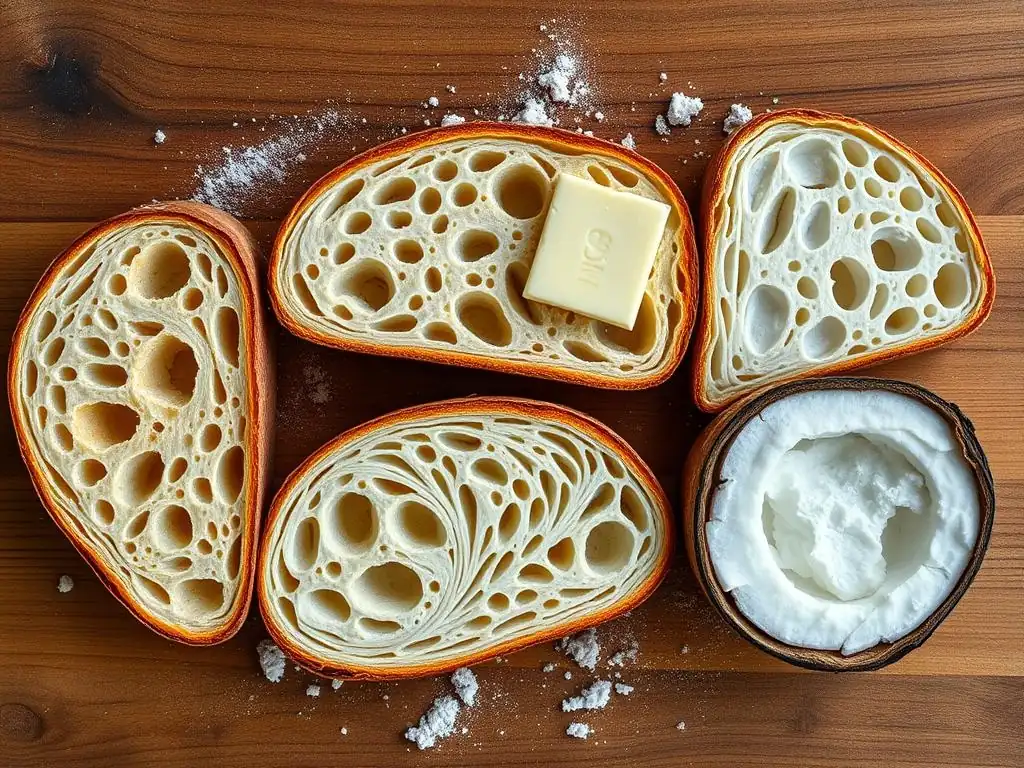
Choosing the right fat involves understanding the trade-offs each option presents in terms of flavor, texture, handling, and cost.
Butter vs. Olive Oil: Which Fat is Best for Your Artisan Bread?
| Feature | Butter | Olive Oil |
|---|---|---|
| Flavor | Rich, dairy, often preferred in sweet/enriched doughs | Fruity, sometimes peppery, characteristic of Mediterranean breads |
| Crumb Texture | Finer, softer, more regular artisan bread crumb texture | More open, irregular artisan bread crumb texture |
| Crust | Softer, more tender crust | Crispier, sometimes thinner crust |
| Dough Handling | Can make dough slightly stiffer when cold; melts during baking | Makes dough more extensible and sometimes stickier |
| Melting Point | Lower (~30-35°C) | Liquid at room temperature |
| Water Content | ~16-18% | 0% |
Choosing between butter and olive oil largely depends on the desired style of bread. For a soft, rich loaf like challah, butter is ideal. For a rustic, open-crumb bread with a crispy crust like focaccia, olive oil is typically preferred.
Lard vs. Vegetable Shortening: Understanding the Trade-offs
| Feature | Lard | Vegetable Shortening |
|---|---|---|
| Flavor | Mildly savory, traditional | Neutral |
| Crumb Texture | Very tender, can be slightly flaky artisan bread crumb texture | Very tender, fine, sometimes crumbly artisan bread crumb texture |
| Crust | Tender, can be slightly flaky | Soft, very tender |
| Dough Handling | Similar to butter but no water content | Consistent, easy to work with |
| Melting Point | Higher than butter (~35-45°C) | Often higher and more consistent than lard |
| Water Content | 0% | 0% |
Lard offers a traditional flavor and slightly different textural nuances compared to shortening. Shortening provides consistency and a neutral profile, making it versatile when the flavor contribution of the fat is not desired. Both are excellent for achieving significant tenderness in the artisan bread crumb texture and crust, often more so than butter due to their higher fat content and lack of water.
Practical Tips for Using Fat to Improve Your Artisan Bread
Incorporating fat correctly is as important as choosing the right type. The technique used can significantly impact the final artisan bread crumb texture and crust.
Fat Incorporation Techniques for Optimal Results
The method of adding fat to your dough depends on the type of fat and the desired outcome. For solid fats like butter or lard, techniques include creaming, cutting in, or adding softened fat gradually. Creaming fat with sugar (though sugar is less common in artisan bread) incorporates air and tenderizes.
Cutting cold fat into flour, as in pie crusts or some biscuit methods adapted for enriched doughs, creates layers that result in flakiness. Adding softened fat gradually to the dough during kneading allows it to be fully incorporated, resulting in a smooth, extensible dough and a fine artisan bread crumb texture.
For liquid fats like olive oil, the process is simpler; it is typically added along with the other wet ingredients at the beginning of mixing, or sometimes drizzled over the dough during folding (as in some focaccia recipes) to enhance flavor and crust development. Ensuring the fat is fully dispersed is key to achieving uniform texture throughout the loaf.
Adjusting Fat Content to Control Crumb and Crust
The percentage of fat relative to flour weight (baker's percentage) is a primary lever for controlling artisan bread crumb texture and crust characteristics. Lean doughs (< 5% fat) yield chewy crusts and open crumbs. Moderately enriched doughs (5-15% fat) produce softer crumbs and slightly more tender crusts. Highly enriched doughs (> 15% fat) result in very soft, cake-like crumbs and tender crusts.
- To achieve a more open artisan bread crumb texture and a crispier crust, reduce the fat content or switch to a liquid fat like olive oil.
- To achieve a finer, softer artisan bread crumb texture and a more tender crust, increase the fat content, using a solid fat like butter or lard.
- Experimenting within these ranges allows bakers to fine-tune the results to their preference. Starting with a recipe and adjusting the fat by 1-2% can yield noticeable changes over several bakes.
Troubleshooting Common Issues Related to Fat in Artisan Bread Dough
Sometimes, working with fat in dough can present challenges. If your dough feels greasy and won't develop gluten properly, it might be due to adding too much fat relative to the flour, or not incorporating it properly. Ensure fat is added gradually or is at the correct temperature (softened, not melted, for solid fats) to allow gluten to start forming first.
If your enriched dough doesn't rise well, consider the fat content. High fat levels can slow yeast activity. Ensure your yeast is active and give the dough sufficient time to proof, possibly in a warmer environment. Also, check that the fat hasn't separated during mixing, which can inhibit even gas distribution and affect the final artisan bread crumb texture. Over-handling enriched dough can also lead to a tough crumb despite the fat, so aim for sufficient but not excessive kneading.
Recipes Demonstrating Fat's Influence on Artisan Bread
Understanding the theory is one thing; seeing it in action is another. Here are descriptions of two types of recipes that highlight the impact of different fats on artisan bread crumb texture and crust.
Recipe 1: Enriched Artisan Bread with Butter for a Tender Crumb
Imagine a recipe for a classic enriched loaf, perhaps similar to a soft sandwich bread or a light challah, using about 10-15% butter by flour weight. The butter, added softened after some initial gluten development, is kneaded in until the dough is smooth and elastic. This method allows the butter to fully integrate, coating the gluten strands and inhibiting their strong network formation.
The resulting dough proofs into a pillowy mass. When baked, the butter contributes to significant oven spring and promotes even browning. The final loaf boasts a very tender, fine, and uniform artisan bread crumb texture – the cells are small and evenly distributed. The crust is relatively thin and soft, without the robust chewiness of a lean loaf, showcasing butter's ability to create richness and tenderness throughout the bread.
Recipe 2: Olive Oil Artisan Bread with a Crispy Crust
Consider a recipe for a rustic loaf like focaccia or a high-hydration ciabatta, incorporating 5-10% olive oil. The olive oil is typically mixed in with the water and flour from the start. As a liquid, it lubricates the dough, making it very extensible and often quite wet. This allows for minimal kneading and emphasizes folding techniques to build strength gently.
During baking, the olive oil encourages a more open structure. The final bread has a characteristic open, irregular artisan bread crumb texture with large, varying-sized holes. The crust, particularly if baked on a hot surface like a baking stone and perhaps drizzled with extra oil before baking, is wonderfully crisp and golden-brown, a direct result of the olive oil's influence on moisture retention and heat transfer at the surface. This contrasts sharply with the soft crust produced by butter.
Mastering Artisan Bread Crumb Texture Through Fat Selection: Key Takeaways
Controlling the artisan bread crumb texture and crust is a hallmark of skilled baking, and understanding the role of fat is fundamental to this mastery.
Summary of Fat's Effects on Crumb and Crust
Fat in artisan bread dough:
- Interferes with gluten development, leading to a more tender crumb.
- Stabilizes air cells, influencing the uniformity and size of the crumb structure (the artisan bread crumb texture).
- Retains moisture, contributing to a softer crumb and a less thick, more tender crust.
- Promotes browning and crispness in the crust through heat distribution and interaction in browning reactions.
Different fats offer distinct advantages: butter for rich flavor and soft crumb/crust; olive oil for a more open crumb and crispy crust; lard and shortening for maximum tenderness and neutral flavor profiles (especially shortening).
Choosing the Right Fat for Your Baking Goals
Ultimately, the "best" fat for your artisan bread depends entirely on the type of bread you want to bake and the specific artisan bread crumb texture and crust characteristics you aim to achieve.
- For soft, enriched loaves, lean towards butter or lard/shortening.
- For rustic, open-crumb breads with a crispy exterior, olive oil is often the superior choice.
- Experimentation is key! Try baking the same recipe with different fats (adjusting quantities slightly if needed, e.g., using slightly less butter than shortening due to butter's water content) to experience firsthand how each one transforms the artisan bread crumb texture and crust. By thoughtfully selecting and incorporating fat, you gain significant control over the final outcome of your artisan bread.
- Understanding the Role of Fat in Artisan Bread Baking
- The Impact of Fat on Artisan Bread Crumb Texture: A Detailed Look
- Fat's Role in Achieving the Perfect Artisan Bread Crust
- Exploring Different Types of Fats for Artisan Bread
- Comparing Fat Options: Pros and Cons for Artisan Bread Baking
- Practical Tips for Using Fat to Improve Your Artisan Bread
- Recipes Demonstrating Fat's Influence on Artisan Bread
- Mastering Artisan Bread Crumb Texture Through Fat Selection: Key Takeaways
- How does the type of fat impact the crumb texture of artisan bread?
- What role does fat play in the crust formation of artisan bread?
- Can I substitute different types of fat in artisan bread recipes?
- How does the amount of fat used affect the bread's crumb?
- What's the best way to incorporate fat into my artisan bread dough for optimal crumb structure?
Frequently Asked Questions
How does the type of fat impact the crumb texture of artisan bread?
The type of fat significantly impacts the crumb. Saturated fats often lead to a denser, tighter crumb, while unsaturated fats can create a more open and airy texture.
What role does fat play in the crust formation of artisan bread?
Fat affects the crust by influencing browning and crispness. Higher fat content often results in a richer, browner crust and can contribute to a more tender crumb.
Can I substitute different types of fat in artisan bread recipes?
Yes, but with caution. Substituting fats will alter the final texture and flavor. Consider the fat's melting point and composition when making substitutions to achieve desired results.
How does the amount of fat used affect the bread's crumb?
The amount of fat impacts the crumb's tenderness and moisture. More fat generally creates a softer, more tender crumb, while less fat can lead to a drier, chewier texture.
What's the best way to incorporate fat into my artisan bread dough for optimal crumb structure?
Proper incorporation is key. Adding fat after the gluten has developed is generally recommended to prevent it from inhibiting gluten formation, leading to a better crumb structure and rise.
Final Reflection: The Crumb's Tale: A Baker's Journey into Fat's Influence
The quest for the perfect artisan bread crumb, a texture so coveted by bakers and bread lovers alike, is far more than a culinary pursuit; it's a journey into the intricate science of fat. Understanding the profound impact of fat quality on both crumb and crust structure is not merely a niche interest, but a key to unlocking consistently superior bread-making. This knowledge empowers bakers to elevate their craft and create truly exceptional loaves.
The exploration of fat's role in bread-making has profoundly shifted my own baking practice, highlighting the often-overlooked subtleties that contribute to a loaf's final character. The seemingly minor variations in fat type—from the richness of butter to the subtle nuances of olive oil—can dramatically alter the final product. This journey has reinforced the importance of mindful ingredient selection and the interconnectedness of seemingly disparate elements in the baking process. The proof of the pudding is in the eating,
and the proof of a great loaf is in its crumb.
Now, it's your turn. Consider the fats you use in your own baking. Experiment, explore, and discover the unique textures and flavors that different fats can bring to your artisan bread. Don't be afraid to deviate from tradition; embrace the journey of experimentation and unlock the potential of your own baking prowess. The perfect crumb awaits your discovery.
Unleash Your Inner Bread Artisan: Master the Crumb!
Thanks for taking the time to explore the fascinating world of fat and its impact on bread baking! You've now got the knowledge to elevate your loaves to the next level. Ready to put your new skills into practice?
- Bake a test loaf: Experiment with different fats (butter, lard, olive oil) and observe the changes in crumb structure and crust texture. Document your findings! This is your chance to truly become a master of your craft.
- Share your baking journey: Post a picture of your creations on social media and tag #BakeWithEaseCrumbMaster – let’s inspire each other!
- Explore our other articles on advanced bread techniques for even more expert tips.
What unique fat will you experiment with next to perfect your artisan bread crumb?