
The Role of Salt in Sourdough: More Than Just Flavor


Welcome to BakeWithEase, where we demystify the delicious world of baking! Ever wondered if that pinch of salt in your sourdough is just for taste? Prepare to be surprised! This week, we dive deep into the often-overlooked, yet crucial, sourdough bread salt benefits. Discover how this humble ingredient impacts everything from gluten development to fermentation, unlocking the secrets to a truly exceptional loaf. Ready to elevate your sourdough game? Let's get started!
- Introduction: Understanding Salt's Crucial Role in Sourdough
- Salt's Impact on Sourdough Fermentation
- Salt and Gluten: Strengthening the Sourdough Structure
- Flavor Enhancement: The Obvious Benefit of Salt in Sourdough
- Determining the Ideal Salt Percentage for Sourdough
- Troubleshooting Sourdough Issues Related to Salt
- Best Practices for Using Salt in Sourdough
- Conclusion: Mastering the Art of Salt in Sourdough
-
Frequently Asked Questions
- What are the primary sourdough bread salt benefits besides just taste?
- How does salt impact the fermentation process in sourdough bread?
- Can I reduce the amount of salt in my sourdough recipe for health reasons?
- What type of salt is best for baking sourdough bread?
- How does salt contribute to the crust of sourdough bread?
- Final Reflection: The Unsung Hero of Sourdough – Salt's Profound Influence
- Unlock Your Sourdough's Potential: Master the Art of Salt!
Introduction: Understanding Salt's Crucial Role in Sourdough
Why Salt Matters in Sourdough Baking
Salt, a seemingly simple ingredient, holds profound importance in the complex world of sourdough baking. Its function extends far beyond merely adding taste; it is a critical component that influences fermentation, dough structure, and the final characteristics of your loaf. Without the right amount of salt, the unique sourdough bread salt benefits related to texture and crust development simply wouldn't be realized, leading to a subpar baking experience and result.
Incorporating salt correctly is fundamental for achieving a balanced, flavorful, and well-structured sourdough loaf. It is one of the few ingredients added to flour and water in most basic sourdough recipes, highlighting its essential status alongside the starter itself. Understanding its multifaceted contributions is a significant step in mastering sourdough, moving from simply following a recipe to truly understanding the process.
Beyond Flavor: Exploring the Multifaceted Role of Salt
While its primary role in our perception is flavor enhancement, salt acts as a powerful control agent and structural fortifier in sourdough. It significantly impacts the activity of the wild yeasts and lactic acid bacteria within your dough, preventing the fermentation process from becoming too rapid and uncontrollable. This regulatory effect is vital for allowing the complex flavors characteristic of sourdough to develop fully over time.
Furthermore, salt plays a crucial role in strengthening the gluten network. By interacting with the gluten proteins (glutenin and gliadin), salt helps create a more cohesive, elastic, and extensible dough. This improved structure is essential for trapping the gases produced during fermentation, leading to better oven spring and a more open crumb structure. The sourdough bread salt benefits in terms of structure alone make it indispensable.
Salt's Impact on Sourdough Fermentation
How Salt Controls Sourdough Starter Activity
Salt directly impacts the microbial activity within sourdough dough by moderating the speed at which wild yeasts and lactic acid bacteria consume sugars and produce acids and gases. Although salt is typically not added to the sourdough starter itself (as it would inhibit its growth), its presence in the dough environment creates an osmotic effect. This effect draws water out of the microbial cells, slowing down their metabolic processes and preventing fermentation from proceeding too quickly.
This slowing effect is crucial for developing the characteristic sourdough tang and complexity. A fermentation process that is too fast can lead to a dough that rises rapidly but lacks structural integrity and depth of flavor. By keeping the microbial activity in check, salt ensures a more gradual, controlled fermentation, allowing for a longer fermentation period during which beneficial enzymatic reactions occur and flavors deepen.
Salt as a Fermentation Regulator: Slowing Down the Process
The regulatory action of salt on fermentation is one of its most vital functions, contributing significantly to the desired sourdough bread salt benefits. It doesn't stop fermentation entirely but rather acts as a gentle brake. This controlled pace allows the dough to develop strength and flavor simultaneously. Without salt, the dough would ferment wildly, potentially doubling in size very quickly but then collapsing due to a weak gluten structure unable to support the rapid gas production.
Consider a dough fermented at room temperature without salt; it might be ready for shaping in just 2-3 hours. The same dough with the standard 2% salt might require 4-6 hours or even longer, depending on ambient temperature and starter strength. This extended time is not a delay but an opportunity for the dough to mature properly, resulting in a more robust structure and a richer flavor profile in the final baked loaf.
The Science Behind Salt and Gluten Development in Sourdough
Salt's influence on gluten development is a key aspect of its structural sourdough bread salt benefits. When salt is added to hydrated flour, it interacts with the gluten proteins (glutenin and gliadin). While the exact mechanisms are complex, it's understood that salt helps to stabilize and strengthen the bonds within the gluten network as it forms during mixing and kneading (or stretching and folding).
This interaction results in a dough that is less sticky, more manageable, and possesses greater elasticity and extensibility. The salt essentially tightens the gluten structure, creating a more robust framework capable of trapping the carbon dioxide gas produced by the yeast. This leads to a dough that holds its shape better, is easier to handle during shaping, and achieves better volume and crumb structure during baking.
Salt and Gluten: Strengthening the Sourdough Structure

The Relationship Between Salt, Gluten Strength, and Bread Volume
A strong, well-developed gluten network is paramount for achieving good volume and an desirable open crumb in sourdough bread. Salt directly contributes to this strength. As salt dissolves in the dough's water, it interacts with the gluten proteins, promoting the formation of stronger cross-links. This results in a dough with increased tenacity and elasticity.
This improved gluten structure is better able to withstand the pressure of the expanding gases during fermentation and the rapid expansion in the oven known as oven spring. A dough made with adequate salt will hold its shape, trap gas effectively, and rise significantly, leading to a lighter loaf with a more open crumb. Conversely, a dough lacking salt will often spread outwards rather than rise upwards, resulting in a dense, flat loaf.
Achieving Optimal Dough Strength with the Right Amount of Salt
Finding the correct salt percentage is crucial for balancing fermentation control and gluten development. The commonly accepted range for salt in sourdough bread is typically between 1.8% and 2.2% of the total flour weight. Within this range, salt effectively strengthens the gluten without overly inhibiting yeast activity.
Using significantly less than 1.8% salt can lead to a weak, slack dough that is difficult to handle and results in poor loaf volume. The uncontrolled fermentation can also degrade the gluten structure faster than it can develop. Conversely, exceeding 2.5% salt can overly suppress yeast activity, leading to very slow or stalled fermentation and a dense loaf, in addition to an unpleasantly salty taste.
Salt's Effect on Dough Elasticity and Extensibility
Elasticity refers to the dough's ability to spring back after being stretched, while extensibility is its capacity to be stretched without tearing. Salt improves both of these properties, contributing to the overall sourdough bread salt benefits for dough handling and shaping. Dough with sufficient salt is less sticky and feels more cohesive and manageable.
During the mixing and folding process, the presence of salt helps the gluten strands align and bond more effectively. This creates a dough that has enough 'snap' (elasticity) to hold its shape but also enough 'give' (extensibility) to be stretched and folded without breaking. This balance is essential for developing the dough's structure gradually and preparing it for successful shaping and baking.
Flavor Enhancement: The Obvious Benefit of Salt in Sourdough
Salt's Role in Balancing Acidity in Sourdough
One of the defining characteristics of sourdough is its pleasant tang, a result of the lactic and acetic acids produced during fermentation. While this acidity is desirable, too much can make the bread taste overly sour or unbalanced. Salt plays a critical role in balancing these acidic notes.
By enhancing other flavors present in the bread, such as the subtle sweetness developed from the breakdown of starches, salt harmonizes with the acidity. It doesn't neutralize the acids but rather makes the overall flavor profile more rounded and palatable, preventing the sourness from being overwhelming. This balancing act is a key part of the flavor-related sourdough bread salt benefits.
Unlocking Complex Flavors: Salt as a Flavor Enhancer
Beyond simply tasting "salty," salt acts as a general flavor enhancer in bread, much like it does in other cooking. It makes the inherent flavors of the flour and the complex fermentation byproducts more perceptible to our taste buds. The nutty, sweet, malty, and tangy notes in sourdough are all amplified by the presence of salt.
Salt influences enzymatic activity in the dough, indirectly affecting flavor development. Enzymes break down complex carbohydrates into simpler sugars, which are then consumed by yeast and bacteria, producing a range of flavor compounds. While salt directly slows microbial activity, its structural role and influence on water availability within the dough can subtly impact these enzymatic processes, contributing to the depth of flavor.
How Different Types of Salt Affect Sourdough Flavor
While the chemical composition of pure salt (NaCl) is the same, different types of salt vary in crystal size, shape, mineral content, and how quickly they dissolve. These differences can subtly impact the final flavor and texture of sourdough. Fine table salt dissolves quickly and provides uniform salinity, but some contain anti-caking agents which can be undesirable.
Sea salt and kosher salt are popular among bakers. Sea salt often contains trace minerals that can impart subtle flavor nuances, while kosher salt's larger flakes are easy to measure by volume (though weight is always recommended for accuracy) and dissolve more slowly, which some bakers prefer. Ultimately, the most important factor is consistency – using the same type and accurately measuring by weight ensures repeatable sourdough bread salt benefits in terms of flavor.
Determining the Ideal Salt Percentage for Sourdough
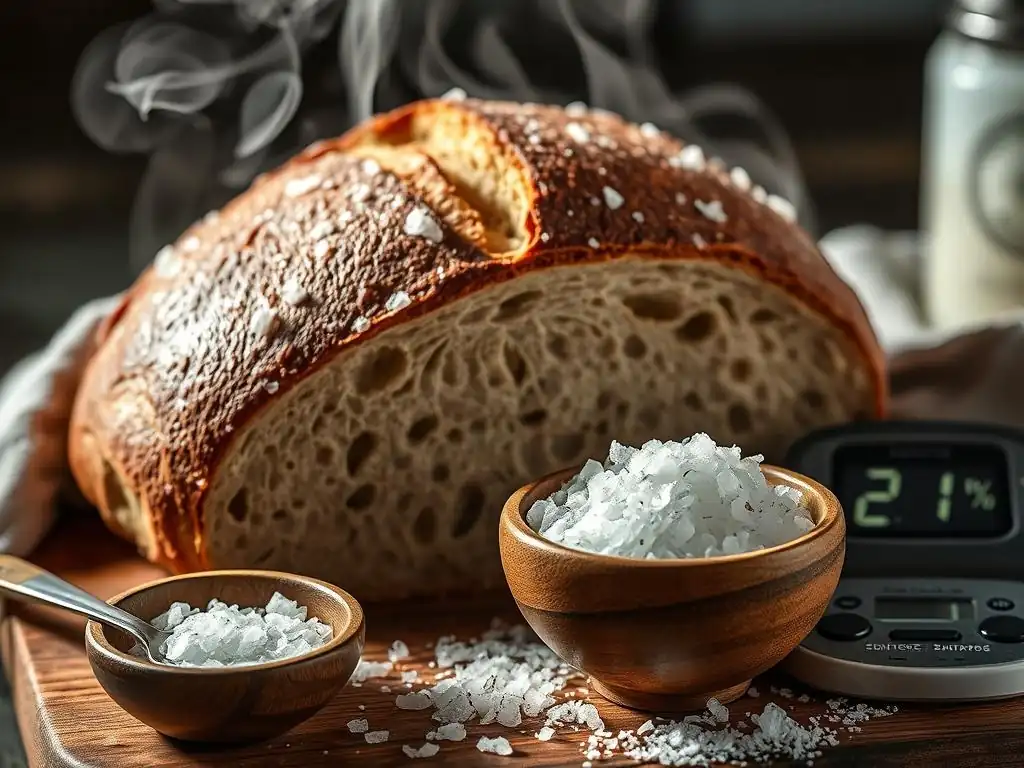
Calculating Salt Ratios in Sourdough Recipes
In baking, ingredients are typically measured using "baker's percentages," where each ingredient is expressed as a percentage of the total flour weight. Calculating the salt ratio is straightforward:
(Weight of Salt / Total Weight of Flour) * 100% = Salt Percentage
For example, if a recipe uses 500 grams of flour and calls for 10 grams of salt, the salt percentage is (10g / 500g) * 100% = 2%. This method provides a consistent way to scale recipes and understand the ingredient proportions, crucial for achieving reliable sourdough bread salt benefits.
Factors Influencing Salt Requirements in Sourdough
While 1.8% to 2.2% is a common range, several factors might influence the optimal salt percentage for a specific sourdough loaf. Higher hydration doughs (e.g., above 75%) might benefit from a slightly higher salt percentage (e.g., 2.2%) to maintain perceived salinity and help manage the stickier dough.
The type of flour used also matters; whole wheat or rye flours absorb more water and have different protein structures than white bread flour, potentially requiring slight adjustments. Personal preference for saltiness is also a factor. Experimenting within the typical range, perhaps starting at 2% and adjusting slightly in future bakes, is the best way to find your preferred balance of flavor and structure.
What Happens When You Use Too Little Salt in Sourdough?
Using too little salt is a common issue that significantly impacts the final bread. The most immediate effect is uncontrolled fermentation; the dough will rise very quickly, often becoming overly airy and weak. This rapid fermentation can exhaust the yeast too soon and lead to a dough that collapses easily.
Structurally, the dough will be slack, sticky, and difficult to shape because the gluten network hasn't been adequately strengthened. The resulting baked loaf will likely be flat with poor volume, a dense or irregular crumb structure, and a pale crust. Flavor-wise, it will taste bland, lacking the balance and depth that salt provides, missing out on crucial sourdough bread salt benefits.
Over-Salting Sourdough: Identifying and Correcting the Problem
Conversely, too much salt can severely inhibit yeast and bacterial activity, slowing or even stalling fermentation entirely. The dough will feel dense and tight, showing little to no rise even after an extended period. This makes the dough hard to work with and shape.
When baked, an over-salted loaf will be dense, heavy, and have very little oven spring. The crust might be excessively dark (salt affects crust browning), and the taste will be overwhelmingly salty and potentially bitter. Unfortunately, there's no easy way to correct over-salting once the dough is mixed; prevention through accurate measurement is key. If you realize you've added too much salt, the best approach is often to discard the dough or try adding more flour and water to rebalance the ratios, though this can be tricky.
Best Practices for Using Salt in Sourdough

Adding Salt at the Right Time: When to Incorporate it into Your Dough
A common practice in sourdough baking is to add salt after the initial mixing phase, often referred to as the "autolyse." Autolyse involves mixing just the flour and water and letting it rest for 20-60 minutes (or longer). This allows the flour to hydrate fully and enzymatic activity to begin breaking down starches, while also allowing gluten development to start without the inhibitory effect of salt.
Once the autolyse is complete and the starter is mixed in, the salt is added, often dissolved in a small amount of water from the recipe's total hydration. Adding salt after autolyse ensures that its primary function in strengthening gluten and controlling fermentation begins at the optimal time, contributing effectively to the overall sourdough bread salt benefits. While some bakers add all ingredients at once, the delayed salt method is widely adopted for its proven benefits in dough handling and structure.
Even Distribution: Ensuring Uniform Salt Content
Proper distribution of salt throughout the dough is essential for consistent results. If salt is not evenly mixed, pockets of high salt concentration can kill yeast locally, leading to uneven fermentation and irregular crumb structure. Undissolved salt crystals can also lead to unpleasant bursts of saltiness when eating the bread.
Dissolving the salt in a small portion of the recipe's water before adding it to the dough is an excellent way to ensure even distribution. If adding dry salt, make sure it is thoroughly incorporated during the initial mixing phase, ensuring no clumps remain. Stretching and folding the dough during bulk fermentation also helps to distribute the salt uniformly throughout the network.
Measuring Salt Accurately for Consistent Results
Accuracy in measuring salt is paramount for repeatable sourdough bread salt benefits. Because different types of salt have varying crystal sizes and densities, measuring by volume (like teaspoons or tablespoons) is highly inaccurate. One tablespoon of fine table salt weighs significantly more than one tablespoon of flakey kosher salt.
Using a digital kitchen scale to weigh your salt is the most reliable method. Always measure salt based on the baker's percentage relative to your flour weight. This ensures that regardless of the type of salt you use or how densely it packs, you are adding the precise amount needed for optimal gluten development, fermentation control, and flavor in your sourdough.
Conclusion: Mastering the Art of Salt in Sourdough
The Importance of Experimentation and Observation
Mastering the use of salt in sourdough is an ongoing journey that benefits greatly from experimentation and careful observation. While general guidelines exist (like the 1.8%-2.2% range), factors such as your specific starter's activity, the type of flour you use, ambient temperature, and even your personal taste preference mean that the "ideal" salt percentage might vary slightly.
Keep a baking journal to note the salt percentage used in each bake and observe its effects on dough handling, fermentation time, loaf volume, crumb structure, and flavor. Did a slightly higher percentage make the dough easier to handle? Did a lower percentage result in a tangier loaf? By systematically varying the salt just slightly, you can fine-tune your recipe to achieve the sourdough bread salt benefits that matter most to you.
Salt's Benefits in Sourdough: A Summary of Key Takeaways
Salt is a powerhouse ingredient in sourdough, offering a range of essential benefits. It's not just a flavor enhancer; it's a critical tool for controlling fermentation speed, thereby promoting the development of complex flavors and desirable acidity. Simultaneously, salt strengthens the gluten network, providing the necessary structure for good dough handling, excellent oven spring, and an appealing open crumb.
From improving dough elasticity and extensibility to balancing the inherent tang of sourdough, the sourdough bread salt benefits are undeniable and multifaceted. Accurate measurement, even distribution, and understanding its interaction with gluten and microbes are key to harnessing its full potential. By paying close attention to this humble ingredient, you can significantly elevate the quality and consistency of your homemade sourdough bread.
Frequently Asked Questions
What are the primary sourdough bread salt benefits besides just taste?
Salt plays a crucial role in controlling fermentation and strengthening the gluten structure. This leads to a better rise and overall texture.
How does salt impact the fermentation process in sourdough bread?
Salt slows down the activity of the yeast and bacteria, preventing over-fermentation. This allows for a more controlled and flavorful rise.
Can I reduce the amount of salt in my sourdough recipe for health reasons?
While possible, drastically reducing salt can affect the dough's structure and flavor. Experiment gradually to find a balance that works for you.
What type of salt is best for baking sourdough bread?
Kosher salt is often preferred because of its consistent grain size and lack of additives. However, sea salt can also add a subtle flavor complexity.
How does salt contribute to the crust of sourdough bread?
Salt helps to draw moisture to the surface of the dough during baking, promoting a crisper and more flavorful crust. It also aids in browning.
Final Reflection: The Unsung Hero of Sourdough – Salt's Profound Influence
The role of salt in sourdough bread extends far beyond mere seasoning; it's a fundamental element shaping the very essence of this ancient craft. Its impact on flavor, texture, and the overall microbial ecosystem of the sourdough starter is profound, a fact often overlooked by even experienced bakers. Understanding this multifaceted contribution is key to unlocking the true potential of your sourdough loaves.
The journey of exploring salt's influence in sourdough has been a fascinating one, revealing the intricate dance between chemistry and biology that occurs within the dough. It's a reminder that even the simplest ingredients hold complex secrets, waiting to be uncovered. The most beautiful things are the most simple.
– This quote, while not directly about baking, perfectly captures the elegance and power of understanding the fundamental elements of sourdough baking. The subtle nuances brought about by salt – from the crisp crust to the improved flavor development – are a testament to this simplicity. This exploration has deepened my own appreciation for the careful balance required in sourdough baking, highlighting the importance of respecting tradition while embracing experimentation.
Now, it's your turn. Consider the seemingly insignificant details in your own baking endeavors. Experiment with varying salt quantities in your next sourdough batch, observing the subtle shifts in texture and taste. Don't just follow recipes blindly; understand the why behind each ingredient. By embracing this mindful approach, you'll not only improve your baking skills but also cultivate a deeper connection to the rich history and artistry of sourdough bread making. The journey of discovery is ongoing, and your next loaf awaits.
Unlock Your Sourdough's Potential: Master the Art of Salt!
Thanks for diving deep into the fascinating world of sourdough salt! You've now unlocked a key ingredient to truly elevate your baking. Ready to put this newfound knowledge into action?
- Perfect your next loaf: Experiment with different salt types and quantities, paying close attention to how it affects your dough's development and final taste. Note your findings and share your experiences!
- Join our baking community forum and share your sourdough salt journey! Let's discuss salt's impact on gluten development, texture, and crust.
- Try a "blind taste test" with friends – can they detect the subtle differences between your various salt experiments?
What unique salt will you experiment with in your next sourdough adventure?