
Tips for Baking Several Trays of Croissants

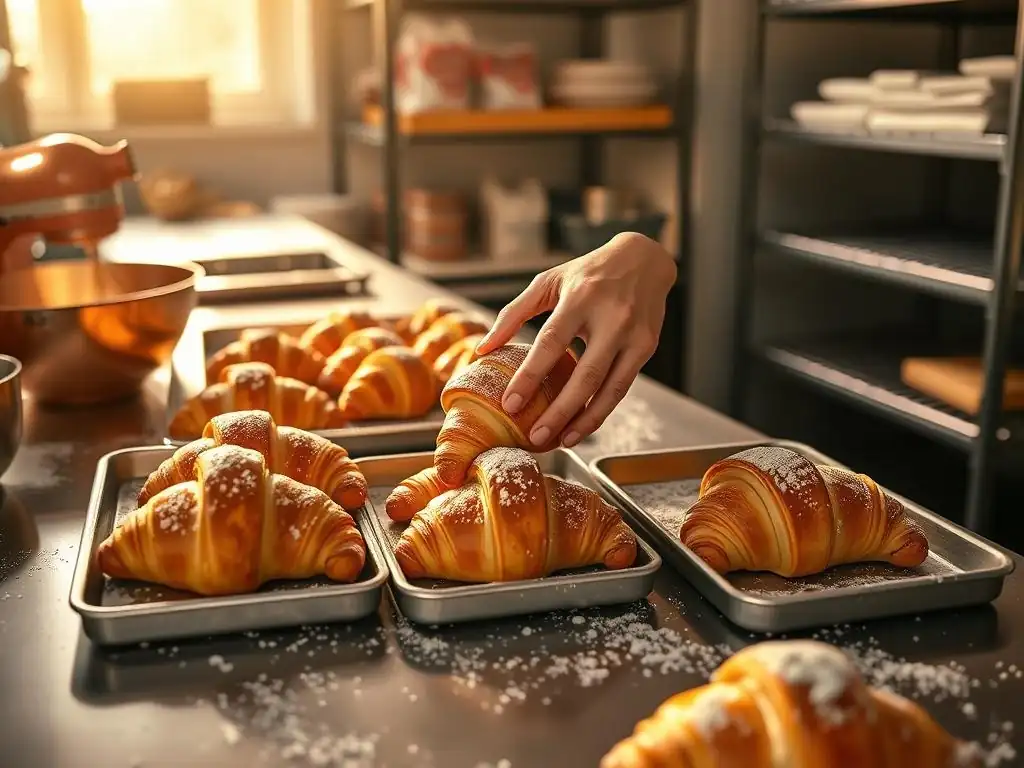
Welcome to BakeWithEase, your trusted guide to creating delicious baked goods! Ever wondered how to achieve perfectly golden, flaky croissants when baking multiple trays at once? Unlocking the secrets to consistent results is easier than you think. Dive into our expert tips for baking multiple croissant trays and elevate your baking game today. Are you ready to achieve bakery-quality croissants from your very own oven? Let's get started!
- Baking Multiple Croissant Trays: Achieving Consistent Results
- Understanding the Challenges of Baking Multiple Croissant Batches
-
Essential Tips for Evenly Baked Croissants Across Multiple Trays
- Tip 1: Optimize Oven Temperature for Baking Multiple Croissant Trays
- Tip 2: The Importance of Oven Rack Placement for Consistent Croissant Baking
- Tip 3: Rotating Croissant Trays for Uniform Baking
- Tip 4: Mastering Proofing Time for Multiple Croissant Batches
- Tip 5: Using a Baking Stone or Baking Steel for Even Heat Distribution
- Advanced Techniques for Baking Large Quantities of Croissants
- Troubleshooting Common Croissant Baking Issues When Baking Multiple Trays
- Croissant Baking at Home: Ensuring Quality and Consistency
- Storing and Reheating Croissants Baked in Large Batches
-
Frequently Asked Questions
- How does baking multiple croissant trays at once affect baking time?
- What oven settings should I adjust when baking several trays of croissants simultaneously?
- How can I ensure even browning when baking multiple trays of croissants?
- What's the best way to store baked croissants if I make a large batch?
- Can I proof multiple trays of croissants at the same time?
- Final Reflection: Mastering the Art of the Multi-Tray Croissant Bake
- Unleash Your Inner Croissant Master!
Baking Multiple Croissant Trays: Achieving Consistent Results
When you're ready to scale up your croissant baking from just one or two trays to a full oven load, you enter a new realm of challenges and rewards. Baking multiple croissant trays simultaneously is incredibly satisfying when it works, yielding a bounty of flaky, buttery pastries. However, it requires careful attention to detail to ensure each croissant, regardless of its position in the oven, bakes up perfectly golden, airy, and consistent in texture.
Mastering the art of baking multiple batches of croissants at home is entirely achievable with the right knowledge and techniques. This guide will walk you through the common pitfalls and provide practical tips to help you achieve professional-level results even when your oven is packed. We'll focus on strategies to combat uneven heat, manage proofing for a larger quantity, and ensure every single croissant meets your high standards.
Understanding the Challenges of Baking Multiple Croissant Batches
When you transition from baking a single tray to baking multiple croissant trays, you introduce variables that can significantly impact the outcome. A home oven, designed primarily for roasting or baking a cake on a single rack, often struggles to distribute heat evenly when filled to capacity. This is the primary challenge when baking multiple batches of pastries like croissants, which rely on precise temperature and consistent heat transfer for their signature layers and rise.
The sheer volume of cold dough entering the oven simultaneously absorbs a significant amount of heat, causing the oven temperature to drop more drastically than with a single tray. Furthermore, the trays themselves obstruct airflow, creating dead spots and areas where radiant heat is blocked. Understanding these inherent limitations of home ovens is the first step towards successfully baking multiple croissant trays with uniform results.
Why Baking Croissants in Batches Can Be Tricky
Baking croissants is a delicate process where precise temperature control and even heat distribution are paramount for achieving that desired airy, flaky interior and golden-brown exterior. When you attempt baking multiple croissant trays at once, you're essentially asking your oven to perform under stress. The oven cavity becomes crowded, disrupting the natural convection currents that help distribute heat. This often leads to hot spots and cold spots within the oven, meaning croissants on one side or one rack might brown faster than those on another.
Additionally, the large mass of dough going into the oven lowers the internal temperature more dramatically than a single tray would. While the oven thermostat will try to compensate, the recovery time can be slow, potentially affecting the initial crucial "oven spring" where the croissants rapidly expand. For instance, if your oven typically drops 25°F when you open the door for a single tray, it might drop 40-50°F or more when loading multiple trays, and take longer to return to the target temperature. This fluctuation can compromise the texture and rise of your croissants.
Common Problems When Baking Multiple Trays of Croissants Simultaneously
One of the most frustrating issues when baking multiple croissant trays is uneven browning. You might find croissants on the top rack getting too dark while those on the bottom remain pale, or pastries at the back of the oven browning faster than those at the front. This inconsistency is a direct result of the uneven heat distribution we discussed. For example, in many ovens, the heating element is at the bottom, leading to hotter temperatures near the bottom rack unless convection is used effectively.
Another frequent problem is inconsistent rise and texture. Croissants in colder spots may not achieve full oven spring, resulting in dense layers, while those in hotter spots might bake too quickly, leading to a less tender interior or even burnt tips before the center is cooked through. You might also encounter issues like soggy bottoms if trays are placed too low without adequate heat from beneath, or if the oven is overcrowded, trapping steam. These are common hurdles when baking large quantities of croissants at home.
Essential Tips for Evenly Baked Croissants Across Multiple Trays
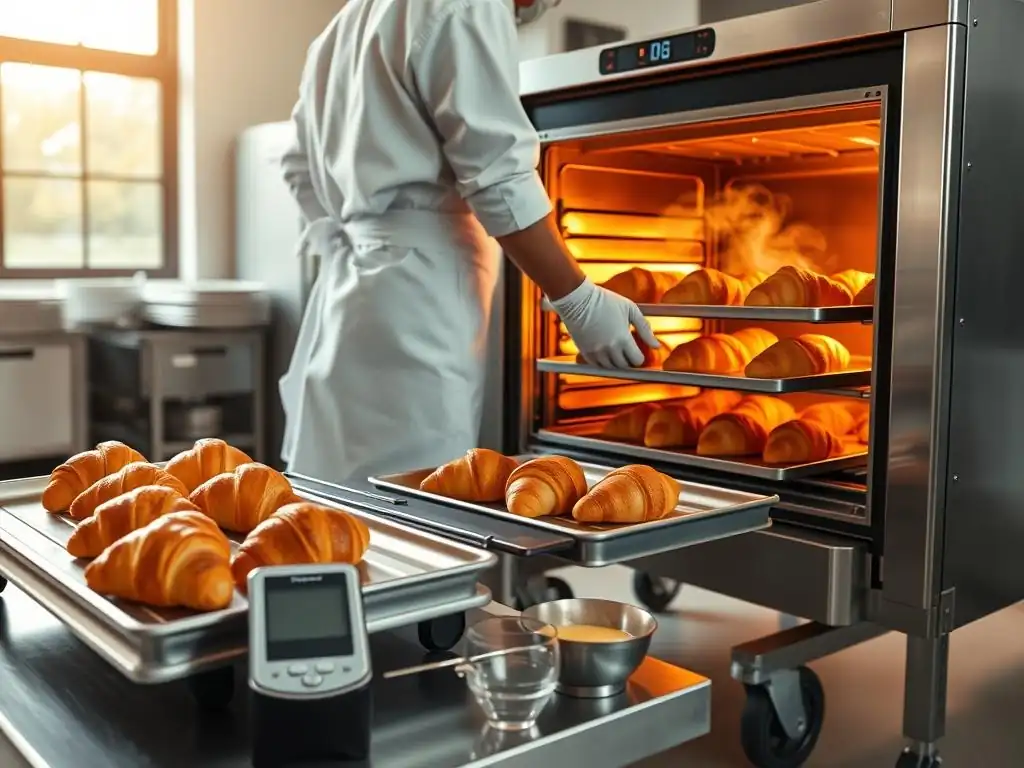
Achieving consistency when baking multiple croissant trays requires a strategic approach that compensates for the limitations of your oven. By implementing a few key techniques, you can significantly improve the uniformity of your bake, ensuring every croissant is a masterpiece. These tips focus on optimizing your oven environment and managing the baking process actively.
Think of your oven as a system that needs careful management when under load. Simple adjustments to temperature, placement, and timing can make a world of difference in the final outcome. The goal is to create an environment where heat reaches all your croissants as evenly as possible throughout the entire baking cycle, crucial for successful baking multiple croissant trays.
Tip 1: Optimize Oven Temperature for Baking Multiple Croissant Trays
Proper oven temperature is critical, but when baking multiple croissant trays, you might need to make slight adjustments. While a single tray might bake perfectly at 400°F (200°C), the increased load of multiple trays can benefit from a slightly lower temperature or a longer preheating time. Preheat your oven for at least 20-30 minutes after it reaches the set temperature, allowing the heat to fully saturate the oven walls and racks. This helps the oven recover faster after loading the cold dough.
Consider reducing the temperature by 10-15°F (5-8°C) compared to baking a single tray, perhaps aiming for 385°F (195°C) or 390°F (199°C). This can help prevent the outside of the croissants from browning too quickly before the interior is fully baked, especially in crowded ovens. Monitoring with an external oven thermometer (Tip 6) is highly recommended to verify the actual temperature inside the oven cavity, as built-in thermostats can be inaccurate, sometimes off by as much as 25°F (14°C).
Tip 2: The Importance of Oven Rack Placement for Consistent Croissant Baking
Where you place your trays in the oven significantly impacts how evenly they bake when baking multiple croissant trays. Avoid placing trays on the very top or very bottom racks, as these areas are often subject to the most extreme temperature fluctuations and direct heat. The middle racks offer the most consistent heat distribution in most ovens.
If you are baking three trays, try using the lower-middle, middle, and upper-middle racks. If baking two trays, the middle and upper-middle racks are usually best. Ensure there is sufficient space between the trays and the oven walls, as well as between the trays themselves, to allow for proper air circulation. Crowding the oven is a major culprit for uneven baking, so prioritize airflow even if it means baking slightly fewer croissants at once.
Tip 3: Rotating Croissant Trays for Uniform Baking
Even with optimal rack placement and temperature, most home ovens will still have hot and cold spots. Rotating your trays partway through the baking process is a simple yet highly effective technique for ensuring uniform browning and even baking across all your croissants. This practice helps expose all parts of every tray to different temperature zones within the oven.
Rotating allows croissants that were in a cooler spot to move to a warmer one, and vice-versa, promoting a more consistent bake. This is particularly important when baking multiple croissant trays, as the variations in temperature across the oven are amplified. Don't skip this step if you want all your pastries to look and taste their best.
When and How to Rotate Croissant Trays for Best Results
The ideal time to rotate your croissant trays is typically halfway through the estimated baking time. For example, if your croissants usually take 20-25 minutes to bake, plan to rotate them around the 10-12 minute mark. At this point, the croissants should have achieved most of their oven spring and begun to set, but before significant browning has occurred.
When rotating, carefully open the oven door (minimize heat loss! ), pull out each rack, and rotate the tray 180 degrees. If you are using multiple racks, swap their positions as well – move the top tray to the bottom rack position and the bottom tray to the top rack position. Work quickly and efficiently to minimize the time the oven door is open and temperature drops.
Tip 4: Mastering Proofing Time for Multiple Croissant Batches
Proofing is a critical stage for croissants, allowing them to double in size and develop their airy structure. When you are proofing a larger quantity of croissants for baking multiple croissant trays, managing the proofing environment becomes even more important. The sheer volume of dough can slightly alter the ambient temperature and humidity around the pastries compared to proofing a small batch.
Monitor your proofing croissants closely, as the time required can vary based on kitchen conditions. Aim for croissants that are visibly puffy and jiggly when gently shaken, with layers that are starting to separate slightly. An under-proofed croissant won't rise properly in the oven, resulting in a dense interior, while an over-proofed one may collapse or lose its shape during baking, leading to poor structure and texture.
Adjusting Proofing Based on Kitchen Temperature
Kitchen temperature is the primary factor affecting proofing time. In a warmer kitchen (say, 75°F / 24°C), croissants might proof fully in 1.5 to 2 hours. In a cooler kitchen (around 68°F / 20°C), it could take 2.5 to 3 hours or even longer. When proofing a large batch for baking multiple croissant trays, consider that the mass of dough might slightly cool the immediate environment, potentially lengthening the proofing time compared to a single tray.
Check for readiness by gently poking a croissant with a floured finger; the indentation should slowly spring back about halfway. If it springs back completely, it needs more time. If it stays indented, it's likely over-proofed. Keeping your kitchen temperature consistent or using a proofing box/oven on a low setting (often around 75-80°F / 24-27°C) can help standardize proofing times, especially when managing large quantities.
Tip 5: Using a Baking Stone or Baking Steel for Even Heat Distribution
A baking stone or steel can be a valuable tool when baking multiple croissant trays, particularly if your oven struggles with bottom heat or temperature stability. Placed on a rack towards the bottom of the oven (but not the very bottom), a preheated stone or steel acts as a thermal mass. It absorbs and retains heat efficiently, releasing it steadily during the bake.
This helps create a more stable temperature environment within the oven and provides consistent, direct heat to the bottom of the baking trays placed above it. This can be particularly helpful in preventing soggy bottoms and promoting even browning on the underside of your croissants. Ensure the stone/steel is fully preheated along with the oven, ideally for 30-60 minutes, before loading your trays.
Advanced Techniques for Baking Large Quantities of Croissants
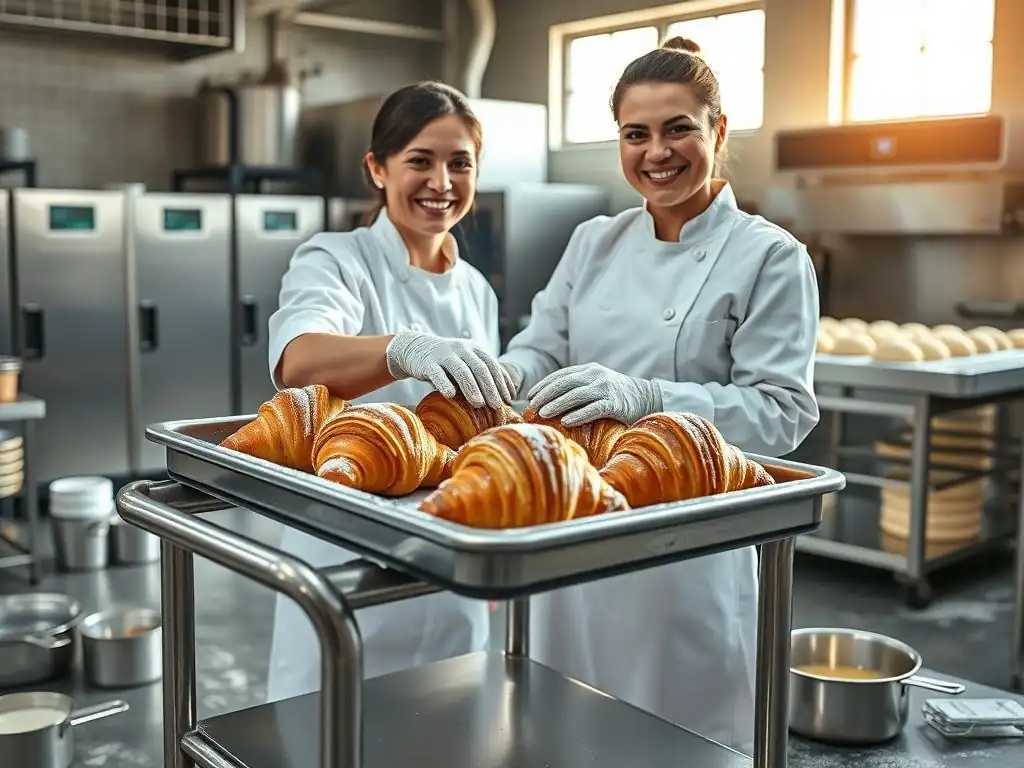
Beyond the essential tips, there are a few advanced considerations and tools that can further enhance your success when baking large quantities of croissants. These techniques often involve optimizing your equipment or process flow to handle the increased volume efficiently and effectively.
While not strictly necessary for success, these methods can help streamline the process and improve consistency, especially if you are frequently baking multiple croissant trays. They represent investments in either equipment or a slightly altered workflow to achieve superior results.
Investing in a Convection Oven for Efficient Croissant Baking
If baking multiple croissant trays is a regular activity for you, investing in a convection oven can be a game-changer. Convection ovens use a fan to circulate hot air throughout the oven cavity, drastically improving heat distribution and reducing hot spots. This forced air circulation ensures that heat reaches all surfaces of your croissants more evenly and quickly.
When using a convection oven for baking multiple batches, you often need to reduce the temperature by about 25°F (14°C) and potentially shorten the baking time compared to a conventional oven. For instance, if you bake at 400°F in conventional mode, try 375°F in convection mode. This even heat allows you to confidently use multiple racks simultaneously with less worry about uneven browning or inconsistent rise, making baking multiple croissant trays much simpler.
Utilizing an Oven Thermometer for Accurate Temperature Monitoring
Relying solely on your oven's built-in thermostat can be misleading when baking multiple croissant trays. These thermostats often measure the air temperature near the heating element and can be inaccurate, sometimes by a significant margin. An inexpensive, standalone oven thermometer placed near your baking trays provides a much more accurate reading of the actual temperature your croissants are experiencing.
Knowing the true temperature allows you to make informed adjustments. If your oven says 400°F but the thermometer reads 370°F, you know you need to increase the set temperature or allow longer preheating time. Consistent and accurate temperature monitoring is crucial for reproducible results, especially when managing the thermal load of baking multiple batches of croissants.
Batch Baking Croissants: Staggering Baking Times for Optimal Rise
If your oven is small, has poor heat distribution, or you are baking an exceptionally large quantity, staggering your baking times might be the best approach. Instead of trying to cram every tray into the oven at once, bake them in smaller batches, perhaps two trays at a time. This prevents overcrowding and allows your oven to maintain a more stable temperature and better airflow.
While this means the overall process takes longer, the quality of each batch will likely be higher and more consistent. You can keep the unbaked, proofed croissants chilled in the refrigerator for a short period (around 30-60 minutes) while the first batch bakes. This slight chilling can even help firm up the butter layers slightly before they hit the heat. This method is a reliable way to ensure optimal rise and texture for every croissant when baking multiple croissant trays.
Troubleshooting Common Croissant Baking Issues When Baking Multiple Trays
Even with the best planning, issues can arise when baking multiple croissant trays. Knowing how to identify and address common problems on the fly can save your batch and help you learn for next time. Here are solutions to some frequent challenges.
Understanding the root cause of a problem is key to fixing it. Often, issues when baking multiple batches of croissants relate back to heat distribution, proofing, or oven capacity.
Addressing Uneven Browning in Multiple Croissant Trays
Uneven browning is typically a sign of uneven heat distribution within your oven. If some croissants are browning much faster than others, it indicates hot spots. The primary solution is diligent rotation (Tip 3). Ensure you are rotating trays 180 degrees and swapping rack positions halfway through the bake.
If rotation isn't fully solving the issue, consider if you are overcrowding the oven. Too many trays can significantly impede airflow. Try baking fewer trays at once. Also, verify your oven temperature with an external thermometer (Tip 6); an inaccurate thermostat can exacerbate hot spot issues. Using a baking stone (Tip 5) can also help stabilize temperature and improve uniformity.
Preventing Soggy Bottoms When Baking Large Croissant Batches
Soggy bottoms usually occur when the bottom of the croissant doesn't receive enough heat to fully cook and crisp up, often due to poor heat distribution or trapped steam. When baking multiple croissant trays, this can be more common, especially on lower racks or in overcrowded ovens.
Ensure there is adequate space between your trays and the oven floor and walls. If using multiple racks, avoid placing a tray directly on the bottom rack unless your oven has a bottom heating element specifically designed for it. Using a preheated baking stone or steel (Tip 5) on a lower rack can provide excellent bottom heat, helping to crisp up the base of the croissants on the tray above it. Proper air circulation from not overcrowding the oven also helps dissipate steam.
Correcting Over-Proofing or Under-Proofing When Baking Multiple Croissant Trays
Proofing issues are often related to temperature and time, and managing a large batch for baking multiple croissant trays requires careful monitoring. If your croissants are consistently coming out dense with poor rise, they are likely under-proofed. If they collapse in the oven or have a poor, open structure, they might be over-proofed.
Review your proofing environment. Is the temperature consistent? Are you allowing enough time, considering the potential cooling effect of a large batch? Check the proofing readiness using the poke test (Tip 4). If under-proofing is an issue, try proofing in a slightly warmer spot or for longer. If over-proofing is the problem, reduce proofing time or find a cooler spot. Maintaining consistent kitchen temperature (Tip 9) is key to predictable proofing results.
Croissant Baking at Home: Ensuring Quality and Consistency
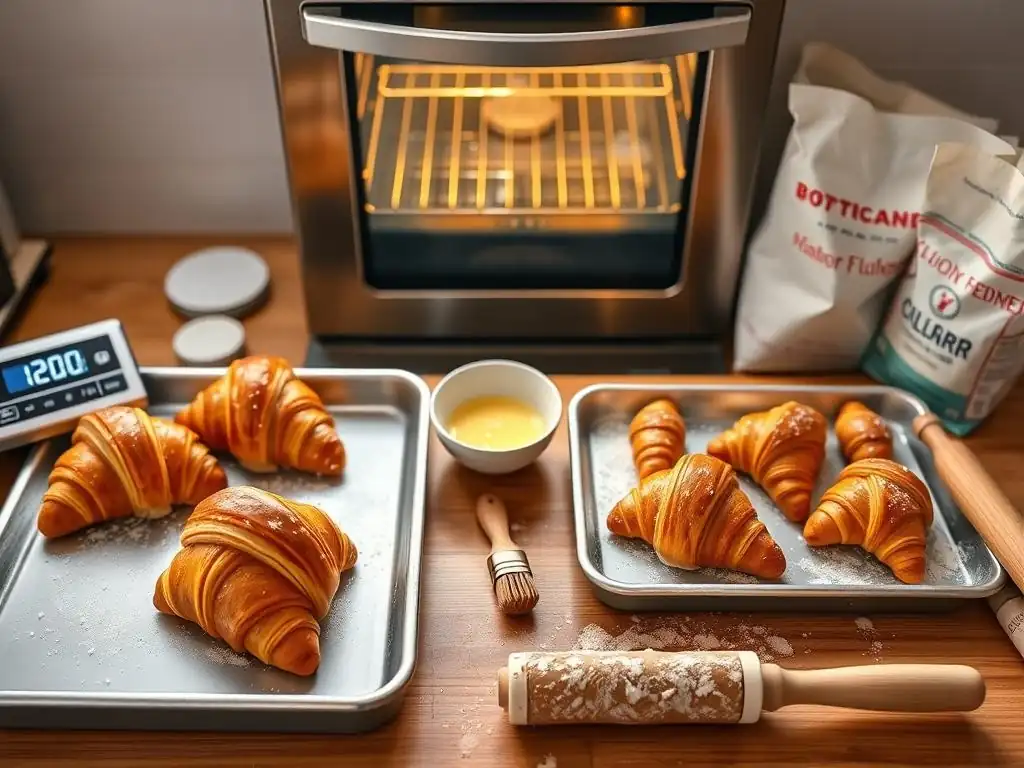
Achieving consistent, high-quality croissants, especially when baking multiple croissant trays, goes beyond just the oven environment. It starts with the dough itself and the conditions under which it is handled and proofed. Attention to detail at every step of the process contributes to the final outcome.
From selecting your ingredients to managing the dough's temperature and the proofing environment, these factors are foundational to successful croissant baking, whether you're making a single batch or baking multiple batches.
Maintaining Consistent Dough Temperature Throughout the Process
One of the most critical factors in croissant success is maintaining cold dough, particularly the butter layers. The flakiness comes from the steam created when the cold butter melts and rapidly expands in the hot oven. If your dough or butter warms up too much during lamination or shaping, the butter can integrate into the dough rather than remaining in distinct layers.
When baking multiple croissant trays, you're handling more dough for a longer period. Work quickly, especially during lamination and shaping. If your kitchen is warm, frequently chill the dough in the refrigerator between folds and after shaping the croissants. Aim to keep the dough temperature between 40-50°F (4-10°C) during handling. Using high-quality, high-fat butter (Tip 10) that is pliable but still cool is also essential.
Choosing the Right Ingredients for Optimal Croissant Texture
The quality of your ingredients directly impacts the texture and flavor of your croissants. For that signature flaky texture, you need high-quality butter with a high fat content, ideally 82% or higher. European-style butters are often preferred for their pliability and fat content, which helps create distinct layers.
Using a strong bread flour with a protein content of around 12-13% is also important. The gluten developed in the dough provides the structure necessary to support the many layers and the significant rise during baking. Using inferior ingredients can compromise both the flakiness and the structural integrity needed for successful baking, particularly when aiming for consistent results across multiple trays of croissants.
Monitoring Humidity Levels During Proofing
While temperature is often the primary focus for proofing, humidity also plays a significant role, especially for pastries like croissants that can dry out on the surface. A humid environment prevents a skin from forming on the dough, allowing for maximum expansion during proofing and oven spring.
When proofing a large batch for baking multiple croissant trays, you might be proofing in a larger space or for a longer duration, making humidity control more relevant. If your kitchen is dry, consider creating a humid environment by placing a tray of hot water in the proofing area or using a dedicated proofing box with humidity control. Aim for a relative humidity of around 75-80%. This helps keep the surface of the croissants supple, ensuring they can expand fully without cracking or tearing.
Storing and Reheating Croissants Baked in Large Batches
Congratulations on baking multiple croissant trays! Now that you have a generous supply of delicious pastries, proper storage and reheating are key to enjoying them at their best over time. You want to preserve that hard-earned flakiness and buttery flavor.
Whether you plan to enjoy them all within a day or two or save some for later, knowing the right techniques will ensure your croissants remain a treat.
Best Practices for Storing Baked Croissants to Maintain Freshness
Freshly baked croissants are best enjoyed the same day. However, if you have extras from baking multiple croissant trays, proper storage is essential. For short-term storage (1-2 days), store cooled croissants in an airtight container at room temperature. Avoid refrigerating fully baked croissants, as the cold temperature can accelerate staling and dull the flavor.
For longer storage, freezing is the best option. Once the croissants are completely cool, place them in a single layer on a baking sheet and freeze until solid, about 1-2 hours. Then, transfer the frozen croissants to a freezer-safe bag or airtight container, removing as much air as possible. Properly frozen croissants can maintain quality for up to 2-3 months.
Tips for Reheating Croissants to Restore Their Flaky Texture
Reheating is crucial for bringing back the flaky texture of stored croissants. Avoid using a microwave, which will make them soft and dense. The best method is using an oven or toaster oven.
Preheat your oven or toaster oven to a relatively low temperature, around 300-325°F (150-160°C). Place the croissants directly on the oven rack or on a baking sheet. Reheat for 5-10 minutes for room-temperature croissants, or 10-15 minutes for frozen croissants (no need to thaw first). The goal is to warm them through and crisp up the exterior without over-baking. You'll know they're ready when they are warm to the touch and feel light and crisp. Enjoy your perfectly reheated pastries from your successful session of baking multiple croissant trays!
Frequently Asked Questions
How does baking multiple croissant trays at once affect baking time?
Baking multiple trays can increase the baking time slightly. It's essential to monitor the internal temperature to ensure the croissants are fully cooked.
What oven settings should I adjust when baking several trays of croissants simultaneously?
You might need to increase the oven temperature by a small amount (around 10-15 degrees Fahrenheit) and ensure the oven is properly preheated for even baking.
How can I ensure even browning when baking multiple trays of croissants?
Rotate the trays halfway through the baking process. This helps to compensate for any hot spots within the oven and promotes uniform browning.
What's the best way to store baked croissants if I make a large batch?
Allow the croissants to cool completely, then store them in an airtight container at room temperature for a day or two. For longer storage, freeze the croissants after they've cooled.
Can I proof multiple trays of croissants at the same time?
Yes, you can. Ensure they are spaced adequately for optimal rising. A proofing cabinet is ideal, but a warm, draft-free location works too.
Final Reflection: Mastering the Art of the Multi-Tray Croissant Bake
The pursuit of perfectly flaky, buttery croissants is a rewarding, albeit challenging, endeavor. Baking multiple trays simultaneously elevates this challenge, demanding precision, planning, and a deep understanding of your oven's nuances. This isn't just about making more croissants; it's about mastering the art of efficient, high-volume baking, a skill applicable far beyond the pastry world.
The consistent rise and even browning of numerous trays of croissants speaks volumes about the baker's dedication and understanding of heat distribution. It's a testament to patience and meticulous preparation. The process itself is a meditation on timing and temperature, a dance between the baker and the oven. As Julia Child once wisely said, You don't have to cook fancy or complicated masterpieces - just good food from fresh ingredients.
This applies perfectly to croissants; the focus should always be on quality, even when scaling up production.
Now, consider your own baking journey. Have you ever tackled a large baking project? What strategies did you employ to ensure success? Perhaps this article has given you the confidence to attempt baking multiple trays of croissants, or perhaps it has inspired you to approach other baking challenges with renewed focus and planning. Embrace the challenge, learn from each bake, and remember that the most delicious results often come from the most dedicated efforts. The journey of the baker is a continuous learning process, and every perfectly risen croissant is a testament to your growth and skill.
Unleash Your Inner Croissant Master!
Thanks for taking the time to explore the art of baking multiple trays of croissants! We hope you've gained valuable insights and are ready to elevate your baking game. Now it's time to put your newfound knowledge into action.
- Bake a batch this weekend! Challenge yourself to make at least one tray of these delightful pastries. Remember those crucial chilling steps!
- Share your croissant creations on social media using #BakeWithEaseCroissants – let's inspire each other!
- Consider trying a new variation of croissants (chocolate, almond, etc.) and document your experience.
Ready to transform your kitchen into a croissant haven? What unique flavor will you create next?