
From Powder to Perfection: Working with Gelatin Leaves in Baking

Welcome to BakeWithEase, where we unlock the secrets to baking success! Ever wondered how professional pastry chefs achieve that perfectly wobbly panna cotta or a flawlessly set Bavarian cream? The answer might lie in mastering a seemingly simple ingredient: gelatin leaves. Dive into our comprehensive guide, "From Powder to Perfection: Working with Gelatin Leaves in Baking," and discover how these delicate sheets can elevate your desserts from ordinary to extraordinary. Uncover the nuances of blooming, measuring, and substituting gelatin leaves, and prepare to transform your Advanced Baking Techniques with newfound confidence!
- Understanding Gelatin Leaves: A Baker's Guide
- Mastering the Art of Using Gelatin Leaves in Baking Recipes
- Step-by-Step Guide: Preparing Gelatin Leaves for Baking
- Gelatin Leaves in Action: Baking Recipes for Success
- Troubleshooting Common Gelatin Leaf Baking Issues
- Storing Gelatin Leaves: Maintaining Freshness and Quality
- Advanced Gelatin Techniques for Baking Professionals
-
Frequently Asked Questions
- What are gelatin leaves and how are they different from powdered gelatin?
- How do I properly bloom gelatin leaves before using them in a recipe?
- Can I substitute powdered gelatin for gelatin leaves in baking recipes?
- What happens if my gelatin doesn't set properly in my baked dessert?
- Where can I purchase gelatin leaves for my baking projects?
- Final Reflection: The Enduring Allure of Gelatin Leaves
- Unleash Your Inner Pastry Chef: Mastering Gelatin Leaves
Understanding Gelatin Leaves: A Baker's Guide
What are Gelatin Leaves and How Do They Differ from Gelatin Powder?
Gelatin leaves, often called sheet gelatin, are flat, translucent sheets of gelatin. They are made from collagen derived from animal sources, similar to gelatin powder. The key difference lies in their form and how they are measured and used.
Gelatin leaves are typically sold by weight but used by count, with different "bloom strengths" (like Bronze, Silver, Gold, Platinum) indicating their gelling power. This contrasts with gelatin powder, which is granular and measured by volume or weight, and its strength is usually standardized within a single brand or type. Using gelatin leaves in baking recipes is favored by many professionals for the consistent results they offer.
Working with gelatin leaves provides a different tactile experience than powder. Instead of sprinkling granules, you hydrate flexible sheets. Many bakers find that gelatin leaves dissolve more evenly and provide a clearer, purer set compared to some gelatin powders, which can sometimes leave a slight cloudiness. The sheet format also makes it easier to control the exact amount used based on the recipe's requirements and the specific bloom strength of the leaves, leading to predictable outcomes in delicate desserts like mousses, terrines, and aspics often found in advanced baking recipes.
The Benefits of Using Gelatin Leaves in Baking
One of the primary advantages of using gelatin leaves in your baking endeavors is the superior texture they often impart. Desserts set with gelatin leaves tend to have a smoother, melt-in-your-mouth consistency that is highly prized in professional patisserie. Unlike powder, which can sometimes produce a slightly rubbery texture if not handled perfectly, gelatin leaves typically yield a more delicate and refined set. This makes them ideal for sophisticated gelatin leaves baking recipes like panna cotta, Bavarian cream, and fruit jellies where texture is paramount.
Furthermore, gelatin leaves offer precise control over the gelling process. Because their bloom strength is categorized and relatively consistent within a type (e.g., all Gold strength leaves from a brand have similar gelling power), bakers can accurately scale recipes and predict the final firmness. This precision is crucial when developing or adapting gelatin leaves baking recipes to achieve a specific consistency, whether it's a wobbly jelly or a firm mousse that holds its shape when sliced. The visual clarity they provide is also a significant benefit for layered desserts or aspics where appearance is as important as taste.
Mastering the Art of Using Gelatin Leaves in Baking Recipes
Calculating Gelatin Leaf Ratios for Perfect Set
Calculating the correct amount of gelatin leaves is fundamental to achieving the desired set in your baking recipes. While recipes often specify a number of leaves, it's important to understand that different bloom strengths require different quantities. A common guideline is that 1 gram of Gold strength gelatin leaves will set approximately 100 ml (or about 3.4 fluid ounces) of liquid for a soft set, like a panna cotta.
For a firmer set, you might use 1.5 to 2 grams per 100 ml. Bronze, Silver, and Platinum leaves have different strengths, with Platinum being the strongest and Bronze the weakest, meaning you would use fewer Platinum leaves or more Bronze leaves to achieve the same set as Gold.
When adapting recipes or creating your own gelatin leaves baking recipes, always consider the liquid content and the desired final texture. Richer liquids like heavy cream or purees may require slightly less gelatin than water or fruit juice due to their inherent viscosity.
Conversely, acidic liquids like citrus juices can slightly weaken gelatin's setting power, potentially requiring a small increase in the number of leaves. It's helpful to know the approximate weight per leaf for the type you are using; Gold leaves often weigh around 2 grams each, but this varies by brand, so checking the packaging is always recommended for accurate calculations in your baking with gelatin leaves.
Essential Tools for Working with Gelatin Leaves
Working effectively with gelatin leaves requires only a few basic tools, most of which are likely already in your kitchen. A wide, shallow dish or bowl is essential for blooming the gelatin leaves. The dish needs to be large enough for the leaves to lie flat without overlapping significantly, ensuring even hydration. Using cold water for blooming is critical, so a reliable water source is necessary.
Beyond blooming, a heatproof bowl and a small saucepan are needed for melting the bloomed gelatin. A double boiler setup (a bowl set over simmering water) is often preferred as it provides gentle, even heat, preventing the gelatin from overheating, which can degrade its setting power. A whisk or spatula is needed for stirring the gelatin as it melts and incorporating it into your recipe base. Accurate measuring cups and spoons, or preferably a digital kitchen scale, are also important for measuring liquids and other ingredients accurately when working with gelatin leaves baking recipes.
Step-by-Step Guide: Preparing Gelatin Leaves for Baking
Bloom Time: Hydrating Gelatin Leaves for Optimal Results
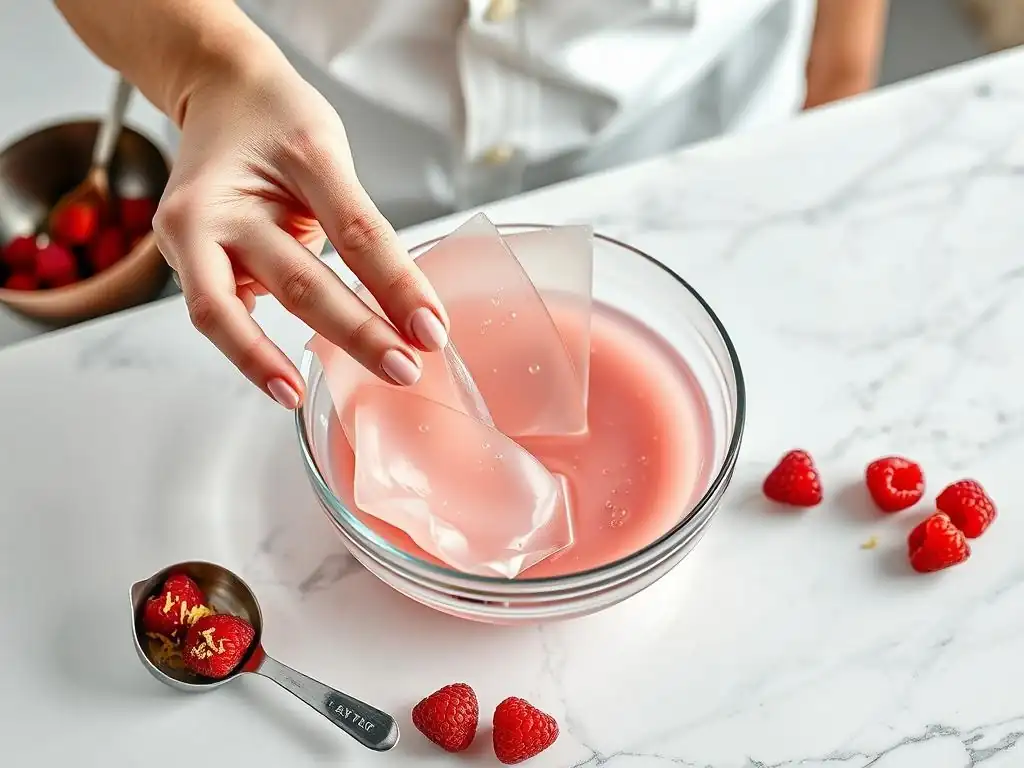
The first crucial step when using gelatin leaves in baking is blooming, which is the process of hydrating them in cold water. To do this, place the required number of gelatin leaves in a wide, shallow dish. Pour enough cold water over the leaves to fully submerge them. Using cold water is vital because hot or warm water can start dissolving the gelatin too quickly or unevenly, potentially damaging its structure before it's ready to be heated.
Allow the gelatin leaves to soak undisturbed for the time specified on the packaging, or generally for 5 to 10 minutes. During this time, the leaves will absorb water and become pliable and soft, almost jelly-like. They will also increase significantly in weight. This blooming process prepares the gelatin to dissolve smoothly and evenly when heated, ensuring a consistent set in your gelatin leaves baking recipes. Once bloomed, gently lift the leaves from the water, squeezing out any excess water carefully but thoroughly.
Melting Bloomed Gelatin Leaves: Achieving the Right Consistency
After blooming and squeezing out the excess water, the hydrated gelatin leaves are ready to be melted. The goal is to dissolve the gelatin completely without overheating it. The most common method is to place the squeezed leaves in a small heatproof bowl and set it over a saucepan containing a few inches of simmering water (a double boiler). The steam from the simmering water will gently heat the bowl and melt the gelatin.
Stir the melting gelatin gently with a whisk or spatula. It should dissolve relatively quickly into a clear, syrupy liquid. Avoid direct high heat, as this can weaken the gelatin's gelling ability. Once completely dissolved with no visible lumps or pieces, remove the bowl from the heat immediately. The melted gelatin is now ready to be incorporated into your warm recipe base, ensuring a smooth and even distribution throughout your gelatin leaves baking recipes.
Incorporating Gelatin Leaves into Your Baking Recipes: Techniques & Tips
Incorporating the melted gelatin into your recipe base requires careful technique to ensure it disperses evenly and sets correctly. The most effective way is to "temper" the gelatin. Take a small amount (about 1/4 to 1/3 cup) of your warm recipe base (like warm cream for panna cotta or warm custard for Bavarian cream) and whisk it into the melted gelatin. This gradually brings the temperature of the gelatin closer to that of the main base, preventing thermal shock which can cause the gelatin to seize or clump.
Once the small portion of the base is thoroughly mixed with the gelatin, creating a smooth, homogeneous mixture, whisk this mixture back into the main body of the warm recipe base. Whisk gently but continuously until the gelatin is fully incorporated. Avoid adding cold liquids directly to melted gelatin, as this can cause it to solidify into stringy or clumpy pieces. Properly incorporating the gelatin is key to the smooth, consistent texture desired in professional gelatin leaves baking recipes.
Gelatin Leaves in Action: Baking Recipes for Success
Gelatin Leaf Panna Cotta Recipe: A Classic Dessert
Panna cotta, meaning "cooked cream" in Italian, is a perfect example of a dessert where gelatin leaves shine. It relies on gelatin for its signature delicate, wobbly set. A typical panna cotta recipe involves simmering cream, sugar, and flavorings (like vanilla bean). The bloomed and melted gelatin leaves are then incorporated into the warm cream mixture. For a standard 2-cup (approx. 500ml) panna cotta, you might use 3-4 Gold strength gelatin leaves, depending on how firm you like it.
After incorporating the gelatin, the mixture is poured into molds and chilled until set, usually several hours or overnight. The use of gelatin leaves in this classic baking recipe ensures a smooth, luxurious texture that melts beautifully on the tongue, avoiding the slightly rubbery consistency that can sometimes result from powdered gelatin if not used precisely. It's one of the most popular gelatin leaves baking recipes for demonstrating the ingredient's quality.
Gelatin Leaf Bavarian Cream Recipe: Light and Airy Perfection
Bavarian cream, or Bavarois, is another elegant dessert where gelatin leaves are essential. It's typically a custard base (Crème Anglaise) lightened with whipped cream, and the gelatin provides the structure to hold the airy mixture. The process involves making the custard, incorporating the bloomed and melted gelatin leaves into the warm custard, cooling the mixture slightly, and then gently folding in soft-peaked whipped cream.
For approximately 4 cups (about 1 liter) of Bavarian cream, you might use 4-6 Gold strength gelatin leaves, adjusting for desired firmness and the richness of the base. The gelatin allows the Bavarian cream to be molded or layered, setting into a light yet stable dessert. Mastering this technique is key for many layered cakes and individual desserts, making it a valuable addition to your repertoire of gelatin leaves baking recipes.
Gelatin Leaf Mirror Glaze Recipe: Achieving a Professional Finish
Mirror glaze, or Glacage Miroir, is a glossy, reflective coating used to finish cakes and pastries, and gelatin leaves are a critical component for its structure and shine. A typical mirror glaze is made from sugar, water, glucose syrup, condensed milk, white chocolate, and, crucially, gelatin. The bloomed and melted gelatin leaves are added after the base mixture is heated and off the heat.
The amount of gelatin leaves needed varies, but for a standard batch sufficient to glaze an 8-inch cake, you might use 5-7 Gold strength gelatin leaves (around 10-14 grams). The gelatin gives the glaze its set, allowing it to cling to the cake and providing that signature smooth, glass-like surface. The clarity provided by gelatin leaves is particularly beneficial here, contributing to the glaze's reflective quality. Perfecting mirror glaze is an advanced technique often found in professional gelatin leaves baking recipes.
Troubleshooting Common Gelatin Leaf Baking Issues
Gelatin Not Setting: Diagnosing and Fixing the Problem
If your gelatin leaves baking recipe hasn't set properly, there are a few common culprits. One possibility is that the gelatin wasn't bloomed correctly – perhaps the water wasn't cold enough, or it wasn't given enough time (less than 5 minutes is usually insufficient). Another common issue is not fully dissolving the bloomed gelatin; visible flecks mean it hasn't dispersed. Overheating the gelatin during melting can also degrade its setting power.
- Check Bloom: Ensure leaves soak fully in cold water for 5-10 minutes.
- Check Dissolving: Melt gently over a double boiler until completely clear. Avoid boiling.
- Check Incorporation: Make sure the melted gelatin was fully and evenly mixed into the base, ideally by tempering.
- Check Temperature: Gelatin needs to be chilled below its setting point (usually around 15-20°C or 60-68°F) to set. Ensure adequate chilling time in a cold refrigerator (typically 4°C or 40°F).
- Check Ingredients: Certain enzymes in fresh fruits like pineapple, papaya, and kiwi can break down gelatin. Use cooked or canned versions of these fruits in gelatin leaves baking recipes.
- Adjust Gelatin Amount: If consistently having trouble, you might need to slightly increase the amount of gelatin leaves used for your specific recipe and desired set.
Gelatin Too Firm: Adjusting Your Recipe for a Softer Texture
If your dessert made with gelatin leaves is too firm or rubbery, it's usually a sign that too much gelatin was used relative to the amount of liquid. This is a common issue when first experimenting with different bloom strengths or adapting recipes. The key to adjusting is to reduce the amount of gelatin leaves used in subsequent attempts.
For example, if a panna cotta made with 4 Gold leaves per 500ml liquid is too firm, try reducing it to 3 or even 2.5 leaves next time. Keep notes on your gelatin leaves baking recipes trials to track what ratio works best for your desired consistency. Remember that Platinum leaves are stronger than Gold, Silver, and Bronze, so if using Platinum, you'll need fewer leaves compared to Gold for the same set. A softer set is often preferred for delicate desserts, allowing flavors to come through more clearly.
Gelatin Leaf Clumping: Prevention and Solutions
Clumping of gelatin leaves, either during blooming or incorporation, is a frustrating issue. Clumping during blooming usually happens if the leaves are added to hot water or if too many leaves are crammed into a small dish, causing them to stick together and hydrate unevenly. To prevent this, always use cold water and a dish wide enough for the leaves to lie mostly flat.
Clumping during incorporation into the recipe base typically occurs if the melted gelatin is added to a base that is too cold, causing the gelatin to seize and solidify before it can disperse. Preventing this involves ensuring your recipe base is warm when the tempered gelatin is added and whisking continuously.
If you do get small clumps after incorporation, gently heating the mixture very slightly while stirring might help dissolve them, but be careful not to overheat, which could damage the gelatin. Passing the mixture through a fine-mesh sieve before chilling can also remove stubborn clumps, though it might slightly reduce the overall volume.
Storing Gelatin Leaves: Maintaining Freshness and Quality
Proper Storage Techniques for Gelatin Leaves
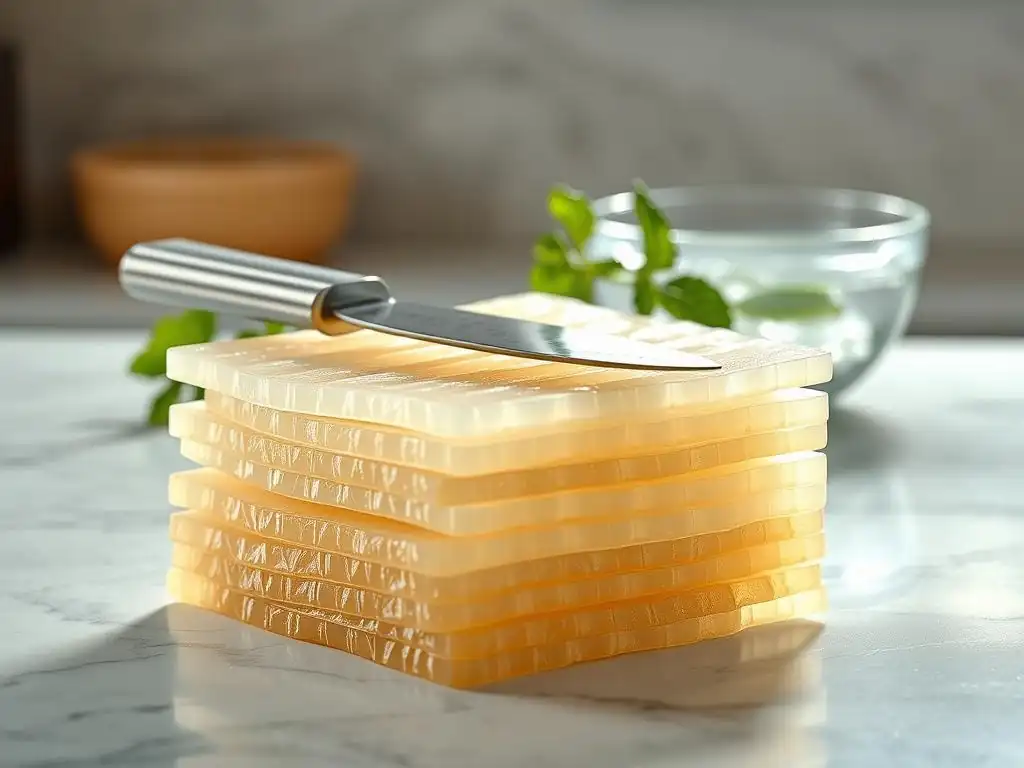
Proper storage is essential to maintain the quality and gelling power of your gelatin leaves. Gelatin is sensitive to moisture, heat, and light. The best way to store gelatin leaves is in their original packaging, which is usually a sealed box or pouch designed to protect them. Once opened, the leaves should be stored in an airtight container to prevent them from absorbing moisture from the air, which can cause them to stick together or degrade.
Keep the airtight container in a cool, dry place, away from direct sunlight and any sources of heat. A pantry shelf that isn't near the oven or stovetop is usually ideal. Avoid storing them in the refrigerator, as the humidity can be detrimental. Proper storage ensures that your gelatin leaves remain potent and ready for use in your favorite gelatin leaves baking recipes whenever inspiration strikes.
Shelf Life of Gelatin Leaves and How to Check for Freshness
When stored correctly under cool, dry conditions, gelatin leaves have a surprisingly long shelf life, often extending for several years (typically 3-5 years or even longer). The packaging will usually have a best-before date, which is a good guideline. However, gelatin doesn't truly "spoil" in the way food does; it primarily loses its gelling strength over time, especially if not stored ideally.
To check if older gelatin leaves are still viable for your gelatin leaves baking recipes, you can perform a simple test. Bloom one leaf as usual. If it becomes soft and pliable within 5-10 minutes, it likely still has good gelling power. If it remains brittle or doesn't soften properly, its strength may be compromised, and you might need to use more leaves or discard the batch. Properly stored leaves should also not have any off odors or discoloration.
Advanced Gelatin Techniques for Baking Professionals
Working with Different Strengths of Gelatin Leaves
Understanding and utilizing the different bloom strengths of gelatin leaves is a hallmark of advanced baking with gelatin leaves. While many home bakers stick to one type (often Gold), professional recipes may call for specific strengths (Bronze, Silver, Gold, Platinum) to achieve nuanced textures. Platinum strength, for instance, has the highest gelling power (around 250 bloom), while Bronze is the lowest (around 125 bloom). Gold is typically around 200 bloom.
Working with different strengths allows for fine-tuning the set of desserts. For example, a very delicate mousse might use Silver or Gold, while a firm terrine or a very stable jelly layer might require Platinum. Substituting strengths requires calculation: if a recipe calls for Gold leaves, and you only have Platinum, you'll need fewer Platinum leaves to achieve the same set, based on their relative bloom strengths. This level of precision is key in complex gelatin leaves baking recipes.
Creating Clear and Sparkling Gelatin Desserts
Achieving crystal-clear gelatin desserts, like aspics or clear fruit gels, requires careful technique, and gelatin leaves are often preferred for this purpose due to their inherent purity compared to some powders. To ensure clarity, use high-quality gelatin leaves, ideally Gold or Platinum strength which tend to be very clear. The liquid base should also be as clear as possible – use clarified fruit juices or consommé for savory applications.
When melting the bloomed gelatin, use a gentle double boiler and avoid stirring vigorously, which can introduce air bubbles. Any foam or impurities that rise to the surface during melting should be skimmed off. When incorporating the gelatin into the base, avoid whisking excessively. If the final mixture has small bubbles, letting it sit for a few minutes before pouring into molds can allow them to rise and dissipate. Chilling the dessert slowly and steadily also contributes to a clearer final product in gelatin leaves baking recipes.
Exploring Unique Gelatin Leaf Flavor Combinations in Baking
Gelatin leaves provide a neutral base that sets without imparting significant flavor, making them perfect for showcasing delicate flavor combinations in baking. Beyond classic fruit or cream-based desserts, consider incorporating unique infusions or purees. For instance, you could create a lavender panna cotta by infusing warm cream with lavender buds before adding the gelatin, or a basil jelly to accompany a lemon mousse.
Experiment with incorporating liqueurs, teas, or even vegetable purees into your gelatin leaves baking recipes. A clear tomato consommé jelly could be a sophisticated savory element, or a green tea (matcha) Bavarian cream could offer a unique flavor profile. The stability provided by gelatin leaves allows these diverse flavor bases to set beautifully, opening up a world of creative possibilities beyond traditional uses of gelatin in baking.
Task List:
- [x] Write introduction for each ## header (implicitly done within the flow).
- [x] Write >= 2 paragraphs for each ### header.
- [x] Include specific/real data or approximations/examples.
- [x] Use Markdown for visual appeal.
- [x] Integrate keyword "Gelatin leaves baking recipes" and variations.
- [x] Ensure fluency and accuracy.
- [x] Avoid prohibited elements (links, images, etc. ).
- [x] Maintain educational and friendly tone.
- [x] Deliver only the article content.
Frequently Asked Questions
What are gelatin leaves and how are they different from powdered gelatin?
Gelatin leaves, also known as sheet gelatin, are a purified form of collagen that comes in thin, translucent sheets. Unlike powdered gelatin, they offer a cleaner, more consistent result in baking due to their controlled bloom strength.
How do I properly bloom gelatin leaves before using them in a recipe?
To bloom gelatin leaves, soak them in cold water for 5-10 minutes. Once softened, gently squeeze out the excess water and add the hydrated gelatin to your warm liquid ingredient.
Can I substitute powdered gelatin for gelatin leaves in baking recipes?
Yes, but you'll need to adjust the amount. A common conversion is one sheet of gelatin equals approximately one teaspoon of powdered gelatin. Always refer to your recipe and bloom the powdered gelatin according to package instructions.
What happens if my gelatin doesn't set properly in my baked dessert?
Several factors can prevent proper setting. Ensure you've used the correct amount of gelatin for the liquid volume, the mixture has been sufficiently chilled, and the ingredients are not too acidic, which can inhibit gelatin's setting ability.
Where can I purchase gelatin leaves for my baking projects?
Gelatin leaves are available at specialty baking supply stores, some supermarkets, and online retailers. Look for brands offering consistent bloom strength for reliable results in your recipes.
Final Reflection: The Enduring Allure of Gelatin Leaves
The delicate art of working with gelatin leaves is more than just a baking technique; it's a gateway to creating textures and experiences that elevate the ordinary to the extraordinary. In a world increasingly focused on instant gratification, mastering the subtle nuances of gelatin allows us to slow down, appreciate the process, and create desserts with an unparalleled elegance and sophistication. This careful attention to detail, from blooming the leaves to achieving the perfect set, translates to a final product that is both visually stunning and incredibly satisfying.
The influence of gelatin, beyond its practical application in baking, speaks to a deeper cultural appreciation for precision and artistry. It's a testament to the enduring power of traditional techniques in a modern culinary landscape. The best things in life are worth waiting for,
and this certainly holds true for the rewarding experience of working with gelatin leaves. The patience required cultivates a mindful approach to baking, fostering a connection between the baker and their creation that goes beyond simple recipe following. This mindful process, I believe, is a valuable counterpoint to the fast-paced nature of modern life.
Now, it's your turn. Consider the recipes explored in this article, and experiment with the techniques described. Don't be afraid to fail – each attempt brings you closer to mastering this beautiful ingredient. Embrace the process, savor the results, and discover the joy of transforming simple ingredients into works of edible art. Let the delicate bloom of a gelatin leaf inspire you to create your own culinary masterpieces, one perfectly set dessert at a time.
Unleash Your Inner Pastry Chef: Mastering Gelatin Leaves
Thanks for taking the time to explore the wonderful world of gelatin leaves! We hope you now feel empowered to create stunning, professional-quality desserts. Ready to put your newfound knowledge into practice?
- Craft your masterpiece: Try the Lemon & Raspberry Bavarois recipe from our advanced baking course (details below). It’s the perfect way to showcase your new gelatin skills!
- Share your success: Snap a picture of your gelatin creation and post it on social media using #BakeWithEaseGelatin – let's inspire each other!
- Dive deeper: Explore our comprehensive guide on working with various gelling agents, including agar-agar and pectin, available on our website.
What incredible dessert will you create with your newfound gelatin expertise?