
The Role of Salt in Croissant Flavor and Structure


Welcome to BakeWithEase, where we believe everyone can create delicious baked goods! Ever wondered how a seemingly simple ingredient can dramatically impact a bake? Dive in as we unravel the surprising science behind how salt enhances croissant flavor structure, transforming ordinary dough into flaky, flavorful perfection. Get ready to elevate your croissant game!
- Understanding Salt's Importance in Croissant Baking
- Salt and Croissant Flavor: Enhancing the Taste Profile
- Salt's Impact on Croissant Structure and Texture
- The Science Behind Salt's Effects on Croissant Dough
- Choosing the Right Salt for Your Croissants
- Troubleshooting: Salt-Related Croissant Baking Issues
- Salt Measurement and Incorporation Techniques for Croissants
- Advanced Techniques: Salt Variations for Unique Croissant Flavors
- Mastering the Art of Croissant Baking: The Perfect Salt Balance
- Frequently Asked Questions
- Final Reflection: The Unsung Hero of the Croissant
- Unleash Your Inner Croissant Master!
Understanding Salt's Importance in Croissant Baking
Why Salt is Essential for Perfect Croissants
Salt is far more than just a flavor enhancer in baking, especially when it comes to delicate pastries like croissants. Its role is foundational, impacting everything from the dough's handling characteristics to the final product's aroma and texture. Without sufficient salt, croissant dough becomes sticky, challenging to work with, and lacks the necessary structure to create those signature flaky layers. It's a critical ingredient that stabilizes the dough and ensures the successful execution of lamination, where layers of dough and butter are folded repeatedly.
Beyond structure, salt plays a vital role in controlling the pace of fermentation. Yeast activity can be quite vigorous, and salt acts as a natural inhibitor, slowing the yeast down. This controlled fermentation allows for the development of more complex flavors in the dough over time, which is essential for the rich, nuanced taste of a well-made croissant. A typical croissant recipe might call for salt in the range of 1.8% to 2.2% of the total flour weight, a small but significant percentage that yields profound results.
Salt's Multifaceted Impact on Croissant Quality
The influence of salt in croissants extends across multiple dimensions, proving that salt enhances croissant flavor structure in truly significant ways. On the structural side, salt strengthens the gluten network, making the dough more elastic and extensible – qualities crucial for rolling out thin sheets without tearing, which is necessary for lamination. This robust gluten structure traps the steam generated during baking, contributing to the airy, open crumb and distinct layers characteristic of a perfect croissant.
Flavor-wise, salt doesn't just add saltiness; it brightens and balances other tastes. It mutes bitterness, enhances sweetness (paradoxically), and brings out the inherent richness of the butter and the subtle notes from the fermented dough. The right amount of salt ensures the croissant isn't bland or overly sweet, creating a harmonious taste profile that is both satisfying and complex. Without this multifaceted impact, the result would be a flat-tasting, poorly structured pastry, far from the desired flaky, buttery perfection.
Salt and Croissant Flavor: Enhancing the Taste Profile
How Salt Balances Sweetness in Croissants
While croissants aren't typically considered overtly sweet pastries, most recipes include a small amount of sugar, and the dough itself develops some natural sweetness during fermentation. Salt plays a crucial role in balancing this sweetness, preventing the croissant from tasting flat or one-dimensional. By adding salt, you create a more complex flavor profile where the sweetness is present but not overwhelming, allowing other flavors, like butter and fermented dough notes, to shine through.
This balancing act is similar to how a pinch of salt in a dessert recipe can enhance the overall sweetness without making it taste salty. In croissants, this effect is particularly important because the richness of butter and the slight tang from fermentation need a counterpoint. The interaction between salt and sugar perception on the palate ensures that the final bite is well-rounded and more appealing than a croissant made without sufficient salt.
The Subtle Enhancement of Butter Flavor by Salt
One of the defining characteristics of a great croissant is the rich, luxurious flavor of butter. Salt acts as a powerful amplifier for this key ingredient. It helps to 'open up' the flavor receptors on the tongue, making the subtle, creamy notes of the butter more pronounced and enjoyable. Think of how unsalted butter tastes relatively flat compared to salted butter; salt brings the inherent richness to the forefront.
In the context of a laminated dough like croissants, where layers of butter are encased in dough, salt ensures that each flaky bite delivers that quintessential buttery taste. The salt distributed throughout the dough and interacting with the butter layers during baking contributes significantly to the overall aroma and flavor experience, making the butter taste even more vibrant and appealing.
Unlocking Complex Flavors with the Right Salt Amount
Achieving the ideal flavor in a croissant goes beyond just tasting buttery and slightly sweet. A truly exceptional croissant possesses layers of flavor, including nutty notes from toasted flour, tangy hints from fermentation, and the deep richness of caramelized butter. The correct amount of salt is essential for unlocking and highlighting these complex flavors. Too little salt leaves the croissant tasting bland and underdeveloped, while too much can introduce a harsh bitterness that masks other subtle notes.
Salt interacts with the aromatic compounds produced during fermentation and baking, helping to release and enhance them. It also influences the Maillard reaction (browning) during baking, which contributes to the crust's flavor. By carefully measuring and incorporating salt, bakers ensure that the salt enhances croissant flavor structure, allowing the full spectrum of flavors developed during the long and intricate process of croissant making to come through in the final bite.
Salt's Impact on Croissant Structure and Texture

Strengthening Gluten Development with Salt
The characteristic flaky, airy structure of a croissant relies heavily on a well-developed gluten network. Gluten, formed when proteins in flour (glutenin and gliadin) combine with water and are kneaded, provides the dough with elasticity and strength. Salt plays a critical role in strengthening this network. It helps to tighten the gluten strands, making them more organized and robust.
This strengthening effect is partly due to salt's ionic nature, which affects the charge of the gluten proteins and encourages them to bond more effectively. A dough mixed with salt will feel less sticky and more manageable than one mixed without it. This improved structure is fundamental for the subsequent steps of lamination, where the dough must be rolled thinly and folded multiple times without tearing, allowing for the formation of distinct, thin layers separated by butter.
Salt's Role in Dough Elasticity and Extensibility
For successful lamination, croissant dough needs a delicate balance of elasticity and extensibility. Elasticity allows the dough to spring back after being stretched, while extensibility allows it to be stretched thinly without breaking. Salt enhances both these properties. It makes the gluten network strong enough to resist tearing during rolling (extensibility) while still allowing it to stretch and hold its shape (elasticity).
Imagine trying to roll out a dough that tears easily or snaps back excessively – it would be impossible to create the uniform, thin layers required for a flaky croissant. Salt provides the necessary structure to withstand the physical stress of rolling and folding, ensuring that the dough can be manipulated into the desired shape and thickness needed for successful lamination and the eventual rise in the oven.
Controlling Fermentation: Salt's Influence on Yeast Activity
Yeast activity is crucial for leavening croissant dough, but it needs to be controlled. If yeast works too quickly, the dough can over-proof, leading to a weak structure and poor flavor development. Salt acts as a natural regulator of yeast activity. It draws water out of the yeast cells through osmosis, effectively slowing them down.
This inhibition is beneficial because it allows for a longer, slower fermentation period, often involving refrigeration. This extended time is vital for developing complex flavors in the dough through the breakdown of starches and proteins by enzymes, as well as the production of various compounds by the yeast and other microorganisms. By controlling the pace of fermentation, salt ensures the dough develops both excellent flavor and a robust structure capable of supporting the delicate layers.
The Science Behind Salt's Effects on Croissant Dough
Osmosis and Water Retention: Salt's Hydration Effects
At a microscopic level, salt influences how water behaves within the dough. Salt is hygroscopic, meaning it attracts and holds onto water molecules. When salt is present, it competes with other components, like flour proteins and starch, for water. This interaction affects the overall hydration of the dough and how water is distributed.
Furthermore, salt's effect on osmosis, the movement of water across a semi-permeable membrane, is particularly relevant to yeast activity as mentioned earlier. However, it also influences how water is retained within the dough structure. A dough with the correct salt level tends to hold onto moisture better during fermentation and baking, potentially contributing to a slightly moister final product and a longer shelf life compared to unsalted versions.
Protein Interaction: Stabilizing Gluten Networks
The primary structural impact of salt comes from its interaction with the proteins in flour, specifically glutenin and gliadin, which form gluten. Salt, being an ionic compound (NaCl), dissociates into Na⁺ and Cl⁻ ions in the dough's water. These ions interact with the charged regions of the gluten proteins.
This interaction helps to neutralize some of the negative charges on the gluten proteins, allowing them to align and bond more closely and effectively. This results in a stronger, more cohesive, and elastic gluten network. This stabilization is fundamental; it's why salt enhances croissant flavor structure by providing the necessary scaffolding for those signature layers to form and hold their shape during baking.
Enzyme Activity: How Salt Regulates Dough Breakdown
Flour naturally contains enzymes, such as proteases and amylases, which can break down protein (gluten) and starch, respectively. While some enzymatic activity is desirable for flavor development, excessive activity can weaken the dough structure, making it slack and difficult to handle. Salt acts as an enzyme inhibitor, slowing down the activity of these enzymes, particularly proteases.
By inhibiting protease activity, salt helps to preserve the integrity of the gluten network. This is crucial during long fermentation periods, especially cold fermentation common in croissant making. Without salt's regulating effect on enzymes, the gluten structure could degrade over time, leading to a dough that lacks strength and the ability to rise properly or maintain its laminated layers during baking.
Choosing the Right Salt for Your Croissants

Table Salt vs. Sea Salt: Which is Best?
When selecting salt for croissants, the type can influence results, although the most critical factor is accurate measurement. Standard table salt is refined and often contains anti-caking agents and sometimes iodine. While it works, some bakers prefer sea salt or Kosher salt due to their purity and lack of additives, which they believe can subtly impact flavor. Fine sea salt dissolves quickly and evenly, which is advantageous in dough.
Kosher salt, with its larger flakes, dissolves more slowly than fine salt but is often preferred by bakers for its lack of additives and ease of pinching for measurement (though weighing is more accurate). Ultimately, either table salt or fine sea salt can produce excellent croissants, provided it is measured correctly and fully dissolved. The key is consistency – choose one type and stick with it for reliable results.
Fine vs. Coarse Salt: Impact on Dough Consistency
The crystal size of salt significantly impacts its dissolution rate in the dough. Fine salt, whether table salt or fine sea salt, dissolves quickly and evenly throughout the dough during mixing. This ensures that the salt's effects on gluten development and fermentation begin uniformly from the start.
Coarse salt, like Kosher salt or flaky sea salt, dissolves more slowly. If not fully dissolved during mixing, pockets of high salt concentration can remain in the dough. These pockets can draw water away from surrounding areas, potentially stressing the gluten network in those spots and leading to uneven dough development. While Kosher salt is manageable if mixing is thorough, using coarse, flaky finishing salts within the dough mix is generally not recommended for croissants; save those for sprinkling on top before baking if desired.
Salt Quality and Its Influence on Final Croissant Product
The quality of salt primarily refers to its purity and the presence (or absence) of additives. Highly refined salts like standard table salt are very pure NaCl but may contain anti-caking agents like calcium silicate, which are generally harmless but can sometimes slightly cloud dough water. Iodized salt can impart a subtle, sometimes metallic, off-flavor, although this is usually only noticeable at higher concentrations.
Unrefined sea salts contain trace minerals depending on their origin, which some bakers believe can add subtle complexity to the flavor. While these mineral differences are often minimal in the context of a rich croissant, choosing a pure, non-iodized salt ensures that the salt's only contribution is its intended flavor and structural benefits, allowing the true taste of the butter and fermentation to dominate.
Too Much Salt: Effects on Flavor and Texture
Adding too much salt to croissant dough can lead to several detrimental outcomes, directly impacting how salt enhances croissant flavor structure – or rather, how it hinders it. Flavor-wise, excessive salt makes the croissant unpleasantly salty, masking the delicate butter and fermentation flavors and potentially introducing a bitter metallic taste, especially if using iodized salt.
Structurally, too much salt tightens the gluten network excessively, making the dough stiff, less extensible, and difficult to roll thinly without tearing. It also significantly inhibits yeast activity, leading to slow or insufficient rising, resulting in dense, heavy croissants instead of light, airy ones. If your dough feels too tight or resists rolling, and the taste is overpoweringly salty, excess salt is likely the culprit.
Insufficient Salt: Weak Dough and Bland Taste
Conversely, using too little salt results in a dough that is difficult to handle and a final product lacking in flavor. Without enough salt to strengthen the gluten, the dough will be sticky, slack, and challenging to laminate. It will tear easily when rolled, making it hard to create those crucial thin layers.
Flavor-wise, insufficient salt leaves the croissant tasting bland, flat, and potentially overly sweet due to the unbalanced sugar content. Yeast activity will be too rapid, potentially leading to over-proofing before sufficient flavor has developed and a poor structure that collapses during baking. A sticky, unmanageable dough and a bland, dense croissant are strong indicators that you haven't used enough salt.
How to Adjust Salt Levels for Different Flour Types
Different flours have varying protein contents, which affect their gluten-forming potential. Strong bread flours have higher protein and can often handle a slightly higher salt percentage (closer to 2.2%) as they form a robust gluten network that salt helps to refine. All-purpose flour, with a lower protein content, might require a slightly lower salt percentage (closer to 1.8-2.0%) to avoid making the dough too tight and difficult to work with.
Additionally, the hydration level of your recipe can influence how salt is perceived and how it interacts with the dough. While standard salt percentages (1.8-2.2% of flour weight) are a good starting point for most croissant recipes, you might slightly adjust within this range based on the specific flour you use and your recipe's hydration to achieve the optimal balance of flavor and structure. Always consider the flour type when aiming for how salt enhances croissant flavor structure in your specific bake.
Salt Measurement and Incorporation Techniques for Croissants
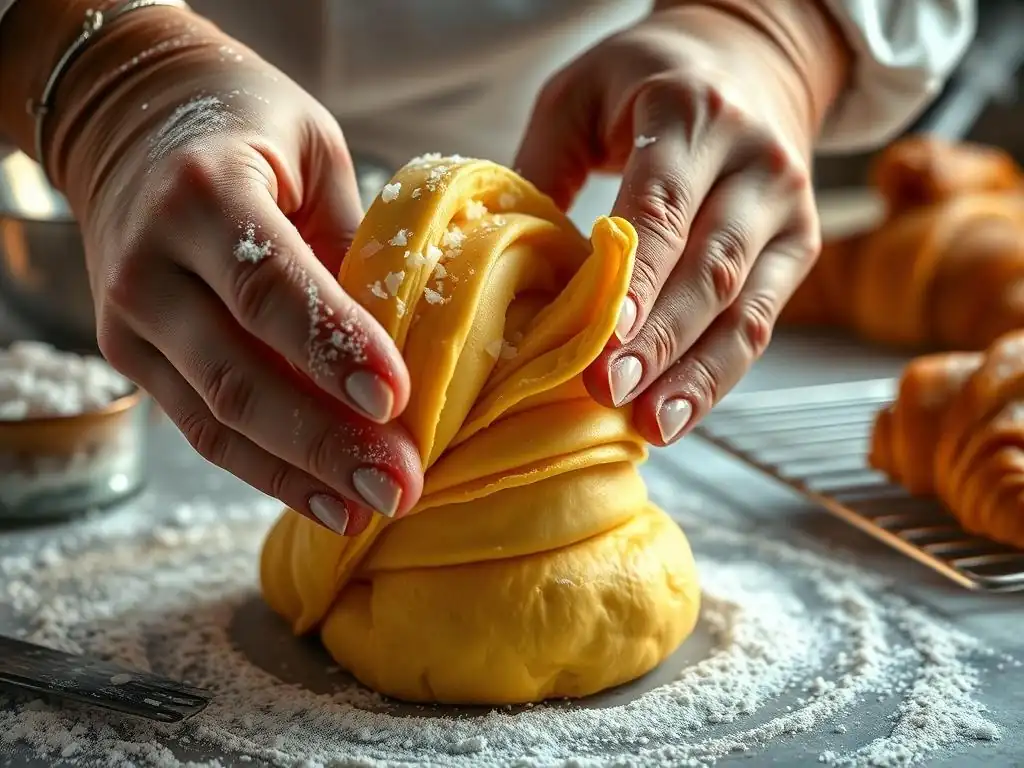
Accurate Salt Measurement for Consistent Results
Precision in baking, especially with sensitive recipes like croissants, is paramount. Salt is a powerful ingredient, and even small deviations in quantity can significantly impact the outcome. Therefore, measuring salt accurately is crucial for consistent results. The most reliable method is to weigh your salt using a digital kitchen scale, typically expressed as a percentage of the flour weight (baker's percentage).
Volume measurements (teaspoons, tablespoons) are less accurate because the density of salt varies depending on the type and crystal size (e.g., a tablespoon of fine salt weighs more than a tablespoon of flaky salt). Aiming for 1.8% to 2.2% salt based on your flour weight provides a standard range; for example, for 500g of flour, you would use 9g to 11g of salt. Weighing ensures that you are always adding the correct amount of salt, regardless of its crystal form.
Best Practices for Incorporating Salt into Croissant Dough
The timing of salt incorporation into croissant dough is important. Salt can initially interfere with the initial hydration of flour proteins and can slow down yeast activity if added directly at the very beginning with the water and yeast. Many bakers prefer to mix the dough without salt initially (sometimes called an autolyse phase if just flour and water are mixed) or add the salt a few minutes into the mixing process after the flour has started to hydrate and some gluten development has begun.
Adding salt later allows the flour to fully absorb water and the initial stages of gluten formation to occur unimpeded. Once added, the salt should be thoroughly mixed into the dough to ensure even distribution. This prevents concentrated pockets of salt, which can negatively impact dough structure and taste. Continue mixing until the salt is fully incorporated and the dough is smooth and elastic.
Avoiding Salt Pockets: Ensuring Even Distribution
Uneven distribution of salt is a common issue that can lead to inconsistent dough quality and flavor. Pockets of undissolved or highly concentrated salt can create weak spots in the gluten network and result in areas of the croissant that are excessively salty. To avoid this, especially when using fine salt, you can dissolve the salt in the liquid component of your dough before adding it to the dry ingredients.
If adding dry salt directly to the mixer, ensure it is added after the initial mixing phase and given sufficient time to disperse throughout the dough. For larger crystal salts like Kosher salt, ensure your mixing time is adequate for the crystals to dissolve completely. Visually inspect the dough during mixing to confirm that no white flecks of salt remain, indicating even distribution and that the salt enhances croissant flavor structure uniformly throughout the batch.
Advanced Techniques: Salt Variations for Unique Croissant Flavors
Using Flavored Salts to Enhance Croissant Taste
While classic croissants rely on simple ingredients, experienced bakers might experiment with subtly flavored salts to add a unique dimension. Smoked salts, for example, can impart a very mild, intriguing smoky note that complements the richness of butter. Herb-infused salts, like rosemary or thyme salt, could be used cautiously in savory variations, though they require careful consideration to ensure the herb flavor doesn't overpower the delicate croissant profile.
These flavored salts are typically used in small quantities as a direct substitute for a portion of the regular salt, or sometimes sprinkled lightly on the surface before baking for a finishing touch. The key is subtlety; the goal is to enhance, not dominate, the inherent flavors of the croissant. Experimentation with flavored salts allows bakers to explore how salt enhances croissant flavor structure in novel ways beyond simple salinity.
Salt Brining for Enhanced Moisture and Flavor
While "brining" typically refers to soaking meat in a salt solution, in the context of dough, this concept can be interpreted as ensuring optimal salt hydration and distribution to enhance moisture retention. One approach is to dissolve the full amount of salt in the recipe's water or milk before adding it to the flour. This ensures the salt is fully dissolved and evenly dispersed from the moment the liquid hits the flour.
This method facilitates the salt's interaction with proteins and starch, promoting better hydration of the flour components. Well-hydrated dough tends to retain moisture better during baking, potentially contributing to a slightly softer crumb and improved keeping quality. While not a traditional "brining" process, ensuring the salt is fully dissolved and evenly integrated is a technique that leverages salt's properties to enhance both the dough's handling and the final croissant's texture and moisture.
Exploring Different Salt Types for Unique Textures
While the type of salt within the dough primarily affects structure and internal texture via gluten and fermentation control, the choice of salt used on the surface can significantly impact the final texture and presentation. Flaky sea salts, such as Maldon, are often sprinkled on savory pastries just before baking. Their large, thin crystals provide a delightful crunch and bursts of clean saltiness on the surface.
For classic croissants, a light sprinkle of fine salt or very fine sea salt on the surface before the final proof or baking can add a subtle salty crust that contrasts nicely with the rich, buttery interior. While the salt within the dough is crucial for the internal structure where salt enhances croissant flavor structure fundamentally, experimenting with finishing salts allows for textural and flavor variations on the exterior.
Mastering the Art of Croissant Baking: The Perfect Salt Balance
Achieving the Ideal Salt Level for Optimal Flavor and Structure
Finding the perfect salt balance is crucial for mastering croissant baking. The ideal range of 1.8% to 2.2% of the flour weight is a widely accepted guideline, providing the necessary structural support for lamination, controlling fermentation for optimal flavor development, and balancing the sweetness and richness of the other ingredients. Too little salt results in a weak, bland pastry, while too much leads to a tight, slow-rising dough and an unpleasant taste.
Experimentation within this range is often necessary to account for variations in flour type, environmental conditions, and personal preference. Paying close attention to how the dough feels during mixing and handling, as well as evaluating the flavor and texture of the baked croissant, will help you fine-tune the salt level in your recipe to achieve consistently excellent results.
Testing and Refining Your Croissant Recipe for Salt
Refining a croissant recipe is an iterative process, and the salt level is a key variable to test. If your croissants are consistently bland or the dough is too sticky and weak, consider increasing the salt slightly within the recommended range. If the dough is too tight or the baked croissants taste overly salty, reduce the salt slightly.
Keep detailed notes of your experiments, including the exact salt percentage used and your observations about the dough's handling, fermentation time, and the final croissant's flavor and texture. Over time, this systematic approach will allow you to pinpoint the salt percentage that works best with your specific ingredients and baking environment, ensuring that salt enhances croissant flavor structure precisely as you intend.
The Indispensable Role of Salt in Croissant Perfection
Salt is an indispensable ingredient in the pursuit of croissant perfection. Its influence permeates every stage of the process, from strengthening the delicate gluten network required for lamination to controlling the slow fermentation that builds complex flavors. Salt doesn't just add saltiness; it brightens, balances, and amplifies the rich flavors of butter and fermented dough, while simultaneously providing the structural integrity needed for that signature flaky texture.
Understanding and respecting the multifaceted role of salt is key for any aspiring croissant baker. By accurately measuring and properly incorporating salt, and by recognizing its profound impact on both flavor and structure, you are well on your way to mastering the art of creating truly exceptional croissants. The careful management of salt is a testament to how salt enhances croissant flavor structure, transforming simple ingredients into a pastry masterpiece.
Frequently Asked Questions
What is the primary role of salt in croissant dough?
Salt primarily controls the yeast activity and strengthens the gluten structure, contributing to the dough's elasticity. It also helps to prevent the dough from over-proofing.
How does salt affect the flavor of a croissant?
Salt enhances the overall flavor profile by balancing the sweetness of the butter and flour. It also intensifies the buttery notes, making the croissant more flavorful.
Can I omit salt from my croissant recipe? What would happen?
Omitting salt is not recommended. Without salt, the dough will likely over-proof, resulting in a flat, flavorless croissant, and the gluten structure will be weak.
How much salt should I use in my croissant dough recipe?
The precise amount varies, but generally, a recipe will call for around 1.5% to 2% salt relative to the flour weight. Always refer to your specific recipe for accurate measurements.
What type of salt is best to use for making croissants?
Fine sea salt or table salt are both suitable for making croissants. Ensure the salt is evenly distributed throughout the dough for consistent results.
Final Reflection: The Unsung Hero of the Croissant
The subtle yet profound impact of salt on croissant flavor and structure is far more significant than many realize; it's the secret ingredient that elevates a good croissant to a truly exceptional one. This isn't just about taste; the precise balance of salt influences the gluten development, fermentation process, and ultimately, the textural perfection we associate with a flaky, buttery croissant. Understanding this relationship allows for a deeper appreciation of the baker's craft and the delicate dance between science and artistry in bread making.
The exploration of salt's role in baking has been a fascinating journey, highlighting how a seemingly simple ingredient can have such a complex influence on the final product. Its effect transcends mere seasoning; it's a fundamental component in achieving the desired texture and flavor profile. The best things in life are simple, but not easy.
This quote perfectly encapsulates the challenge and reward of mastering the art of croissant baking, where the seemingly insignificant detail of salt plays a crucial role in achieving greatness.
Now, consider your own baking endeavors, or even your appreciation for a perfectly crafted croissant. Think about the subtle nuances of flavor and texture, and how they might be affected by the precise amount of salt used. Experiment, explore, and discover the magic that lies within this often-overlooked ingredient. The next time you bite into a flaky, buttery croissant, take a moment to appreciate the unsung hero – the salt – that contributes so significantly to its delicious perfection.
Unleash Your Inner Croissant Master!
Thanks for exploring the fascinating world of salt's impact on croissant flavor and structure! You now have the knowledge to elevate your baking game. Ready to put your newfound expertise to the test?
- Master the Salt Technique: Experiment with different salt types and quantities in your next croissant batch, paying close attention to the changes in taste and texture. Note the subtle differences!
- Share Your Success: Post a picture of your perfectly layered creations on social media and tag #BakeWithEaseSaltSecret – let's see those golden-brown beauties!
- Dive Deeper: Explore other BakeWithEase articles on advanced baking techniques to further refine your croissant-making skills.
What unique salt variation will you try in your next croissant creation?