
Scaling Up and Down: Precise Recipe Adjustments Without Compromising Flavor

Welcome to BakeWithEase, your partner in baking perfection! Ever feel overwhelmed trying to double a cookie recipe or halve a cake for a smaller gathering? This is where the magic happens. Dive into our guide on easy recipe scaling adjustments and discover how to precisely tweak your favorite recipes without sacrificing a single ounce of flavor. Unlock the secrets to adapting any recipe to your needs and never waste ingredients again. Ready to bake smarter, not harder?
- Introduction to Easy Recipe Scaling Adjustments for Baking Perfection
- Mastering the Fundamentals of Recipe Scaling
- Scaling Up Recipes: Baking for a Crowd
- Scaling Down Recipes: Baking for One or Two
- Preserving Flavor When Scaling Recipes: The Flavor Factor
- Advanced Techniques for Precise Recipe Adjustments
- Tips for Successful Recipe Scaling Every Time
- Conclusion: Enjoy Baking with Confidence Through Easy Recipe Scaling Adjustments
-
Frequently Asked Questions
- How do I determine the scaling factor for my recipe?
- What is the best way to adjust liquid ingredients when scaling a recipe?
- How do I handle scaling recipes that contain eggs?
- When scaling a recipe, what ingredients are most sensitive to changes?
- What are some tools that can help with making easy recipe scaling adjustments?
- Final Reflection: The Joy of Culinary Flexibility
- Unlock Your Baking Potential: Master the Art of Recipe Scaling!
Introduction to Easy Recipe Scaling Adjustments for Baking Perfection
Baking is often seen as a precise science, and for good reason! Unlike cooking, where you can often adjust seasonings and ingredients on the fly, baking relies on chemical reactions and exact ratios to achieve the desired texture, rise, and flavor. This means that when you need to bake for more or fewer people than a recipe originally intends, simply guessing at ingredient amounts can lead to disappointing results. Mastering easy recipe scaling adjustments is a fundamental skill for any baker looking for flexibility and consistent success.
Whether you're hosting a large gathering and need to double your famous chocolate chip cookie recipe, or you're baking just for yourself and want to halve a cake, knowing how to accurately scale a recipe is essential. It allows you to adapt your favorite treats to any occasion without sacrificing quality. This guide will walk you through the principles and practical steps for making precise recipe adjustments, ensuring your baked goods turn out perfectly every time, no matter the batch size.
Why Accurate Recipe Scaling Matters: Maintaining Consistent Quality
Accurate recipe scaling is paramount in baking because the interactions between ingredients are highly sensitive to proportion. The ratio of leavening agents (like baking powder or soda) to flour, the balance of fat to sugar, and the amount of liquid all play critical roles in the final structure, texture, and rise of a baked good. Even slight deviations when scaling can throw off these delicate balances, leading to outcomes far from the original recipe's intention.
Consider a simple cookie recipe. If you incorrectly double the flour but not the liquid or fat, your cookies could end up dry and crumbly instead of chewy and moist. Conversely, if you add too much liquid relative to the flour when scaling down, your batter might be too thin, resulting in flat, spread-out cookies. Precise recipe adjustments ensure that the critical ratios are maintained, allowing you to replicate the intended quality, flavor, and texture of the original recipe, whether you're making a single loaf of bread or a dozen cakes.
The Common Pitfalls of Recipe Conversion: Avoiding Baking Disasters
Many novice bakers fall into common traps when attempting recipe scaling, often leading to undesirable results. One frequent mistake is simply multiplying or dividing every ingredient by the desired factor without considering the nuances of certain components. For instance, doubling the amount of a potent extract like almond extract might result in an overpowering flavor, as flavor intensity doesn't always scale linearly. Similarly, doubling baking powder or soda can sometimes lead to too much rise followed by a collapse, or a soapy flavor.
Another pitfall is mismanaging unit conversions. Recipes might list ingredients by volume (cups, teaspoons) or by weight (grams, ounces). When scaling, especially between different measurement systems (like converting a US cup recipe to metric grams for easier scaling), inaccuracies can creep in. A US cup of flour, for example, is generally considered 120-130 grams, but this can vary based on how it's measured (scooped vs. spooned). Relying solely on volume measurements when scaling large amounts can compound these inconsistencies. Careful calculation and attention to detail are key to avoiding these common baking disasters and achieving easy recipe scaling adjustments.
Mastering the Fundamentals of Recipe Scaling
Understanding Ratios and Proportions in Baking: The Key to Success
At the heart of successful recipe scaling lies a solid understanding of ratios and proportions. A baking recipe is essentially a list of ingredients in specific proportions relative to each other. For example, a basic pound cake recipe might have a ratio of 1:1:1:1 for butter, sugar, eggs, and flour by weight.
Understanding these fundamental ratios allows you to scale ingredients accurately. If you know the ratio of flour to liquid is, say, 2:1 by volume in a muffin recipe, you can maintain that proportion whether you use 2 cups of flour and 1 cup of milk, or 4 cups of flour and 2 cups of milk.
This ratio concept is particularly powerful when you only know the amount of one key ingredient. If you're adapting a recipe and know you want to use exactly 300 grams of flour, and the original recipe used 200 grams of flour and 100 grams of sugar (a 2:1 flour:sugar ratio by weight), you can calculate that you'll need 150 grams of sugar (300g flour / 2 = 150g sugar) to maintain the original proportion. Focusing on these inherent ratios, rather than just the absolute numbers, is crucial for making easy recipe scaling adjustments that preserve the recipe's integrity.
Converting Units of Measurement: A Comprehensive Guide
Accurately converting between units is a vital step in precise recipe adjustments, especially when dealing with recipes from different regions or when switching between volume and weight measurements. While many recipes use volume measurements like cups, tablespoons, and teaspoons, scaling by weight (grams, ounces, pounds) is generally more accurate, particularly for dry ingredients like flour, sugar, and leavening agents. A cup of flour can vary in weight depending on how densely packed it is, whereas 100 grams of flour is always 100 grams.
When converting units, it's helpful to have reliable conversion charts or tools. For instance, 1 US cup is approximately 237 milliliters, 1 tablespoon is about 15 milliliters, and 1 teaspoon is about 5 milliliters. For dry ingredients, common approximations include 1 US cup of all-purpose flour being about 120-135 grams, 1 US cup of granulated sugar being about 200 grams, and 1 US cup of butter being about 227 grams (or 8 ounces). Using weight measurements whenever possible minimizes variability and makes scaling much more straightforward and precise.
Metric vs. Imperial: Quick Conversion Charts for Bakers
Navigating between metric and imperial units is a frequent necessity when using recipes from around the globe. Having a handy conversion chart can significantly simplify the process of making easy recipe scaling adjustments. Here are some common conversions to keep in mind:
- Volume:
- 1 teaspoon ≈ 5 ml
- 1 tablespoon ≈ 15 ml
- 1/4 cup ≈ 60 ml
- 1/3 cup ≈ 80 ml
- 1/2 cup ≈ 120 ml
- 1 cup ≈ 240 ml (often rounded from 237 ml for simplicity)
- 1 quart ≈ 946 ml (or 0.946 liters)
- 1 gallon ≈ 3.8 liters
- Weight:
- 1 ounce (oz) ≈ 28 grams (g)
- 1 pound (lb) ≈ 454 grams (g)
- Common Ingredient Weight Approximations (vary slightly based on density and packing):
- 1 cup All-Purpose Flour ≈ 120-135 g
- 1 cup Granulated Sugar ≈ 200 g
- 1 cup Brown Sugar (packed) ≈ 220 g
- 1 cup Powdered Sugar (sifted) ≈ 115 g
- 1 cup Butter ≈ 227 g (8 oz)
- 1 large egg ≈ 50-57 g (approx. 4 tablespoons liquid)
Using these approximations or a more detailed chart allows you to convert a recipe written in one system to another, facilitating accurate scaling. For the most precise results, especially when scaling significantly, converting to weight measurements using a kitchen scale is highly recommended.
Using Online Conversion Tools for Accurate Measurements
While manual conversion charts are useful, online conversion tools and baking apps can offer even greater accuracy and convenience, especially when dealing with complex conversions or scaling factors. Many websites and apps are specifically designed for recipe scaling and unit conversion, allowing you to input ingredient amounts and units and instantly get the scaled amounts in your desired units (e.g., convert 1.5 cups to grams and then double it).
These digital tools can be particularly helpful for ingredients where the volume-to-weight conversion isn't straightforward or varies significantly (like different types of flour or cocoa powder). Using a reliable online tool minimizes the risk of mathematical errors during the scaling process, contributing significantly to achieving easy recipe scaling adjustments with high precision. Just be sure to use a reputable source that understands common baking ingredient densities.
Scaling Up Recipes: Baking for a Crowd
Calculating Ingredients for Larger Batches: Step-by-Step Instructions
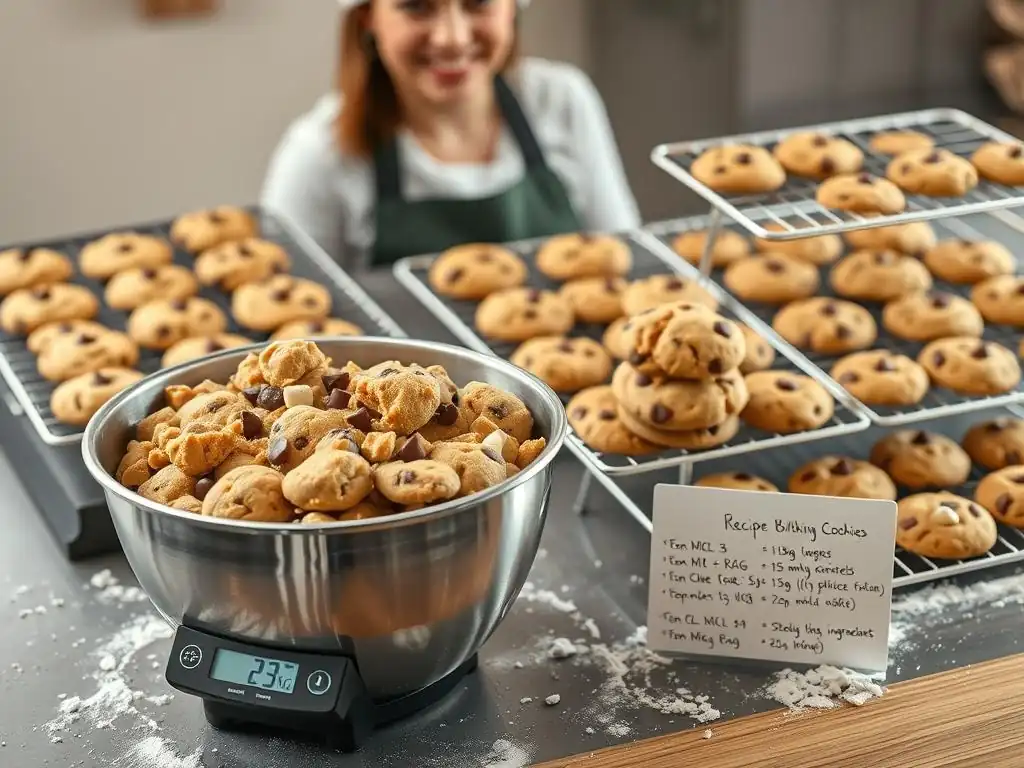
Scaling up a recipe means multiplying each ingredient quantity by a specific factor. If a recipe makes 12 cookies and you need 36, your scaling factor is 3 (36 / 12 = 3). You then multiply the amount of each ingredient by 3.
- Step 1: Determine the Scaling Factor.: Divide the desired yield by the original recipe's yield. Example: Original recipe makes 1 dozen (12) cupcakes. You need 3 dozen (36). Scaling factor = 36 / 12 = 3.
- Step 2: Convert to a Consistent Unit (Optional but Recommended).: For accuracy, especially with dry ingredients, convert volume measurements (cups, tsp) to weight (grams, oz) using a scale or reliable conversion chart before multiplying. Example: Original recipe calls for 1.5 cups flour. Convert to grams (approx. 180g). Original recipe calls for 1/2 tsp baking powder. Convert to grams (approx. 2g).
- Step 3: Multiply Each Ingredient Quantity by the Scaling Factor.: Be meticulous and multiply every ingredient, including salt, extracts, and leavening. Example: Flour: 180g * 3 = 540g. Baking Powder: 2g * 3 = 6g. Sugar: 1 cup (200g) * 3 = 600g. Eggs: 2 large eggs * 3 = 6 large eggs.
- Step 4: Convert Back to Usable Units (If Necessary).: If you converted to weight, you can bake using weight. If you need volume measurements (e.g., for liquids like milk or oil), convert the final scaled weight back to volume using your chart or tool. Example: 600g sugar could be roughly converted back to 3 cups if needed, but weighing is more accurate.
Following these steps methodically ensures that the critical ratios are maintained, making your easy recipe scaling adjustments for a crowd successful.
Adjusting Baking Times and Temperatures for Increased Volume
Scaling up a recipe doesn't typically mean simply multiplying the baking time by the same factor. A larger volume of batter or dough in a larger pan will take longer for heat to penetrate to the center and cook through. However, doubling the batch might only increase the baking time by 10-20%, not 100%. The exact adjustment depends on the type of baked good, the pan size and material, and your oven.
Generally, when scaling up:
- Temperature: Keep the oven temperature the same as the original recipe, or slightly reduce it (by 10-15°F or 5-8°C) if you are baking a very large or thick item (like a large cake or multiple loaves of bread) to prevent the outside from over-browning before the inside is cooked.
- Time: Increase the baking time. Start checking for doneness around the original recipe's maximum time, then continue baking and checking at intervals (e.g., every 5-10 minutes) until done. A doubled batch might take 20-30% longer, a tripled batch potentially 30-50% longer, depending on the item. Use visual cues (golden brown color, edges pulling away) and internal tests (toothpick test, internal temperature for bread/cakes) to determine doneness.
Equipment Considerations for Large-Scale Baking: Choosing the Right Tools
When scaling up, you'll likely need larger equipment to accommodate the increased volume of ingredients and batter/dough. Attempting to mix a triple batch of cookie dough in a standard 4.5-quart stand mixer might overload the motor and result in uneven mixing.
Consider the following:
- Mixing Bowls: You'll need significantly larger mixing bowls. A standard recipe might use a 4-quart bowl, but a doubled or tripled recipe might require an 8-quart or even 12-quart bowl.
- Mixer: A standard hand mixer may not be powerful enough for large, stiff doughs or batters. A stand mixer with a larger capacity bowl (e.g., 6-quart or more) is often necessary for scaling up.
- Pans: Ensure you have enough pans of the correct size. If a recipe uses one 8-inch cake pan and you're doubling it, you'll likely need two 8-inch pans, or perhaps a larger 9x13 inch rectangular pan (which holds roughly the volume of two 8-inch rounds). Check pan volume equivalents to choose appropriately.
- Oven Capacity: Make sure your oven can accommodate multiple pans without crowding, which can lead to uneven baking. Air circulation is key. You might need to bake in batches.
Having the right tools is crucial for efficiently handling larger quantities and ensuring successful easy recipe scaling adjustments for your big baking projects.
Scaling Down Recipes: Baking for One or Two
Dividing Ingredients for Smaller Portions: Ensuring Accuracy
Scaling down a recipe involves dividing each ingredient quantity by a specific factor. If a recipe makes 12 muffins and you only want 6, your scaling factor is 0.5 (6 / 12 = 0.5), or you divide by 2. You then divide the amount of each ingredient by 2.
- Step 1: Determine the Scaling Factor.: Divide the desired yield by the original recipe's yield. Example: Original recipe makes 12 cookies. You want 4. Scaling factor = 4 / 12 = 1/3 (or approx. 0.33).
- Step 2: Divide Each Ingredient Quantity by the Scaling Factor.: This is where accuracy is paramount, especially with small measurements. Example: Flour: 1 cup (approx. 125g) / 3 = approx. 42g. Sugar: 1/2 cup (approx. 100g) / 3 = approx. 33g. Butter: 1/4 cup (approx. 57g) / 3 = approx. 19g.
- Step 3: Handle Awkward Measurements.: Dividing can result in fractions of teaspoons or grams that are hard to measure precisely. Using a digital scale for even small amounts of dry ingredients and fats is highly recommended. For liquids, use measuring spoons designed for small volumes. For eggs, which are hard to divide, you might need to whisk a whole egg and then measure out the required fraction by weight or volume (a large egg is roughly 50-57g or 4 tablespoons). If you need 1/2 an egg, whisk one large egg and use about 25-28g or 2 tablespoons.
Precise division, ideally using a scale for dry ingredients and fats, is key to making easy recipe scaling adjustments for small batches work without sacrificing flavor or texture.
Adapting Baking Times and Temperatures for Reduced Volume
Just as scaling up affects baking time, scaling down also requires adjustments. A smaller volume of batter or dough in a smaller pan will cook faster because heat penetrates the smaller mass more quickly.
Generally, when scaling down:
- Temperature: Keep the oven temperature the same as the original recipe. Reducing the temperature is usually unnecessary and can sometimes negatively affect leavening.
- Time: Decrease the baking time. A recipe scaled down by half might bake 15-25% faster than the original. Start checking for doneness well before the original recipe's minimum time (e.g., start checking halfway through the original time, or even sooner for very small items like a single cookie). Use visual cues (light golden color, edges setting) and internal tests (toothpick test) to determine when it's done. It's better to check frequently than to overbake a small batch.
The Best Baking Vessels for Small-Batch Baking: Optimizing Results
Using the correct size pan or baking vessel is critical when scaling down a recipe. Putting a small amount of batter into a pan that is too large will result in a thin, potentially dry, or overcooked product because the heat distribution will be uneven and too intense for the shallow depth.
For small-batch baking, consider:
- Smaller Cake Pans: Instead of an 8-inch round, use a 4-inch or 6-inch pan. Be aware that scaling down a recipe by half often requires a pan that holds less than half the volume of the original pan, as the ratio of surface area to volume changes. A single-serving cake might fit in a ramekin.
- Smaller Muffin Tins: Use a 6-cup muffin tin instead of a 12-cup one, or even individual ramekins for single portions.
- Smaller Baking Sheets: For cookies, use a smaller baking sheet or bake fewer cookies on a standard sheet, ensuring adequate spacing.
- Loaf Pans: Scale down a standard loaf recipe to fit a smaller pan size (e.g., a 7x3 inch pan instead of a 9x5 inch).
Choosing the appropriately sized vessel ensures the batter/dough is the correct depth, allowing it to bake evenly and achieve the intended texture and rise, making your easy recipe scaling adjustments for smaller portions a success.
Preserving Flavor When Scaling Recipes: The Flavor Factor

The Impact of Scaling on Flavor Intensity: Understanding the Nuances
While most ingredients in baking scale linearly (double the flour, double the sugar, double the butter), certain potent flavorings do not always follow this rule perfectly. Ingredients like extracts (vanilla, almond, peppermint), ground spices (cinnamon, nutmeg, cloves), and zests (lemon, orange) can become overpowering if simply multiplied or divided by the scaling factor, especially when scaling up significantly.
The intensity of these flavor compounds can be perceived differently in larger or smaller quantities. For example, doubling the vanilla extract might make the vanilla flavor too dominant, masking other subtle tastes in the recipe. Similarly, halving a recipe with a pinch of a strong spice like clove might mean you need slightly more than half a pinch to get any discernible flavor. It's important to approach these ingredients with caution and be prepared to adjust based on taste (if possible) or experience.
Adjusting Seasonings and Extracts When Scaling: Maintaining Flavor Balance
To maintain the intended flavor balance when making easy recipe scaling adjustments, particularly with potent flavorings, it's often best to start with a slightly adjusted amount and add more if needed.
When scaling up:
- Multiply the amount of extracts, spices, and zests by the scaling factor, but consider adding maybe 80-90% of that calculated amount initially.
- For example, if doubling a recipe that calls for 1 teaspoon of vanilla extract, calculate 2 teaspoons, but initially add only 1.75 teaspoons.
- For spices, if tripling a recipe with 1/2 teaspoon of cinnamon (calculated to 1.5 teaspoons), start with 1.25 teaspoons.
- You can't taste raw batter for doneness, but you can sometimes adjust frosting or fillings after scaling. For the baked item itself, rely on experience and the principle of adding slightly less than calculated.
When scaling down:
- Divide the amount of extracts, spices, and zests by the scaling factor.
- For very small amounts, like halving a recipe with 1/4 teaspoon of almond extract (calculated to 1/8 teaspoon), this tiny amount might get lost. You might need to use slightly more than the calculated amount, perhaps 1/8 teaspoon plus a tiny drop, to ensure the flavor comes through.
- Use the smallest measuring spoons available for accuracy.
It's a subtle art, but erring on the side of slightly less when scaling up and slightly more (relative to the exact division) when scaling down can help preserve the intended flavor profile.
Scaling a Classic Vanilla Cake Recipe: A Practical Example
Let's illustrate easy recipe scaling adjustments with a hypothetical Classic Vanilla Cake recipe.
Original Vanilla Cake Recipe
This recipe yields one 8-inch round cake, serving about 8-10 people.
*   1 1/2 cups (180g) All-Purpose Flour
*   1 1/4 cups (250g) Granulated Sugar
*   2 1/2 teaspoons Baking Powder
*   1/2 teaspoon Salt
*   1/2 cup (113g) Unsalted Butter, softened
*   2 Large Eggs (approx. 100-114g)
*   1 teaspoon Vanilla Extract
*   3/4 cup (180ml) Milk
Scaled-Up Vanilla Cake Recipe (Double Batch)
To make two 8-inch cakes or one 9x13 inch rectangular cake, serving about 16-20 people, we double the recipe (scaling factor = 2).
*   1 1/2 cups * 2 = 3 cups (180g * 2 = 360g) All-Purpose Flour
*   1 1/4 cups * 2 = 2 1/2 cups (250g * 2 = 500g) Granulated Sugar
*   2 1/2 teaspoons * 2 = 5 teaspoons Baking Powder
*   1/2 teaspoon * 2 = 1 teaspoon Salt
*   1/2 cup * 2 = 1 cup (113g * 2 = 226g) Unsalted Butter, softened
*   2 Large Eggs * 2 = 4 Large Eggs (approx. 100-114g * 2 = 200-228g)
*   1 teaspoon * 2 = 2 teaspoons Vanilla Extract (Consider starting with 1.75 tsp)
*   3/4 cup * 2 = 1 1/2 cups (180ml * 2 = 360ml) Milk
Note: Baking time will likely increase by 15-25% for the larger volume/pans.
Scaled-Down Vanilla Cake Recipe (Half Batch)
To make one small 6-inch round cake, serving about 4-5 people, we halve the recipe (scaling factor = 0.5 or divide by 2).
*   1 1/2 cups / 2 = 3/4 cup (180g / 2 = 90g) All-Purpose Flour
*   1 1/4 cups / 2 = 5/8 cup (250g / 2 = 125g) Granulated Sugar
*   2 1/2 teaspoons / 2 = 1 1/4 teaspoons Baking Powder
*   1/2 teaspoon / 2 = 1/4 teaspoon Salt
*   1/2 cup / 2 = 1/4 cup (113g / 2 = 56.5g) Unsalted Butter, softened
*   2 Large Eggs / 2 = 1 Large Egg (approx. 100-114g / 2 = 50-57g)
*   1 teaspoon / 2 = 1/2 teaspoon Vanilla Extract (Consider using slightly more if 1/2 tsp seems too little)
*   3/4 cup / 2 = 3/8 cup (180ml / 2 = 90ml) Milk
Note: Baking time will likely decrease by 15-25% for the smaller volume/pan.
This example demonstrates the direct application of scaling factors to each ingredient quantity, providing a clear path for easy recipe scaling adjustments.
Advanced Techniques for Precise Recipe Adjustments
Using Baker's Percentage for Accurate Scaling
For serious bakers, especially those working with bread or pastry, understanding Baker's Percentage offers an incredibly precise method for recipe scaling. In this system, the weight of the flour is always considered 100%, and all other ingredients are expressed as a percentage of the flour's weight.
For example, a simple bread recipe might be:
- Flour: 100% (e.g., 500g)
- Water: 60% (e.g., 300g)
- Yeast: 1.5% (e.g., 7.5g)
- Salt: 2% (e.g., 10g)
- Total: 163.5% (817.5g dough)
To scale this recipe using Baker's Percentage, you simply decide how much flour you want to use (e.g., 1000g for a double batch). Then, calculate the weight of all other ingredients based on that new flour weight using the original percentages:
- Flour: 1000g
- Water: 60% of 1000g = 600g
- Yeast: 1.5% of 1000g = 15g
- Salt: 2% of 1000g = 20g
This method is inherently accurate because it relies solely on weight, eliminating the inconsistencies of volume measurements. It makes making easy recipe scaling adjustments for professional or high-volume baking much more reliable.
Compensating for Changes in Moisture Content
When scaling recipes, especially those involving ingredients like fruits, vegetables, or dairy, it's important to be aware that the moisture content can sometimes affect the final outcome, particularly in large batches. For example, if scaling up a zucchini bread recipe significantly, the sheer volume of zucchini might introduce more moisture than the recipe is designed to handle proportionally, potentially leading to a gummy texture.
While a direct formula for compensating moisture is difficult without testing, experienced bakers might slightly reduce the liquid ingredient (milk, oil, water) by a small percentage (e.g., 5-10%) when significantly scaling up a recipe heavy in high-moisture ingredients. Conversely, when scaling down, the relative impact of a small amount of moisture might be less pronounced. This level of adjustment often comes with experience and testing, highlighting that while easy recipe scaling adjustments are achievable, some complex recipes might require slight fine-tuning after the initial calculation.
Troubleshooting Common Scaling Problems: Dry Cakes, Runny Batters, Uneven Baking
Even with careful calculations, you might encounter issues when scaling recipes. Knowing how to troubleshoot common problems is part of the learning process for easy recipe scaling adjustments.
- Dry Cakes or Muffins: This often results from adding too much dry ingredient (flour, leavening) relative to wet ingredients, or from overbaking. Double-check your weight measurements for flour. When scaling up, ensure you didn't over-measure flour by volume. When scaling down, ensure small amounts of liquid weren't lost due to imprecise measurement. Adjust baking time in the future.
- Runny Batters or Doughs: This is usually too much liquid or not enough flour. Re-check your liquid measurements, especially if converting units. Ensure dry ingredients were measured accurately, ideally by weight.
- Uneven Baking: Pans too crowded in the oven, incorrect pan size for scaled volume, or hot spots in the oven can cause this. Ensure adequate space between pans. Use the correct pan size for the scaled amount. If scaling up, consider rotating pans halfway through baking. If scaling down, ensure the pan isn't too large for the batter volume.
Keeping notes on what worked and what didn't during your easy recipe scaling adjustments helps you refine your technique for next time.
Tips for Successful Recipe Scaling Every Time
Double-Checking Your Calculations: Accuracy is Key
The most crucial step in successful recipe scaling is meticulous calculation. A small mathematical error early in the process can be compounded when dealing with multiple ingredients, leading to significant deviations from the original recipe.
Before you start measuring, take a moment to:
- Confirm your scaling factor.
- Write down the calculated amount for each ingredient.
- Mentally (or with a calculator) double-check each multiplication or division.
- If converting units, verify your conversion factors or use a trusted online tool.
Treating the calculation phase with extreme care sets you up for success and makes the actual measuring and mixing stages of easy recipe scaling adjustments much smoother and more reliable.
Testing Small Batches Before Scaling Up Significantly
If you plan to scale a favorite recipe significantly, especially for a critical event like a wedding or large party, it's highly advisable to perform a smaller test batch first using your scaled calculations. For instance, if you plan to make a quadruple batch of cookies, try making a double batch first.
This test run allows you to:
- Verify your calculations for accuracy.
- Assess if flavorings (extracts, spices) need adjustment at the larger volume.
- Determine the correct baking time and temperature adjustments for your oven and pans.
- Identify any equipment limitations.
A small test batch requires minimal extra ingredients and effort compared to the potential disaster of a failed large batch, making it a wise investment for confident easy recipe scaling adjustments.
Keeping Detailed Notes for Future Reference: Building Your Baking Knowledge Base
Becoming proficient at easy recipe scaling adjustments is an ongoing process, and keeping detailed notes is an invaluable tool for improvement. After you scale and bake a recipe, take a few minutes to record:
- The original recipe source and yield.
- Your target yield and scaling factor.
- Your calculated ingredient amounts.
- Any unit conversions made.
- The pan size(s) used.
- The actual baking time and temperature used.
- Any adjustments made to flavorings.
- Observations about the final result (texture, flavor, appearance).
- Notes on what worked well and what you might change next time.
Over time, these notes will become a personalized guide, helping you refine your easy recipe scaling adjustments for specific recipes and types of baked goods, building your confidence and expertise in the kitchen.
Conclusion: Enjoy Baking with Confidence Through Easy Recipe Scaling Adjustments
Mastering the art of easy recipe scaling adjustments unlocks a new level of flexibility and confidence in your baking journey. By understanding the fundamental principles of ratios, converting units accurately, and carefully calculating ingredient quantities, you can successfully adapt your favorite recipes to suit any occasion, whether you're baking a single-serving treat or preparing for a large celebration. Remember to pay special attention to potent flavorings, adjust baking times and temperatures, and use appropriately sized equipment.
With practice, patience, and the tips outlined here, you'll find that making precise recipe adjustments becomes second nature, allowing you to share your delicious baked goods with just the right number of people, every single time. Happy baking!
Frequently Asked Questions
How do I determine the scaling factor for my recipe?
To find the scaling factor, divide the desired yield by the original recipe yield. This gives you the number by which you must multiply each ingredient.
What is the best way to adjust liquid ingredients when scaling a recipe?
Measure liquids precisely using measuring cups or a kitchen scale. Consider the impact on consistency and adjust accordingly for best results.
How do I handle scaling recipes that contain eggs?
If scaling requires a fractional egg, consider using egg substitutes or beating an egg and using a portion of it. Alternatively, if the scale is small, you may not need to adjust the egg quantity.
When scaling a recipe, what ingredients are most sensitive to changes?
Ingredients like leavening agents (baking powder/soda) and spices are highly sensitive. They might require only slight adjustments to maintain the intended flavor and texture.
What are some tools that can help with making easy recipe scaling adjustments?
A kitchen scale is essential for precise measurements. Also, using a recipe scaling calculator online can quickly determine the adjusted ingredient amounts for easy recipe scaling adjustments.
Final Reflection: The Joy of Culinary Flexibility
Mastering the art of recipe scaling isn't just about feeding more people; it's about unlocking culinary freedom. The ability to effortlessly adjust recipes, whether scaling up for a feast or down for a single serving, transforms the kitchen from a place of rigid adherence to a space of creative exploration. This newfound flexibility empowers home cooks to confidently tackle any culinary challenge, eliminating food waste and maximizing enjoyment.
The impact of precise scaling extends beyond the individual kitchen; it fosters a more sustainable approach to cooking. By accurately adjusting ingredient quantities, we minimize waste and reduce the environmental impact of food preparation. This mindful approach resonates deeply with the growing awareness of sustainable living. Waste not, want not
– a timeless adage that perfectly encapsulates the spirit of efficient recipe scaling. This simple principle, when applied consistently, can make a significant difference in our collective effort towards responsible consumption.
Now, consider your own culinary journey. What recipes have you been hesitant to try because of perceived scaling difficulties? What new culinary adventures await you, now armed with the knowledge to confidently adjust any recipe to your needs? I encourage you to experiment, to embrace the flexibility, and to discover the joy of effortlessly scaling your favorite dishes. Let the kitchen become your laboratory of culinary creativity, where precise measurements unlock a world of delicious possibilities.
Unlock Your Baking Potential: Master the Art of Recipe Scaling!
Thanks for taking the time to learn about scaling recipes! You're now equipped to confidently adjust ingredient quantities without sacrificing delicious results. Ready to put your new skills to the test?
- Bake a scaled recipe today: Choose your favorite recipe and try scaling it up or down. Experiment with different ratios and see what works best for you! (This is your primary action.)
- Share your baking triumph (or challenge!): Tell us about your scaling experience in the comments below! Let's build a supportive baking community.
- Explore our recipe library: Discover even more delicious recipes you can easily scale using your new knowledge. We have tons of options for every occasion.
So, what incredible baked creation will you scale next?