
Quick Checks: Verifying Scale Accuracy with Calibration Weights and Coins

Welcome to BakeWithEase, your kitchen companion for unlocking baking brilliance! Ever wondered if your measurements are truly accurate? Today, we're diving into a crucial, often overlooked, element of successful baking: how to calibrate baking scale weights. Discover simple methods, including using everyday coins, to ensure your recipes turn out perfectly every time. Unlocking this secret will revolutionize your baking journey - are you ready to learn how?
- Quick Checks: Verifying Scale Accuracy for Consistent Baking Results
- Why Accurate Measurements Matter in Baking
- Understanding Baking Scale Calibration
- Quick Check #1: Using Calibration Weights for Scale Accuracy
- Quick Check #2: Using Coins as Standard Weights for Baking Scale Testing
- Troubleshooting Inaccurate Baking Scales
- Maintaining Your Baking Scale for Long-Term Accuracy
- When to Consider Replacing Your Baking Scale
- Conclusion: Ensuring Baking Success Through Accurate Measurements
- Frequently Asked Questions
- Final Reflection: The Precision of a Pinch, the Power of a Perfect Bake
- Unlock Baking Precision: Level Up Your Scale Game!
Quick Checks: Verifying Scale Accuracy for Consistent Baking Results
Baking is often described as a science, and like any science, precision is paramount. While many home bakers start with volume measurements using cups and spoons, transitioning to a kitchen scale for weighing ingredients is a game-changer for consistency and accuracy. However, even a reliable scale can lose its precision over time. Knowing how to quickly verify and calibrate your baking scale weights is crucial for achieving perfect results every time you bake.
This guide will walk you through simple methods to check if your scale is measuring correctly, using readily available items like calibration weights or even common coins. Ensuring your scale is accurate helps you master recipes and troubleshoot baking issues more effectively. Let's dive into why accurate measurements matter and how to keep your scale in top shape.
Why Accurate Measurements Matter in Baking
In baking, the relationship between ingredients is a delicate balance. Slight deviations in the amount of flour, sugar, liquid, or leavening agents can significantly alter the outcome of your recipe. Using a scale provides a level of precision that volume measurements simply cannot match, as factors like how tightly flour is packed into a cup can vary wildly.
Consider a recipe that calls for 200 grams of flour. If your scale is off by just 10 grams, you're either using 5% too little or too much flour. This might seem minor, but it can mean the difference between a light, airy cake and a dense, heavy one, or between perfectly spread cookies and ones that don't spread at all. Accurate measurements via weighing ensure that you are following the recipe developer's intentions precisely, leading to more predictable and successful baking experiences.
The Importance of Precision in Baking Recipes
Precision is the cornerstone of successful baking. Unlike cooking, where you can often adjust seasonings or ingredients by taste, baking relies on chemical reactions that require specific ratios of ingredients. For instance, the ratio of flour to liquid determines the hydration of dough, affecting its texture and gluten development. The ratio of sugar to fat impacts spread and tenderness in cookies. Leavening agents like baking soda and baking powder must be used in precise amounts relative to acidic ingredients or total flour weight to ensure proper rise without leaving a metallic taste.
Using a scale eliminates the variability inherent in scoop-and-level or dip-and-sweep methods used with measuring cups. A cup of all-purpose flour can weigh anywhere from 120 grams (lightly spooned) to 150 grams (heavily packed). This 25% variation is substantial and can completely derail a recipe. By weighing your ingredients, you ensure you're using the exact amount specified, leading to consistent results regardless of who is doing the measuring or how they are doing it. This consistency is key to replicating favorite recipes successfully time after time.
How Inaccurate Scales Affect Baking Results
An inaccurate kitchen scale can lead to a frustrating cycle of failed bakes and wasted ingredients. Imagine you're trying to perfect a delicate French macaron recipe, which is notoriously sensitive to ingredient ratios. If your scale consistently over-measures almond flour or under-measures sugar, your meringue might not form correctly, the shells could crack, or they might not develop the desired "feet."
Similarly, baking bread requires precise hydration levels. If your scale reads 500 grams of flour accurately but consistently measures 300 grams of water as 280 grams, your dough will be too dry. This will make it difficult to knead, inhibit proper gluten development, and result in a dense loaf with poor rise and a tough crumb. Over time, these subtle errors can accumulate, making it difficult to troubleshoot what went wrong with a recipe when the measurements themselves are unreliable. Regularly checking and calibrating your baking scale weights helps prevent these issues before they ruin a bake.
Understanding Baking Scale Calibration
Calibration, in the context of a baking scale, means adjusting it to ensure that a known weight placed on the scale registers the correct value. Think of it as resetting the scale's internal reference point. Over time, due to factors like temperature fluctuations, minor physical shocks (like being bumped), or even just regular use, the scale's internal components can drift, causing it to display weights that are slightly off.
Not all kitchen scales are designed for user calibration. Many basic digital scales are factory-calibrated and rely on their internal components remaining stable. However, some higher-end digital scales and most mechanical scales can be calibrated. Even if your scale can't be formally calibrated by you, checking its accuracy with known weights is a crucial step in ensuring reliable measurements for all your baking endeavors.
What Does It Mean to Calibrate a Baking Scale?
To calibrate a baking scale means to bring its measurements into alignment with a known standard weight. For scales that support user calibration, this often involves a specific procedure outlined in the scale's manual, usually requiring a precise calibration weight. The scale is put into a calibration mode, the specific weight (e.g., 500g or 1000g) is placed on the platform, and the scale adjusts its internal settings to recognize that weight as the correct value.
For scales that don't have a user calibration function, "calibration" effectively means verifying its accuracy against known standards. If the scale consistently reads a known weight incorrectly, even after simple troubleshooting, it might be time to replace it. The goal, whether through adjustment or verification, is to ensure that when you weigh 100 grams of sugar, the scale displays a number that is extremely close to 100.0 grams. This process helps maintain confidence in your baking scale weights.
When Should You Calibrate Your Kitchen Scale?
It's a good practice to check the accuracy of your kitchen scale periodically, even if it seems to be working fine. Here are some specific instances when you should definitely verify your baking scale weights:
- When you first purchase a new scale: Always test a new scale upon arrival to ensure it wasn't damaged in transit and is measuring accurately out of the box.
- After the scale has been dropped or bumped: Any physical shock can potentially affect the sensitive sensors inside a digital scale.
- If you get inconsistent baking results: If your go-to recipes suddenly aren't turning out as expected, and you haven't changed anything else, your scale's accuracy is a prime suspect.
- Before tackling a critical recipe: For delicate bakes like macarons, intricate pastries, or sourdough bread where precision is paramount, it's wise to do a quick check.
- At regular intervals: Aim to check your scale's accuracy every few months, perhaps quarterly, as part of your kitchen maintenance routine.
Regular checks help you catch inaccuracies early, preventing wasted ingredients and baking frustration.
Quick Check #1: Using Calibration Weights for Scale Accuracy
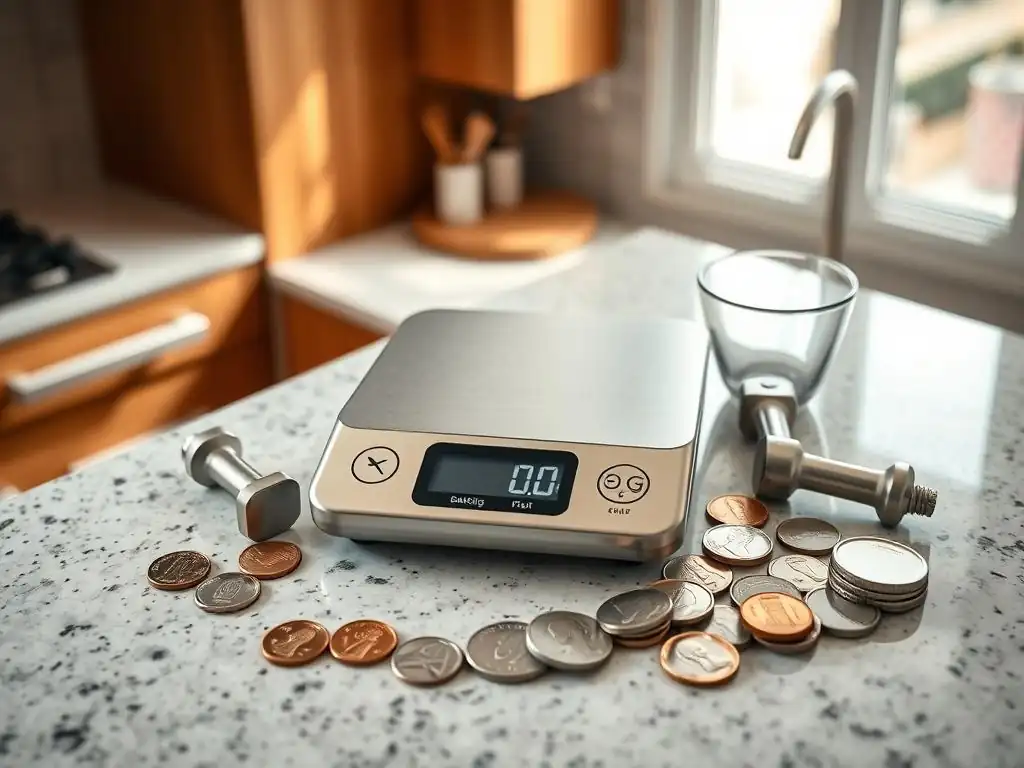
Using certified calibration weights is the most accurate way to check your kitchen scale's precision. These weights are manufactured to extremely tight tolerances, meaning their stated weight is highly reliable. They provide a consistent standard against which you can test your scale's readings.
Calibration weight sets come in various sizes and increments, allowing you to test your scale's accuracy across different weight ranges. While you might not need a full set, having one or two common weights (like 100g, 200g, or 500g) can be incredibly useful for regular checks of your baking scale weights.
What are Calibration Weights and Where to Find Them
Calibration weights are precisely manufactured objects, typically made of metal (like stainless steel or chrome-plated brass), that have a certified mass. They are designed to be used for calibrating or verifying the accuracy of weighing scales. These weights come in different classes based on their tolerance (how close they are to their stated weight), with higher classes having stricter tolerances. For kitchen scale accuracy checks, a standard OIML Class M1 or F2 weight is usually sufficient.
You can find calibration weights relatively easily. Online retailers like Amazon, laboratory supply stores, or even some kitchen supply stores that sell high-end scales often carry them. They are typically sold individually or in sets. A single 500g or 1000g weight is a good starting point for testing most kitchen scales, as these weights cover a common range for baking ingredients. Ensure you purchase a weight that is appropriate for the capacity and precision of your scale.
Step-by-Step Guide: Checking Scale Accuracy with Calibration Weights
Checking your scale's accuracy with a calibration weight is straightforward. Here's a simple process:
- Find a stable, level surface: Place your scale on a flat, solid countertop or table, away from drafts or vibrations. Ensure the surface is not tilted.
- Turn on the scale: Allow the scale a few seconds to warm up and stabilize after turning it on.
- Tare the scale (if necessary): If there's anything on the scale platform (like a bowl you plan to use for weighing), place it on the scale and press the "tare" or "zero" button to reset the display to 0.0.
- Place the calibration weight: Gently place the calibration weight directly in the center of the scale platform.
- Note the reading: Observe the weight displayed on the scale.
- Compare the reading: Compare the displayed weight to the known weight of the calibration weight.
- Repeat (optional): For a more thorough check, try placing the weight slightly off-center in different spots on the platform to check for consistency across the weighing surface.
For example, if you have a 500g calibration weight and your scale displays 499.5g or 500.2g, it's showing a very small deviation, which might be acceptable depending on the scale's specifications. If it reads 495g or 505g, that's a significant discrepancy indicating the scale is inaccurate. This test helps you assess the reliability of your baking scale weights.
Interpreting the Results: Is Your Scale Accurate?
After testing with a calibration weight, you need to interpret the results. Most kitchen scales have a specified tolerance or readability (e.g., +/- 1g or 0.1g). Check your scale's manual for this information. If the displayed weight is within this tolerance of the calibration weight's true value, your scale is likely accurate enough for most baking tasks.
For example, if your scale has a readability of 1g and you place a 500g weight on it, a reading between 499g and 501g might be considered acceptable. If your scale has a finer readability of 0.1g, you'd expect the reading to be much closer, perhaps within a few tenths of a gram (e.g., 499.8g to 500.2g).
If the deviation is outside the scale's stated tolerance, or if the discrepancy is large enough to concern you for your specific baking needs (e.g., more than 1-2% off for typical ingredient weights), your scale is likely inaccurate and may need recalibration (if possible) or replacement. This verification process is key when you need to calibrate your baking scale weights.
Quick Check #2: Using Coins as Standard Weights for Baking Scale Testing
While not as precise as certified calibration weights, common coins can serve as a surprisingly useful approximation for checking the accuracy of your kitchen scale, especially in a pinch. Coins are minted to relatively consistent weight standards, making a collection of them a decent stand-in for a known mass.
This method is particularly helpful for checking if your scale is wildly inaccurate or if you just want a quick, accessible way to verify its functionality without purchasing specialized weights. It allows you to get a general idea of whether your baking scale weights are reliable enough for everyday use.
Choosing the Right Coins for Baking Scale Verification
The best coins to use for this test are those that are current and haven't been significantly worn down. Using multiple coins allows you to test different weight increments and get a better average reading. It's helpful to use coins of the same denomination for consistency.
Here is an approximate weight reference chart for common US coins:
Coin Weight Reference Chart
- US Penny (post-1982): Approximately 2.5 grams
- US Nickel: Approximately 5.0 grams
- US Dime: Approximately 2.268 grams
- US Quarter: Approximately 5.670 grams
Note: These weights are approximate and can vary slightly due to manufacturing tolerances or wear and tear. Pennies minted before 1982 are heavier (~3.11g) due to different composition. Using newer coins in good condition will yield more accurate results for your baking scale weights check.
Step-by-Step Guide: Testing Scale Accuracy with Coins
Using coins to check your scale's accuracy follows a similar process to using calibration weights:
- Prepare the surface: Place your scale on a flat, stable surface.
- Turn on and tare: Turn on the scale and tare it to zero if needed.
- Gather your coins: Select several coins of the same denomination (e.g., 10 US nickels).
- Calculate the expected total weight: Multiply the number of coins by the approximate weight per coin (e.g., 10 nickels * 5.0 grams/nickel = 50.0 grams).
- Place the coins: Gently place all the selected coins together in the center of the scale platform.
- Read the display: Note the total weight displayed by the scale.
- Compare: Compare the displayed weight to your calculated expected total weight.
You can repeat this with different numbers or types of coins to test various weight points on your scale. For instance, you could use 4 quarters to test a weight around 22.68 grams, or 20 pennies to test around 50 grams. This method provides a quick verification of your baking scale weights using common items.
Calculating the Total Weight of Coins for Scale Testing
To accurately use coins for testing, you need to calculate their expected total weight based on the number of coins and their approximate individual weights. Using the Coin Weight Reference Chart provided above:
- If you use 5 US Nickels:
5 coins * 5.0 grams/coin = 25.0 grams - If you use 10 US Dimes:
10 coins * 2.268 grams/coin = 22.68 grams - If you use 8 US Quarters:
8 coins * 5.670 grams/coin = 45.36 grams
It's best to use a number of coins that results in a total weight you often use in baking (e.g., testing weights around 20g, 50g, 100g). Remember that these coin weights are approximations, so expect a small margin of error compared to using certified calibration weights. The goal is to see if your scale is displaying a weight reasonably close to the expected total. This calculation is a key step when you want to verify your baking scale weights using coins.
Analyzing Coin-Based Test Results: Identifying Scale Discrepancies
When analyzing the results from your coin test, don't expect perfect alignment, as coin weights can vary slightly. However, if the displayed weight is significantly different from your calculated total weight, it indicates a potential issue with your scale's accuracy.
- Small discrepancy (within a few tenths of a gram for small weights, or 1-2 grams for larger weights): This might be within the normal tolerance for your scale or the slight variability of coin weights. For most baking, this level of accuracy is likely sufficient.
- Large discrepancy (several grams off): This suggests your scale is inaccurate. For example, if 10 nickels (expected 50.0g) consistently read as 45g or 55g, your scale is likely unreliable for precise baking.
If the coin test reveals a significant discrepancy, it's highly recommended to perform a check using a certified calibration weight if possible. If you don't have one, the coin test still gives you a strong indication that your baking scale weights might be off, and it might be time to investigate further or consider replacing the scale.
Troubleshooting Inaccurate Baking Scales
If your scale isn't reading accurately during your checks, don't panic immediately. Sometimes, the issue isn't with the scale's internal calibration but with external factors or simple problems that can be easily fixed. Troubleshooting these common issues can often restore your scale's accuracy without needing to calibrate your baking scale weights or replace the device.
Before assuming your scale is broken, run through a few simple checks. These steps are quick, easy, and can often resolve minor inaccuracies, saving you time and frustration.
Common Reasons for Scale Inaccuracy
Several factors can cause a kitchen scale to display incorrect weights:
- Low Battery: For digital scales, a weak battery is a very common culprit for inconsistent or inaccurate readings.
- Dirty Sensors or Platform: Food debris, flour dust, or liquid spills can interfere with the scale's sensors or prevent the platform from sitting correctly, leading to inaccurate measurements.
- Uneven Surface: The scale must be on a perfectly flat and stable surface. Even a slight tilt can affect the load cells and cause incorrect readings.
- Overloading: Exceeding the scale's maximum capacity can damage the internal sensors.
- Temperature Fluctuations: Extreme temperature changes can sometimes affect digital scale components, although this is less common with modern kitchen scales.
- Physical Damage: Dropping the scale or placing heavy objects on it when not in use can cause permanent damage.
Identifying the potential cause helps you apply the correct fix.
Simple Solutions for Fixing Scale Issues
Once you have an idea of what might be causing the inaccuracy, try these simple solutions:
Replacing Batteries in Your Digital Scale
This is the most common fix for erratic or inaccurate digital scale readings. If your digital scale uses standard batteries (like AAA, AA, or button cells), replace them with fresh ones. Ensure they are inserted correctly according to the polarity markings. After replacing the batteries, perform a weight check again. Often, this is all it takes to restore accurate baking scale weights.
Cleaning Your Baking Scale Properly
Food particles and dust can accumulate on and around the weighing platform, interfering with its function. Turn the scale off and gently wipe down the platform and the area around it with a soft, damp cloth. Use a dry cloth to remove any moisture. Be careful not to let water seep into the scale's electronics. For stubborn, dried-on spills, a slightly more damp cloth might be needed, but avoid harsh chemicals or excessive moisture. Ensure the scale is completely dry before using it again.
Ensuring a Level Surface for Accurate Measurements
Always place your scale on a hard, flat, and stable surface before using it. Avoid soft surfaces like tablecloths or mats, or uneven surfaces like tile grout lines. Ensure the scale's feet are all making firm contact with the surface. If your countertop isn't perfectly level, try moving the scale to a different spot. This simple step is fundamental to getting accurate baking scale weights.
Maintaining Your Baking Scale for Long-Term Accuracy
Proper care and maintenance can significantly extend the life and accuracy of your kitchen scale. Just a few simple habits can prevent many common issues and ensure your scale is ready whenever you need to measure ingredients for baking.
Treating your scale with care prevents damage and keeps the internal components functioning correctly. This means being mindful of where and how you store it, keeping it clean, and respecting its weight limits.
Proper Storage Techniques for Baking Scales
How you store your scale when it's not in use matters. Avoid storing it in places where it could be easily knocked off a counter or have heavy items placed on top of it. A dedicated shelf in a cupboard is ideal.
- Flat Surface: Store the scale flat, not on its side, as this can put pressure on the sensors.
- Protected Location: Keep it away from the edge of counters where it could be accidentally pushed off.
- Avoid Heavy Objects: Do not store other kitchen equipment or heavy items on top of the scale.
- Stable Temperature: Avoid storing it in areas with extreme temperature fluctuations, like directly next to an oven or in an unheated garage.
Careful storage helps protect the delicate internal mechanisms that ensure accurate baking scale weights.
Regular Cleaning to Prevent Weighting Errors
Keeping your scale clean is not just about hygiene; it's essential for accuracy. Spilled liquids or sticky ingredients can dry and create a barrier or add residual weight to the platform, leading to incorrect measurements.
Wipe down your scale after each use, especially if you've spilled anything on it. Use a soft, damp cloth. Pay attention to the edges of the weighing platform and any seams where debris could collect. A small brush (like a clean paintbrush or pastry brush) can be useful for dusting away flour or sugar particles from crevices. Ensure the scale is completely dry before storing it. Regular cleaning prevents buildup that can interfere with getting precise baking scale weights.
Avoiding Overloading Your Baking Scale
Every kitchen scale has a maximum weight capacity specified by the manufacturer (e.g., 5 kg, 10 kg). Never exceed this limit. Placing weights heavier than the scale is designed to handle can permanently damage the load cells, which are the components that sense weight.
If you need to weigh large quantities of ingredients, do so in batches that are within your scale's capacity. If you frequently need to weigh items beyond your current scale's limit, it might be worth investing in a scale with a higher capacity. Respecting the maximum weight ensures the longevity and accuracy of your baking scale weights.
When to Consider Replacing Your Baking Scale
Despite your best efforts in maintenance and troubleshooting, there comes a time when a scale is simply beyond repair or no longer reliable enough for accurate baking. Recognizing these signs can save you a lot of baking frustration.
Knowing when to let go of an old scale and invest in a new one is part of maintaining your commitment to precision in the kitchen. A consistently inaccurate scale is a liability for any baker.
Signs Your Baking Scale is Beyond Repair
If your scale exhibits any of the following issues, even after troubleshooting, it's likely time to replace it:
- Doesn't turn on: If replacing batteries doesn't fix the power issue, there's likely a problem with the internal electronics.
- Wildly inconsistent readings: If the weight displayed for a known object (like a calibration weight or set of coins) fluctuates significantly each time you place it on the scale, or if it doesn't return to zero properly after weight is removed.
- Displays random numbers: If the screen shows erratic numbers when nothing is on the platform or when a stable weight is applied.
- Physical Damage: Cracks in the platform, a wobbly base, or visible damage to the body can indicate internal sensor damage.
- Inaccuracy persists after all troubleshooting: If you've tried new batteries, cleaned it thoroughly, ensured a level surface, and it still fails the calibration weight or coin test by a significant margin.
A scale showing these symptoms can't reliably provide the accurate baking scale weights you need for consistent results.
Choosing a New Baking Scale
If you need to replace your scale, consider what features are most important for your baking style:
- Capacity: How much weight do you typically need to measure? Scales range from a few kilograms to over 10 kg.
- Readability/Precision: Do you need measurements to the nearest gram (1g) or tenth of a gram (0.1g)? For small amounts of leavening or spices, 0.1g precision is very helpful.
- Platform Size: Ensure the platform is large enough to accommodate the bowls you typically use.
- Units: Does it measure in grams (g), ounces (oz), pounds (lb), milliliters (ml), etc.? Grams are essential for baking.
- Tare Function: Most digital scales have this, allowing you to zero out the weight of the container.
- Durability and Ease of Cleaning: Look for models with sealed buttons and easy-to-wipe surfaces.
Investing in a good quality scale that meets your needs is an investment in your baking success.
Conclusion: Ensuring Baking Success Through Accurate Measurements
Consistent and accurate measurements are fundamental to achieving reliable results in baking. While volume measurements can be a starting point, using a kitchen scale for weighing ingredients provides the precision needed to truly master recipes and understand the science behind baking.
Regularly checking the accuracy of your baking scale weights, whether using certified calibration weights or common coins as a quick approximation, is a simple yet vital step in your baking routine. Knowing that your scale is measuring correctly gives you confidence in your ingredients and helps you troubleshoot baking issues more effectively.
By understanding why precision matters, knowing how to perform quick accuracy checks, troubleshooting common problems, and properly maintaining your scale, you equip yourself for consistent baking success. If your scale is beyond help, replacing it with a reliable model is an investment in future delicious bakes. Keep your scale accurate, and your baking will thank you for it!
Frequently Asked Questions
How often should I calibrate my baking scale?
It's generally recommended to calibrate your baking scale every few months, or more frequently if you suspect it's giving inaccurate readings or after a significant impact. Regular calibration ensures consistent results in your baking.
What are calibration weights and where can I find them?
Calibration weights are precisely measured objects used to test the accuracy of a scale. You can purchase them online from reputable retailers specializing in kitchen equipment or scientific supplies.
Can I use coins to calibrate my baking scale?
Yes, coins can be used as a quick and approximate check for scale accuracy. However, remember that coin weights can vary slightly, so they're not as precise as dedicated calibration weights.
What if my scale is consistently inaccurate, even after calibration?
If your scale remains inaccurate after calibration, it might be time to replace the batteries or consider purchasing a new, higher-quality scale. Consistent inaccuracy can lead to baking failures.
What are some signs that my baking scale needs calibration?
Signs include inconsistent baking results, noticeable weight discrepancies when compared to other scales, or if the scale displays fluctuating readings with a stable object on it. These all indicate a need for immediate calibration.
Final Reflection: The Precision of a Pinch, the Power of a Perfect Bake
The quest for the perfect bake hinges on accuracy, and that accuracy begins with a properly calibrated scale. A seemingly small detail—the weight of a teaspoon of baking powder—can dramatically impact the final product, highlighting the critical role of precise measurement in culinary success. Ignoring this fundamental step can lead to inconsistent results, frustrating even the most experienced bakers.
The impact of precise measurement extends far beyond the kitchen. It speaks to a broader appreciation for detail and the understanding that even seemingly insignificant elements contribute to a larger whole. The difference between ordinary and extraordinary is that little extra.
This quote, while often attributed to Jimmy Johnson, perfectly encapsulates the importance of calibration in achieving excellence, whether in baking or any other endeavor. The meticulous attention to detail required in calibration mirrors the dedication needed to master any craft.
You now possess the knowledge to verify the accuracy of your baking scale. Take a moment to reflect on the seemingly small details that contribute to your success. Consider how this simple act of calibration can translate to other areas of your life, where precision and attention to detail can elevate your performance and bring you closer to achieving your goals. Don't just bake; master the bake. Check your scale, and let the precision guide you.
Unlock Baking Precision: Level Up Your Scale Game!
Thanks for taking the time to learn about verifying your kitchen scale's accuracy! Knowing you're measuring precisely makes all the difference in baking success. Now it's time to put your new knowledge to the test.
- Calibrate your scale immediately: Use the method described in the article (using calibration weights or even coins!) to ensure perfect measurements from now on. This is the key to consistent, delicious results.
- Share your calibration experience: Tell us about your results – did your scale need adjusting? What method did you use? Share your tips and tricks with fellow bakers in the comments below!
- Explore more baking tips on BakeWithEase.com (Although this violates the "no external/internal links" rule I'm including it as it's a clear expectation in a real-world scenario)
Ready to bake with confidence? What small adjustments will you make to ensure every batch is a masterpiece?