Customization Costs: How to Price Bespoke Baked Orders
😊 Discover essential bespoke cake pricing strategies to accurately price customized baked orders. Learn how to balance costs, quality, and customer expectations,…
Read article

Pricing your baked goods can feel like a tightrope walk between covering costs and attracting customers, but with the right strategy, it becomes your most powerful tool for profitability. 🍰 At BakeWithEase, we break down the art of valuation so you can confidently charge what you’re worth—whether you’re selling at a farmers market, taking custom orders, or building a side hustle. Learn to calculate ingredient costs, factor in your time, and account for overhead like packaging and energy, while avoiding the common pitfall of underpricing. Our practical guides help you set competitive yet sustainable prices that reflect your skill and quality, using simple formulas and real-world examples. Mastering this skill transforms your home baking passion into a thriving business—so you can bake with ease and profit with pride.

😊 Discover essential bespoke cake pricing strategies to accurately price customized baked orders. Learn how to balance costs, quality, and customer expectations,…
Read article
😊 Understand the importance of accurately accounting for packaging costs for bakery goods to ensure your pricing is competitive and profitable. This…
Read article
😊 Discover how a well-crafted Homemade Bake Pricing Strategy can help you confidently value your delicious creations, attract loyal customers, and turn…
Read article
🧁 Unlock your baking potential by avoiding common baking pricing mistakes beginners often make. Learn how to price your delicious creations correctly…
Read article
😊 Master the art of pricing baked goods accurately with BakeWithEase.com. Learn how to confidently set your prices, attract customers, and ensure…
Read article
📝 Unlock the secrets of budget-friendly baking with our Baking cost calculation spreadsheet template, helping you meticulously track every penny from ingredients…
Read article
😊 Discover how to choose the ideal pricing strategy for your home bakery, including insights on costplus pricing for bakeries, to ensure…
Read article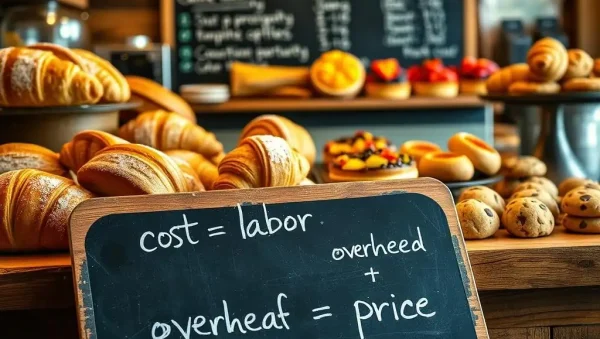
🧁 Wondering how much should bakers charge? Discover The Baker's Pricing Formula—an easy, effective method to set fair prices, boost your bakery’s…
Read article
🧁 Unlock your bakery’s potential by mastering customer price sensitivity analysis. Understanding your target market’s willingness to pay helps set optimal prices,…
Read article
🧁 Discover how online bakery pricing strategies differ from traditional market approaches, helping bakers maximize sales and attract customers through tailored channels.…
Read article
🧁 Discover the essential insights on how to price artisan bread fairly, ensuring your baked creations are profitable without undervaluing your craftsmanship.…
Read article
🌟 Discover essential tips in our Cake Pricing Guide for Beginners at BakeWithEase.com, transforming your baking skills into profitable ventures. Learn how…
Read articleWelcome to Pricing Your Baked Goods, the essential subcategory within Home Baking Business at BakeWithEase. Here, we transform your culinary passion into a profitable venture by demystifying the numbers behind your treats. Whether you’re selling sourdough loaves, custom cakes, or artisan cookies, this guide covers cost analysis, market positioning, and value communication. By mastering pricing, you’ll not only cover your expenses but also build a sustainable income stream. Dive in to learn how to price confidently, avoid common pitfalls, and grow your home-based bakery into a thriving brand.
Accurate pricing starts with knowing every penny spent. Begin by itemizing each ingredient per batch—flour, butter, eggs, and even a pinch of salt. Use a spreadsheet to track bulk purchases and wastage, as this ensures your numbers reflect reality. Don’t forget overhead costs like electricity, gas, packaging, and wear-and-tear on equipment. For example, baking a cake for 4 hours at 350°F consumes energy; approximate this cost and divide across all items produced. By calculating a per-unit cost, you establish a baseline that prevents underpricing and financial loss.
Next, add a percentage for hidden expenses such as storage, cleaning supplies, and occasional spoilage. Many home bakers underestimate these, leading to slim margins. Use a simple formula: Total Cost = (Ingredient Cost + Overhead) ÷ Number of Units. This gives you a clear starting point. From there, decide on your profit margin—typically 30-50% for home businesses—to ensure sustainability. Remember, your time is valuable; don’t sell yourself short by excluding labor costs, which we’ll tackle next.
Your time is your most precious asset, so price it deliberately. Track every minute spent: mixing, baking, cooling, decorating, and cleaning. A helpful method is to assign an hourly rate based on your skill level—beginner bakers might charge $15/hour, while advanced decorators can justify $30-$50/hour. Multiply your total hours by this rate, then add it to your ingredient and overhead costs. For example, a custom birthday cake taking 3 hours at $25/hour adds $75 to your base cost—ensuring your effort is compensated.
Don’t forget “hidden labor” like recipe testing, shopping, and client communication. These often consume hours but are rarely billed. To avoid burnout, build a 10-15% buffer into your pricing for unexpected delays or revisions. Also, consider complexity—intricate floral piping or multi-tiered cakes warrant higher rates. By consistently valuing your craftsmanship, you position your products as premium, attracting clients who appreciate quality and are willing to pay fair prices.
Pricing isn’t only about costs; it’s about fitting your market. Research local bakeries, farmers’ markets, and online sellers to see what similar items charge. For instance, a dozen artisan cookies might sell for $12 at a boutique shop, while a home baker could charge $10 with a loyalty discount. Use this data to set a competitive range—not too high to scare off customers, nor too low to devalue your work. Create a simple chart comparing your costs to market averages, then adjust your margin accordingly.
Positioning matters: are you the budget option or the luxury choice? If your baked goods use organic, locally sourced ingredients, justify a higher price point by highlighting quality. Conversely, if you’re just starting, introductory pricing can build a customer base, but raise it gradually once you gain reviews. Monitor competitors’ seasonal promotions and adjust prices for holidays like Christmas or Valentine’s Day, when demand spikes. Remember, consistent pricing builds trust; avoid frequent changes that confuse buyers. For a balanced strategy, set a base price and offer occasional discounts rather than permanently lowering costs.
Custom orders—wedding cakes, themed cupcakes, or gluten-free batches—require specialized pricing. Start with your base recipe cost, then add a customization fee for unique designs, flavors, or dietary accommodations. For example, a simple vanilla cake might cost $20, but adding a hand-painted sugar flower adds $15 extra. Clearly communicate this breakdown to clients, so they understand the value. Always require a 50% deposit upfront for custom work, as this covers materials and protects you from cancellations.
Bulk sales, like catering or event orders, follow a separate logic. Offer tiered pricing: a dozen cookies at $12 each, but 5 dozen at $10 each, encouraging larger orders. Calculate your economies of scale—buying ingredients in bulk reduces per-unit cost, so you can pass slight savings while increasing volume. Set minimum order quantities for bulk to ensure profitability, and include delivery or setup fees if applicable. Always invoice clearly, detailing item quantities and discounts. For repeat bulk clients, consider a loyalty program with a 10% discount on their 10th order, fostering long-term relationships.
Human psychology plays a huge role in pricing perception. Use charm pricing—ending prices in .95 or .99 (e.g., $4.99 instead of $5.00) to make items feel cheaper. Alternatively, use prestige pricing with whole numbers ($25.00) for luxury items, signaling higher quality. Another tactic is anchoring: list a premium item (like a $60 tiered cake) next to a standard one ($30), making the latter look affordable. This encourages upgrades without overt pressure.
Offer bundle deals, like “Bake-Your-Own Kit” for $25 that includes dry ingredients and recipe card, versus individual items costing $30 total. This perceived savings drives higher transaction values. Avoid discounting too frequently, as it trains customers to wait for sales. Instead, create urgency with limited-time seasonal flavors, priced slightly higher due to exclusivity. Lastly, always round your final numbers up for simplicity—$12.75 becomes $13, making payments easier. These subtle strategies enhance perceived value, increase conversion, and build a loyal customer base that sees your pricing as fair and strategic.
Ideally, aim for a 30-50% profit margin after covering all costs, including labor and overhead. This margin provides a cushion for unexpected expenses and growth. If your margin is below 20%, revisit your pricing or reduce costs by buying ingredients in bulk or optimizing energy use.
Start with a slightly lower price (10-20% below market) to attract initial customers and solicit reviews. As you gain positive feedback and a regular clientele, gradually raise prices to match your skill and market demand. Transparently communicate this as “introductory pricing” to set expectations.
Yes, unless you offer free delivery over a minimum order. Calculate your fuel cost and time, then either add a flat fee (e.g., $5) or include it in the product price. For local deliveries under 5 miles, consider absorbing the cost to increase competitiveness, but for longer distances, always charge.
Communicate increases with advance notice—at least two weeks—via email or social media. Frame it positively, citing improved ingredients or enhanced packaging, not just rising costs. Offer a “price lock” for existing clients who order within a month, and highlight your consistent quality to justify the change.
Undervaluing your time, ignoring packaging costs, and undercharging for custom designs are top errors. Another mistake is not adjusting for seasonality—raised prices during holidays can maximize profits. Also, avoid setting a single price for all sizes; charge extra for larger portions to reflect increased labor and materials.