
Using Digital Thermometers Alongside Scales for Precise Chocolate Baking

Welcome to BakeWithEase, your trusted companion on your baking journey! Ever wondered how professionals achieve that perfect melt, that impeccable shine, in their chocolate creations? The secret often lies beyond just recipes. Dive into our latest guide and discover the power of using precise chocolate baking thermometer scales alongside your favorite ingredients. Unlock the secrets to consistent, professional-quality chocolate baking and leave behind the guesswork – you might be surprised at how much these simple tools can elevate your results!
- Achieving Baking Perfection: Why Precise Measurement Matters for Chocolate
- The Dynamic Duo: Digital Thermometers and Scales for Chocolate
- Understanding Chocolate: Temperature and Weight Considerations
- Mastering Chocolate Tempering with a Digital Thermometer
- Scale-Based Precision for Chocolate Recipes: Avoiding Common Mistakes
- Combining Thermometer Readings and Scale Measurements for Optimal Results
- Recommended Digital Thermometers and Scales for Chocolate Baking
- Advanced Techniques: Using Temperature and Weight for Chocolate Experimentation
- Cleaning and Maintaining Your Thermometer and Scales
-
Frequently Asked Questions
- What is the primary benefit of using a digital thermometer and scales in chocolate baking?
- Why are scales more important than measuring cups when baking with chocolate?
- At what temperature should I temper chocolate for optimal results?
- Can I use any digital thermometer for chocolate baking?
- What are some common mistakes that precise chocolate baking thermometer scales can help me avoid?
- Final Reflection: The Sweet Science of Precise Chocolate Baking
- Unlock Your Inner Chocolate Master!
Achieving Baking Perfection: Why Precise Measurement Matters for Chocolate
The Importance of Accuracy in Chocolate Baking
Baking, especially with chocolate, is often described as a science as much as an art. Unlike cooking where you can often adjust seasonings and ingredients by taste during the process, baking relies on precise ratios and temperatures for chemical reactions to occur correctly. When working with chocolate, this precision becomes even more critical.
Slight deviations in the weight of ingredients like sugar, flour, or the chocolate itself can drastically alter the final structure and flavor profile of your bake. For example, adding just a few grams too much liquid can turn a perfectly crisp cookie into a cakey one, while incorrect cocoa powder measurement can lead to a bitter or bland result.
Using accurate measurement tools like a digital thermometer for precise chocolate baking and scales for precise chocolate baking is fundamental to achieving consistent, high-quality results every time you bake with chocolate. Eyeballing measurements or relying on volume cups and spoons, which can vary wildly depending on how ingredients are packed, introduces variability that professional bakers meticulously avoid.
By using scales to weigh ingredients down to the gram and digital thermometers to monitor crucial temperatures, you eliminate much of the guesswork and ensure that your recipes perform as intended, leading to predictable and delicious outcomes for everything from delicate chocolate mousse to rich brownies.
Beyond Taste: Why Precision Affects Texture and Appearance
Precision in chocolate baking extends far beyond just the flavor; it profoundly impacts the texture and visual appeal of your creations. Consider chocolate chip cookies: the spread, chewiness, and crispness are all determined by the exact ratio of fats, sugars, and flour, as well as the temperature at which they are baked.
A variation of just 10-15 grams in flour or sugar can shift the texture from delightfully chewy to unpleasantly hard or crumbly. Similarly, achieving that glossy, snap-worthy finish on tempered chocolate requires hitting and holding specific temperature ranges during melting, cooling, and reheating – a task impossible without an accurate digital thermometer.
The visual presentation of chocolate baked goods also relies heavily on precision. A ganache that splits or is grainy is often the result of incorrect fat-to-chocolate ratios (weight issue) or overheating the cream or chocolate (temperature issue).
A cake that sinks in the middle might be due to an inaccurate leavening agent measurement (weight issue) or baking at the wrong temperature (oven temperature, though ingredient temperature can also play a role). By embracing precise measurement using reliable scales and digital thermometers, you gain control over these variables, ensuring your chocolate treats not only taste amazing but also look professionally made, with the desired texture and finish every single time.
The Dynamic Duo: Digital Thermometers and Scales for Chocolate
Why Digital Thermometers Are Essential for Tempering Chocolate
Tempering chocolate is a process of melting, cooling, and reheating chocolate to specific temperatures to stabilize its cocoa butter crystals. This stabilization is what gives chocolate its desired snap, smooth texture, and shiny finish, and prevents it from blooming (developing grayish streaks) as it cools. The precise temperature ranges for tempering vary depending on the type of chocolate – dark chocolate typically requires heating to around 113-120°F (45-49°C), cooling to 80-82°F (27-28°C), and reheating slightly to 88-91°F (31-33°C). Milk and white chocolate have slightly lower temperature requirements at each stage. Hitting these narrow windows is absolutely critical.
A digital thermometer is indispensable for this process because it provides instant, accurate temperature readings. Using an old-fashioned candy thermometer can be slow and less precise, and guessing temperatures is guaranteed to fail.
A good digital thermometer for precise chocolate baking allows you to monitor the chocolate's temperature continuously as it melts over a double boiler or in a microwave, track its descent during the cooling phase (often over an ice bath or by adding seed chocolate), and ensure it reaches the correct working temperature without exceeding it. This level of control is the difference between perfectly tempered, professional-looking chocolate coatings and dull, streaky, soft chocolate.
Scales: The Foundation of Accurate Baking Ratios
While thermometers handle the critical temperature aspect, scales provide the foundational accuracy for all baking ingredients, particularly when working with chocolate. Recipes developed by professionals almost always specify ingredients by weight (grams or ounces) rather than volume (cups or tablespoons). This is because weight is a consistent measure; 100 grams of flour is always 100 grams of flour, regardless of how fluffed or packed it is.
In contrast, 1 cup of flour can vary in weight by as much as 20-30 grams depending on handling. This variability is simply too large for precise chocolate baking, where ingredient balance is key.
Using scales for precise chocolate baking ensures that you are incorporating the exact amount of each ingredient specified by the recipe developer. This is especially important for chocolate itself, leavening agents like baking soda and powder, and fats. For instance, a brownie recipe relying on the precise ratio of cocoa powder, sugar, and fat for its fudgy texture will fail if these ingredients are measured inaccurately by volume. Scales eliminate this variable, providing the necessary reliability for consistent, high-quality results across all your chocolate baking endeavors, from delicate macarons with a chocolate ganache filling to sturdy chocolate loaves.
Understanding Chocolate: Temperature and Weight Considerations
Different Types of Chocolate and Their Ideal Temperatures
Understanding the specific temperature requirements for different types of chocolate is paramount for successful melting and tempering. Dark chocolate, with its higher percentage of cocoa solids and lower sugar content, is the most forgiving in terms of initial melting temperature, typically requiring temperatures between 113°F and 120°F (45-49°C). However, its tempering temperatures are slightly higher than other types. Milk chocolate, containing milk solids and more sugar, is more sensitive to heat and should be melted at a slightly lower temperature, usually not exceeding 110°F (43°C), and its tempering temperature range is also lower, typically finishing around 86-88°F (30-31°C).
White chocolate, which contains no cocoa solids but is made from cocoa butter, sugar, and milk solids, is the most delicate and prone to seizing or burning. It should be melted gently, ideally not exceeding 105°F (40°C), and requires the lowest tempering temperatures, often finishing around 84-86°F (29-30°C). Using a precise chocolate baking thermometer scale helps you monitor these critical thresholds, ensuring you don't overheat the chocolate during melting, which can damage its structure and make tempering impossible, and that you hit the correct target temperatures during the tempering process for optimal crystal formation.
The Role of Weight in Chocolate Ganache and Sauces
Chocolate ganache, a classic mixture of chocolate and cream, is a perfect example of how critical precise weight measurements are. The texture of ganache – whether it's a pourable sauce, a truffle filling, or a firm frosting – is determined almost entirely by the ratio of chocolate to cream by weight. A typical pourable ganache might use a 1:1 ratio of chocolate to cream (e.g., 200g chocolate to 200g cream), while a truffle filling might use a 2:1 ratio (e.g., 400g chocolate to 200g cream). A very firm ganache for frosting or slicing might even be 3:1 or higher.
Measuring chocolate and cream by volume for ganache is highly inaccurate. Cups of cream can vary based on how full they are, and chocolate weight varies significantly depending on whether you're using chips, fèves, or chopped bar chocolate. Using scales for precise chocolate baking guarantees you have the correct ratio, ensuring your ganache sets up with the desired consistency every time. Beyond ganache, scales are vital for other chocolate sauces and fillings, where the balance of chocolate, sugar, butter, and liquids dictates the final viscosity, richness, and stability of the product.
Mastering Chocolate Tempering with a Digital Thermometer
Step-by-Step Guide to Tempering Chocolate Using a Thermometer
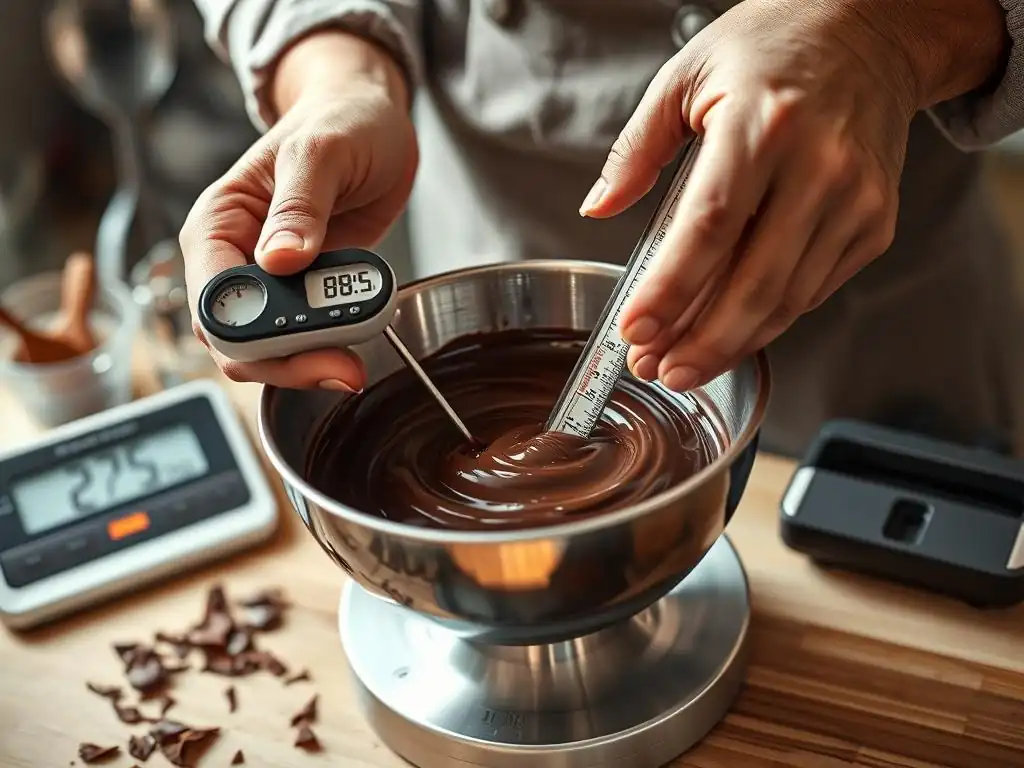
Tempering chocolate using a digital thermometer and the seeding method is a reliable way to achieve a professional finish. Here's a simplified guide:
- Chop Chocolate: Finely chop the chocolate you intend to temper. Using high-quality chocolate is recommended for best results.
- Melt Most Chocolate: Place about two-thirds of the chopped chocolate in a heatproof bowl set over a saucepan of barely simmering water (a double boiler). Ensure the bottom of the bowl does not touch the water.
- Monitor Melting Temperature: Insert your digital thermometer into the chocolate and stir gently. Heat the chocolate until it reaches its initial melting temperature: 113-120°F (45-49°C) for dark, 105-110°F (40-43°C) for milk, 100-105°F (38-40°C) for white. Remove the bowl from the heat once the target temperature is reached.
- Add Seed Chocolate: Add the remaining one-third of the chopped chocolate (the "seed") to the melted chocolate. Stir continuously with a spatula.
- Monitor Cooling Temperature: Keep stirring until all the seed chocolate is melted and the mixture cools down. Use your digital thermometer to track the temperature. The target cooling temperature is typically 80-82°F (27-28°C) for dark, 78-80°F (26-27°C) for milk, and 76-78°F (24-26°C) for white chocolate. This cooling step is crucial for forming stable beta crystals.
- Reheat to Working Temperature: Once the chocolate reaches the bottom of its cooling range, gently heat it again very briefly. This can be done by placing the bowl back over the warm (but not simmering) water for just a few seconds or by microwaving in 5-10 second bursts, stirring thoroughly after each.
- Reach Working Temperature: Monitor the temperature closely with your digital thermometer until it reaches the final working temperature: 88-91°F (31-33°C) for dark, 86-88°F (30-31°C) for milk, and 84-86°F (29-30°C) for white. The chocolate should now be in temper and ready to use for dipping, molding, or coating. Maintain the temperature within this narrow range while working.
Troubleshooting Common Tempering Issues with Temperature Readings
When tempering chocolate, several issues can arise, and a digital thermometer is your best tool for diagnosing them. If your chocolate is dull, streaky (bloomed), or soft after it sets, it's almost certainly an issue with the tempering process, specifically the temperatures you hit (or missed). A common problem is not cooling the chocolate enough during the seeding phase; if it doesn't drop below the target cooling temperature (e.g., stays above 82°F for dark chocolate), the correct crystal structure won't form, resulting in bloom. Your thermometer will immediately show if you've stopped cooling too soon.
Another frequent error is overheating the chocolate during the final reheating step. If the temperature exceeds the target working temperature (e.g., goes above 91°F for dark chocolate), you've likely melted the desirable crystals you just formed, and the chocolate will be out of temper. Using a precise chocolate baking thermometer scale allows you to catch these temperature excursions immediately.
If you accidentally overheat, you'll need to start the tempering process over from the initial melting phase. Similarly, if the chocolate thickens too quickly while working, its temperature may have dropped too low; a quick, gentle reheat back into the working range (confirmed by your thermometer) can fix this.
Scale-Based Precision for Chocolate Recipes: Avoiding Common Mistakes
Converting Volume Measurements to Weight for Chocolate Ingredients
Many older or less professional recipes still use volume measurements (cups, tablespoons), which are highly unreliable for baking, especially with chocolate. To ensure precise chocolate baking, it's best practice to convert these to weight measurements using a scale. While perfect conversions vary based on density and how ingredients are packed, standard baking conversions offer reliable approximations.
For instance, a cup of all-purpose flour is typically around 120-130 grams when spooned and leveled, but can be 150 grams or more when scooped. Granulated sugar is usually about 200-220 grams per cup. Cocoa powder is lighter, often around 85-100 grams per cup.
When a recipe calls for chocolate chips by volume (e.g., 1 cup), the weight can vary significantly by brand and chip size, but a general estimate is around 150-170 grams per cup. For chopped bar chocolate, it might be closer to 170-190 grams per cup due to less air space. Using a scale for precise chocolate baking allows you to use these approximate weight conversions, but ideally, seek out recipes that provide weights.
If a recipe only gives volume, find a reliable conversion chart online or weigh the ingredient yourself from a known volume once to get your own approximate conversion for that specific ingredient and way of measuring. This eliminates the large margin of error associated with volume.
Measuring Dry vs. Wet Chocolate Ingredients Accurately
Scales are invaluable for measuring both dry and wet ingredients accurately, critical for balancing recipes involving chocolate. For dry ingredients like flour, cocoa powder, sugar, baking soda, and salt, weighing is far superior to using measuring cups. Simply place your bowl on the scale, tare it (set it to zero), and add the ingredient until the desired weight is reached. This ensures you have the exact amount specified, preventing issues like overly dense cakes (too much flour/cocoa) or cookies that spread too much (too little flour/cocoa).
For wet ingredients like milk, cream, water, and eggs, scales are also highly effective. Many recipes will specify liquids by weight (grams or milliliters, which are equivalent for water-based liquids) or eggs by weight (e.g., 50g of egg). Placing a container on the scale, taring it, and pouring in the liquid until the correct weight is shown is more accurate than relying on the markings on a liquid measuring cup, which can be hard to read precisely.
Even melted butter or oil can be weighed for ultimate accuracy. Using scales for precise chocolate baking of both dry and wet components ensures the intended hydration and richness levels, leading to consistent textures and flavors in your chocolate bakes.
Combining Thermometer Readings and Scale Measurements for Optimal Results
Ensuring Consistency in Chocolate Batters and Doughs
Achieving consistent results in chocolate batters and doughs requires the combined power of precise temperature control and accurate weight measurement. For example, when making a chocolate cake batter, the temperature of your liquids (milk, eggs) can affect how they emulsify with fats and how quickly dry ingredients are absorbed.
While not always as critical as chocolate tempering temperatures, ensuring ingredients are at room temperature (around 68-72°F or 20-22°C) as specified by a recipe, potentially checked with your digital thermometer, helps create a smooth, well-combined batter. Simultaneously, using scales to measure flour, sugar, cocoa powder, and leavening agents down to the gram ensures the structural components are perfectly balanced.
Consider a chocolate cookie dough: the ratio of butter, sugar, flour, and chocolate chips by weight dictates its spread and chewiness. If the butter isn't at the correct temperature (often softened, around 65°F or 18°C, which can be checked with a thermometer), it won't cream properly with the sugar, affecting the dough's structure. Combining this temperature check with accurate weight measurements of all ingredients using scales for precise chocolate baking ensures the dough behaves consistently batch after batch. This integrated approach minimizes variables, making troubleshooting easier and success more predictable.
Achieving Perfect Chocolate Glazes and Coatings Every Time
Perfect chocolate glazes and coatings, whether tempered chocolate or a simple glaze, are the result of precise temperature and weight control. For tempered chocolate coatings, as discussed, hitting the exact melting, cooling, and working temperatures using a digital thermometer is non-negotiable for achieving that desirable snap and shine. The weight of the chocolate used is also important, ensuring you have enough volume to work with and that any additions (like cocoa butter or oil for viscosity) are added in the correct proportion by weight.
For non-tempered glazes, like a simple chocolate ganache glaze, the ratio of chocolate to cream by weight is critical for the desired consistency – too much cream and it won't set, too little and it will be too thick. Heating the cream to the correct temperature (often just to a simmer, around 200°F or 93°C), checked with a thermometer, before pouring it over the weighed chocolate ensures it's hot enough to melt the chocolate without scorching it.
Using scales for precise chocolate baking of the chocolate and cream, combined with monitoring cream temperature, guarantees a smooth, stable, and perfectly pourable or spreadable glaze every time.
Recommended Digital Thermometers and Scales for Chocolate Baking
Features to Look for in a Chocolate Baking Thermometer
When selecting a digital thermometer for precise chocolate baking, look for several key features. Speed and accuracy are paramount; a good thermometer should provide a reading within a few seconds and be accurate to within ±1°F or ±0.5°C. A wide temperature range is useful, but specifically ensure it covers the critical chocolate tempering ranges (roughly 75°F to 120°F or 24°C to 49°C). A thin probe is preferable as it minimizes the amount of chocolate displaced and allows for easier temperature reading in smaller quantities.
Other useful features include a hold function (to lock the temperature reading when removed from the chocolate), a large, easy-to-read digital display, and durability. Waterproof or water-resistant models are easier to clean. Some thermometers have clips to attach to the side of a pot, which can be convenient when melting chocolate over a double boiler, although direct immersion and stirring for a reading is often best for accuracy. Investing in a reliable digital thermometer for precise chocolate baking is a game-changer for anyone serious about working with chocolate.
Selecting the Right Scale for Accurate Ingredient Measurement
Choosing the right scale for scales for precise chocolate baking involves considering capacity, precision, and ease of use. For baking, a digital kitchen scale is essential. Look for one with a capacity of at least 5 kg (about 11 lbs), which is sufficient for most home baking tasks, including weighing larger batches of ingredients.
Precision is key; the scale should measure in increments of at least 1 gram (or 0.1 ounces if you prefer imperial). Some scales offer higher precision (0.1g), which can be beneficial for very small amounts of ingredients like leavening agents, though 1g precision is often adequate for standard recipes.
A tare function is absolutely necessary, allowing you to zero out the weight of your container or add multiple ingredients to the same bowl. Look for a clear, easy-to-read digital display, preferably backlit. The weighing surface should be large enough to accommodate typical mixing bowls. Durability and ease of cleaning are also important considerations. While high-end professional scales exist, a reliable digital kitchen scale with 1g precision and a tare function is sufficient for most home bakers looking to achieve precise chocolate baking results.
Advanced Techniques: Using Temperature and Weight for Chocolate Experimentation
Adjusting Recipes Based on Chocolate Type and Desired Outcome
Once you've mastered the basics of using scales for precise chocolate baking and a digital thermometer for temperature control, you can begin experimenting and adjusting recipes. Understanding the properties of different types of chocolate by weight (e.g., dark vs. milk vs. white) allows you to substitute them in recipes while maintaining the correct overall ingredient balance.
For example, if a recipe calls for 200g of dark chocolate and you want to use milk chocolate, you might need to slightly adjust the sugar or fat content in other parts of the recipe because milk chocolate contains more sugar and milk solids and often less cocoa butter than dark chocolate.
Similarly, knowing the ideal working temperatures for different chocolates allows you to adapt tempering instructions. If a recipe gives a generic tempering temperature, but you are using a specific type of chocolate (like a high-quality single-origin dark chocolate with a unique cocoa butter composition), you might need to adjust the tempering curve slightly based on its specific properties, using your precise chocolate baking thermometer scales to guide you through the adapted temperature ranges. This level of understanding and control, facilitated by accurate tools, opens up possibilities for creating your own chocolate formulations and adapting recipes with confidence.
Creating Custom Chocolate Blends with Precise Ratios
For truly advanced work or specific flavor profiles, you might want to create custom chocolate blends by mixing different types of chocolate. This is where precise weight measurement becomes invaluable. You can mix specific percentages of dark, milk, or even white chocolate, plus perhaps some pure cocoa butter or unsweetened chocolate, all measured by weight on your scale, to achieve a unique flavor, sweetness level, and viscosity. For instance, mixing 70% dark chocolate with 30% milk chocolate (measured by weight) can create a custom blend with a specific cocoa percentage and desired level of sweetness.
Once your custom blend is created, you will need to temper it. The tempering temperatures for a blend will be somewhere between the temperatures of the individual chocolates, leaning towards the type that makes up the majority of the blend, or requiring a bit of experimentation. Using your digital thermometer for precise chocolate baking, you can carefully monitor the melting, cooling, and reheating temperatures of your custom blend to find the optimal tempering curve. This combination of precise weighing for the blend composition and precise temperature control for tempering allows for incredible creativity and control over your chocolate work.
Cleaning and Maintaining Your Thermometer and Scales
Ensuring Longevity and Accuracy of Your Baking Tools
Proper cleaning and maintenance are essential for ensuring the longevity and continued accuracy of your digital thermometer for precise chocolate baking and your scales for precise chocolate baking. For scales, avoid submerging the base unit in water. Wipe the weighing surface clean with a damp cloth after each use, especially after weighing sticky or powdery ingredients.
If your scale has a removable platform, clean that separately. Store scales in a dry place and avoid placing heavy objects on them when not in use, as this can damage the sensors. Periodically check the scale's accuracy by weighing something with a known weight, like a new, unopened bag of sugar (a 4lb bag should weigh 1814g).
For digital thermometers, clean the probe after each use, typically by wiping it with a damp cloth or sponge. Avoid getting the main unit (where the electronics and display are) wet unless the model is specifically rated as waterproof. Never put the probe or unit in a dishwasher. Store the thermometer safely to protect the probe from bending or damage. Some come with protective sleeves. If your thermometer uses batteries, replace them when the display starts to dim to ensure accurate readings. Proper care ensures these vital tools remain reliable for all your precise chocolate baking needs.
Proper Storage for Optimal Performance
Storing your precise chocolate baking thermometer scales correctly is crucial for maintaining their optimal performance and accuracy over time. Digital scales should be stored on a flat, stable surface, away from extreme temperatures or humidity. Avoid stacking heavy items on top of them. If the scale has a lock feature for storage or transport, engage it to protect the weighing mechanism. Keeping the weighing surface clean before storage prevents residue buildup that could affect future measurements.
Digital thermometers, particularly probe thermometers, should be stored carefully to protect the delicate probe tip. Many come with a protective sheath or a case. Store them in a drawer where the probe won't be bent or damaged by other tools. Avoid storing them in excessively hot or cold environments, as this can affect the electronics and battery life. Proper storage, combined with regular cleaning, ensures that when you reach for your precise chocolate baking thermometer scales, they are ready to deliver the accuracy needed for perfect chocolate results every time.
Frequently Asked Questions
What is the primary benefit of using a digital thermometer and scales in chocolate baking?
The primary benefit is achieving precise temperature control and accurate ingredient measurements, leading to consistent and high-quality results when working with sensitive ingredients like chocolate.
Why are scales more important than measuring cups when baking with chocolate?
Scales offer greater accuracy compared to measuring cups. This is especially crucial when dealing with chocolate, as even slight variations in ingredient ratios can significantly impact the final product's texture and taste.
At what temperature should I temper chocolate for optimal results?
Tempering chocolate requires careful temperature control. Generally, dark chocolate is tempered around 88-90°F (31-32°C), milk chocolate around 84-86°F (29-30°C), and white chocolate around 82-84°F (28-29°C), but always refer to your recipe.
Can I use any digital thermometer for chocolate baking?
While most digital thermometers can work, look for one with a fast response time and accurate temperature readings in the specific range required for tempering and melting chocolate. An instant-read thermometer is often preferred.
What are some common mistakes that precise chocolate baking thermometer scales can help me avoid?
Using both a digital thermometer and scales can help avoid common mistakes such as burning chocolate, improper tempering, and incorrect ingredient ratios, all of which can ruin your chocolate creations.
Final Reflection: The Sweet Science of Precise Chocolate Baking
The pursuit of perfectly tempered chocolate, once a mystical art, is now within reach of every home baker thanks to the precise measurements afforded by combining digital thermometers and scales. The seemingly small act of accurately measuring temperature and weight unlocks a world of consistent, professional-quality results, transforming the frustrating experience of seized chocolate into the joy of flawlessly smooth ganaches and glistening bonbons.
The impact of precise measurement extends beyond just chocolate; it underscores a broader shift in culinary practices towards scientific accuracy. We've moved beyond relying solely on intuition and experience, embracing the power of data to achieve consistent, repeatable results. This resonates deeply with my own baking journey; I've witnessed firsthand the transformative effect of precise measurements, moving from inconsistent results to consistently stunning creations. The only way to do great work is to love what you do.
- Steve Jobs. This quote, while not directly about baking, perfectly encapsulates the passion and precision required to master the art of chocolate making.
Now, it's your turn. Consider how the principles of precise measurement, learned through this exploration of digital thermometers and scales, can be applied to other areas of your life. Whether it's baking a different dessert, pursuing a new hobby, or tackling a challenging project, the commitment to accuracy and detail will undoubtedly yield rewarding results. Embrace the power of precise measurement, and unlock your potential for excellence in whatever you undertake.
Unlock Your Inner Chocolate Master!
Thanks for diving into the world of precise chocolate baking with us! You've now got the knowledge to create flawlessly tempered chocolate every time. Ready to put your new skills to the test?
- Whip up your dream chocolate creation: Use your newfound expertise with digital thermometers and scales to bake your favorite chocolate recipe—or try a new one!
- Share your baking triumph: Post a picture of your masterpiece on social media and tag us @BakeWithEase (this is entirely optional!). Let’s celebrate your chocolate success together!
- Explore our other baking guides: Find more helpful tips and tricks to elevate your baking game on BakeWithEase.com.
What incredible chocolate creation will you bake first? Let us know in the comments!